
Phoenicia and Carthage: Harbours, Letters and Hannibal
Story10th century–216 BCE: how a maritime network worked, and how it lost a war
Around the 10th century BCE, merchants from Tyre, Sidon and Byblos carried harbours, trading posts and alphabetic writing onto the sea. They built no continental empire, yet stretched a maritime network from the Levant to North Africa, Spain and Sicily. Tradition assigns Carthage's foundation in 814 BCE to the Tyrian princess Dido; the archaeological layers are about a century later. In the 5th century BCE Hanno sailed down the West African coast; in 218 BCE Hannibal crossed the Alps and brought war into Italy; in 216 BCE his double envelopment at Cannae nearly destroyed a large Roman army. The six chapters tell one story: how a network run through nodes lost the strategic initiative to Rome's system of mobilisation.
Phoenician–Punic power came from nodes rather than territory: harbours, trading posts, a reproducible alphabet, and money and alliances capable of putting diverse peoples into one army. It could run for centuries without a unified bureaucratic empire. Rome's victory came not from a single battle but from citizen manpower, an alliance system and naval blockade that pulled out Carthage's nodes one by one. Hannibal achieved a textbook double envelopment at Cannae but could not turn tactical victory into political reconstruction; in 146 BCE Carthage was destroyed and the network of nodes ended with it.
Chapter-level sources; key claims checked.
Chapter timeline
Chapters in reading orderAll anchors are approximate region-level placements; they are not precise sites. Chapters without coordinates are listed below by region only.
Chapter contents6 chapters
- The Phoenician city-states: a maritime network without an empire
- Founding Carthage: tradition and archaeology
- The alphabet: from North Semitic to Greek
- Hanno's voyage: a route at the edge of the known world
- Hannibal crosses the Alps: bringing war into Italy
- Cannae: double envelopment and an unfulfilled victory
The story, chapter by chapter
Each chapter opens the underlying event- 01
The Phoenician city-states: a maritime network without an empire
Phoenicia was a group of city-states on the eastern Mediterranean, roughly modern Lebanon, with Byblos, Sidon, Tyre and Berot as chief cities. Kingship was limited by merchant families and no large-scale federation formed. From the 2nd millennium BCE they established settlements along the Levant, North Africa, Anatolia and Cyprus; Carthage later became the leading maritime power of the western Mediterranean. Exports…
A group of city-states on the eastern Mediterranean, chiefly Byblos, Sidon, Tyre and Berot; kingship was limited by merchant families and no large-scale federation formed. From the 2nd millennium BCE they established settlements along the Levant, North Africa, Anatolia and Cyprus, and Carthage later became the leading maritime power of the western Mediterranean. Exports included cedar, fine linen, Tyrian purple, wine, metalwork and glass, with an important transit trade.
Phoenicia was the historical region on the eastern coast of the Mediterranean corresponding roughly to modern Lebanon, with parts of Syria and Israel; its chief cities included Byblos, Sidon, Tyre and Berot (modern Beirut).
The oldest form of government in these cities was kingship, limited by the power of wealthy merchant families; large-scale federation never occurred. The cities sometimes fell under common rule as vassals of neighbouring empires.
By the 2nd millennium BCE the Phoenicians had established a series of settlements along the Levant coast; colonisation in North Africa, Anatolia and Cyprus also occurred early, and Carthage later became the chief maritime and commercial power in the western Mediterranean.
Their exports included cedar and pine wood, fine linen from Tyre and Byblos, cloth dyed with Tyrian purple from the murex snail, embroideries from Sidon, wine, metalwork, glass, glazed faience, salt and dried fish; they also conducted an important transit trade.
The name 'Phoenician' was not their own; they usually identified themselves by their city-states, and it remains unclear whether or when they saw themselves as one people. The Phoenician network was less a state with a capital than a set of cities sharing language, religion and port conventions.
Understanding Phoenicia means looking not for its capital but for the way harbours, trading posts and writing joined scattered cities into a reproducible network.
Sources: 7 event claims, 5 sourced; source cards src-b8-phoenicia (background only).
SourcesPhoenicia background
- 02
Founding Carthage: tradition and archaeology
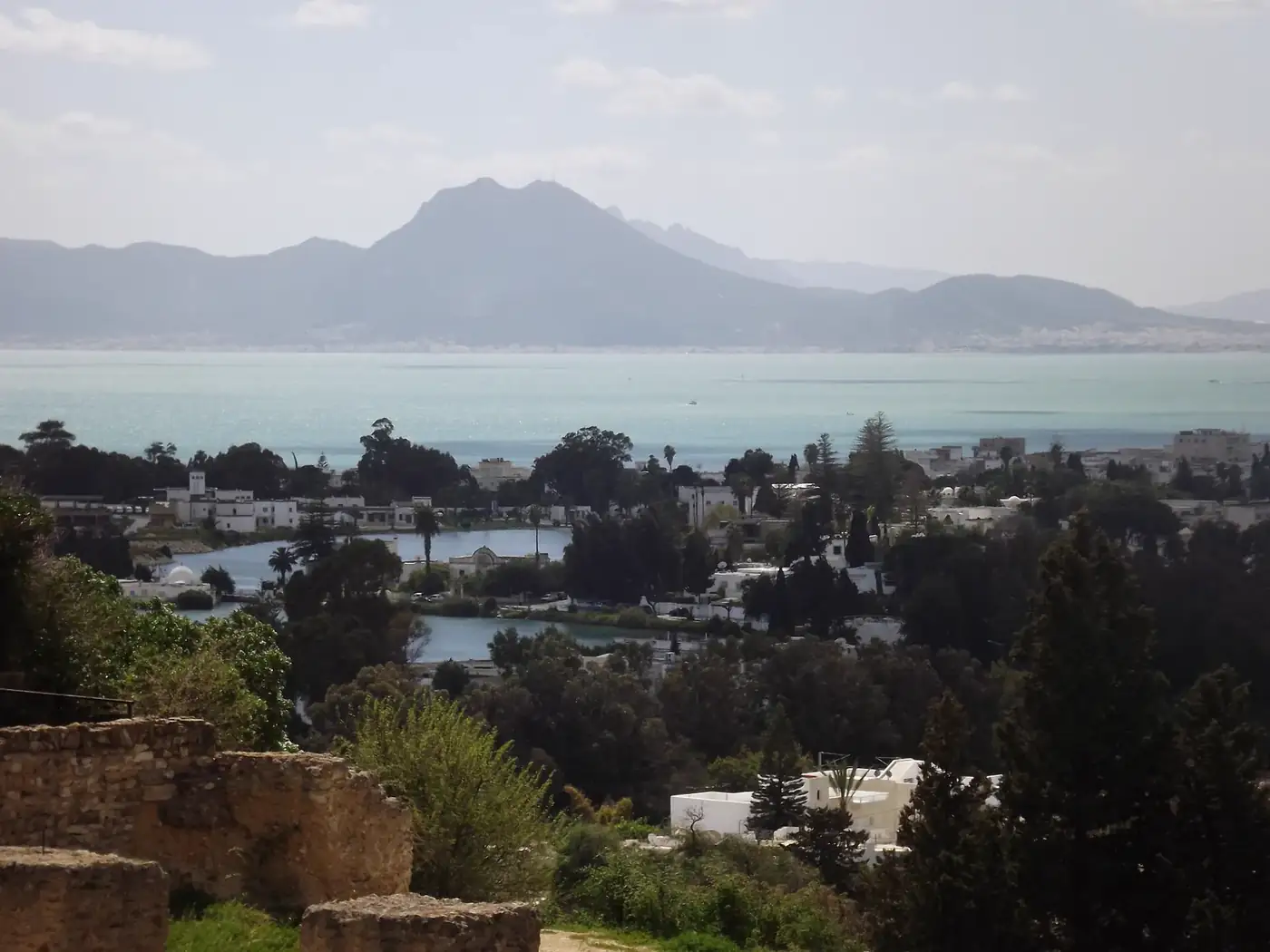
Tradition says the Phoenicians of Tyre founded Carthage in 814 BCE and called it 'new town'; the Roman tradition credits Dido, chiefly through the Aeneid. Archaeology has found nothing earlier than the last quarter of the 8th century BCE, about a century later than the tradition, while Utica may be half a century older. Carthage occupied a triangular peninsula on the Gulf of Tunis, with the Byrsa as its citadel; it g…
Tradition dates the Tyrian foundation to 814 BCE and calls the city 'new town'; the Roman tradition credits Dido, chiefly through the Aeneid. The earliest archaeology is from the last quarter of the 8th century BCE, a century later than the tradition, while Utica may be half a century older. The city occupied a triangular peninsula on the Gulf of Tunis with the Byrsa as its citadel; it grew rich on purple dye and silver, led the western Phoenicians by the 5th century BCE, and was destroyed by Rome in 146 BCE.
According to tradition, the Phoenicians of Tyre founded Carthage in 814 BCE; its Phoenician name means 'new town'.
The Roman tradition credits the foundation to the Tyrian princess Dido, who fled from her brother Pygmalion; the story became widely known through Virgil's Aeneid. The Dido narrative is not a contemporary record but a later Roman literary rewriting of the city's foundation memory.
The traditional date was probably exaggerated by the Carthaginians themselves; nothing earlier than the last quarter of the 8th century BCE has been found, a full century later than the traditional foundation. Utica may have predated Carthage by about half a century, showing that Phoenician settlements in the region were already older.
Carthage was built on a triangular peninsula on the Gulf of Tunis, backed by the Lake of Tunis and close to the Strait of Sicily, a strategic bottleneck in east-west Mediterranean trade; its ancient core was the Byrsa citadel overlooking the sea. The site offered both a safe anchorage and control over passing ships.
Carthage controlled much of the western Mediterranean trade in purple dye and drew revenue from silver mines in North Africa and southern Spain: mining near Gadir began as early as 800 BCE, and near Cartagena in the 3rd century BCE. By the 5th century BCE Carthage had become the leader of the western Phoenicians, forming an empire centred on North Africa.
In 146 BCE Rome captured Carthage in the Third Punic War and plundered and burned the city. A Roman city was later rebuilt on the site, and Carthage continued under another form.
The traditional date belongs to civic memory, not to an archaeological layer; keeping the two apart preserves both the meaning of the legend and the evidence of the excavator.
Sources: 10 event claims, 8 sourced; source cards src-b7-carthage-foundation (background only).
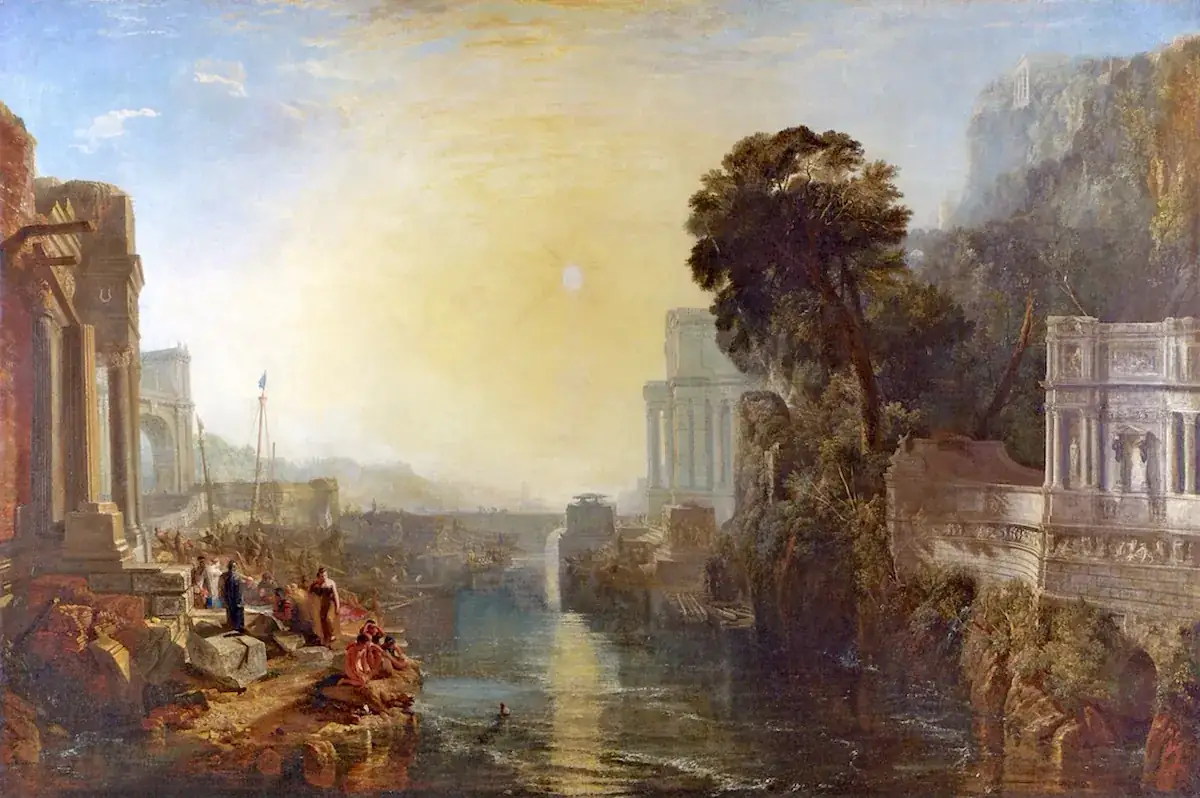
Dido and Carthage.J. M. W. Turner, 1815 · Wikimedia Commons · Public Domain · PD - 03
The alphabet: from North Semitic to Greek
The Phoenician alphabet developed from the North Semitic alphabet and was spread by Phoenician traders. The earliest surviving inscription is the Ahiram epitaph at Byblos, from the 11th century BCE; the alphabet had 22 signs, ran right to left, represented consonants only, and remained in use in Phoenicia until about the 1st century BCE. Colonial variants included Cypro-Phoenician and Sardinian, while Punic and neo-P…
Developed from the North Semitic alphabet and spread by traders; the earliest surviving inscription is the Ahiram epitaph at Byblos, from the 11th century BCE. Twenty-two letters, right to left, consonants only, used in Phoenicia until about the 1st century BCE; colonial variants include Cypro-Phoenician and Sardinian, while Punic and neo-Punic at Carthage lasted until about the 3rd century CE. The Greek alphabet derived from it about 1000 BCE, turned consonantal signs into vowels, and passed through Etruscan to Latin.
The Phoenician alphabet developed out of the North Semitic alphabet and was spread around the Mediterranean by Phoenician traders; it is the probable ancestor of the Greek alphabet and therefore of all Western alphabets. It was not invented from nothing but was a writing tool repeatedly used in trade and administration.
The earliest surviving Phoenician inscription is the Ahiram epitaph at Byblos, dating from the 11th century BCE. It is written in the North Semitic alphabet. The Phoenician alphabet gradually developed from that prototype.
The alphabet had only 22 signs, written from right to left and representing consonants alone. It had no separate vowel letters, so readers supplied vowels from context. In Phoenicia proper it remained in use until about the 1st century BCE.
Colonies produced variants. Cypro-Phoenician was used from the 10th to the 2nd century BCE and Sardinian around the 9th century; a third variant evolved at Carthage into Punic and neo-Punic, written until about the 3rd century CE.
The Greek alphabet formed about 1000 BCE, derived from the North Semitic alphabet via the Phoenicians; the Greeks turned several consonantal signs into vowels. Alef, he, yod, ayin and vav became alpha, epsilon, iota, omicron and upsilon. The western Greek alphabet passed through Etruscan to Latin.
The point of alphabet history is not who invented it first, but who made a set of signs simple enough to be borrowed and rewritten by different languages.
Sources: 9 event claims, 8 sourced; source cards src-b8-phoenician-alphabet, src-b8-greek-alphabet (background only).
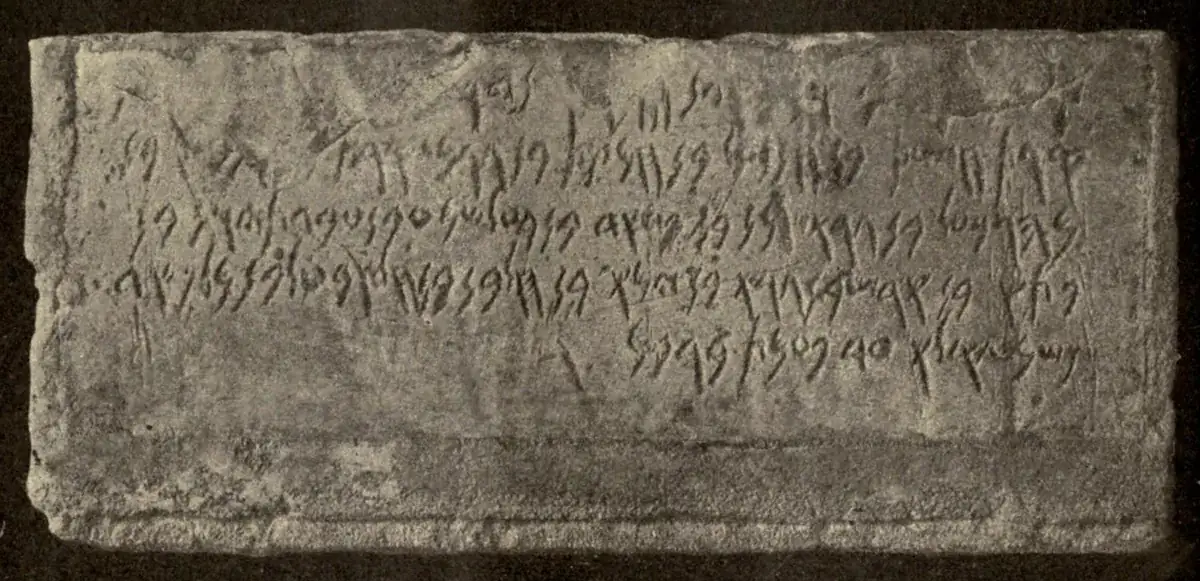
Phoenician alphabet.Antonio Taramelli (photograph), 1911 (photograph of a 3rd-century BCE inscription) · Wikimedia Commons · Public Domain · PD SourcesPhoenician alphabet backgroundGreek alphabet background
- 04
Hanno's voyage: a route at the edge of the known world
Hanno was active in the 5th century BCE and sailed with 60 vessels and 30,000 men and women along the West African coast. He founded Thymiaterion (Kenitra), built a temple at Soloeis, founded five cities in Morocco including the Carian Fortress and Acra (Agadir), and established Cerne as a trading post farther south. Ancient accounts have him reaching Gambia or Sierra Leone and perhaps Cameroon, but modern scholars d…
Active in the 5th century BCE, Hanno sailed with 60 vessels and 30,000 people along the West African coast. He founded Thymiaterion (Kenitra), a temple at Soloeis, five Moroccan cities including the Carian Fortress and Acra (Agadir), and Cerne farther south. Ancient accounts have him reaching Gambia or Sierra Leone and perhaps Cameroon, but modern scholars doubt whether he went beyond Morocco. The account was written in the temple of Baal and survives in a 10th-century Greek manuscript claiming to translate a Punic inscription.
Hanno was a Carthaginian navigator active in the 5th century BCE; he sailed with 60 vessels carrying 30,000 men and women along the West African coast on a voyage of exploration and colonisation. The scale looks more like armed migration than a single ship's reconnaissance.
He founded Thymiaterion, now Kenitra in Morocco, and built a temple at Soloeis (Cape Cantin); he then founded five cities in and around Morocco, including the Carian Fortress and Acra (Agadir). The Carian Fortress may be Essaouira, where remains of Punic settlers have been found.
Farther south he founded Cerne, possibly near the Río de Oro, as a trading post. Ancient accounts say he evidently reached the coast of present Gambia or Sierra Leone, and may have ventured as far as Cameroon.
Modern scholars, however, doubt whether he really went beyond Morocco. Ancient voyage accounts often turn 'reaching' into exotic spectacle; without contemporary evidence, the safest reading treats everything south of Cerne as possible rather than mapped.
The account was written in the temple of Baal at Carthage and survives in a 10th-century Greek manuscript, the Periplus of Hannon, which claims to translate a Punic inscription. What we read is therefore not the original logbook but a version copied and translated repeatedly.
The value of Hanno's voyage is not that it proves Carthaginians 'discovered' West Africa, but that it shows how a maritime network tied trading posts, colonies and mythical geography together.
Node Mechanism Pressure and fracture City-state network Harbours, trading posts, transit trade; shared language, religion and alphabet No unified federation; Assyrian pressure from the 9th century, Persian rule in 538 BCE Carthage Gulf of Tunis hub, purple dye, North African and Spanish silver, fleet Dependence on mercenaries and local allies; limited citizen manpower Alphabet 22 consonants, right to left, spread by traders Every language had to adapt it; written kinship is not political unity West African voyage 60 ships, 30,000 people, Cerne trading post Text copied and translated repeatedly; whether Hanno passed Morocco is doubtful Hannibal Alpine crossing, double envelopment at Cannae Could not take Rome; supply, reinforcements and allies steadily drained Roman victory Citizen manpower, alliance system, naval blockade, Fabian strategy Carthage was worn down; the city was destroyed in 146 BCE Table: the six nodes fed and strained one another. Harbours produced wealth, wealth paid for fleets and mercenaries, and fleets and trading posts needed allies; once Rome cut the sea links and held the allies, the network lost its capacity to repair itself.
Sources: 8 event claims, 5 sourced; source cards src-b8-hanno (background only).
- 05
Hannibal crosses the Alps: bringing war into Italy
In spring 218 BCE Hannibal left Cartagena and crossed the Alps into Italy after five months; the crossing itself took 15 days, and he descended with about 25,000 infantry, 6,000 cavalry and most of his original 37 elephants. The pass is unidentified, with candidates including Montgenèvre, the Little St. Bernard, Mount Cenis, Col du Clapier–Savine Coche and Col de la Traversette. He won at the Ticino, Trebbia, Trasime…
Left Cartagena in spring 218 BCE and crossed the Alps after five months; the crossing took 15 days and he descended with about 25,000 infantry, 6,000 cavalry and most of his original 37 elephants. The pass is unidentified, with candidates including Montgenèvre, the Little St. Bernard, Mount Cenis, Col du Clapier–Savine Coche and Col de la Traversette. He won at the Ticino, Trebbia, Trasimene and Cannae but never marched on Rome; the Second Punic War ended with Rome victorious and in control of Carthage's Spanish territories.
In spring 218 BCE Hannibal set out from Cartagena in Spain; the whole journey from Cartagena took five months.
The Alpine crossing itself took 15 days; when he descended into Italy he had about 25,000 infantry, 6,000 cavalry and most of his original 37 elephants.
Where the pass lay was never fixed by the ancient authors. Polybius and later Livy did not name it clearly; modern candidates include Montgenèvre, the Little St. Bernard, Mount Cenis, and the higher Col du Clapier–Savine Coche and Col de la Traversette.
Once in Italy, Hannibal won successively at the Ticino, the Trebbia (December 218 BCE) and Lake Trasimene (June 217 BCE); in 216 BCE he destroyed a large Roman army at Cannae. He never marched on Rome itself.
The Second Punic War ran from 218 to 201 BCE; although Hannibal won repeated battles in Italy, Rome ultimately prevailed and seized Carthage's territories in Spain. Hannibal was defeated by Scipio at Zama in 202 BCE, later went into exile, and died about 183–181 BCE.
Crossing the Alps was a logistical feat, not a strategic end point. Hannibal could win battles but could not break Rome's alliance system; the closer he came to Rome, the narrower his supply and political space became.
Sources: 7 event claims, 6 sourced; source cards src-b7-hannibal-alps, src-b8-punic-wars (background only).
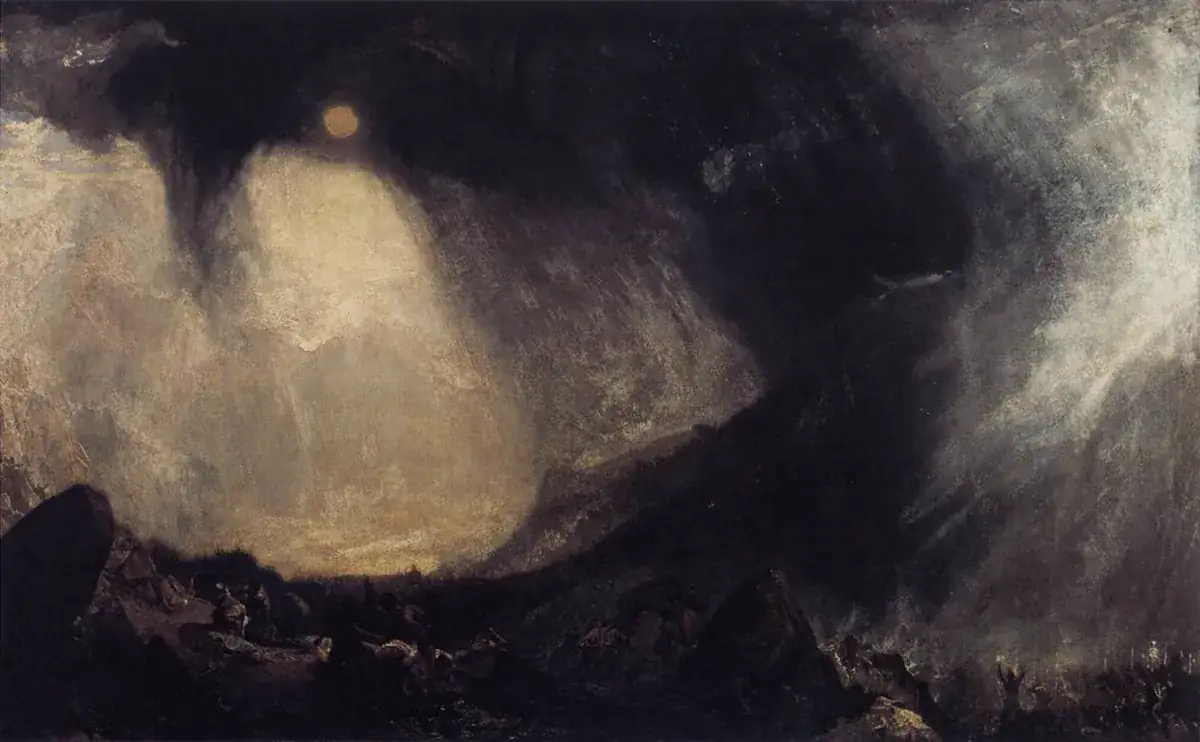
Hannibal crossing the Alps.J. M. W. Turner, 1812 · Wikimedia Commons · Public Domain · PD SourcesHannibal — The Alpine crossing backgroundPunic Wars background
- 06
Cannae: double envelopment and an unfulfilled victory
In August 216 BCE Cannae was fought in Apulia. Hannibal had about 40,000 infantry and 10,000 cavalry against roughly 80,000 Romans, about half without experience. He seized the water supply and forced the Romans into a narrow plain; his Gallic and Spanish centre gave ground without breaking, the African infantry pressed inward and the cavalry closed the rear. Roman losses are given as 55,000 by Livy and 70,000 by Pol…
In August 216 BCE at Cannae in Apulia, Hannibal had about 40,000 infantry and 10,000 cavalry against roughly 80,000 Romans, about half without experience. He seized the water supply and forced the Romans into a narrow river-backed plain; his Gallic and Spanish centre gave ground without breaking, the African infantry pressed inward and the cavalry closed the rear. Roman losses are given as 55,000 by Livy and 70,000 by Polybius; about 14,000 escaped, 10,000 were captured and Carthage lost about 6,000. Hannibal did not march on Rome, and Rome resumed the Fabian strategy, wearing Carthage down by attrition.
In August 216 BCE the Battle of Cannae was fought in Apulia, southeastern Italy; Hannibal had about 40,000 infantry and 10,000 cavalry, while Rome had about 80,000 men, roughly half without significant battle experience.
Hannibal first seized the water supply of the Aufidus and forced the Romans into a narrow plain backed by the river, facing a hot summer wind and dust. When battle began, his Gallic and Spanish infantry in the centre gave ground without breaking; the Romans pressed deeper and exposed their flanks.
The real blow came on the wings: the African infantry pressed inward while the cavalry, after routing the Roman cavalry, closed from the rear. Hannibal's crescent became a circle, and the packed Romans could hardly use their weapons.
Roman losses are given as 55,000 by Livy and 70,000 by Polybius. About 14,000 escaped, 10,000 were captured, and Carthage lost about 6,000. Of 40 tribunes, 28 died; up to 80 senators or senior officials and at least 200 knights died; an estimated 20 percent of Roman fighting men aged 18–50 were killed.
After Cannae, Maharbal urged Hannibal to march on Rome, but he did not; he hoped the South Italian allies would defect and preferred political collapse to a siege. Rome resumed the Fabian strategy, avoided another Cannae-scale battle and wore Carthage down with time and supply.
Cannae was a tactical masterpiece but not a strategic victory. Hannibal did not take Rome and Rome did not sue for peace. Carthage finally lost the city itself in 146 BCE.
The real lesson of Cannae is that a double envelopment can destroy an army but cannot by itself break an alliance system; tactical genius must convert victory into a political result, or it only postpones defeat.
Sources: 10 event claims, 9 sourced; source cards src-b7-cannae (background only).
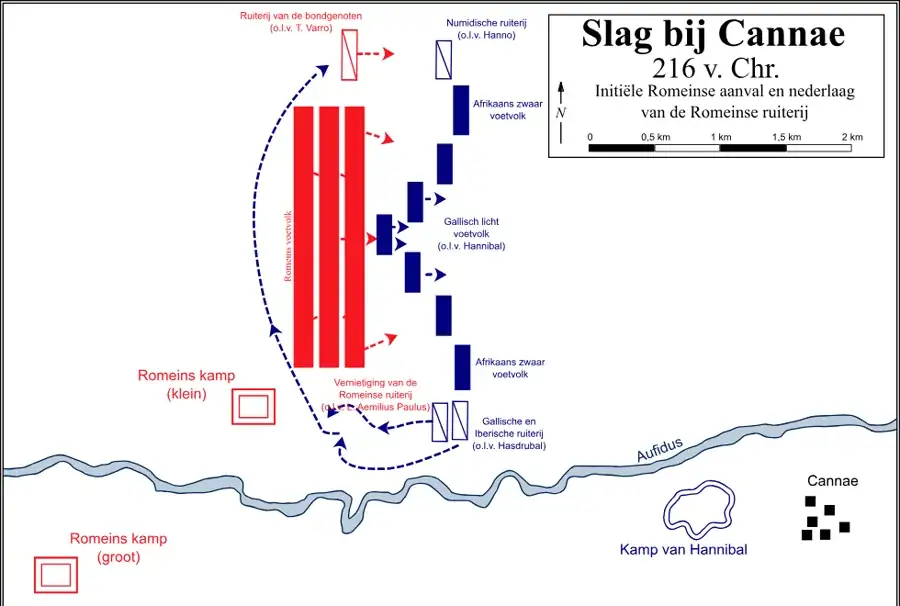
Battle of Cannae.Wikibelgiaan / USMA Department of History · Wikimedia Commons · CC BY-SA 4.0 · CC-BY-SA-4.0 SourcesBattle of Cannae background
Cast
People whose choices move the story. Roles describe this story only.
- Hannibal BarcaCarthaginian commander
247–c. 183/181 BCE; commanded Carthage in the Second Punic War (218–201), crossed the Alps into Italy and won the double envelopment at Cannae, then lost at Zama in 202 and went into exile.
- Hanno the NavigatorCarthaginian navigator and coloniser
Active in the 5th century BCE; sailed with 60 ships and 30,000 people down the West African coast. The extent is disputed, and modern scholars doubt whether he went beyond Morocco.
- DidoFounding figure of Carthage in tradition
The Tyrian princess and founder of Carthage in Roman tradition, known chiefly through Virgil's Aeneid; not a contemporary source and not a proven historical figure.
Evidence and limits
Chapter-level sources; key claims checked.
Source count is the number of distinct source records attached to the event nodes shown here. It does not certify the narrative as a whole.