
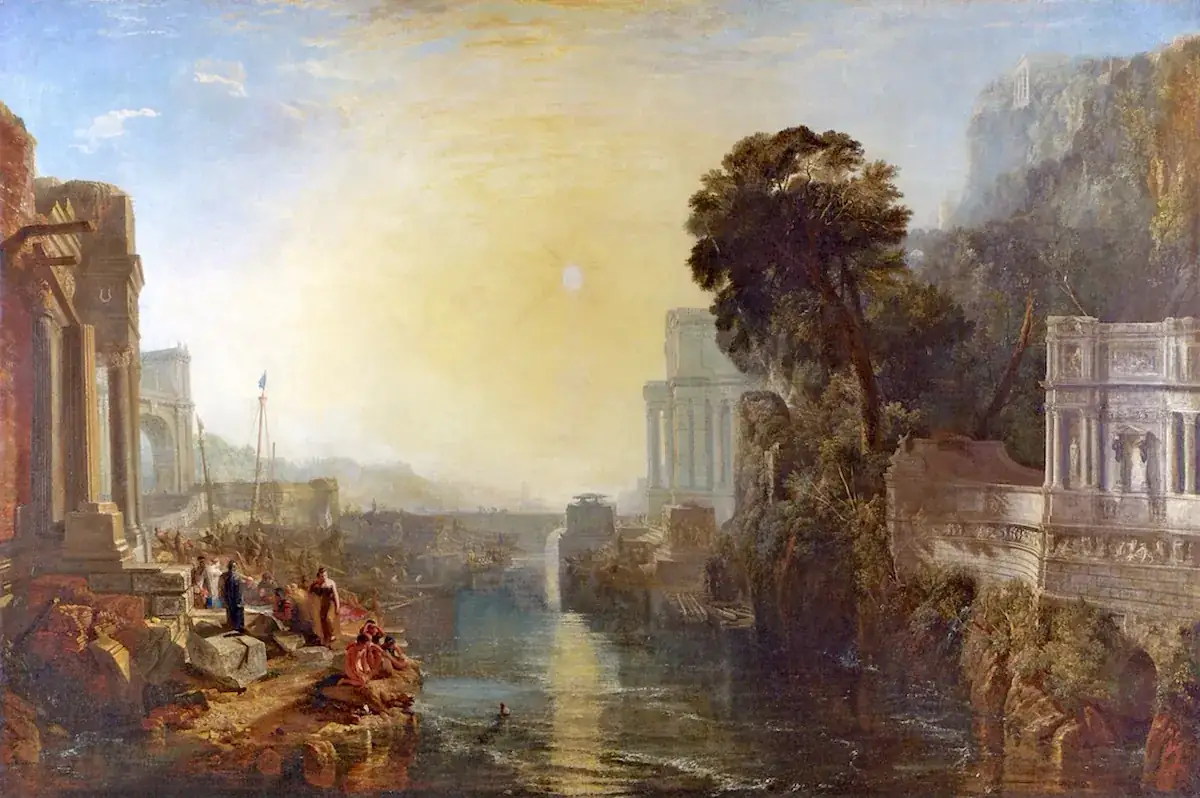
According to tradition, the Phoenicians of Tyre founded Carthage in 814 BCE; its Phoenician name means 'new town'.1
The Roman tradition credits the foundation to the Tyrian princess Dido, who fled from her brother Pygmalion; the story became widely known through Virgil's Aeneid.2 The Dido narrative is not a contemporary record but a later Roman literary rewriting of the city's foundation memory.3
The traditional date was probably exaggerated by the Carthaginians themselves; nothing earlier than the last quarter of the 8th century BCE has been found, a full century later than the traditional foundation.4 Utica may have predated Carthage by about half a century, showing that Phoenician settlements in the region were already older.5
Carthage was built on a triangular peninsula on the Gulf of Tunis, backed by the Lake of Tunis and close to the Strait of Sicily, a strategic bottleneck in east-west Mediterranean trade; its ancient core was the Byrsa citadel overlooking the sea.6 The site offered both a safe anchorage and control over passing ships.
Carthage controlled much of the western Mediterranean trade in purple dye and drew revenue from silver mines in North Africa and southern Spain: mining near Gadir began as early as 800 BCE, and near Cartagena in the 3rd century BCE.7 By the 5th century BCE Carthage had become the leader of the western Phoenicians, forming an empire centred on North Africa.8
In 146 BCE Rome captured Carthage in the Third Punic War and plundered and burned the city.9 A Roman city was later rebuilt on the site, and Carthage continued under another form.
The traditional date belongs to civic memory, not to an archaeological layer; keeping the two apart preserves both the meaning of the legend and the evidence of the excavator.10
Evidence ledger
10 claims8 sourced0 unsourced2 author judgment
Every hard fact in the narrative above is registered here. A claim may also record source-only details that the narrative does not repeat; the related-narrative line points to the corresponding passage, not a guarantee that the source supports every word of the body. A claim without a source stays visibly unsourced.
- Carthage (ancient city)Britannica, Carthage, opening paragraph
According to tradition, Carthage was founded by the Phoenicians of Tyre in 814 BCE; its Phoenician name means “new town.”
Accessed 2026-11-25 · human read
Says 'according to tradition', not proven in 814 BCE.
- Carthage (ancient city)Britannica, Carthage, opening paragraph
The Roman tradition credits the foundation to the Tyrian princess Dido, who fled from her brother Pygmalion; the story became widely known through Virgil's Aeneid.
Related narrativeThe Roman tradition credits the foundation to the Tyrian princess Dido, who fled from her brother Pygmalion; the story became widely known through Virgil's Aeneid.
- Carthage (ancient city)Britannica, Carthage, foundation traditions
The Roman tradition is better known, however, because of the Aeneid, which tells of the city’s foundation by the Tyrian princess Dido, who fled from her brother Pygmalion (the name of a historical king of Tyre).
Accessed 2026-11-25 · human read
Marked as Roman tradition and literary narrative; no claim that Dido certainly existed.
- Carthage (ancient city)Britannica, Carthage, foundation traditions
The Dido narrative is not a contemporary record but a later Roman literary rewriting of the city's foundation memory.
Related narrativeThe Dido narrative is not a contemporary record but a later Roman literary rewriting of the city's foundation memory.
Editorial judgment, not a historical fact.
Author judgment: treats Dido as literary tradition, not a historical source.
The traditional date was probably exaggerated by the Carthaginians themselves; nothing earlier than the last quarter of the 8th century BCE has been found, a full century later than the traditional foundation.
Related narrativeThe traditional date was probably exaggerated by the Carthaginians themselves; nothing earlier than the last quarter of the 8th century BCE has been found, a full century later than the traditional foundation.
- Carthage (ancient city)Britannica, Carthage, archaeology paragraph
The traditional date of the foundation of Carthage as 814 BCE was probably exaggerated by the Carthaginians themselves, for it does not necessarily agree with the archaeological data. Nothing earlier than the last quarter of the 8th century BCE has been discovered, a full century later than the traditional foundation date.
Accessed 2026-11-25 · human read
Archaeological limit and 'probably exaggerated' follow the entry; no claim that archaeology proves 814 BCE.
- Carthage (ancient city)Britannica, Carthage, archaeology paragraph
Utica may have predated Carthage by about half a century, showing that Phoenician settlements in the region were already older.
Related narrativeUtica may have predated Carthage by about half a century, showing that Phoenician settlements in the region were already older.
- Carthage (ancient city)Britannica, Carthage, Utica sentence
Carthage was probably not the earliest Phoenician settlement in the region; Utica may have predated it by half a century.
Accessed 2026-11-25 · human read
Says 'may have predated by half a century', not 'Utica founded in 1100 BCE'.
- Carthage (ancient city)Britannica, Carthage, Utica sentence
Carthage was built on a triangular peninsula on the Gulf of Tunis, backed by the Lake of Tunis and close to the Strait of Sicily, a strategic bottleneck in east-west Mediterranean trade; its ancient core was the Byrsa citadel overlooking the sea.
Related narrativeCarthage was built on a triangular peninsula on the Gulf of Tunis, backed by the Lake of Tunis and close to the Strait of Sicily, a strategic bottleneck in east-west Mediterranean trade; its ancient core was the Byrsa citadel overlooking the sea.
- Carthage (ancient city)Britannica, Carthage, site paragraph
The site chosen for Carthage in the centre of the shore of the Gulf of Tunis was ideal; the city was built on a triangular peninsula covered with low hills and backed by the Lake of Tunis … its proximity to the Strait of Sicily placed it at a strategic bottleneck in east-west Mediterranean trade. … The ancient citadel, the Byrsa, was on a low hill overlooking the sea.
Accessed 2026-11-25 · human read
Only the site, lake, strait and Byrsa; no claim that the military harbour held 200 warships.
- Carthage (ancient city)Britannica, Carthage, site paragraph
Carthage controlled much of the western Mediterranean trade in purple dye and drew revenue from silver mines in North Africa and southern Spain: mining near Gadir began as early as 800 BCE, and near Cartagena in the 3rd century BCE.
Related narrativeCarthage controlled much of the western Mediterranean trade in purple dye and drew revenue from silver mines in North Africa and southern Spain: mining near Gadir began as early as 800 BCE, and near Cartagena in the 3rd century BCE.
- Carthage (ancient city)Britannica, Carthage, economy paragraph
Much of the revenue of Carthage came from its exploitation of the silver mines of North Africa and southern Spain, begun as early as 800 BCE near Gadir (modern Cádiz, Spain) and in the 3rd century BCE near what is now Cartagena, Spain. … Carthage controlled much of the Western trade in the luxurious purple dye from the murex shell.
Accessed 2026-11-25 · human read
Purple dye and silver revenue; no claim of a complete monopoly of western Mediterranean trade.
- Carthage (ancient city)Britannica, Carthage, economy paragraph
By the 5th century BCE Carthage had become the leader of the western Phoenicians, forming an empire centred on North Africa.
Related narrativeBy the 5th century BCE Carthage had become the leader of the western Phoenicians, forming an empire centred on North Africa.
- Carthage (ancient city)Britannica, Carthage, Top Questions
By the 5th century BCE, it had become the leader of the western Phoenicians, forming its own empire centered on North Africa.
Accessed 2026-11-25 · human read
Says leader and North-African-centred empire; no claim of unifying the western Mediterranean.
- Carthage (ancient city)Britannica, Carthage, Top Questions
In 146 BCE Rome captured Carthage in the Third Punic War and plundered and burned the city.
Related narrativeIn 146 BCE Rome captured Carthage in the Third Punic War and plundered and burned the city.
- Carthage (ancient city)Britannica, Carthage, destruction paragraph
When Carthage finally fell in 146 BCE, the site was plundered and burned, fulfilling the demand by the senator and orator Cato the Elder … “Carthage must be destroyed.”
Accessed 2026-11-25 · human read
Only the destruction in 146 BCE; the Roman rebuild is mentioned separately.
- Carthage (ancient city)Britannica, Carthage, destruction paragraph
The traditional date belongs to civic memory, not to an archaeological layer; keeping the two apart preserves both the meaning of the legend and the evidence of the excavator.
Related narrativeThe traditional date belongs to civic memory, not to an archaeological layer; keeping the two apart preserves both the meaning of the legend and the evidence of the excavator.
Editorial judgment, not a historical fact.
Author judgment: tradition and archaeology are kept in separate registers.
Sources and review
Key claims rely on a single source record
- Carthage (ancient city) · Encyclopaedia Britannica (accessed 2026-11-25) Original source ↗
Locations
- Carthage· 36.85, 10.32· Approximate
evt-6e846f7ef0839f94Source file:
events/evt-6e846f7ef0839f94/event.md