
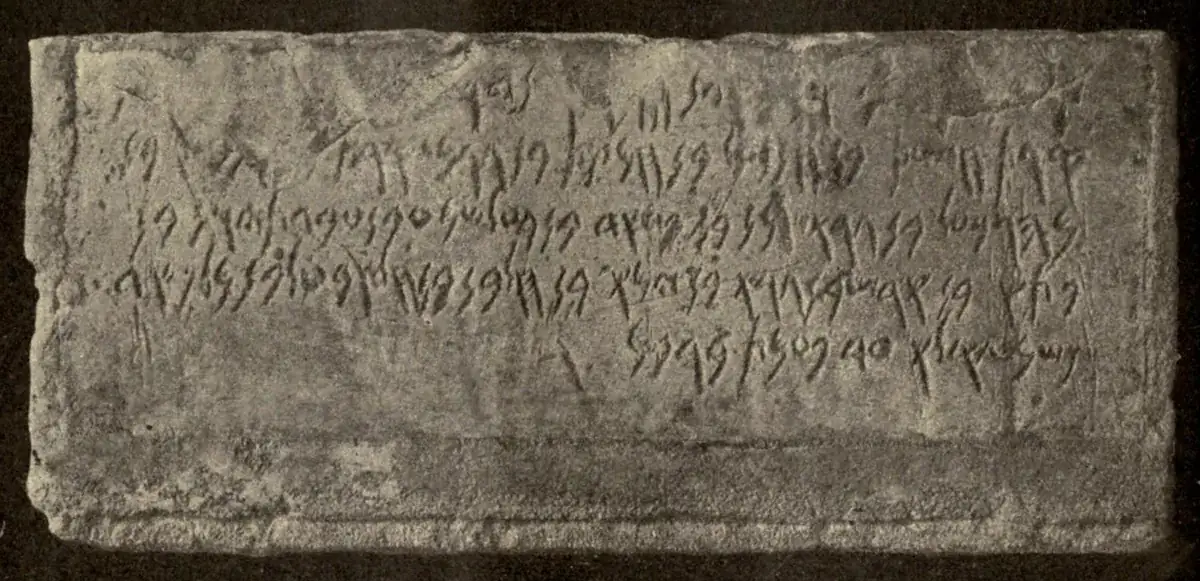
The Phoenician alphabet developed out of the North Semitic alphabet and was spread around the Mediterranean by Phoenician traders; it is the probable ancestor of the Greek alphabet and therefore of all Western alphabets.1 It was not invented from nothing but was a writing tool repeatedly used in trade and administration.
The earliest surviving Phoenician inscription is the Ahiram epitaph at Byblos, dating from the 11th century BCE. It is written in the North Semitic alphabet.2 The Phoenician alphabet gradually developed from that prototype.
The alphabet had only 22 signs, written from right to left and representing consonants alone.3 It had no separate vowel letters, so readers supplied vowels from context. In Phoenicia proper it remained in use until about the 1st century BCE.4
Colonies produced variants. Cypro-Phoenician was used from the 10th to the 2nd century BCE and Sardinian around the 9th century; a third variant evolved at Carthage into Punic and neo-Punic, written until about the 3rd century CE.5
The Greek alphabet formed about 1000 BCE, derived from the North Semitic alphabet via the Phoenicians; the Greeks turned several consonantal signs into vowels.6 Alef, he, yod, ayin and vav became alpha, epsilon, iota, omicron and upsilon.7 The western Greek alphabet passed through Etruscan to Latin.8
The point of alphabet history is not who invented it first, but who made a set of signs simple enough to be borrowed and rewritten by different languages.9
Evidence ledger
9 claims8 sourced0 unsourced1 author judgment
Every hard fact in the narrative above is registered here. A claim may also record source-only details that the narrative does not repeat; the related-narrative line points to the corresponding passage, not a guarantee that the source supports every word of the body. A claim without a source stays visibly unsourced.
- Phoenician alphabetBritannica, Phoenician alphabet, opening paragraph
Phoenician alphabet, writing system that developed out of the North Semitic alphabet and was spread over the Mediterranean area by Phoenician traders. It is the probable ancestor of the Greek alphabet and, hence, of all Western alphabets.
Accessed 2026-11-25 · human read
Says development from North Semitic and 'probable ancestor'; no claim of inventing 22 letters from nothing.
- Phoenician alphabetBritannica, Phoenician alphabet, opening paragraph
The earliest surviving Phoenician inscription is the Ahiram epitaph at Byblos, dating from the 11th century BCE. It is written in the North Semitic alphabet.
Related narrativeThe earliest surviving Phoenician inscription is the Ahiram epitaph at Byblos, dating from the 11th century BCE. It is written in the North Semitic alphabet.
- Phoenician alphabetBritannica, Phoenician alphabet, Ahiram paragraph
The earliest Phoenician inscription that has survived is the Ahiram epitaph at Byblos in Phoenicia, dating from the 11th century BCE and written in the North Semitic alphabet.
Accessed 2026-11-25 · human read
Only the epitaph's date and script; no claim that it is already the mature Phoenician alphabet.
- Phoenician alphabetBritannica, Phoenician alphabet, Ahiram paragraph
The alphabet had only 22 signs, written from right to left and representing consonants alone.
Related narrativeThe alphabet had only 22 signs, written from right to left and representing consonants alone.
- Phoenician alphabetBritannica, Phoenician alphabet, structure paragraph
The alphabet remained, however, essentially a Semitic alphabet of 22 letters, written from right to left, with only consonants represented and phonetic values unchanged from the North Semitic script.
Accessed 2026-11-25 · human read
Letter count, direction and consonants follow the entry; no claim that vowels made reading impossible.
- Phoenician alphabetBritannica, Phoenician alphabet, structure paragraph
In Phoenicia proper it remained in use until about the 1st century BCE.
Related narrativeIn Phoenicia proper it remained in use until about the 1st century BCE.
- Phoenician alphabetBritannica, Phoenician alphabet, mainland use
… was in use until about the 1st century BCE in Phoenicia proper.
Accessed 2026-11-25 · human read
Only the mainland limit; Punic and neo-Punic are treated separately.
- Phoenician alphabetBritannica, Phoenician alphabet, mainland use
Cypro-Phoenician was used from the 10th to the 2nd century BCE and Sardinian around the 9th century; a third variant evolved at Carthage into Punic and neo-Punic, written until about the 3rd century CE.
Related narrativeCypro-Phoenician was used from the 10th to the 2nd century BCE and Sardinian around the 9th century; a third variant evolved at Carthage into Punic and neo-Punic, written until about the 3rd century CE.
- Phoenician alphabetBritannica, Phoenician alphabet, colonial scripts paragraph
Phoenician colonial scripts … are classified as Cypro-Phoenician (10th–2nd century BCE) and Sardinian (c. 9th century BCE) varieties. A third variety … evolved into the Punic and neo-Punic alphabets of Carthage, which continued to be written until about the 3rd century CE.
Accessed 2026-11-25 · human read
Colonial variants and Punic/neo-Punic follow the entry; no claim that Punic was identical to the mainland script.
- Phoenician alphabetBritannica, Phoenician alphabet, colonial scripts paragraph
The Greek alphabet formed about 1000 BCE, derived from the North Semitic alphabet via the Phoenicians; the Greeks turned several consonantal signs into vowels.
Related narrativeThe Greek alphabet formed about 1000 BCE, derived from the North Semitic alphabet via the Phoenicians; the Greeks turned several consonantal signs into vowels.
- Greek alphabetBritannica, Greek alphabet, opening paragraphs
The Greek alphabet is a writing system that was developed in Greece about 1000 BCE. … It was derived from the North Semitic alphabet via that of the Phoenicians. … some of the symbols of the Semitic alphabet, which represented only consonants, were made to represent vowels …
Accessed 2026-11-25 · human read
Says derivation via the Phoenician alphabet and consonantal signs turned into vowels; no claim that Greeks invented vowels from nothing.
- Greek alphabetBritannica, Greek alphabet, opening paragraphs
Alef, he, yod, ayin and vav became alpha, epsilon, iota, omicron and upsilon.
Related narrativeAlef, he, yod, ayin and vav became alpha, epsilon, iota, omicron and upsilon.
- Greek alphabetBritannica, Greek alphabet, vowel adaptation
… the Semitic consonants ʾalef, he, yod, ʿayin, and vav became the Greek letters alpha, epsilon, iota, omicron, and upsilon, representing the vowels a, e, i, o, and u, respectively.
Accessed 2026-11-25 · human read
Only the letter correspondences; no inference beyond the five signs becoming vowel letters.
- Greek alphabetBritannica, Greek alphabet, vowel adaptation
The western Greek alphabet passed through Etruscan to Latin.
Related narrativeThe western Greek alphabet passed through Etruscan to Latin.
- Greek alphabetBritannica, Greek alphabet, Etruscan and Latin
The Chalcidian alphabet probably gave rise to the Etruscan alphabet of Italy in the 8th century BCE and hence indirectly to the other Italic alphabets, including the Latin.
Accessed 2026-11-25 · human read
Says Etruscan indirect route to Latin; no claim that Latin copied Greek directly.
- Greek alphabetBritannica, Greek alphabet, Etruscan and Latin
The point of alphabet history is not who invented it first, but who made a set of signs simple enough to be borrowed and rewritten by different languages.
Related narrativeThe point of alphabet history is not who invented it first, but who made a set of signs simple enough to be borrowed and rewritten by different languages.
Editorial judgment, not a historical fact.
Author judgment: shifts alphabet history from invention claims to diffusion and adaptation.
Sources and review
- Phoenician alphabet · Encyclopaedia Britannica (accessed 2026-11-25) Original source ↗
- Greek alphabet · Encyclopaedia Britannica (accessed 2026-11-25) Original source ↗
Locations
- Phoenicia· 34.12, 35.65· Approximate
evt-b16f482409d07694Source file:
events/evt-b16f482409d07694/event.md