
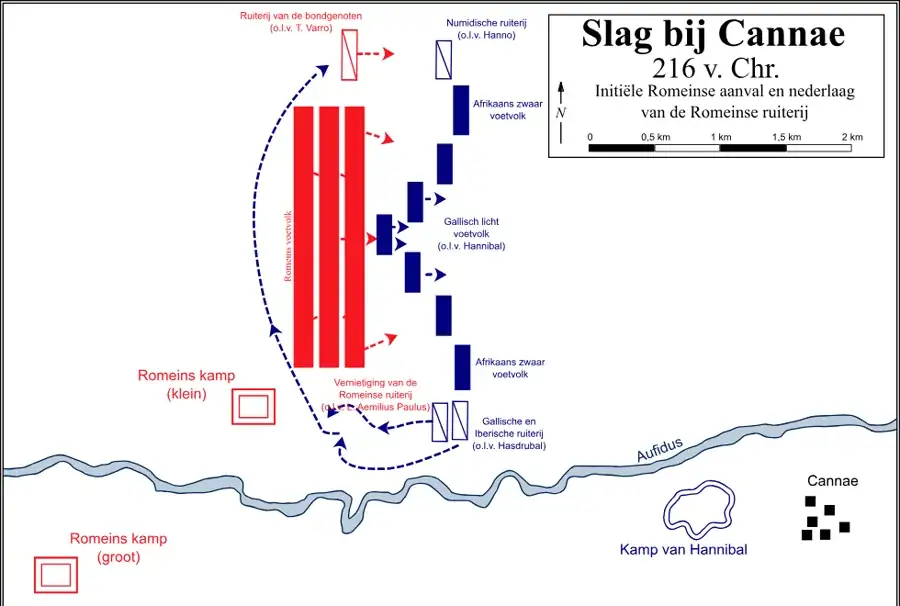
In August 216 BCE the Battle of Cannae was fought in Apulia, southeastern Italy; Hannibal had about 40,000 infantry and 10,000 cavalry, while Rome had about 80,000 men, roughly half without significant battle experience.1
Hannibal first seized the water supply of the Aufidus and forced the Romans into a narrow plain backed by the river, facing a hot summer wind and dust.2 When battle began, his Gallic and Spanish infantry in the centre gave ground without breaking; the Romans pressed deeper and exposed their flanks.3
The real blow came on the wings: the African infantry pressed inward while the cavalry, after routing the Roman cavalry, closed from the rear.4 Hannibal's crescent became a circle, and the packed Romans could hardly use their weapons.
Roman losses are given as 55,000 by Livy and 70,000 by Polybius. About 14,000 escaped, 10,000 were captured, and Carthage lost about 6,000.5 Of 40 tribunes, 28 died; up to 80 senators or senior officials and at least 200 knights died; an estimated 20 percent of Roman fighting men aged 18–50 were killed.6
After Cannae, Maharbal urged Hannibal to march on Rome, but he did not; he hoped the South Italian allies would defect and preferred political collapse to a siege.7 Rome resumed the Fabian strategy, avoided another Cannae-scale battle and wore Carthage down with time and supply.9
Cannae was a tactical masterpiece but not a strategic victory. Hannibal did not take Rome and Rome did not sue for peace. Carthage finally lost the city itself in 146 BCE.8
The real lesson of Cannae is that a double envelopment can destroy an army but cannot by itself break an alliance system; tactical genius must convert victory into a political result, or it only postpones defeat.10
Evidence ledger
10 claims9 sourced0 unsourced1 author judgment
Every hard fact in the narrative above is registered here. A claim may also record source-only details that the narrative does not repeat; the related-narrative line points to the corresponding passage, not a guarantee that the source supports every word of the body. A claim without a source stays visibly unsourced.
- Battle of CannaeBritannica, Battle of Cannae, opening paragraphs
Battle of Cannae, (August 216 BCE), battle fought near the ancient village of Cannae, in southern Apulia … Hannibal was the first to arrive at the battle site, with a force of about 40,000 infantry and 10,000 cavalry. … the Roman consuls … brought to Cannae roughly 80,000 men, about half of whom lacked significant battle experience.
Accessed 2026-11-25 · human read
Date, place and numbers follow the entry; no claim that all 80,000 Romans were veterans.
- Battle of CannaeBritannica, Battle of Cannae, opening paragraphs
Hannibal first seized the water supply of the Aufidus and forced the Romans into a narrow plain backed by the river, facing a hot summer wind and dust.
Related narrativeHannibal first seized the water supply of the Aufidus and forced the Romans into a narrow plain backed by the river, facing a hot summer wind and dust.
- Battle of CannaeBritannica, Battle of Cannae, terrain paragraph
Hannibal … took command of the Aufidus (now Ofanto) River, the main source of water in the area. … Hannibal confined the eight Roman legions in a narrow valley, hemmed in by the river. … compelling the Romans to face mostly to the south, where the hot libeccio wind blew dust and grit into their eyes.
Accessed 2026-11-25 · human read
Terrain and wind follow the entry; no claim that wind alone decided the battle.
- Battle of CannaeBritannica, Battle of Cannae, terrain paragraph
When battle began, his Gallic and Spanish infantry in the centre gave ground without breaking; the Romans pressed deeper and exposed their flanks.
Related narrativeWhen battle began, his Gallic and Spanish infantry in the centre gave ground without breaking; the Romans pressed deeper and exposed their flanks.
- Battle of CannaeBritannica, Battle of Cannae, encirclement paragraph
He stationed his Gallic and Spanish infantry in the centre … although it fell back, it did not break.
Accessed 2026-11-25 · human read
Says 'gave ground without breaking'; no claim that the retreat was improvised.
- Battle of CannaeBritannica, Battle of Cannae, encirclement paragraph
The real blow came on the wings: the African infantry pressed inward while the cavalry, after routing the Roman cavalry, closed from the rear.
Related narrativeThe real blow came on the wings: the African infantry pressed inward while the cavalry, after routing the Roman cavalry, closed from the rear.
- Battle of CannaeBritannica, Battle of Cannae, encirclement paragraph
Hannibal’s crescent became a circle, with Hannibal’s African and Spanish troops on the wings pressing inward on the Romans and the Carthaginian cavalry attacking from the rear.
Accessed 2026-11-25 · human read
Says flank pressure and cavalry encirclement from the rear; no claim that the centre fled.
- Battle of CannaeBritannica, Battle of Cannae, encirclement paragraph
Roman losses are given as 55,000 by Livy and 70,000 by Polybius. About 14,000 escaped, 10,000 were captured, and Carthage lost about 6,000.
Related narrativeRoman losses are given as 55,000 by Livy and 70,000 by Polybius. About 14,000 escaped, 10,000 were captured, and Carthage lost about 6,000.
- Battle of CannaeBritannica, Battle of Cannae, casualty paragraph
recorded Roman losses ranging from 55,000 (according to Roman historian Livy) to 70,000 (according to Greek historian Polybius). … Only 14,000 Roman soldiers escaped, and 10,000 more were captured; the rest were killed. The Carthaginians lost about 6,000 men.
Accessed 2026-11-25 · human read
The two ancient casualty figures are given side by side; they are not merged into one certain 'about 60,000'.
- Battle of CannaeBritannica, Battle of Cannae, casualty paragraph
Of 40 tribunes, 28 died; up to 80 senators or senior officials and at least 200 knights died; an estimated 20 percent of Roman fighting men aged 18–50 were killed.
Related narrativeOf 40 tribunes, 28 died; up to 80 senators or senior officials and at least 200 knights died; an estimated 20 percent of Roman fighting men aged 18–50 were killed.
- Battle of CannaeBritannica, Battle of Cannae, elite casualties
Among the Roman dead were 28 of 40 tribunes, up to 80 Romans of Senatorial or high magistrate rank, and at least 200 knights (Romans of equestrian rank). It was estimated that 20 percent of Roman fighting men between the ages of 18 and 50 died at Cannae.
Accessed 2026-11-25 · human read
Elite casualties and population share follow the entry; no claim that the Senate was emptied.
- Battle of CannaeBritannica, Battle of Cannae, elite casualties
After Cannae, Maharbal urged Hannibal to march on Rome, but he did not; he hoped the South Italian allies would defect and preferred political collapse to a siege.
Related narrativeAfter Cannae, Maharbal urged Hannibal to march on Rome, but he did not; he hoped the South Italian allies would defect and preferred political collapse to a siege.
- Battle of CannaeBritannica, Battle of Cannae, aftermath
Hannibal was exhorted to march on Rome by Maharbal, one of his commanders, but Hannibal did not do so. … Hannibal had hoped that many South Italians would desert Rome and ally with him after his crushing victory.
Accessed 2026-11-25 · human read
Says the urging and the failure to march; no claim that Hannibal feared a siege.
- Battle of CannaeBritannica, Battle of Cannae, aftermath
Carthage finally lost the city itself in 146 BCE.
Related narrativeCarthage finally lost the city itself in 146 BCE.
- Punic WarsBritannica, Punic Wars, Third Punic War
The Third Punic War (149–146 BCE) resulted in the complete destruction of Carthage.
Accessed 2026-11-25 · human read
Only the destruction of the city in 146 BCE; no claim that the Carthaginian people were exterminated.
- Punic WarsBritannica, Punic Wars, Third Punic War
Rome resumed the Fabian strategy, avoided another Cannae-scale battle and wore Carthage down with time and supply.
Related narrativeRome resumed the Fabian strategy, avoided another Cannae-scale battle and wore Carthage down with time and supply.
- Battle of CannaeBritannica, Battle of Cannae, aftermath
Rome resumed the Fabian strategy, denying Hannibal the opportunity to achieve a second victory of Cannae’s scale, and Hannibal saw the strength of his armies and his allies whittled away through slow attrition.
Accessed 2026-11-25 · human read
Says the Fabian strategy and attrition; no claim that Rome only defended thereafter.
- Battle of CannaeBritannica, Battle of Cannae, aftermath
The real lesson of Cannae is that a double envelopment can destroy an army but cannot by itself break an alliance system; tactical genius must convert victory into a political result, or it only postpones defeat.
Related narrativeThe real lesson of Cannae is that a double envelopment can destroy an army but cannot by itself break an alliance system; tactical genius must convert victory into a political result, or it only postpones defeat.
Editorial judgment, not a historical fact.
Author judgment: turns Cannae from a tactical textbook case into a strategic-political analysis.
Sources and review
- Battle of Cannae · Encyclopaedia Britannica (accessed 2026-11-25) Original source ↗
Locations
- Italy· 41.3, 16.1· Approximate
evt-755ac78cb52e5208Source file:
events/evt-755ac78cb52e5208/event.md