
The Rise of the Ottomans: From Frontier Beylik to Empire
Story1299–1522: how a frontier principality became a transcontinental empire
Traditional chronology treats 1299 as the starting point of the Ottoman state; in 1326 Orhan took Bursa, in 1354 the Ottomans crossed the Dardanelles, in 1396 they crushed an international crusade at Nicopolis, in 1453 they captured Constantinople, and in 1522 they took Rhodes. The six chapters are not isolated victories but the accumulation of four capacities: frontier manpower, fiscal capital, imperial legitimacy, and control of the straits and sea.
The Ottoman rise is not a single story of 'the sword of Islam.' It assembled ghazi raiders, Christian vassals, mercenaries, Janissaries and a navy into one expansion machine; each captured city converted war revenue into taxation, coinage, schools and ports. After 1453 it had to rule not a frontier but a multi-religious empire.
Chapter-level sources; key claims checked.
Chapter timeline
Chapters in reading orderAll anchors are approximate region-level placements; they are not precise sites. Chapters without coordinates are listed below by region only.
Chapter contents6 chapters
The story, chapter by chapter
Each chapter opens the underlying event- 01
1299–1300: a frontier beylik
Traditional chronology treats 1299 as the starting point of the Ottoman state. The more defensible account is that Osman led ghazi raids on the Bithynian frontier at the end of the 13th century and by about 1300 controlled an area from Eskişehir to the plain of İznik. This was not an empire built overnight but a frontier polity left by the collapse of Seljuq power, Mongol overlordship and the weakening of Byzantine d…
Traditional chronology treats 1299 as the starting point; more defensibly, Osman led ghazi raids on the Bithynian frontier at the end of the 13th century and by about 1300 controlled an area from Eskişehir to the plain of İznik. It was not an empire built overnight.
Traditional chronology treats 1299 as the starting point of the Ottoman state, but the year was assigned by later dynastic historians. The more reliable picture is this: at the end of the 13th century, after the Mongols defeated the Seljuk army in 1293 and loosened the Seljuk order in Anatolia, Osman led ghazi raiders on the Bithynian frontier and by about 1300 controlled an area from Eskişehir to the plain of İznik.
This territory was not won in a single battle. It accumulated through frontier raiding, alliances and local Byzantine conflicts. Osman gathered fighters from different backgrounds and held their loyalty through plunder and land distribution.
“Ghazi” was not a unified regular army but a loose body of armed men around frontier opportunities. Its strengths were mobility, low cost and local knowledge; its weakness was that it dispersed after a campaign and could not easily hold territory.
So 1299 should not be written as a moment of “declaring independence and founding an empire.” It is a later starting point added to a frontier history; real state-building waited for Bursa.
Sources: 4 event claims, 3 sourced; source cards src-b7-ottoman-emergence-1299 (background only).
- 02
1326: Bursa becomes the capital
On April 6, 1326, Orhan captured the Byzantine city of Bursa; some sources date the fall to 1324. Bursa became the Ottoman capital, and in 1327 Orhan minted the first Ottoman silver coins and reorganized the army on a more permanent footing.
On April 6, 1326, Orhan took Bursa; some sources say 1324. In 1327 he minted the first Ottoman silver coins, reorganized the army into regular infantry and cavalry, and built mosques, colleges and caravansaries in Bursa.
On April 6, 1326, Orhan took Bursa; other sources put the fall in 1324. Osman himself did not see that day. Tradition says he died around 1324, and another account says Bursa fell shortly after his death.
Orhan made Bursa his capital and turned a Byzantine city into the Ottoman court, tax centre and religious centre. Conquest was no longer only about dividing plunder; it required collecting taxes, minting coins, paying troops and building schools.
In 1327 Orhan minted the first Ottoman silver coins, stamped “Orhan, son of Osman.” In the same period he began turning the ghazi raiders into paid regular infantry and cavalry.
Bursa's mosques, colleges and caravansaries plugged the new state into the Islamic urban network. Caravansaries connected Anatolian and Rumelian trade, colleges trained judges and officials, and mosques gave the ruler public legitimacy.
That is what a capital does: it converts war revenue into repeatable institutions. Without Bursa, the Ottomans remained an armed frontier group; with Bursa, they began to look like a state.
Sources: 4 event claims, 4 sourced; source cards src-b7-osman-i-bursa-1326, src-b7-orhan-state-1327 (background only).
SourcesOsman I and the fall of Bursa backgroundOrhan: from principality to state background
- 03
1354: the Gallipoli bridgehead
In 1354 Süleyman Pasha, son of Orhan, crossed the Dardanelles and took the Gallipoli peninsula; some references give 'about 1356'. Gallipoli became the Ottomans' first permanent foothold in Europe, a naval base, and a transit point between the Balkans and Anatolia.
In 1354 Süleyman Pasha crossed the Dardanelles and took Gallipoli; some references give about 1356. Gallipoli became a permanent foothold in Europe, a naval base and a transit station between Rumelia and Anatolia.
In 1354 Süleyman Pasha, son of Orhan, crossed the Dardanelles and seized the Gallipoli peninsula; some references give about 1356. Gallipoli controlled the European side of the strait and was the Ottomans' first permanent foothold in Europe.
The Ottomans built a naval base there and used Gallipoli as a transit station between Rumelia and Anatolia. Troops, grain, taxes and intelligence moved along both shores.
The strait was not a water wall but a two-way channel. Once the Ottomans crossed it, they drew Balkan land, people and nobles into their network; Byzantium and Venice lost their exclusive hold on the northern shore.
Gallipoli mattered not because of one landing but because the Ottomans stayed. A permanent base turned raid into occupation, occupation into taxation, and taxation into the next army.
Sources: 4 event claims, 3 sourced; source cards src-b7-orhan-state-1327, src-b7-gallipoli-1354 (background only).
SourcesOrhan: from principality to state backgroundGallipoli: the first Ottoman foothold in Europe background
- 04
1396: Nicopolis
On September 25, 1396, Bayezid I defeated an international crusade nominally led by Sigismund of Hungary at Nicopolis in present-day Bulgaria. Pope Boniface IX called for the crusade in 1394; France, Burgundy, Hungary, Bohemia, Croatia, Germany and the Knights Hospitaller sent contingents. The crusaders numbered about 12,000–15,000 against some 25,000 Ottoman troops, and the French knights' premature charge broke the…
On September 25, 1396, Bayezid I defeated an international crusade at Nicopolis; the crusaders numbered about 12,000–15,000 against some 25,000 Ottoman troops. The victory ended a massive international effort in the Balkans, but in 1402 Timur defeated Bayezid at Ankara.
In 1394 Pope Boniface IX called for a crusade; in 1396 French, Burgundian, Hungarian, Bohemian, Croatian, German and Hospitaller forces formed a coalition under Sigismund of Hungary. This was not a last crusade organised by the Duke of Burgundy, nor a relief expedition for Constantinople.
On September 25, 1396, the two armies met at Nicopolis (in present-day Bulgaria). The crusaders numbered about 12,000–15,000 against some 25,000 Ottoman troops under Bayezid I; Serbian vassals supplied about 5,000 men.
The crusaders' heavy cavalry broke the Ottoman front line in the first charge, but Bayezid kept his main force in reserve and used the Serbs to hold the flank. Crusader infantry and cavalry lost contact, and the counterattack routed them.
Sigismund was among the few who escaped. Bayezid then had most of the prisoners executed; the victory ended a massive international effort to halt Ottoman expansion in the Balkans.
But the victory did not last. In 1402 Timur defeated Bayezid at Ankara; the Ottoman state entered an interregnum and nearly split. Nicopolis proved the Ottomans could beat an international coalition, and also exposed their dependence on one strong sultan.
Sources: 4 event claims, 4 sourced; source cards src-b7-nicopolis-1396, src-b7-ottoman-emergence-1299 (background only).
SourcesBattle of Nicopolis (1396) backgroundOrigins of the Ottoman state (c. 1300) background
- 05
1453: Constantinople
On April 6, 1453, Mehmed II began bombarding Constantinople; the siege lasted 55 days and the city fell on May 29. The Ottomans deployed about 60,000–80,000 soldiers and 69 cannon. The defenders repaired breaches at night; after Giustiniani was mortally wounded and withdrew, Mehmed sent about 3,000 Janissaries through the Gate of St. Romanus. The city was sacked for three days and Hagia Sophia became a mosque; the Ot…
On April 6, 1453, Mehmed II began bombarding Constantinople; the siege lasted 55 days and the city fell on May 29. The Ottomans deployed about 60,000–80,000 soldiers and 69 cannon; after Giustiniani was mortally wounded, 3,000 Janissaries broke through the Gate of St. Romanus. The city was sacked for three days and Hagia Sophia became a mosque.
On April 6, 1453, Mehmed II began bombarding Constantinople; the siege lasted 55 days and the city fell on May 29. The Ottomans deployed about 60,000–80,000 soldiers and 69 cannon, including great bombards that fired stone balls.
The defenders numbered about 7,000, including Byzantine soldiers, Genoese and Venetian volunteers. The walls were bombarded from land and sea, the Golden Horn was sealed with a chain, and part of the Ottoman fleet was dragged overland into the inlet.
The final assault came on May 29, with the Ottomans breaking through near the Gate of St. Romanus. The Genoese commander Giovanni Giustiniani was mortally wounded and withdrew, and the defence lost its command chain; 3,000 Janissaries climbed the walls. Constantine XI died and the city fell.
The city was sacked for three days; Hagia Sophia became a mosque. Mehmed II did not move the capital there immediately; the transfer was completed in 1457. What ended in 1453 was the Eastern Roman Empire, not merely the defence of one city.
Capacity Key moment What it left behind Manpower Frontier raiding in 1299; regular army in 1327 Ghazi fighters, paid infantry and cavalry Finance Bursa in 1326; silver coinage in 1327 Capital, mint, taxes and colleges Legitimacy Constantinople in 1453 From frontier bey to imperial sultan Sea power Gallipoli in 1354; Rhodes in 1522 Strait base, ports and eastern Mediterranean sea lanes Table: four capacities of one expansion machine. The six chapters are not six isolated victories but manpower, finance, legitimacy and sea power reinforcing one another.
Sources: 5 event claims, 5 sourced; source cards src-b7-fall-constantinople-1453, src-b7-istanbul-capital-1457 (background only).
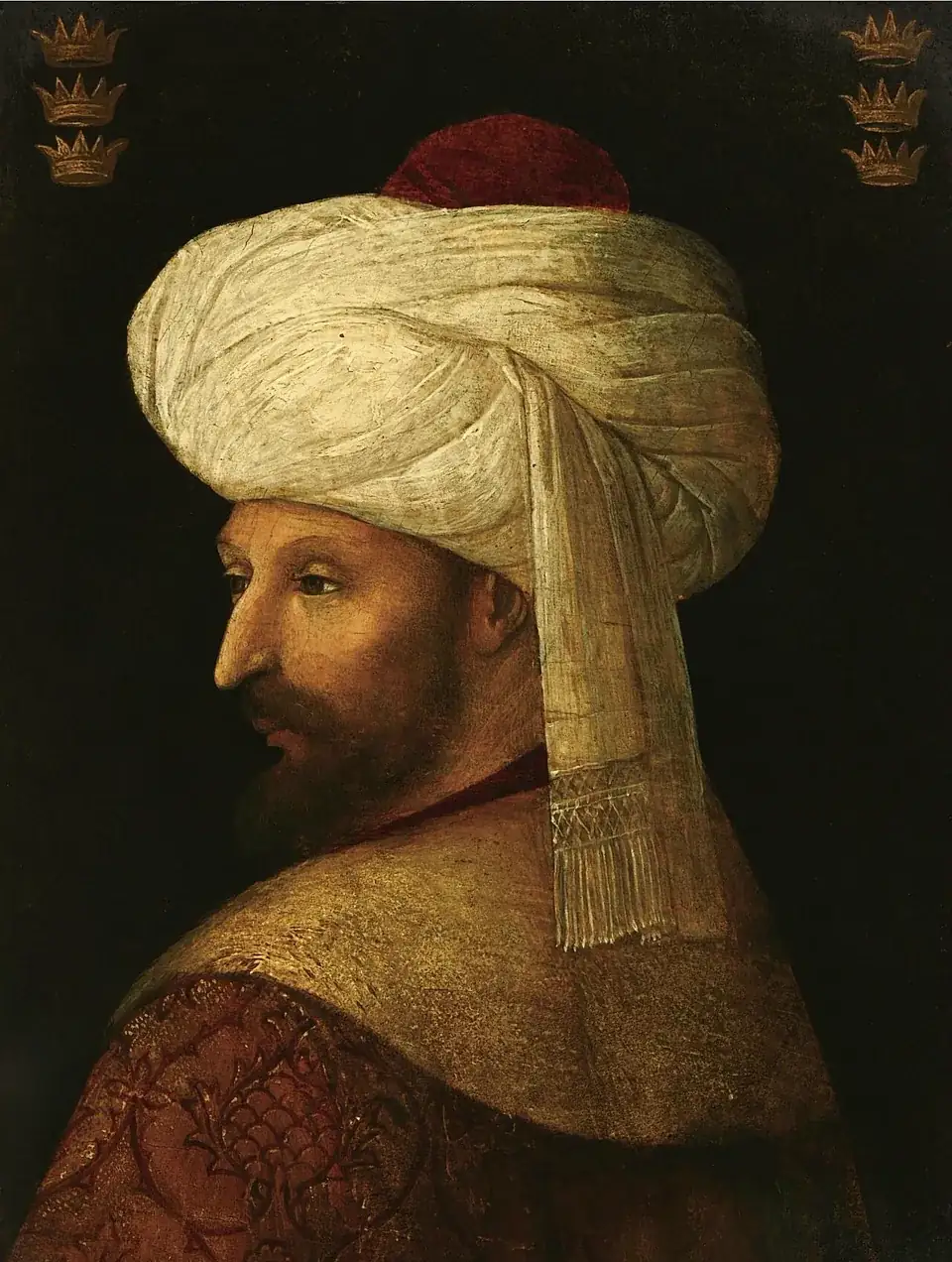
Profile portrait of Mehmed II.Follower of Gentile Bellini / Victoria and Albert Museum / Wikimedia Commons · Public domain · PD SourcesFall of Constantinople (1453) backgroundIstanbul: The Theodosian Land Walls background
- 06
1522: Rhodes
In June 1522 Süleyman I besieged Rhodes with 75,000 men and more than 300 ships. The Knights Hospitaller held the harbour and walls for months; Ottoman cannon breached a section, but English and German knights and the Venetian engineer Gabriel Tadino repeatedly stopped the attacks. On December 18 Grand Master Philippe Villiers de L'Isle-Adam surrendered; the knights went first to Crete and later to Malta, while the O…
In June 1522 Süleyman I besieged Rhodes with 75,000 men and more than 300 ships; on December 18 the Knights Hospitaller surrendered, went first to Crete and later to Malta. The Ottomans lost 25,000 men; the Hospitallers lost 3,000 of 7,500.
In June 1522 Süleyman I besieged Rhodes with 75,000 men and more than 300 ships. The Ottoman fleet blockaded the harbour and bombarded the town; this was not the first attempt, for the 1480 attack had failed, and Süleyman doubled the size of the fleet this time.
After several weeks cannon breached a section of the wall, and the Ottomans attacked an English contingent; English and German knights held them for a day. The Ottomans then tried mines under the walls, but these were defeated by the Venetian engineer Gabriel Tadino. Negotiations began in early December, broke down, and the bombardment resumed with greater ferocity.
Grand Master Philippe Villiers de L'Isle-Adam judged the situation hopeless and surrendered on December 18 to avoid civilian losses. Süleyman allowed the knights to leave with their banners and property and exempted Rhodes' inhabitants from taxes for five years; the knights were transported to Crete and later moved to Malta.
The cost was high: the Ottomans committed 75,000 men and lost 25,000; the Hospitallers lost 3,000 of 7,500. Rhodes brought the eastern Aegean's sea lanes, ports and taxes into the Ottoman network, and made Süleyman's navy a factor in Mediterranean politics.
Rhodes was the end of this line and the start of a new problem. The Ottomans now held a land empire from the Balkans to Arabia and had linked the straits to the eastern Mediterranean ports; what they had to maintain was no longer another conquest but the different religions and tax traditions that kept those places inside the machine.
Sources: 5 event claims, 4 sourced; source cards src-b7-rhodes-1522 (background only).
Cast
People whose choices move the story. Roles describe this story only.
- Osman IFrontier bey and founder of the dynasty
Led ghazi raids on the Bithynian frontier and by about 1300 controlled the area from Eskişehir to the plain of İznik.
- OrhanSultan, capital and institutions
Took Bursa and moved the capital there, minted the first silver coins in 1327 and reorganized the army, turning the principality into a more durable state.
- Bayezid ISultan and victor of Nicopolis
Crushed the international crusade at Nicopolis in 1396, was defeated by Timur at Ankara in 1402, and the empire entered an interregnum.
- Mehmed IISultan and conqueror of Constantinople
Captured Constantinople in 1453 and ended the Eastern Roman Empire; the city became the Ottoman capital only in 1457.
- Suleiman ISultan and conqueror of Rhodes
Took Rhodes in 1522 and brought the eastern Mediterranean's sea lanes and ports into the Ottoman network.
Evidence and limits
Chapter-level sources; key claims checked.
Source count is the number of distinct source records attached to the event nodes shown here. It does not certify the narrative as a whole.