
The Roman Empire: Frontier, Tax and Legitimacy
Story9–410: how an empire kept rebuilding itself in crisis
In 9 CE the Teutoburg Forest stopped Roman expansion east of the Rhine; in 80 the Colosseum opened; in 96 Domitian was assassinated and Nerva adopted Trajan; in 212 Caracalla granted citizenship to the empire's free inhabitants; after 235 the third-century crisis exposed army, tax and succession problems at once; in 313 the Milan agreement proclaimed religious toleration; in 410 Alaric sacked Rome. The seven chapters are not isolated rise-and-fall nodes but four accounts of one empire: frontier, finance, succession and legitimacy.
The empire ran on an expensive loop: legions guarded the frontier, taxes fed the legions, and citizenship and cities supplied legitimacy. After expansion stopped the loop could still work, but every succession crisis, currency debasement or frontier pressure made it more dependent on the army. The third-century crisis was not caused by 'barbarian invasion' alone; military monarchy, taxation, inflation and political instability reinforced one another. Diocletian and Constantine reorganised the empire through the tetrarchy, religious toleration and a new capital. The sack of Rome in 410 was a symbolic blow; the western empire ended only in 476, and the eastern empire lasted until 1453.
Chapter-level sources; key claims checked.
Chapter timeline
Chapters in reading orderAll anchors are approximate region-level placements; they are not precise sites. Chapters without coordinates are listed below by region only.
Chapter contents7 chapters
- The Battle of the Teutoburg Forest: Rome stops east of the Rhine
- The Colosseum opens: public entertainment and imperial finance
- Domitian is assassinated; Nerva adopts Trajan
- Caracalla grants Roman citizenship to the empire's free inhabitants
- The third-century crisis: armies, taxes and Diocletian's reorganisation
- The Milan agreement: religious toleration and Christian legal status
- Alaric sacks Rome: a symbolic blow, not the end of the empire
The story, chapter by chapter
Each chapter opens the underlying event- 01
The Battle of the Teutoburg Forest: Rome stops east of the Rhine
In the autumn of 9 CE Arminius and his Germanic followers ambushed Varus's three legions in the Teutoburg Forest; the fighting lasted four days and nearly 20,000 Romans were killed. Rome then stopped trying to conquer Germania east of the Rhine and garrisoned the frontier with at least eight legions. Augustus's grief is reported by Suetonius, a later biographer.
In autumn 9 CE Arminius ambushed Varus's three legions; four days of fighting killed nearly 20,000 Romans and Rome stopped trying to conquer Germania east of the Rhine.
In the autumn of 9 CE, Publius Quinctilius Varus marched three legions through the Teutoburg Forest and was led into an ambush by Arminius, a noble of the Cherusci. Varus was governor of Germania and commanded the 17th, 18th and 19th legions; Arminius had served in the Roman army and knew how Roman columns marched and were commanded.
The fighting lasted four days. The three legions were destroyed and nearly 20,000 Romans were killed, while German losses were minimal. The figure comes from ancient historians, not a battlefield count, but it is enough to show that Rome's garrison and administrative network east of the Rhine was broken in one stroke.
Tiberius then fought three more campaigns against the Germanic tribes, but chose not to occupy the land east of the Rhine and stationed at least eight legions on the frontier. The Rhine and Danube gradually became the empire's main defensive line. Teutoburg did not make Rome 'abandon Germania forever'; it made Rome give up the costly plan of turning the land east of the Rhine directly into a province.
Suetonius reports that Augustus went months without cutting his hair or beard and repeatedly cried, 'Varus, give me back my legions.' This is a court story from a later biography, not a contemporaneous record; it shows the weight of the defeat in Roman political memory, not a word-for-word scene.
Sources: 6 event claims, 5 sourced; source cards src-b7-teutoburg (background only).
- 02
The Colosseum opens: public entertainment and imperial finance
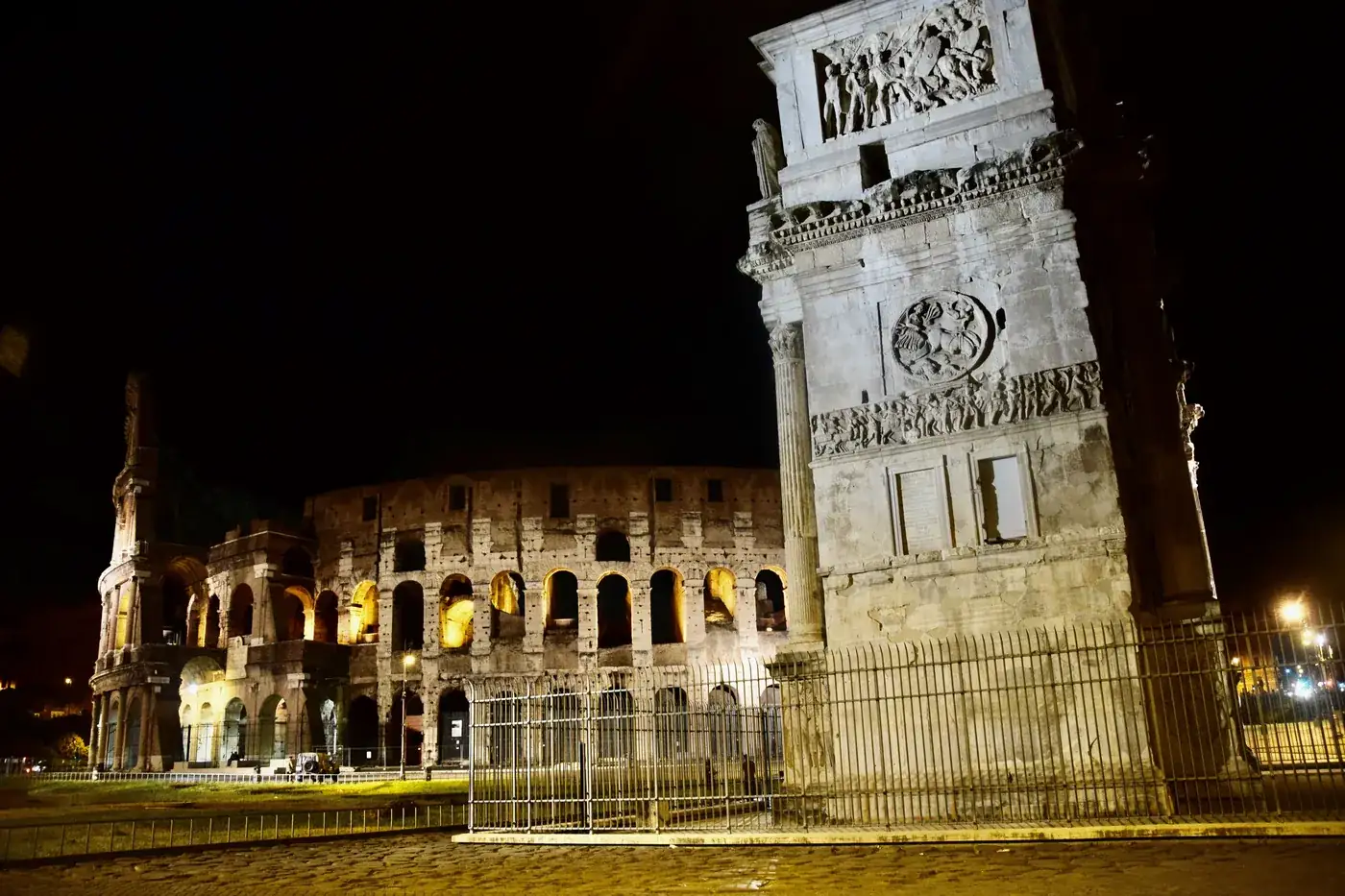
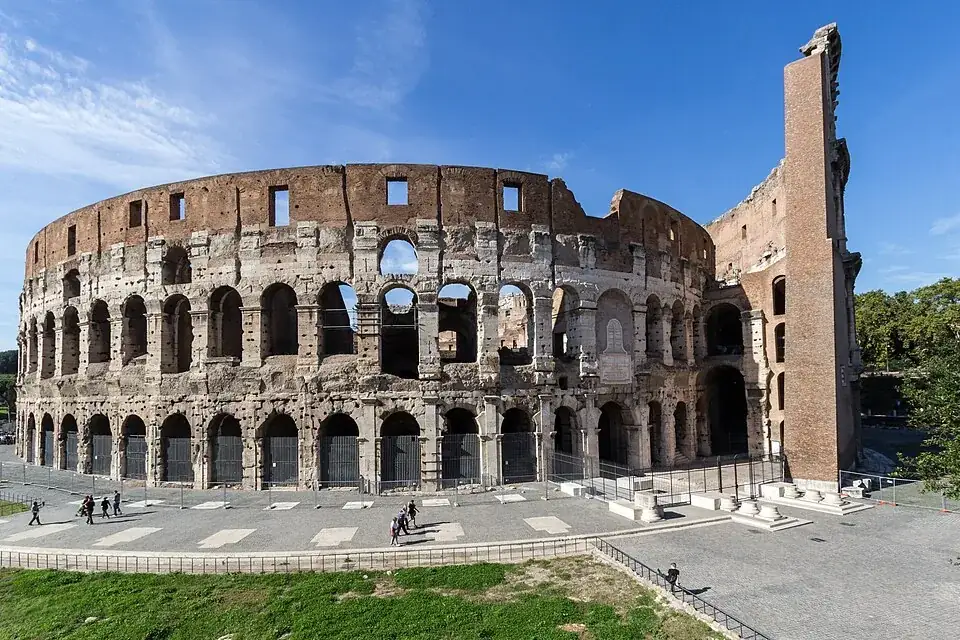
Construction of the Flavian Amphitheatre began under Vespasian in 70–72 CE; Titus dedicated it in 80 with 100 days of games, and Domitian added the fourth story in 82. About 189 by 156 metres and holding as many as 50,000 spectators, it was paid for with the spoils of Jerusalem in 70 and built by enslaved Jews from Judaea.
Vespasian began the Colosseum in 70–72, Titus dedicated it in 80 with 100 days of games, and Domitian added the fourth story in 82; it measured 189 by 156 metres and held as many as 50,000.
The Colosseum was begun by Vespasian in 70–72 CE, dedicated by Titus in 80 with 100 days of games, and given a fourth story by Domitian in 82. It measured about 189 by 156 metres and held 'as many as 50,000' spectators, not the 80,000 often repeated in older accounts.
Its funding came from the spoils of the Jewish War and the capture of Jerusalem in 70. Many of its builders were enslaved Jews from Judaea; the site was the artificial lake of Nero's Golden House, drained before construction. It was used for gladiatorial combat, wild-beast hunts and simulated sea battles, with awnings operated by sailors.
The Colosseum was not merely an 'entertainment building'. It was a stage on which the emperor displayed wealth, order and generosity. Seating was graded by social rank, admission was free, and the games were paid for by the emperor or officials. Public consumption let the population of Rome feel that the empire was still working, and turned imperial generosity into a visible political language.
But the building also fixed the empire's violence and inequality in stone: enslaved people, prisoners of war and animals died in the arena, and the audience sat in ranks. It proved that Rome could organise enormous projects, and that this capacity rested on conquest and slavery.
Sources: 5 event claims, 4 sourced; source cards src-b8-colosseum (background only).
The Colosseum.Dietmar Rabich / Wikimedia Commons / CC BY-SA 4.0 · CC-BY-SA-4.0 - 03
Domitian is assassinated; Nerva adopts Trajan
On September 18, 96 CE Domitian was killed in a palace conspiracy involving the praetorian prefects, court officials and the empress; the Senate welcomed Nerva as emperor. The guard forced Nerva to punish the assassins, and frontier commanders were discontented. In October 97 Nerva adopted Trajan, governor of Upper Germany; when Nerva died in January 98, Trajan was accepted by the armies and the Senate. Later writers…
Domitian was killed on 18 September 96; in October 97 Nerva adopted Trajan, governor of Upper Germany, and in January 98 Trajan was accepted by the armies and Senate. 'Five Good Emperors' is a later label, not a contemporary institution.
On 18 September 96 CE, Domitian was killed in a court conspiracy. The core participants were two praetorian prefects, court officials and the empress Domitia Longina; Nerva was probably privy to the plot. The Senate celebrated, the army was angry, and the next year it demanded punishment of the killers. This was not a rising of the whole Senate but a change of power inside the court.
Nerva was old and had no son, so he had to find someone acceptable to both the army and the Senate. In October 97 he adopted Trajan, governor of Upper Germany; on 1 January 98 Trajan became his colleague in the consulship, and on 27 or 28 January Nerva died. Trajan was accepted by the armies and the Senate.
The 'Five Good Emperors' is a later label for Nerva, Trajan, Hadrian, Antoninus Pius and Marcus Aurelius, not a written institution of the time. Adoption was not a stable rule either: it required a predecessor with judgment, an army that did not object, and an heir with military prestige and reputation. All three had to hold at once.
The significance of this succession was that the empire found a solution not based on blood, but on acceptance by army and Senate. At the same time it exposed the fact that both the praetorians and the frontier legions could veto an heir; every later vacancy was a negotiation between army and court.
Sources: 7 event claims, 6 sourced; source cards src-b7-domitian-nerva, src-b8-nerva-trajan (background only).
SourcesDomitian (emperor 81–96 CE) backgroundTrajan and Nerva's adoption (97 CE) background
- 04
Caracalla grants Roman citizenship to the empire's free inhabitants
In 212 CE Caracalla issued the Constitutio Antoniniana, granting Roman citizenship to all free inhabitants of the empire. Citizenship had already been extended gradually; the edict made it universal. Ancient sources accuse Caracalla of acting only to raise taxes, while modern scholarship treats revenue as one possible motive. The edict changed the boundaries of imperial status and law, but did not make everyone equal…
In 212 the Constitutio Antoniniana granted citizenship to all free inhabitants; citizenship had already spread gradually and the edict made it universal. Ancient sources accuse Caracalla of seeking only taxes; modern scholarship treats revenue as one possible motive.
In 212 CE the emperor Caracalla issued the Constitutio Antoniniana, granting Roman citizenship to all free inhabitants of the empire. Citizenship had already spread gradually through service, manumission and grants to civic elites; the edict universalised the status rather than inventing it.
Ancient sources accuse Caracalla of acting only to raise taxes, since citizens owed inheritance taxes and other obligations; modern scholarship treats a broader tax base as one possible motive. The edict also concerned legal status, marriage, inheritance and civic standing, and cannot be reduced to 'the emperor needed money'.
Nor did 'all free men and women' immediately receive identical rights. The practical position of women, local elites and poorer free inhabitants still differed; a change in legal status did not make social reality equal overnight.
For the empire, universal citizenship brought more people into one legal and fiscal system and thinned the boundary between 'Roman' and 'provincial'. The political value of citizenship did not vanish at once, but its role as a scarce honour did decline.
Sources: 5 event claims, 4 sourced; source cards src-b8-caracalla-edict (background only).
SourcesCaracalla and the Constitutio Antoniniana (212 CE) background
- 05
The third-century crisis: armies, taxes and Diocletian's reorganisation
Early in 235 soldiers killed Severus Alexander and his mother and proclaimed Maximinus; the following half-century was filled with civil war, usurpation and frontier pressure. The crisis had no single cause: military monarchy, taxation, inflation, disrupted commerce and extortion by troops reinforced one another. Diocletian came to power in 284 and rebuilt the administration through the tetrarchy; by 308 seven men we…
Early in 235 soldiers killed Severus Alexander; half a century of civil war, usurpation and frontier pressure followed. Diocletian rebuilt the administration through the tetrarchy in 284, but by 308 seven men were again competing for 'Augustus'.
Early in 235 CE, soldiers killed Severus Alexander and his mother and proclaimed Maximinus. For half a century, usurpation, civil war, frontier invasion, disrupted trade, heavy taxation, currency debasement and garrison extortion reinforced one another. Severus had already made Rome a military monarchy in 193; 235 simply brought the logic of army-made emperors to the surface.
The crisis was not caused by 'barbarian invasion' alone. Legions needed pay, emperors needed army support, cities needed food and security; when taxes fell short, money debased and frontiers tightened at the same time, pressure in any one part was passed to the other two. The old draft's '26 emperors' and '5% silver' are oversimplified figures and are removed here.
In 284 Diocletian took power and used the tetrarchy to divide the empire between two Augusti and two Caesars, sharing frontiers and administration. In 308 seven men were again competing for the title of Augustus; the tetrarchy did not abolish succession rivalry, it packed it into a more elaborate system.
Diocletian's reorganisation improved administration but also increased taxation and control over persons. The crisis was not 'solved'; the empire learned to keep running with a more expensive machine. Constantine later rebuilt that machine, and it lasted longer in the east.
Account Income and resources Pressure Key nodes Frontier Legions on the Rhine–Danube, spoils and provincial taxes Garrison costs, multiple frontiers, armies making emperors 9 Teutoburg; 235 Severus Alexander killed Finance Taxes, spoils, public works, coinage Army pay, debasement, urban consumption and heavy taxation 70 Jerusalem spoils build the Colosseum; third-century inflation Succession Blood, adoption, army proclamation No sons, praetorians, frontier legions vetoing heirs 96 Domitian killed; 97 Nerva adopts Trajan Legitimacy Senate, citizenship, religion Universal citizenship, rise of Christianity, traditional cult 212 Caracalla edict; 313 Milan agreement Table: the four accounts fed one another and also dragged one another down. The frontier needed money, finance needed taxes, succession needed the army, and legitimacy needed a story acceptable to different groups.
Sources: 6 event claims, 4 sourced; source cards src-b8-severus-alexander, src-b8-third-century-crisis (background only).
SourcesSeverus Alexander (emperor 222–235 CE) backgroundThe Crisis of the Third Century and Diocletian's reforms background
- 06
The Milan agreement: religious toleration and Christian legal status
In February 313 Constantine and Licinius met at Milan and concluded a political agreement of religious toleration; the surviving copies are Licinius's June letter to the eastern provinces. The agreement granted all persons freedom of worship, assured Christians the right to organise churches and recover property, and ended systematic persecution, but did not make Christianity the state religion.
In February 313 Constantine and Licinius concluded an agreement of religious toleration at Milan; Christians gained the right to organise churches and recover property, and systematic persecution ended. It did not make Christianity the state religion; that came under Theodosius I in 381.
In February 313 CE, Constantine and Licinius reached a political agreement at Milan: the empire allowed religious freedom, Christians could organise churches and recover confiscated property, and systematic persecution ended. The most important surviving text is not an original 'Edict of Milan' but a copy of Licinius's letter to the eastern provinces in June of that year.
The agreement did not make Christianity the state religion. It settled whether the empire would allow Christianity to exist, not whether Christianity would become the only official faith. State-religion status came under Theodosius I in 381; traditional Roman cults were not banned in 313 either.
In 325 Constantine convened the Council of Nicaea to address the Arian dispute; in 330 he founded Constantinople and moved the empire's centre east. Toleration and the emperor's convening of a council were two different things: the first stopped persecution, the second was an attempt to define orthodoxy.
The significance of Milan is that the empire accepted the coexistence of multiple cults. It did not make all religions equal, nor did it give Christianity immediate political privilege; but it changed the relationship between the imperial state and religious organisation and left a path to later state-church policy.
Sources: 6 event claims, 4 sourced; source cards src-b8-edict-milan (background only).
- 07
Alaric sacks Rome: a symbolic blow, not the end of the empire
In 402 the Western Roman capital moved to Ravenna; Alaric besieged Rome in 408, 409 and 410. On the night of August 24, 410, unknown persons opened the gates and the Visigoths plundered for three days, but respected ordinary inhabitants and destroyed only a few public buildings. It was the first foreign capture of Rome in nearly 800 years; Alaric died soon afterwards and the Visigoths moved on to Spain.
In 402 the western capital moved to Ravenna; Alaric besieged Rome in 408, 409 and 410. On the night of 24 August 410 the gates were opened and the Visigoths plundered for three days, respecting ordinary inhabitants and destroying only a few public buildings; it was Rome's first foreign capture in nearly 800 years.
In 402 the western capital moved from Milan to Ravenna, protected by marshes and fortifications. In 408, 409 and 410 the Visigothic leader Alaric besieged Rome three times; on the night of 24 August 410 the gates were opened from inside by persons never identified, and the Visigoths entered.
The sack lasted three days. The army took treasure from the treasury and the palace but showed relative respect for ordinary inhabitants and destroyed only a few public buildings. There is no reliable count of losses; the exaggerated descriptions of ancient historians cannot be treated as an inventory. It was the first foreign capture of Rome in nearly 800 years, and the symbolic shock was far greater than the material damage.
Alaric died soon afterwards, and the Visigoths moved toward Spain. Augustine began The City of God in 413 in response to the charge that Rome had fallen because it abandoned the old gods. The western empire did not end in 410; it ended in 476, and the eastern empire lasted until 1453.
410 was not 'the whole city burned', nor the single drama of 'barbarian slaves opening the Salarian Gate'. What it exposed was the western empire's inability to control its own army and frontier: the emperor was at Ravenna, the army was commanded by barbarian generals, and taxation and government were reduced to part of Italy.
Put 410 back into the four accounts and it is a legitimacy crisis: the city that stood for the empire had been breached, the claim that the old gods protected Rome was challenged, and Christian apologists had to answer. But frontier, finance and succession had been hollowing out the western empire long before 410; the sack only made everyone see the result.
Sources: 6 event claims, 5 sourced; source cards src-b8-alaric, src-b8-sack-rome-410 (background only).
An ancient triumphal arch in Rome.Ank Kumar / Wikimedia Commons · CC BY-SA 4.0 · CC-BY-SA-4.0 SourcesAlaric and the Visigoths backgroundSack of Rome (410 CE) background
Cast
People whose choices move the story. Roles describe this story only.
- AugustusFirst Roman emperor
Created the principate and rebuilt imperial order through army, finance and religion; accepted the Rhine frontier after Teutoburg.
- ArminiusCherusci noble and architect of Teutoburg
Led Varus's three legions into an ambush and stopped Rome from making a province east of the Rhine.
- CaracallaIssuer of the 212 citizenship edict
Granted Roman citizenship to all free inhabitants, changing the boundaries of imperial status and law.
- Constantine IPromoter of toleration and founder of a new capital
Reached the Milan agreement with Licinius in 313, convened Nicaea in 325 and founded Constantinople in 330.
- AlaricVisigothic leader and sack of Rome in 410
Besieged Rome three times and plundered it for three days in 410; died soon afterwards as the Visigoths moved toward Spain.
Evidence and limits
Chapter-level sources; key claims checked.
Source count is the number of distinct source records attached to the event nodes shown here. It does not certify the narrative as a whole.