
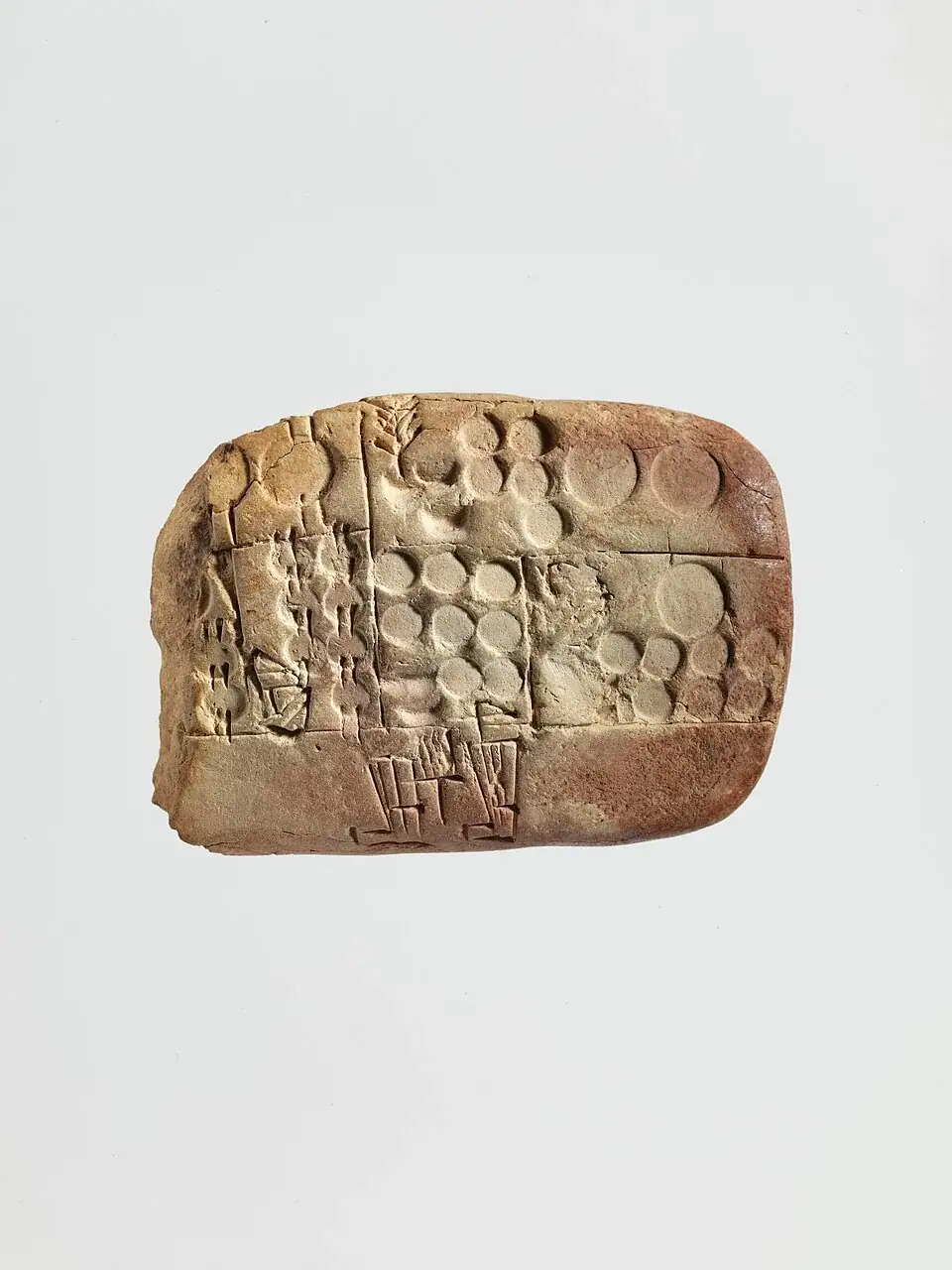
Around 3200 BCE, Uruk produced administrative records written in proto-cuneiform.1 The signs on the tablets began as tokens and pictographs, used to register livestock, commodities and workers; one Uruk III tablet is thought to be a list of slaves' names.2 Later, many pictographs lost their original pictorial function, the sign inventory fell from about 1,500 to about 600, and writing became increasingly phonological.3 Writing's first job was accounting, not poetry: it allowed goods, labour and names to be checked across time.
Evidence ledger
3 claims3 sourced0 unsourced
Every hard fact in the narrative above is registered here. A claim may also record source-only details that the narrative does not repeat; the related-narrative line points to the corresponding passage, not a guarantee that the source supports every word of the body. A claim without a source stays visibly unsourced.
Around 3200 BCE, Uruk produced administrative records written in proto-cuneiform.
Related narrativeAround 3200 BCE, Uruk produced administrative records written in proto-cuneiform.
- Cuneiform — WikipediaWikipedia, "Cuneiform", section on proto-cuneiform
The first unequivocal written documents start with the Uruk IV period, from c. 3300 BC, followed by tablets found in Uruk III.
Accessed 2026-11-26 · machine excerpt · pending human review
L2: machine-extracted from the Wikipedia lead/full article and compared with the prose; not promoted to L3.
- Cuneiform — WikipediaWikipedia, "Cuneiform", section on proto-cuneiform
The signs on the tablets began as tokens and pictographs, used to register livestock, commodities and workers; one Uruk III tablet is thought to be a list of slaves' names.
Related narrativeThe signs on the tablets began as tokens and pictographs, used to register livestock, commodities and workers; one Uruk III tablet is thought to be a list of slaves' names.
- Cuneiform — WikipediaWikipedia, "Cuneiform", sections on proto-cuneiform and Uruk III tablets
Writing began after pottery was invented, during the Neolithic when clay tokens were used to record specific amounts of livestock or commodities. A tablet with proto-cuneiform pictographic characters, end of 4th millennium BC, Uruk III. This is thought to be a list of slaves' names, the hand in the upper left corner representing the owner.
Accessed 2026-11-26 · machine excerpt · pending human review
L2: machine-extracted from the Wikipedia lead/full article and compared with the prose; not promoted to L3.
- Cuneiform — WikipediaWikipedia, "Cuneiform", sections on proto-cuneiform and Uruk III tablets
Later, many pictographs lost their original pictorial function, the sign inventory fell from about 1,500 to about 600, and writing became increasingly phonological.
Related narrativeLater, many pictographs lost their original pictorial function, the sign inventory fell from about 1,500 to about 600, and writing became increasingly phonological.
- Cuneiform — WikipediaWikipedia, "Cuneiform", section on the development of signs
Many pictographs began to lose their original function, and a given sign could have various meanings depending on context. The sign inventory was reduced from some 1,500 signs to some 600 signs, and writing became increasingly phonological.
Accessed 2026-11-26 · machine excerpt · pending human review
L2: machine-extracted from the Wikipedia lead/full article and compared with the prose; not promoted to L3.
- Cuneiform — WikipediaWikipedia, "Cuneiform", section on the development of signs
Sources and review
Key claims rely on a single source record
- Cuneiform — Wikipedia · Wikipedia contributors · Wikipedia lead and full article (accessed 2026-11-26) Original source ↗
L2 claims and source binding
L2 machine extraction plus manual comparison; no L3 two-source human confirmation.
Locations
- Sumer· 31.3, 45.6· Approximate
evt-8589612b5c846610Source file:
events/evt-8589612b5c846610/event.md