
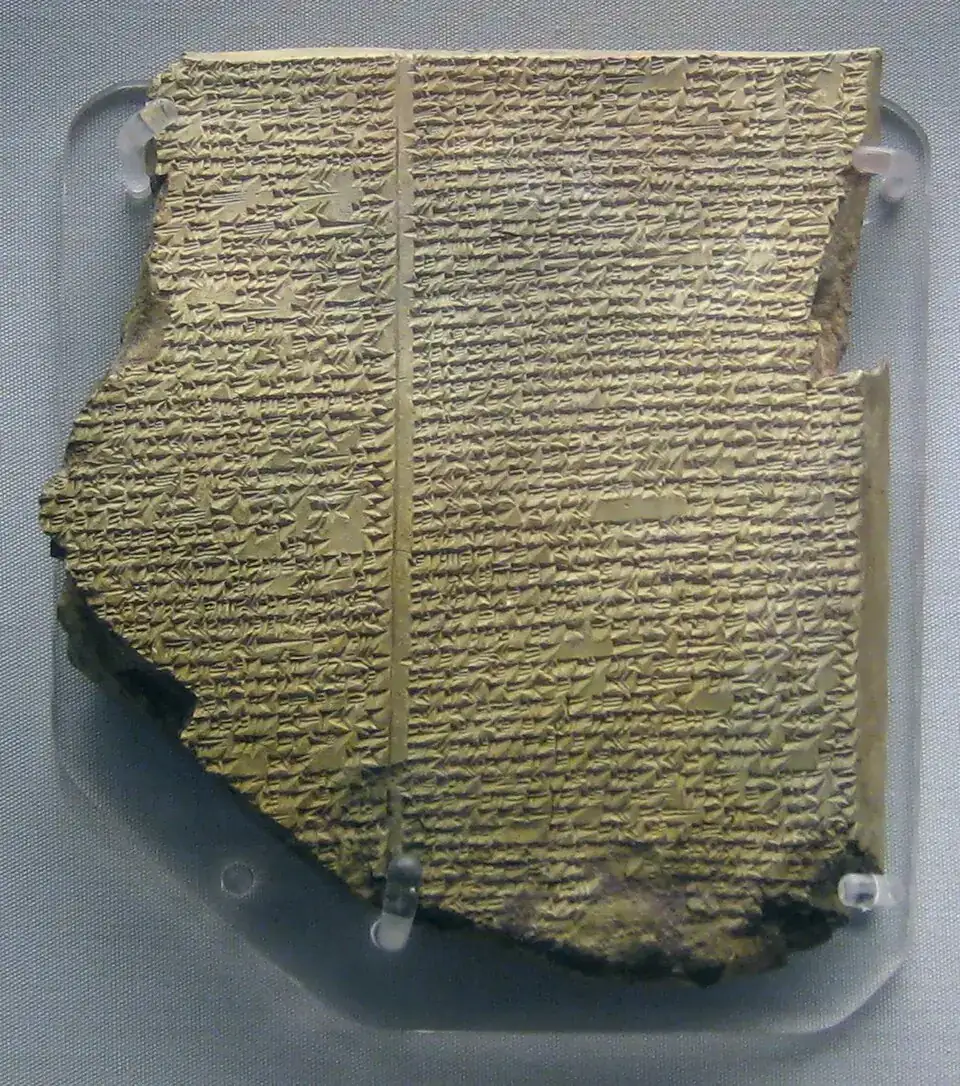
Tradition holds that Gilgamesh may have been a king of Uruk around 2700 BCE.1 Later stories and epics made him a hero; his historical reign cannot be confirmed by direct contemporary documents.2 The Sumerian King List names him as a king of Uruk.3 Inscriptions credit him with building the city’s walls.4
The epic weaves a city ruler’s adventures with his companion, the fear of death and the search for immortality; its flood narrative and wisdom theme recur in later literature.5 The king’s image sits between tyrant and hero, and the work therefore also examines the relationship between power and civilization.6 Because the earliest surviving poems about him were written centuries after his reign, the line between the historical ruler and the legendary hero remains impossible to draw with certainty.7
Evidence ledger
7 claims7 sourced0 unsourced
Every hard fact in the narrative above is registered here. A claim may also record source-only details that the narrative does not repeat; the related-narrative line points to the corresponding passage, not a guarantee that the source supports every word of the body. A claim without a source stays visibly unsourced.
Tradition holds that Gilgamesh may have been a king of Uruk around 2700 BCE.
Related narrativeTradition holds that Gilgamesh may have been a king of Uruk around 2700 BCE.
- Uruk — WikipediaWikipedia, "Uruk", full article, evidence sentence 15
In the Epic of Gilgamesh, Gilgamesh builds the city wall around Uruk and is king of the city.
Accessed 2026-11-26 · machine excerpt · pending human review
L2: machine-extracted from the Wikipedia lead/full article and compared with the prose; not promoted to L3.
- Uruk — WikipediaWikipedia, "Uruk", full article, evidence sentence 15
Later stories and epics made him a hero; his historical reign cannot be confirmed by direct contemporary documents.
Related narrativeLater stories and epics made him a hero; his historical reign cannot be confirmed by direct contemporary documents.
- Sargon of Akkad — WikipediaWikipedia, "Sargon of Akkad", full article, evidence sentence 69
While various copies of the Sumerian king list and later Babylonian chronicles credit Sargon with a reign length ranging from 34 to 56 years, dated documents have been found for only four different year-names of his actual reign.
Accessed 2026-11-26 · machine excerpt · pending human review
L2: machine-extracted from the Wikipedia lead/full article and compared with the prose; not promoted to L3.
- Sargon of Akkad — WikipediaWikipedia, "Sargon of Akkad", full article, evidence sentence 69
The Sumerian King List names him as a king of Uruk.
Related narrativeThe Sumerian King List names him as a king of Uruk.
- Uruk — WikipediaWikipedia, "Uruk", full article, evidence sentence 5
Gilgamesh, according to the chronology presented in the Sumerian King List (SKL), ruled Uruk in the 27th century BC.
Accessed 2026-11-26 · machine excerpt · pending human review
L2: machine-extracted from the Wikipedia lead/full article and compared with the prose; not promoted to L3.
- Uruk — WikipediaWikipedia, "Uruk", full article, evidence sentence 5
Inscriptions credit him with building the city’s walls.
Related narrativeInscriptions credit him with building the city’s walls.
- Sargon of Akkad — WikipediaWikipedia, "Sargon of Akkad", full article, evidence sentence 25
On the other hand, if Sargon had borne the same name since birth, then the “King” referred to in the name would refer to the ruler who reigned at the time of his birth, seeking to bestow his blessing upon him.
Accessed 2026-11-26 · machine excerpt · pending human review
L2: machine-extracted from the Wikipedia lead/full article and compared with the prose; not promoted to L3.
- Sargon of Akkad — WikipediaWikipedia, "Sargon of Akkad", full article, evidence sentence 25
The epic weaves a city ruler’s adventures with his companion, the fear of death and the search for immortality; its flood narrative and wisdom theme recur in later literature.
Related narrativeThe epic weaves a city ruler’s adventures with his companion, the fear of death and the search for immortality; its flood narrative and wisdom theme recur in later literature.
- Sargon of Akkad — WikipediaWikipedia, "Sargon of Akkad", full article, evidence sentence 69
While various copies of the Sumerian king list and later Babylonian chronicles credit Sargon with a reign length ranging from 34 to 56 years, dated documents have been found for only four different year-names of his actual reign.
Accessed 2026-11-26 · machine excerpt · pending human review
L2: machine-extracted from the Wikipedia lead/full article and compared with the prose; not promoted to L3.
- Sargon of Akkad — WikipediaWikipedia, "Sargon of Akkad", full article, evidence sentence 69
The king’s image sits between tyrant and hero, and the work therefore also examines the relationship between power and civilization.
Related narrativeThe king’s image sits between tyrant and hero, and the work therefore also examines the relationship between power and civilization.
- Sargon of Akkad — WikipediaWikipedia, "Sargon of Akkad", full article, evidence sentence 140
The themes addressed also relegated acts of piety toward the gods to the background, focusing instead on military conquests: "the rise of a newcomer from the north facilitated the emergence of a new ideology of kingship, changing the image of the king from that of a cultic and administrative official to that of a war hero."
Accessed 2026-11-26 · machine excerpt · pending human review
L2: machine-extracted from the Wikipedia lead/full article and compared with the prose; not promoted to L3.
- Sargon of Akkad — WikipediaWikipedia, "Sargon of Akkad", full article, evidence sentence 140
Because the earliest surviving poems about him were written centuries after his reign, the line between the historical ruler and the legendary hero remains impossible to draw with certainty.
Related narrativeBecause the earliest surviving poems about him were written centuries after his reign, the line between the historical ruler and the legendary hero remains impossible to draw with certainty.
- Sargon of Akkad — WikipediaWikipedia, "Sargon of Akkad", full article, evidence sentence 5
The literary texts written after Sargon’s death with the aim of glorifying him undoubtedly contain a core of historical truth, but it is difficult to separate fact from fiction.
Accessed 2026-11-26 · machine excerpt · pending human review
L2: machine-extracted from the Wikipedia lead/full article and compared with the prose; not promoted to L3.
- Sargon of Akkad — WikipediaWikipedia, "Sargon of Akkad", full article, evidence sentence 5
Sources and review
- Uruk — Wikipedia · Wikipedia contributors · Wikipedia lead and full article (accessed 2026-11-26) Original source ↗
- Sargon of Akkad — Wikipedia · Wikipedia contributors · Wikipedia lead and full article (accessed 2026-11-26) Original source ↗
L2 claims and source binding
L2 machine extraction plus manual comparison; no L3 two-source human confirmation.
Locations
- Sumer· 31.32, 45.64· Approximate
evt-33075eb5003eff0cSource file:
events/evt-33075eb5003eff0c/event.md