
The Roman Republic: Law, Legions and Dictatorship
Story509–27 BCE: how a system of shared power became the principate
In 509 BCE the Romans expelled their king and replaced royal power with two annually elected consuls; in 451–450 the Twelve Tables turned rules into public text; in 264–241 the First Punic War pulled the Republic into the Mediterranean; in 202 Scipio defeated Hannibal at Zama; around 107 Marius began recruiting the landless; in 44 Caesar was assassinated; in 27 Octavian concentrated real power as Augustus and princeps. The seven chapters are not seven great men but four structures: magistracies, public law, war finance and army loyalty.
The Roman Republic was not a modern democracy. It was an oligarchic system of Senate, consuls and popular assemblies, with citizenship limited to part of the population. Expansion brought tax, slaves and land, and also long-serving professional legions; when armies could decide who held power in Rome, the Senate lost its final arbiter. Caesar was not a sudden exception but the result of long accumulation in that structure; Augustus kept the republican shell and concentrated real power in one man.
Chapter-level sources; key claims checked.
Chapter timeline
Chapters in reading orderAll anchors are approximate region-level placements; they are not precise sites. Chapters without coordinates are listed below by region only.
Chapter contents7 chapters
The story, chapter by chapter
Each chapter opens the underlying event- 01
509 BCE: two consuls
Traditional chronology dates the Roman Republic to 509 BCE, when the Romans expelled their last king and replaced royal power with two annually elected consuls. The date comes from later historians, not contemporary records; the early Republic is also the least documented period of Roman history.
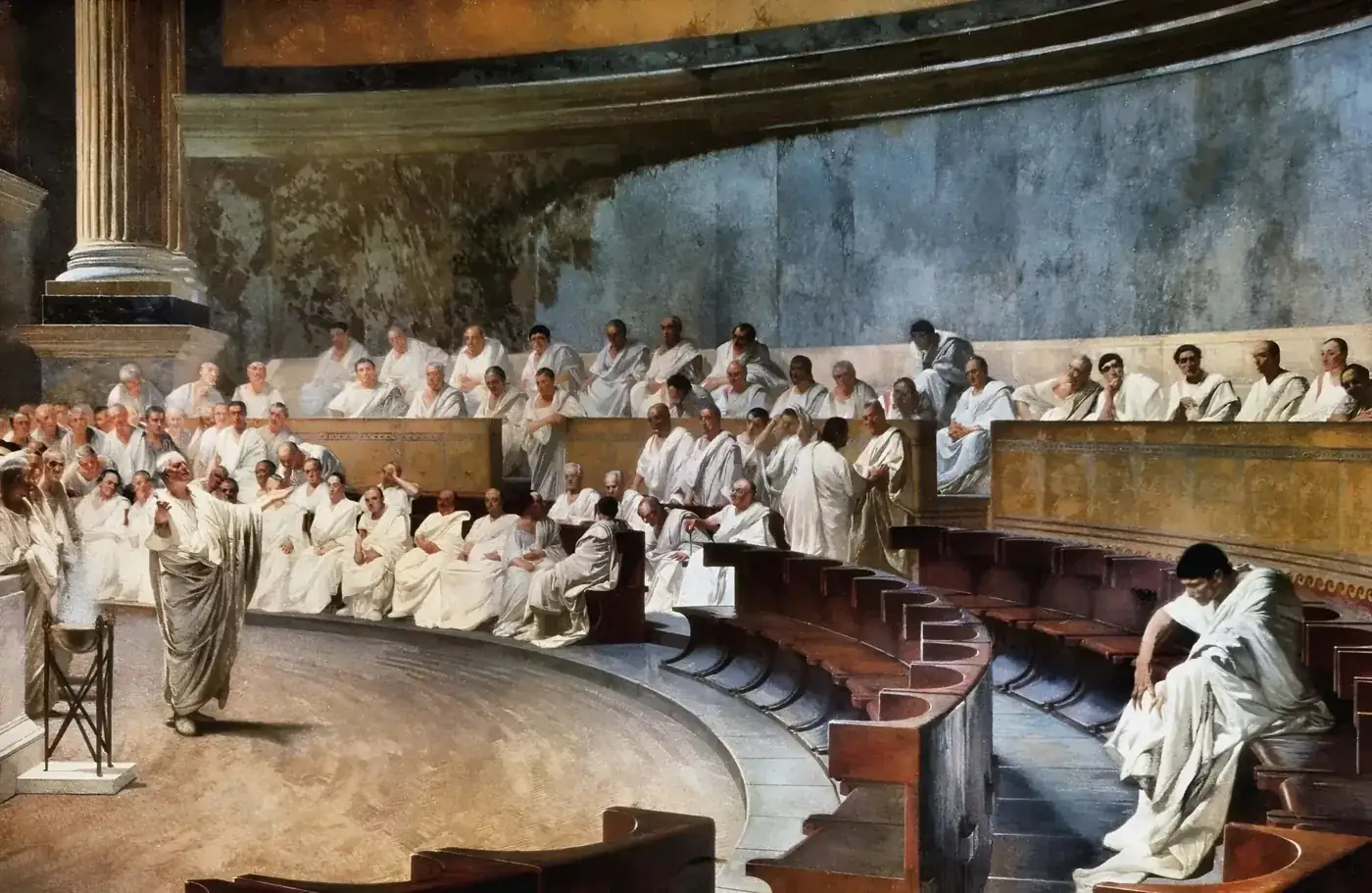
Traditional chronology dates the Republic to 509 BCE; the two consuls were primarily generals, and a dictator could replace them in a military emergency but for no more than six months. The Senate was advisory in theory but powerful through collective prestige; the centuriate and tribal assemblies handled war, elections, legislation and major trials.
Traditional chronology dates the Roman Republic to 509 BCE, when the Romans expelled their last king, Tarquinius Superbus, and replaced royal power with two annually elected consuls. The date comes from later historians, not from a day-by-day contemporary record.
The two consuls were primarily generals responsible for leading Rome's armies; in a military emergency that demanded unified command, the Senate and consuls could appoint a dictator in their place, but his supreme military command could not last longer than six months.
The Senate was in theory only an advisory body, yet in practice it wielded enormous power through the collective prestige of its members. The popular assemblies were divided between the centuriate assembly, which voted on war and peace and elected magistrates with military command, and the tribal assembly, which did most of the legislating and sat as a court for serious public offenses.
The Republic's key was therefore not 'rule by the people' but an oligarchic system that combined annual terms, paired magistrates, senatorial prestige and assembly votes. It prevented the return of kingship, but it did not close the power gap between patricians and plebeians.
Sources: 7 event claims, 5 sourced; source cards src-b8-roman-republic-government (background only).
A Senate debate in a historical painting.Cesare Maccari / Wikimedia Commons · Public domain · PD SourcesRoman Republic: early government and magistracies background
- 02
451–450 BCE: the Twelve Tables
Tradition places the Twelve Tables in 451–450 BCE: a first board drafted ten tables, a second added two, and the code was posted in the Roman Forum, likely on bronze tablets. It publicized the rules but also confirmed patriarchy, debt bondage and patrician privilege.
The first board of ten drafted ten tables in 451, a second board added two, and the code was posted in the Roman Forum, likely on bronze tablets. It publicized the rules but also confirmed patriarchy, debt bondage and patrician privilege; the original text does not survive intact.
Tradition places the making of the Twelve Tables in 451–450 BCE: a first board of ten commissioners drafted ten tables, a second board added two more, and the code was then posted in the Roman Forum, likely on bronze tablets. The original text does not survive intact; today it is reconstructed from quotations in later legal writings.
The immediate effect of a written code was to let plebeians know the rules and use them against arbitrary interpretation by patrician officials. Before that, judgments rested on unwritten custom preserved by a small group of learned patricians.
But the Twelve Tables were not a liberalizing reform. They recognized the prerogatives of the patrician class and the patriarchal family, allowed enslavement for unpaid debt, and let religious custom enter civil cases.
The code later came to be seen as a foundation of Roman private law, but it was not a modern bill of rights. It wrote the rules down and also wrote inequality into the rules.
Sources: 6 event claims, 5 sourced; source cards src-b8-twelve-tables (background only).
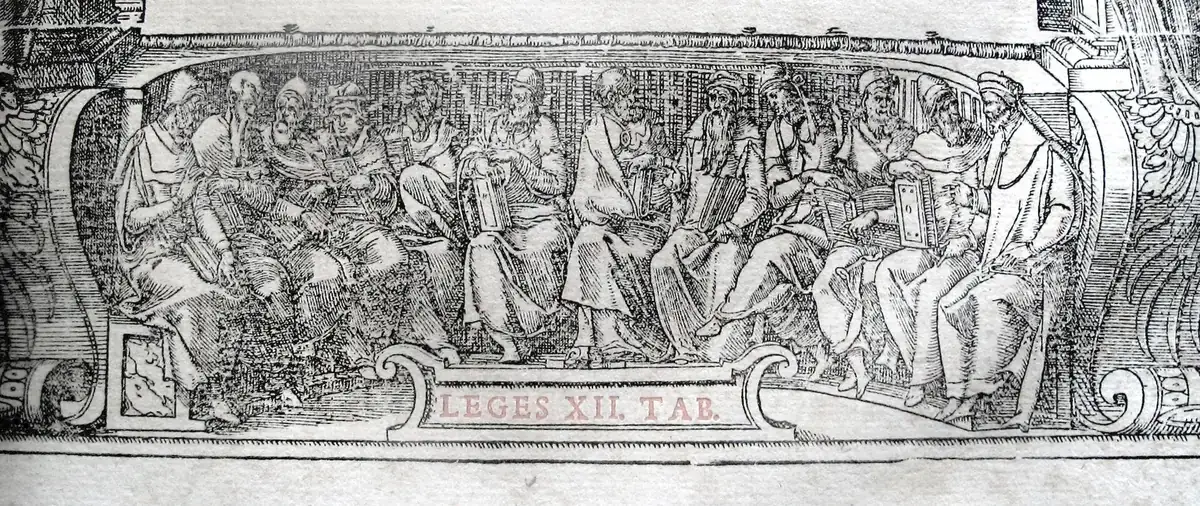
Twelve Tables.Sebastian Sapia, 1555 · Wikimedia Commons · Public Domain · PD - 03
264–241 BCE: the First Punic War
In 264 BCE Carthage intervened in the Messana-Syracuse dispute and established a presence in Sicily; Rome attacked Messana, and the First Punic War began. The war ran to 241, when Roman naval power and a fleet of 200 warships forced Carthage to cede Sicily and the Lipari Islands and pay an indemnity.
In 264 Carthage intervened in the Messana-Syracuse dispute and established a presence on the island; Rome attacked Messana and war broke out. The war was a long stalemate until 241, when a fleet of 200 warships gave Rome control of the sea and Carthage ceded Sicily and the Lipari Islands and paid an indemnity.
The First Punic War ran from 264 to 241 BCE and was the first great war between the Roman Republic and Carthage for control of Corsica and Sicily. In 264 Carthage intervened in a dispute between Messana and Syracuse and established a presence on the island; Rome then attacked Messana and forced the Carthaginians to withdraw.
The war was not quick. In 260 a Roman fleet failed to gain complete control of Sicily but opened the road to Corsica; in 256 a second fleet landed in Africa, but in 255 a new Carthaginian army built around cavalry and elephants drove the invaders back to the sea.
The fighting in Sicily resumed in 254 and remained largely stalemated until 241, when a fleet of 200 warships gave Rome control of the sea-lanes and the Carthaginian stronghold in Sicily collapsed. Carthage surrendered the next year, ceding Sicily and the Lipari Islands and agreeing to pay an indemnity.
Rome now had to maintain a fleet, overseas garrisons and a tax machine over the long term; the republic of 'temporary levies' began to be remade by war.
Sources: 5 event claims, 4 sourced; source cards src-b8-first-punic-war (background only).
SourcesFirst Punic War background
- 04
202 BCE: Zama
In 202 BCE Scipio Africanus defeated Hannibal at Zama. Hannibal had about 37,000 troops and 80 elephants; Scipio had about 40,000 and 6,100 cavalry. Some 20,000 Carthaginians were killed and about 20,000 captured, while Rome lost about 1,500; Carthage then ceded Spain, surrendered its warships and accepted a 50-year indemnity.
In 202 Scipio Africanus defeated Hannibal at Zama; ancient sources already differed on the site, and modern scholars have never fixed it. Hannibal had about 37,000 troops and 80 elephants; Scipio had about 40,000 and 6,100 cavalry. Some 20,000 Carthaginians were killed and about 20,000 captured, while Rome lost about 1,500; Carthage then ceded Spain, surrendered its warships and accepted a 50-year indemnity.
In 202 BCE Scipio Africanus and Hannibal met at Zama. This was the decisive battle of the Second Punic War; ancient sources differ on the site, and modern scholars have never precisely identified it.
Hannibal returned from Italy with 12,000 veterans and gathered about 37,000 troops in Africa; Scipio had about 40,000, including 6,100 cavalry commanded by the Numidian king Masinissa and the Roman general Gaius Laelius. Hannibal had only about 4,000 cavalry and 80 poorly trained war elephants.
Scipio arranged his infantry in maniples with broad gaps; when the elephants charged, the soldiers opened lanes and most of the animals passed through without decisive effect. After the Roman cavalry routed the Carthaginian cavalry, Masinissa's Numidian horsemen swung back and attacked Hannibal's veterans from the rear.
Some 20,000 Carthaginians were killed and perhaps 20,000 captured, while the Romans lost about 1,500 dead. After the battle Carthage ceded Spain, surrendered its warships and accepted a 50-year indemnity. Rome became the unchallenged power of the western Mediterranean, but the victory also brought slaves, bullion and provinces back to Italy.
Sources: 7 event claims, 6 sourced; source cards src-b8-zama (background only).
- 05
108–107 BCE: Marius recruits the landless
Traditional accounts treat 107 BCE as the starting point of the Marian reform. Elected consul at the end of 108 and taking office in 107, Marius recruited landless volunteers because the Numidian war lacked manpower; this broke the property-owner tradition and pushed the legion toward professionalization.
Traditional accounts treat 107 BCE as the starting point of the Marian reform. Elected consul at the end of 108 and taking office in 107, Marius recruited landless volunteers because the Numidian war lacked manpower; this broke the property-owner tradition and pushed the legion toward professionalization. The eagle and cohort tactics were cumulative changes, not a one-day system.
Traditional accounts treat 107 BCE as the starting point of the Marian reform. At the end of 108 Marius was elected consul; after taking office in 107, short of manpower in the Numidian war, he began recruiting volunteers without the property qualification.
This broke the previous rule that only property owners were liable for service. Landless soldiers widened recruitment beyond the property threshold and made service increasingly a long-term career.
Marius also strengthened the legionary eagle as a standard and raised the cohort's importance as a tactical unit. These changes were not a single statute completed in one day but a long accumulation; the later imperial legion is often traced back to this process.
Professionalization solved the manpower problem and changed the structure of loyalty. Veterans wanted land and pay after discharge and depended increasingly on generals to deliver; Marius's veterans supported him politically, and Sulla, Caesar and Octavian later used that force to the full.
Pillar Design Pressure from expansion Key nodes Annual magistracies Two consuls serving one-year terms; a dictator limited to six months in crisis Long wars kept the same general in command for years Marius in 107 BCE; Caesar's dictatorship in 44 BCE Public law The Twelve Tables published the rules The published code still confirmed patriarchy and debt bondage The Twelve Tables, 451–450 BCE War finance Citizen soldiers and temporary levies Overseas fleets, garrisons, indemnities and slaves flowed in First Punic War, 264–241 BCE; Zama, 202 BCE Army loyalty Soldiers served the Republic Veterans wanted land and pay and depended on generals Marius in 107 BCE; Caesar in 44 BCE; the principate in 27 BCE Table: how the four pillars worked against themselves under expansion. They are not four separate stories but one feedback chain: war created wealth, wealth rewrote institutions, and institutions decided who could command war.
Sources: 6 event claims, 5 sourced; source cards src-b8-marius (background only).
- 06
44 BCE: Caesar's assassination
On March 15, 44 BCE, Caesar was killed by some 60 senators in the Senate House within Pompey's theatre complex, suffering an estimated 23 wounds. The conspirators claimed to be saving the Republic, but after Caesar's death the Second Triumvirate ruled and civil war continued; the Republic was not restored.
On March 15, 44 BCE, Caesar was killed by some 60 senators in the Senate House within Pompey's theatre complex, suffering an estimated 23 wounds. The conspirators claimed to be saving the Republic, but after Caesar's death the Second Triumvirate ruled and civil war continued; the Republic was not restored.
On March 15, 44 BCE, Caesar was killed by a group of senators in the Senate House within Pompey's theatre complex. The plot was led by Cassius and Brutus, and later accounts say some 60 men took part.
Caesar suffered an estimated 23 wounds; a physician reportedly claimed only one was fatal, but these figures come from later narratives, not an autopsy.
Caesar conquered Gaul in 58–50 BCE, won the civil war of 49–45 and held the dictatorship in 46–44. His concentration of power stripped the Senate of its normal role as arbiter and convinced some senators that only assassination could stop a return of kingship.
The assassination did not restore the Republic. After Caesar's death, Antony, Lepidus and Octavian formed the Second Triumvirate and civil war continued; the republican shell remained, but control of armies now decided power.
Sources: 5 event claims, 4 sourced; source cards src-b8-caesar (background only).
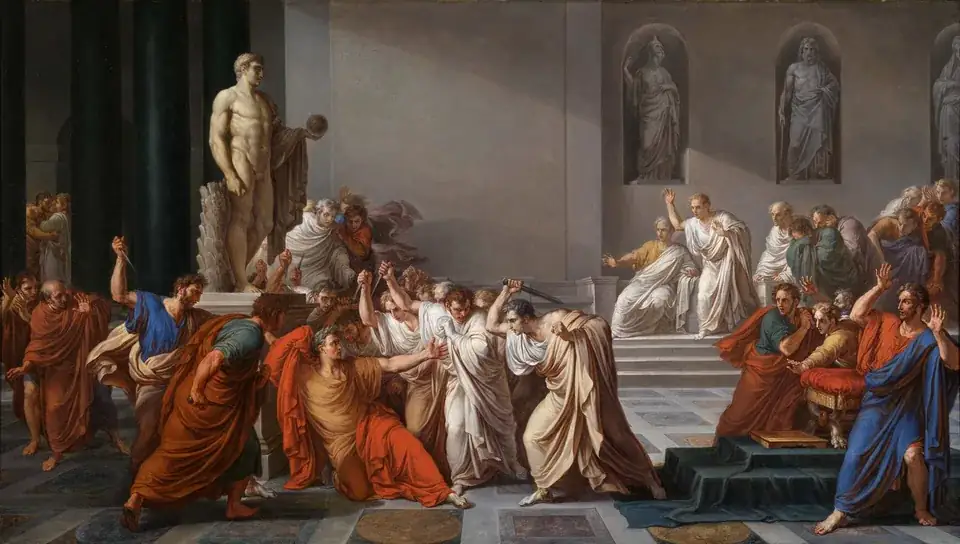
The death of Caesar in a historical painting.Vincenzo Camuccini / Wikimedia Commons / Public Domain · PD SourcesJulius Caesar background
- 07
27 BCE: Augustus and the principate
In 27 BCE Octavian received the honorific 'Augustus' and held real power as the princeps, or 'first citizen'. He nominally restored the Republic while keeping the key powers of the army, the provinces and the treasury; he cut the legions from 60 to 28 and the Senate from about 1,000 to 800 and later 600.
In 27 BCE Octavian received the honorific 'Augustus' and held real power as the princeps, or 'first citizen'. He nominally restored the Republic while keeping the key powers of the army, the provinces and the treasury; he cut the legions from 60 to 28 and the Senate from about 1,000 to 800 and later 600. The republican shell remained, but real power was concentrated in one man.
In 27 BCE Octavian received the honorific 'Augustus' and held real power as the princeps, or 'first citizen'. He nominally restored the Republic while keeping the key powers of the army, the provinces and the treasury in his own hands.
He reduced the legions from 60 to 28, retained about 150,000 legionaries and raised a similar number of auxiliaries.
He also cut the Senate from about 1,000 to 800 and later to 600, and made himself its president. The republican offices, Senate and popular assemblies remained, but the centre of decision had moved around the princeps.
So 27 BCE was not a single night in which the Republic became an empire; the principate took shape gradually, keeping the republican shell while concentrating real power in one man. That packaging made autocracy look like a restoration of tradition and allowed later emperors to keep using it.
Sources: 6 event claims, 3 sourced; source cards src-b8-augustus, src-b8-roman-republic-government (background only).
SourcesAugustus and the principate backgroundRoman Republic: early government and magistracies background
Cast
People whose choices move the story. Roles describe this story only.
- Gaius MariusGeneral and seven-time consul
Elected consul at the end of 108 and recruiting the landless in 107 for want of manpower; professionalization was a long process.
- Julius CaesarGeneral and dictator, 46–44 BCE
Conquered Gaul, won the civil war and was killed on March 15, 44 BCE; the Second Triumvirate then ruled and the Republic was not restored.
- Scipio AfricanusGeneral and victor at Zama
Defeated Hannibal at Zama in 202 BCE, ending the Second Punic War; the battlefield has never been precisely located.
- Octavian / AugustusPrinceps and founder of the principate
Received the name Augustus in 27 BCE, kept the republican shell and concentrated real power over the army, provinces and treasury.
Evidence and limits
Chapter-level sources; key claims checked.
Source count is the number of distinct source records attached to the event nodes shown here. It does not certify the narrative as a whole.