
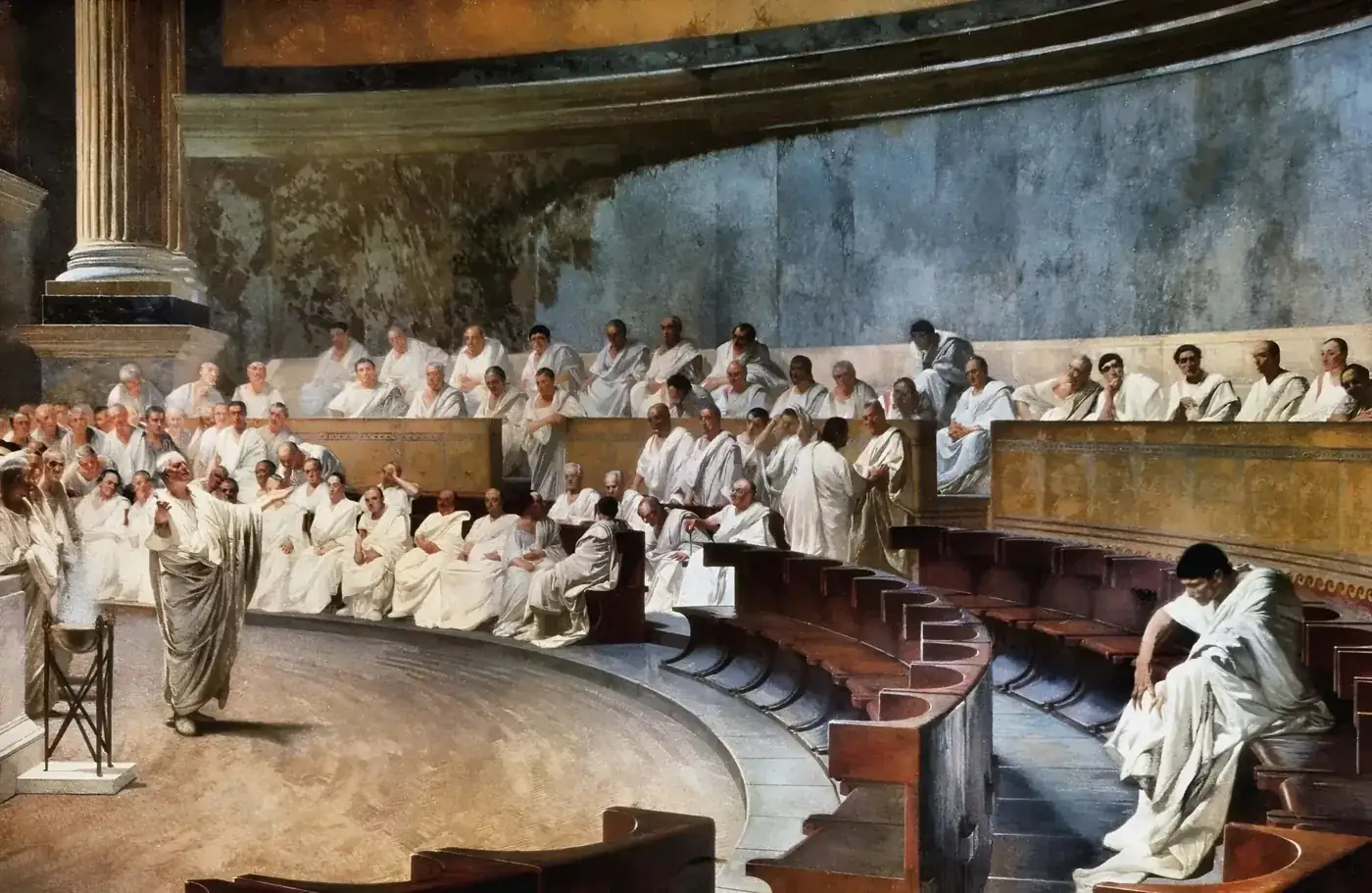
Traditional chronology dates the Roman Republic to 509 BCE, when the Romans expelled their last king, Tarquinius Superbus, and replaced royal power with two annually elected consuls.1 The date comes from later historians, not from a day-by-day contemporary record.2
The two consuls were primarily generals responsible for leading Rome's armies; in a military emergency that demanded unified command, the Senate and consuls could appoint a dictator in their place, but his supreme military command could not last longer than six months.3
The Senate was in theory only an advisory body, yet in practice it wielded enormous power through the collective prestige of its members.4 The popular assemblies were divided between the centuriate assembly, which voted on war and peace and elected magistrates with military command, and the tribal assembly, which did most of the legislating and sat as a court for serious public offenses.5
The Republic's key was therefore not 'rule by the people' but an oligarchic system that combined annual terms, paired magistrates, senatorial prestige and assembly votes.6 It prevented the return of kingship, but it did not close the power gap between patricians and plebeians.7
Evidence ledger
7 claims5 sourced0 unsourced2 author judgment
Every hard fact in the narrative above is registered here. A claim may also record source-only details that the narrative does not repeat; the related-narrative line points to the corresponding passage, not a guarantee that the source supports every word of the body. A claim without a source stays visibly unsourced.
- Roman Republic: early government and magistraciesBritannica, Roman Republic, section 'Early government', opening paragraph
Roman Republic, (509–27 bce), the ancient state centred on the city of Rome that began in 509 bce, when the Romans replaced their monarchy with elected magistrates, and lasted until 27 bce, when the Roman Empire was established.
Accessed 2026-11-25 · human read
Traditional chronology; not presented as a day-by-day contemporary record.
- Roman Republic: early government and magistraciesBritannica, Roman Republic, section 'Early government', opening paragraph
The date comes from later historians, not from a day-by-day contemporary record.
Related narrativeThe date comes from later historians, not from a day-by-day contemporary record.
- Roman Republic: early government and magistraciesBritannica, Roman Republic, section 'The early historical record'
The early Roman Republic (509–264 bce) and the preceding regal period (753–509 bce) are the most poorly documented periods of Roman history.
Accessed 2026-11-25 · human read - Roman Republic: early government and magistraciesBritannica, Roman Republic, section 'The early historical record'
Consequently, over time, historical facts about early Rome suffered from patriotic reinterpretation involving exaggerations of the truth, the suppression of embarrassing facts, and invention.
Accessed 2026-11-25 · human read
The early Republic is the least documented period, and the tradition was embellished later.
- Roman Republic: early government and magistraciesBritannica, Roman Republic, section 'The early historical record'
The two consuls were primarily generals responsible for leading Rome's armies; in a military emergency that demanded unified command, the Senate and consuls could appoint a dictator in their place, but his supreme military command could not last longer than six months.
Related narrativeThe two consuls were primarily generals responsible for leading Rome's armies; in a military emergency that demanded unified command, the Senate and consuls could appoint a dictator in their place, but his supreme military command could not last longer than six months.
- Roman Republic: early government and magistraciesBritannica, Roman Republic, section 'Early government', paragraph 1
The two consuls (who had come to replace the king) were primarily generals whose task it was to lead Rome’s armies in war. In times of military emergency, when unity of command was sometimes necessary, Rome appointed a dictator in place of the consuls, who, however, could not hold supreme military command for longer than six months.
Accessed 2026-11-25 · human read
The dictator is limited to military command and a six-month term; no social reform is implied.
- Roman Republic: early government and magistraciesBritannica, Roman Republic, section 'Early government', paragraph 1
The Senate was in theory only an advisory body, yet in practice it wielded enormous power through the collective prestige of its members.
Related narrativeThe Senate was in theory only an advisory body, yet in practice it wielded enormous power through the collective prestige of its members.
- Roman Republic: early government and magistraciesBritannica, Roman Republic, section 'Early government', paragraph 2
The Senate, which may have existed under the monarchy and served as an advisory council for the king, now advised both magistrates and the Roman people. Although in theory the people were sovereign and the Senate only offered advice, in actual practice the Senate wielded enormous power because of the collective prestige of its members.
Accessed 2026-11-25 · human read
The entry's distinction between advisory theory and practical Senate power is preserved.
- Roman Republic: early government and magistraciesBritannica, Roman Republic, section 'Early government', paragraph 2
The popular assemblies were divided between the centuriate assembly, which voted on war and peace and elected magistrates with military command, and the tribal assembly, which did most of the legislating and sat as a court for serious public offenses.
Related narrativeThe popular assemblies were divided between the centuriate assembly, which voted on war and peace and elected magistrates with military command, and the tribal assembly, which did most of the legislating and sat as a court for serious public offenses.
- Roman Republic: early government and magistraciesBritannica, Roman Republic, section 'Early government', paragraph 3
During the republic there were two different popular assemblies, the centuriate assembly and the tribal assembly. The centuriate assembly was military in nature; it voted on war and peace and elected all those magistrates who exercised imperium (military power). The tribal assembly was a nonmilitary civilian assembly that elected those magistrates who did not exercise imperium. It did most of the legislating and sat as a court for serious public offenses.
Accessed 2026-11-25 · human read
Only the two assemblies named by the entry are described; the four-assembly summary is avoided.
- Roman Republic: early government and magistraciesBritannica, Roman Republic, section 'Early government', paragraph 3
The Republic's key was therefore not 'rule by the people' but an oligarchic system that combined annual terms, paired magistrates, senatorial prestige and assembly votes.
Related narrativeThe Republic's key was therefore not 'rule by the people' but an oligarchic system that combined annual terms, paired magistrates, senatorial prestige and assembly votes.
Editorial judgment, not a historical fact.
Author judgment: the Republic was oligarchic, not a modern democracy.
It prevented the return of kingship, but it did not close the power gap between patricians and plebeians.
Related narrativeIt prevented the return of kingship, but it did not close the power gap between patricians and plebeians.
Editorial judgment, not a historical fact.
Author judgment: the system blocked kingship but not the patrician-plebeian gap.
Sources and review
Key claims rely on a single source record
- Roman Republic: early government and magistracies · Encyclopaedia Britannica (accessed 2026-11-25) Original source ↗
Locations
- Rome· 41.9, 12.5· Approximate
evt-b3cc513de9f2cd43Source file:
events/evt-b3cc513de9f2cd43/event.md