
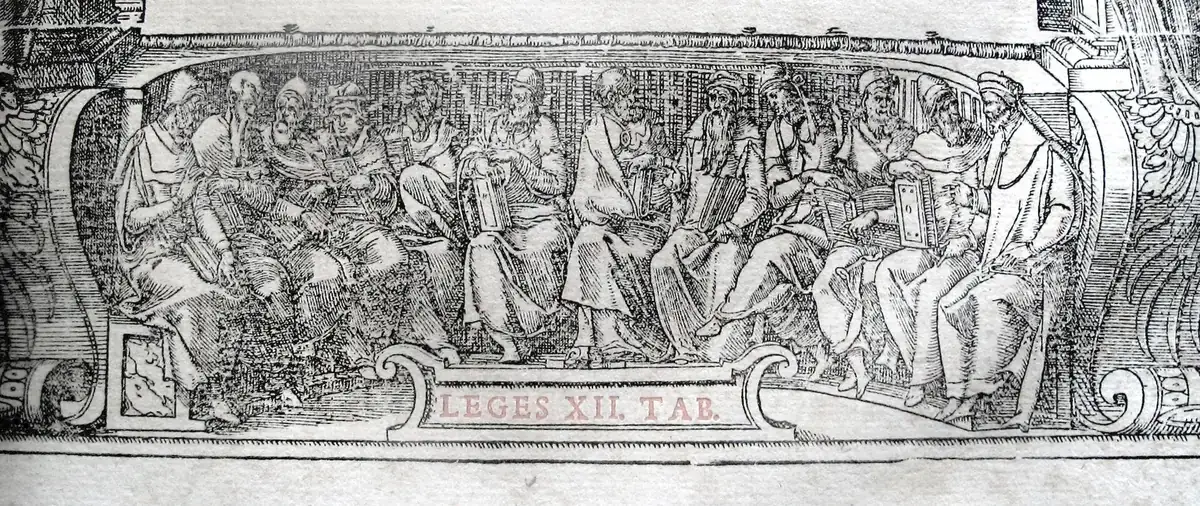
Tradition places the making of the Twelve Tables in 451–450 BCE: a first board of ten commissioners drafted ten tables, a second board added two more, and the code was then posted in the Roman Forum, likely on bronze tablets.1 The original text does not survive intact; today it is reconstructed from quotations in later legal writings.2
The immediate effect of a written code was to let plebeians know the rules and use them against arbitrary interpretation by patrician officials.3 Before that, judgments rested on unwritten custom preserved by a small group of learned patricians.4
But the Twelve Tables were not a liberalizing reform.5 They recognized the prerogatives of the patrician class and the patriarchal family, allowed enslavement for unpaid debt, and let religious custom enter civil cases.5
The code later came to be seen as a foundation of Roman private law, but it was not a modern bill of rights.6 It wrote the rules down and also wrote inequality into the rules.6
Evidence ledger
6 claims5 sourced0 unsourced1 author judgment
Every hard fact in the narrative above is registered here. A claim may also record source-only details that the narrative does not repeat; the related-narrative line points to the corresponding passage, not a guarantee that the source supports every word of the body. A claim without a source stays visibly unsourced.
- Law of the Twelve TablesBritannica, Decemviri, section 'Law of the Twelve Tables', paragraph 2
Beginning work in 451, the first set of commissioners produced 10 tables, which were later supplemented by 2 additional tables. In 450 the code was formally posted, likely on bronze tablets, in the Roman Forum.
Accessed 2026-11-25 · human read
Ten tables in 451 and two more posted in 450; the two years are not collapsed.
- Law of the Twelve TablesBritannica, Decemviri, section 'Law of the Twelve Tables', paragraph 2
The original text does not survive intact; today it is reconstructed from quotations in later legal writings.
Related narrativeThe original text does not survive intact; today it is reconstructed from quotations in later legal writings.
- Law of the Twelve TablesBritannica, Decemviri, section 'Law of the Twelve Tables', last paragraph
Because only random quotations from the Twelve Tables are extant, knowledge about their contents is largely derived from references in later juridical writings.
Accessed 2026-11-25 · human read
The original text is not intact; contents come from later quotations.
- Law of the Twelve TablesBritannica, Decemviri, section 'Law of the Twelve Tables', last paragraph
The immediate effect of a written code was to let plebeians know the rules and use them against arbitrary interpretation by patrician officials.
Related narrativeThe immediate effect of a written code was to let plebeians know the rules and use them against arbitrary interpretation by patrician officials.
- Law of the Twelve TablesBritannica, Decemviri, section 'Law of the Twelve Tables', paragraph 3
The written recording of the law in the Twelve Tables enabled the plebeians both to become acquainted with the law and to protect themselves against patricians’ abuses of power.
Accessed 2026-11-25 · human read
The code publicized rules and limited arbitrary interpretation.
- Law of the Twelve TablesBritannica, Decemviri, section 'Law of the Twelve Tables', paragraph 3
Before that, judgments rested on unwritten custom preserved by a small group of learned patricians.
Related narrativeBefore that, judgments rested on unwritten custom preserved by a small group of learned patricians.
- Law of the Twelve TablesBritannica, Decemviri, section 'Law of the Twelve Tables', paragraph 1
The Twelve Tables allegedly were written by 10 commissioners (decemvirs) at the insistence of the plebeians, who felt their legal rights were hampered by the fact that court judgments were rendered according to unwritten custom preserved only within a small group of learned patricians.
Accessed 2026-11-25 · human read
Previously unwritten custom was held by a small group of patricians.
- Law of the Twelve TablesBritannica, Decemviri, section 'Law of the Twelve Tables', paragraph 1
But the Twelve Tables were not a liberalizing reform. They recognized the prerogatives of the patrician class and the patriarchal family, allowed enslavement for unpaid debt, and let religious custom enter civil cases.
Related narrativeBut the Twelve Tables were not a liberalizing reform.
- Law of the Twelve TablesBritannica, Decemviri, section 'Law of the Twelve Tables', paragraph 4
The Twelve Tables were not a reform or a liberalizing of old custom. Rather, they recognized the prerogatives of the patrician class and of the patriarchal family, the validity of enslavement for unpaid debt, and the interference of religious custom in civil cases.
Accessed 2026-11-25 · human read
No intermarriage clause is added; only patriarchy, debt bondage and religious custom are retained.
- Law of the Twelve TablesBritannica, Decemviri, section 'Law of the Twelve Tables', paragraph 4
The code later came to be seen as a foundation of Roman private law, but it was not a modern bill of rights. It wrote the rules down and also wrote inequality into the rules.
Related narrativeThe code later came to be seen as a foundation of Roman private law, but it was not a modern bill of rights.
Editorial judgment, not a historical fact.
Author judgment: public rules did not mean equal rights.
Sources and review
Key claims rely on a single source record
- Law of the Twelve Tables · Encyclopaedia Britannica (accessed 2026-11-25) Original source ↗
Locations
- Roman Republic· 41.9, 12.5· Approximate
evt-bd9000cab46db1aaSource file:
events/evt-bd9000cab46db1aa/event.md