
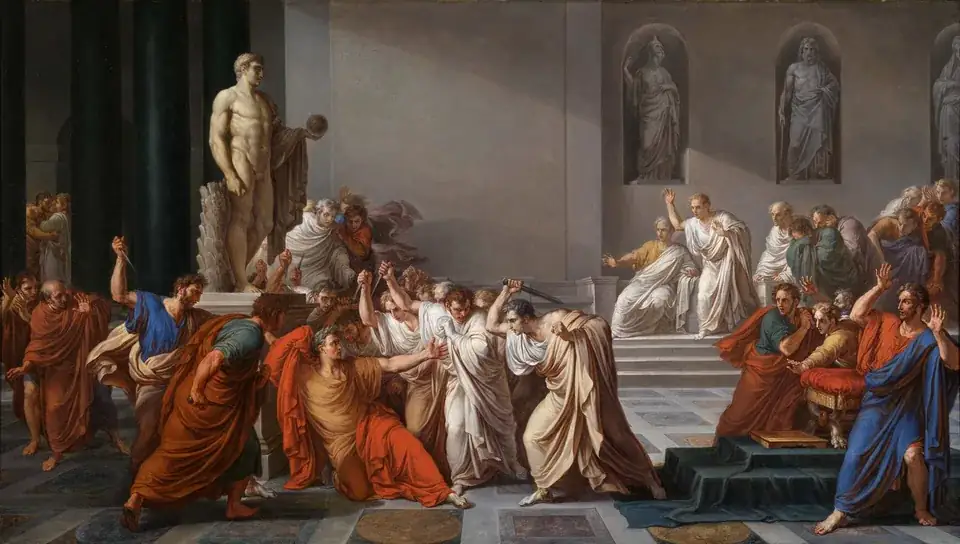
On March 15, 44 BCE, Caesar was killed by a group of senators in the Senate House within Pompey's theatre complex.1 The plot was led by Cassius and Brutus, and later accounts say some 60 men took part.1
Caesar suffered an estimated 23 wounds; a physician reportedly claimed only one was fatal, but these figures come from later narratives, not an autopsy.2
Caesar conquered Gaul in 58–50 BCE, won the civil war of 49–45 and held the dictatorship in 46–44.3 His concentration of power stripped the Senate of its normal role as arbiter and convinced some senators that only assassination could stop a return of kingship.4
The assassination did not restore the Republic.5 After Caesar's death, Antony, Lepidus and Octavian formed the Second Triumvirate and civil war continued; the republican shell remained, but control of armies now decided power.5
Evidence ledger
5 claims4 sourced0 unsourced1 author judgment
Every hard fact in the narrative above is registered here. A claim may also record source-only details that the narrative does not repeat; the related-narrative line points to the corresponding passage, not a guarantee that the source supports every word of the body. A claim without a source stays visibly unsourced.
- Julius CaesarBritannica, Julius Caesar, top question 'How did Julius Caesar die?'
Julius Caesar was murdered in the Roman Senate House by a group of nobles on March 15, 44 bce. The assassination plot was led by Gaius Cassius Longinus and Marcus Junius Brutus, and it reportedly involved some 60 men.
Accessed 2026-11-25 · human read
The meeting place is identified as Pompey's theatre complex; the number is 'some 60', not an exact list.
- Julius CaesarBritannica, Julius Caesar, top question 'How did Julius Caesar die?'
Caesar suffered an estimated 23 wounds; a physician reportedly claimed only one was fatal, but these figures come from later narratives, not an autopsy.
Related narrativeCaesar suffered an estimated 23 wounds; a physician reportedly claimed only one was fatal, but these figures come from later narratives, not an autopsy.
- Julius CaesarBritannica, Julius Caesar, top question 'How did Julius Caesar die?'
Caesar was stabbed an estimated 23 times, though a physician’s report claimed that only one wound was fatal.
Accessed 2026-11-25 · human read
The wound count is a later estimate, not an autopsy finding.
- Julius CaesarBritannica, Julius Caesar, top question 'How did Julius Caesar die?'
Caesar conquered Gaul in 58–50 BCE, won the civil war of 49–45 and held the dictatorship in 46–44.
Related narrativeCaesar conquered Gaul in 58–50 BCE, won the civil war of 49–45 and held the dictatorship in 46–44.
- Julius CaesarBritannica, Julius Caesar, opening paragraph
He is best known for his conquest of Gaul (58–50 bce), his victory in the civil war of 49–45 bce, and his appointment as dictator (46–44 bce).
Accessed 2026-11-25 · human read
Only Gaul, the civil war and the dictatorship are stated; 'dictator for life' is not.
- Julius CaesarBritannica, Julius Caesar, opening paragraph
His concentration of power stripped the Senate of its normal role as arbiter and convinced some senators that only assassination could stop a return of kingship.
Related narrativeHis concentration of power stripped the Senate of its normal role as arbiter and convinced some senators that only assassination could stop a return of kingship.
- Julius CaesarBritannica, Julius Caesar, top question 'How did Julius Caesar die?'
The conspirators claimed that Caesar’s accumulation of power, including his appointment as dictator, threatened the Roman Republic.
Accessed 2026-11-25 · human read
The motive is attributed to the conspirators, not presented as a Senate consensus.
- Julius CaesarBritannica, Julius Caesar, top question 'How did Julius Caesar die?'
The assassination did not restore the Republic. After Caesar's death, Antony, Lepidus and Octavian formed the Second Triumvirate and civil war continued; the republican shell remained, but control of armies now decided power.
Related narrativeThe assassination did not restore the Republic.
Editorial judgment, not a historical fact.
Author judgment: the assassination did not restore the Republic and exposed army loyalty as the decisive question.
Sources and review
Key claims rely on a single source record
- Julius Caesar · Encyclopaedia Britannica (accessed 2026-11-25) Original source ↗
Locations
- Roman Republic· 41.89, 12.49· Approximate
evt-46d4d9ee3f67581fSource file:
events/evt-46d4d9ee3f67581f/event.md