
The Nile Unified: Writing, Pyramids and the Bureaucratic State
Story3200–1550 BCE: from hieroglyphs to the New Kingdom, how Egypt turned a river into a state
Around 3200 BCE a set of signs appeared in the Nile Valley; by about 2900 BCE they could be read phonetically. Tradition assigns the unification of Upper and Lower Egypt to Menes, while modern research identifies him incompletely with Narmer, Aha and other early kings. Djoser then built the Step Pyramid at Saqqara, Khufu compressed national logistics into a mountain at Giza, Ahmose drove the Hyksos from the Delta and opened the New Kingdom, and the Ebers Papyrus copied experience, spell and anatomy into one scroll. The six chapters tell one story: how Egypt used writing, flood, labour and kingship to turn a river into a durable state machine.
Egyptian 'eternity' was not stillness but a reproducible capacity: measuring the flood, collecting grain tax, organising labour, training scribes, and turning kingship into a natural order through monuments. The pyramids were not the product of a tyrant's whim but a combined engineering of quarrying, transport, rations, surveying and seasonal labour; medical papyri were not modern clinical manuals but practice that placed experience, spell and drug in one frame. The stronger the state's capacity, the larger the mobilisation and the heavier the burden on ordinary people; both sides must be written together.
Chapter-level sources; key claims checked.
Chapter timeline
Chapters in reading orderAll anchors are approximate region-level placements; they are not precise sites. Chapters without coordinates are listed below by region only.
Chapter contents6 chapters
The story, chapter by chapter
Each chapter opens the underlying event- 01
Writing serves the state first
At the end of the fourth millennium BCE hieroglyphs appeared on pottery jars and ivory plaques in Egypt. They were phonetic from the start and served religious texts as well as legal and scientific documents. Only officials, priests and craftsmen could read them; everyday writing used hieratic. Writing was first of all a tool of taxation, labour and royal power.
Appeared on pottery jars and ivory plaques at the end of the 4th millennium BCE and readable by c. 2925 BCE; phonetic from the start, used for religious, legal and scientific texts. Officials, priests and craftsmen wrote; everyday script was hieratic.
At the end of the 4th millennium BCE, marks cut into pottery jars and ivory plaques began to appear in Egyptian tombs. The earliest Egyptian hieroglyphs date to the end of the 4th millennium BCE and were incised on pottery jars and ivory plaques, usually to identify the dead. They were not yet long texts but labels of names, titles, goods and ownership.
These early signs were phonetic from the start; Egypt did not pass through a purely pictorial stage. A drawn object often stood not for itself but for another word that sounded similar.
Hieroglyphs were used for religious texts as well as historical inscriptions, songs, legal and scientific documents. The hymns on temple walls and the figures in an official's ledger used the same sign system.
Yet those who could read and write remained few. Only a limited circle of officials, priests and craftsmen understood hieroglyphs; everyday writing used the simplified hieratic script. Writing was an office skill, not universal schooling.
Writing was first of all a tool of taxation, labour and royal power, not literature; whoever controlled writing could turn names, harvests and manpower into actionable records.
Sources: 5 event claims, 4 sourced; source cards src-b8-hieroglyphic-writing (background only).
- 02
The Narmer Palette: unification drawn as one king
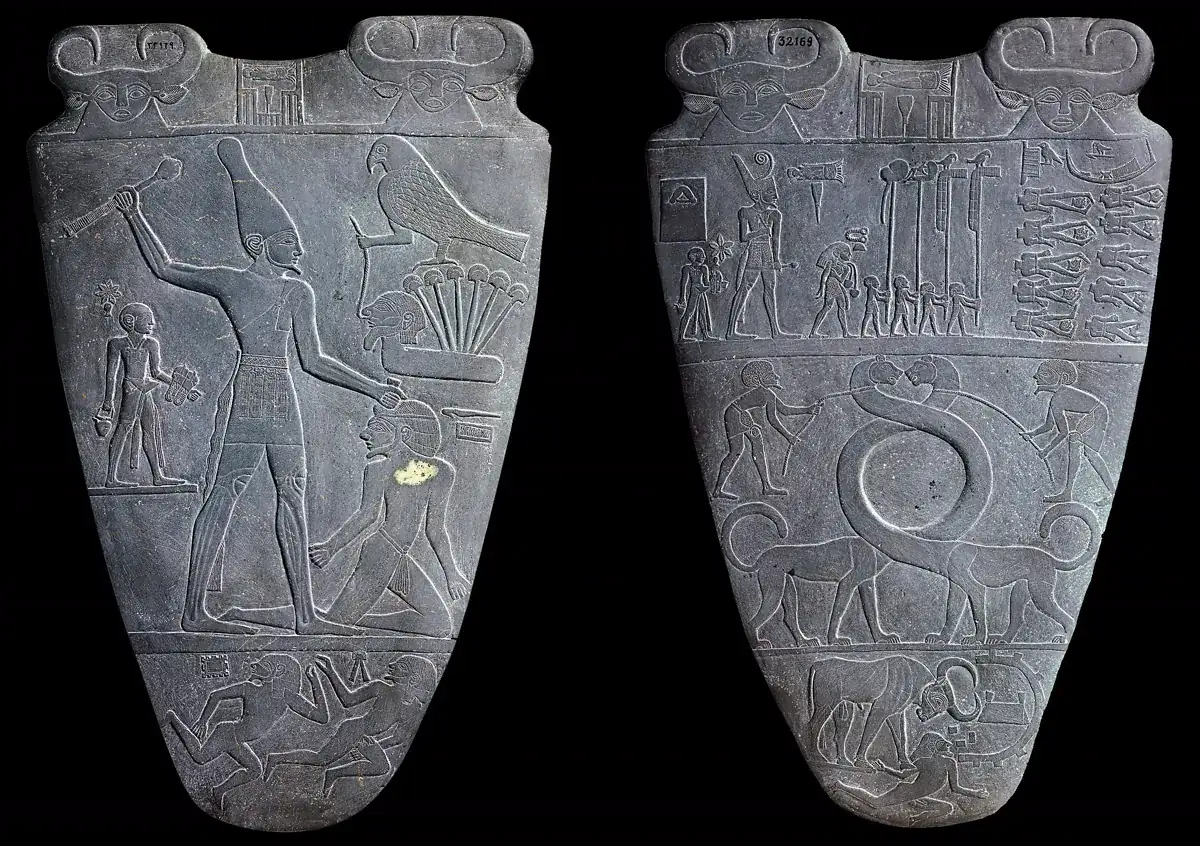
Tradition makes Menes the first king to unify Upper and Lower Egypt; modern scholars identify him inconclusively with Narmer, Aha and other early kings. The Narmer Palette, found at Hierakonpolis and dated c. 2900 BCE, places the two kingdoms under one royal name through the White and Red Crowns. Unification more likely took several generations.
Tradition makes Menes the unifier; modern scholars identify him incompletely with Narmer and Aha. The palette, found at Hierakonpolis c. 2900 BCE, joins the two kingdoms under one royal name through the White and Red Crowns; unification more likely took generations.
Tradition makes Menes the first king to unify Upper and Lower Egypt and credits him with founding the 1st dynasty. The name appears in later king lists and later histories, not in a contemporary coronation record.
Modern scholars have not conclusively identified Menes with Narmer, Aha or other early kings.
The Narmer Palette was found at Hierakonpolis, dates to the beginning of the 1st dynasty, c. 2900 BCE, and shows Narmer wearing the White Crown.
The other side is usually read as the Red Crown; the two crowns place Upper and Lower Egypt under one royal name, but this is commemorative imagery, not an administrative record.
Unification more likely took several generations: the real integration lay in tax rolls, borders, a capital and local officials, not in the aftermath of one battle.
Sources: 5 event claims, 3 sourced; source cards src-b8-menes-unification (background only).
The Narmer Palette.Anonymous, c. 2900 BCE · Wikimedia Commons · Public Domain · PD - 03
Djoser's Step Pyramid: a state project in stone
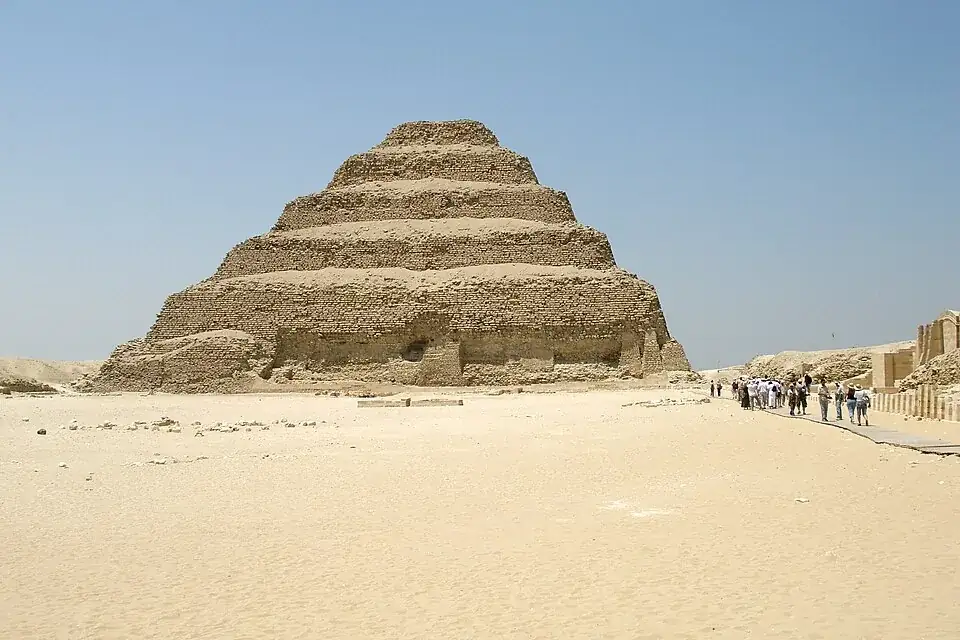
Djoser, first king of the 3rd dynasty, built the Step Pyramid at Saqqara under the architect and physician Imhotep. Six tiers rise about 61 metres, with some 400 underground rooms and a wall about 1.6 kilometres long. It was not the 'first pyramid' but Egypt's earliest important stone building and a template for state engineering.
Djoser, first king of the 3rd dynasty, built Egypt's earliest important stone building at Saqqara under Imhotep. Six tiers rise about 61 metres, with some 400 underground rooms and a wall about 1.6 kilometres long.
Djoser was the first king of the 3rd dynasty and built Egypt's earliest important stone building at Saqqara. His tomb began as a traditional rectangular mastaba and ended as a six-tier step pyramid.
Imhotep was Djoser's architect and physician, and later generations deified him. His name became linked with wisdom, medicine and writing, but at the time he was first a royal official.
The Step Pyramid consists of six tiers of stone and clay, rises about 61 metres, and was originally covered in white limestone. It is not an isolated tower but the centre of a whole funerary complex.
Beneath the pyramid are galleries and some 400 rooms; the wall around the complex is about 1.6 kilometres long and was originally about 11 metres high.
The Step Pyramid was more than a royal tomb: it turned quarrying, transport, craftsmen, rations and ritual into a repeatable engineering template.
Sources: 5 event claims, 4 sourced; source cards src-b8-djoser-step-pyramid (background only).
Step Pyramid.Vyacheslav Argenberg / Wikimedia Commons / CC BY 4.0 · CC-BY-4.0 - 04
The Great Pyramid: national logistics in one mountain
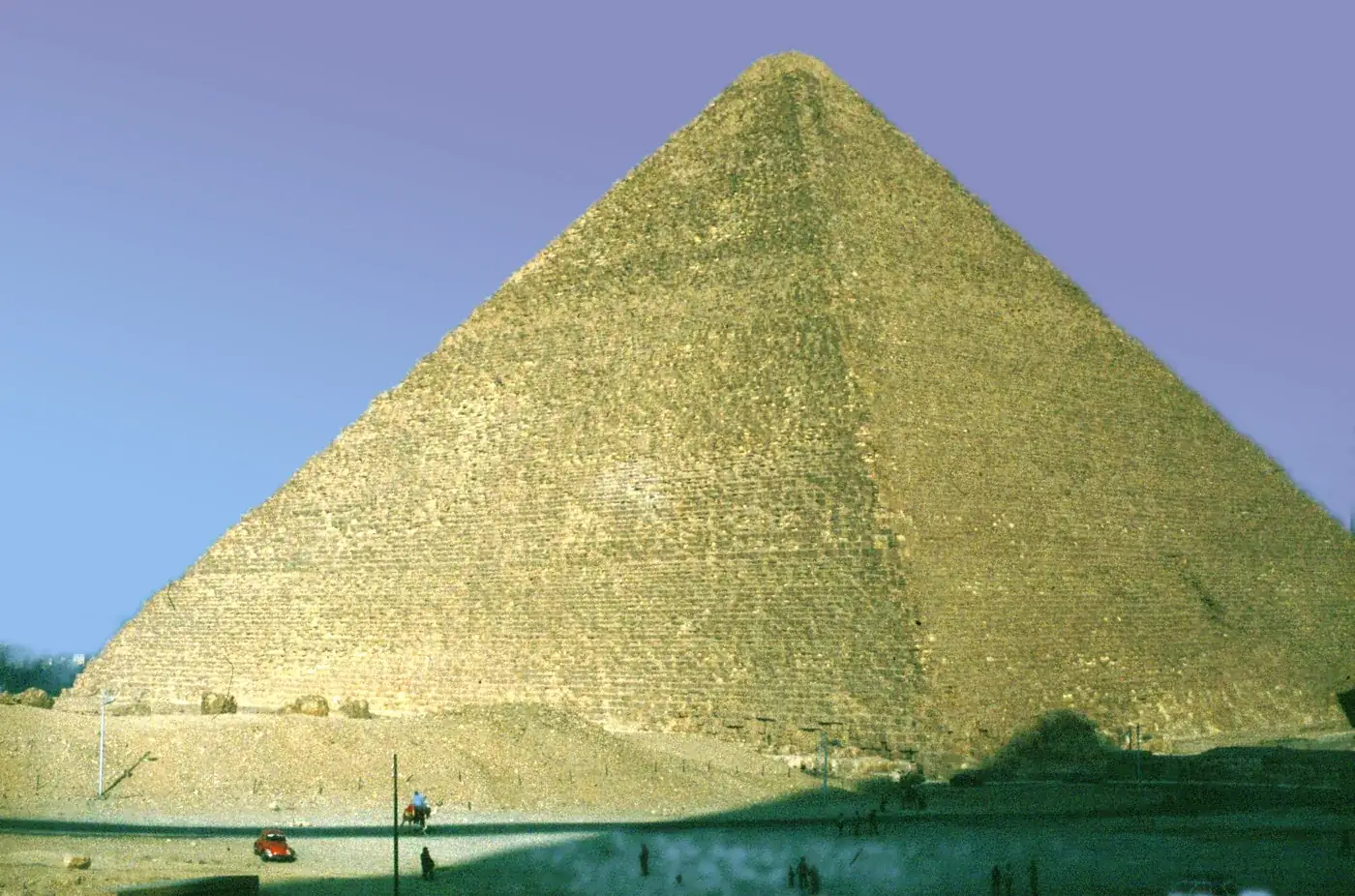
The 4th-dynasty kings Khufu, Khafre and Menkaure built the three pyramids at Giza. Khufu's Great Pyramid has a base of about 230 metres, an original height of 147 metres, about 2.3 million blocks and 5.75 million tons. Herodotus says 20 years and 100,000 men; modern research suggests perhaps 20,000 workers plus support staff, and workers' districts with bakeries, workshops and artisans' tombs.
Three 4th-dynasty pyramids for Khufu, Khafre and Menkaure; Khufu's has a base of about 230 metres, an original height of 147 metres, about 2.3 million blocks and 5.75 million tons. Herodotus says 20 years and 100,000 men; modern research suggests perhaps 20,000 workers plus support staff.
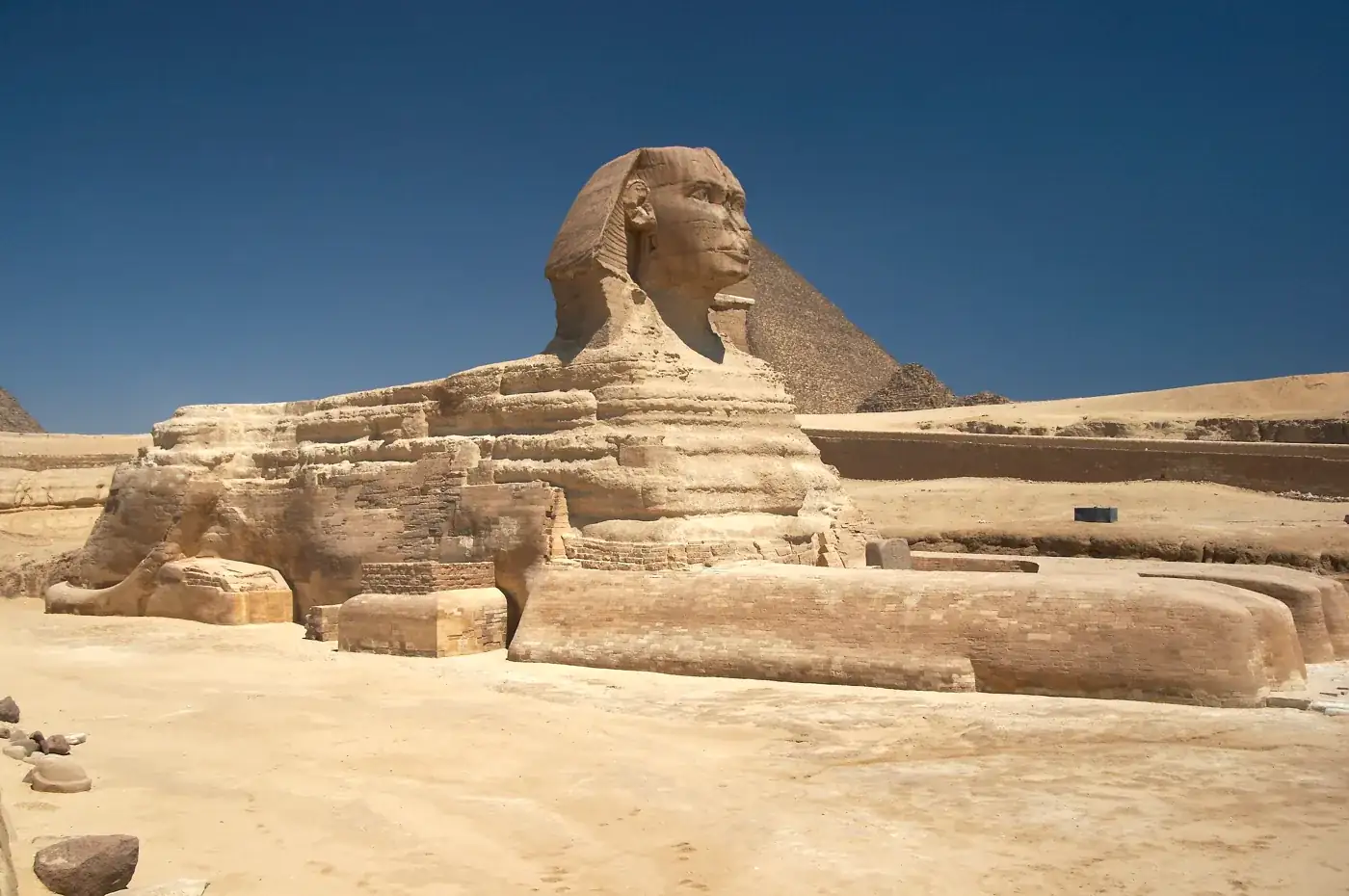
The three pyramids of Giza belong to the 4th-dynasty kings Khufu, Khafre and Menkaure; Khufu's Great Pyramid is the largest and oldest of the three.
The Great Pyramid's base averages about 230 metres, its original height was about 147 metres, and it now stands about 138 metres. The stepped stone surface visible today is what remains after the white limestone casing was stripped away.
Khufu's pyramid used about 2.3 million blocks of stone and weighs about 5.75 million tons. Such a mass was not piled up by one gang; it required long-term coordination of quarrying, transport, surveying and rations.
Herodotus says the Great Pyramid took 20 years and 100,000 men; modern archaeological research suggests as few as about 20,000 workers, plus support staff such as bakers and physicians. The two figures differ greatly: the first is an ancient narrative, the second an archaeological estimate.
Workers' districts have been found near the pyramids, including bakeries, storage areas, workshops and the small tombs of artisans.
Writing the pyramids off as 'built by slaves' misses the real capacity: the organisation of quarrying, transport, rations, surveying and seasonal labour.
Capacity Mechanism and pressure Key node Writing Hieroglyphs, hieratic, seals, ledgers; few literate people, administration depends on scribes Signs at the end of the 4th millennium; rules regularised in the 3rd dynasty Flood agriculture Nile flood, basin irrigation, granaries; unpredictable flood height and costly collection Unification around 3100 BCE; Step Pyramid in the 26th century Engineering labour Quarrying, transport, workers' villages, rations; mobilisation and seasonal window Djoser in the 26th century; Giza in the 25th century Royal legitimacy Horus/pharaoh, Maat, tombs and temples; succession, local elites and foreign enemies Narmer Palette c. 2900 BCE; New Kingdom c. 1550 BCE Table: the four capacities fed one another. Writing recorded flood and labour, the flood fed construction and armies, construction made kingship visible as order, and kingship authorised scribes and craftsmen.
Sources: 6 event claims, 5 sourced; source cards src-b8-giza-pyramids (background only).
The Great Pyramid.Gerd Eichmann, 1982 · Wikimedia Commons · CC BY-SA 4.0 · CC-BY-SA-4.0 SourcesPyramids of Giza background
- 05
Ahmose and the Hyksos: the military-fiscal New Kingdom
Ahmose I reigned c. 1539–1514 BCE, founded the 18th dynasty and completed the expulsion of the Hyksos: he captured Avaris, pursued them to Sharuhen for a three-year siege, and campaigned three times in Nubia. He then restored administration, granted land to veterans and reopened mines and trade. The old claim that he created a standing army is removed.
Ahmose I reigned c. 1539–1514 BCE and founded the 18th dynasty; he captured Avaris, besieged Sharuhen for three years, campaigned three times in Nubia, then restored administration, granted land to veterans and reopened mines and trade.
Ahmose I reigned c. 1539–1514 BCE, founded the 18th dynasty and completed the expulsion of the Hyksos.
He captured the Hyksos capital of Avaris, pursued the enemy to Sharuhen in Palestine, and took it after a three-year siege.
Before advancing into Palestine, Ahmose campaigned three times in Nubia, whose ruler had been an ally of the Hyksos.
After his borders were secure, he established an administration loyal to him, granted land to veterans and members of the royal family, and reopened the copper mines of Sinai and trade with the Syrian coast.
The New Kingdom was not a sudden revival but a military-fiscal machine joining the expulsion of foreigners, frontier warfare, land grants and temple rebuilding.
Sources: 5 event claims, 4 sourced; source cards src-b7-ahmose-i (background only).
SourcesAhmose I background
- 06
The Ebers Papyrus: experience, spell and anatomy in one scroll
The Ebers Papyrus was compiled about 1550 BCE and is one of the oldest known medical works: about 700 magical formulas and folk remedies, from crocodile bite to toenail pain, with a relatively accurate description of the circulatory system. It was acquired by Georg Ebers in 1873. The old claims of '877 prescriptions' and 'cancer diagnosis' are removed.
Compiled c. 1550 BCE and one of the oldest known medical works; about 700 magical formulas and folk remedies, from crocodile bite to toenail pain, with a relatively accurate description of the circulatory system; acquired by Georg Ebers in 1873.
The Ebers Papyrus was compiled about 1550 BCE and is one of the oldest known medical works. It copied symptoms, prescriptions and spells into one scroll rather than sorting them into a modern manual.
It contains about 700 magical formulas and folk remedies, ranging from crocodile bite to toenail pain and including ways to rid a house of flies, rats and scorpions.
The scroll gives a relatively accurate description of the circulatory system: blood vessels run throughout the body, and the heart is the centre of the blood supply.
The papyrus was acquired in 1873 by the German Egyptologist Georg Ebers.
It placed experience, spell and drug within one practice; it was neither a modern clinical manual nor merely 'superstition'.
Sources: 5 event claims, 4 sourced; source cards src-b8-ebers-papyrus (background only).
SourcesEbers papyrus background
Cast
People whose choices move the story. Roles describe this story only.
- NarmerTraditionally identified with Menes; 1st-dynasty king
Traditionally identified with Menes, though the identification is inconclusive; the palette places the White and Red Crowns under one royal name, a key image of unification rather than an administrative record.
- ImhotepArchitect, physician and royal official
Designed Djoser's Step Pyramid, joining stone architecture, engineering and royal funerary ritual; later deified.
- Khufu4th-dynasty pharaoh and builder of the Great Pyramid
The pharaoh associated with the Great Pyramid at Giza; the project depended on nationwide quarrying, transport, grain and craft organisation.
- Ahmose IFounder of the 18th dynasty; expelled the Hyksos
Reigned c. 1539–1514 BCE; captured Avaris, besieged Sharuhen for three years and campaigned three times in Nubia, then restored administration and trade. The old claim that he created a standing army is not used.
Evidence and limits
Chapter-level sources; key claims checked.
Source count is the number of distinct source records attached to the event nodes shown here. It does not certify the narrative as a whole.