
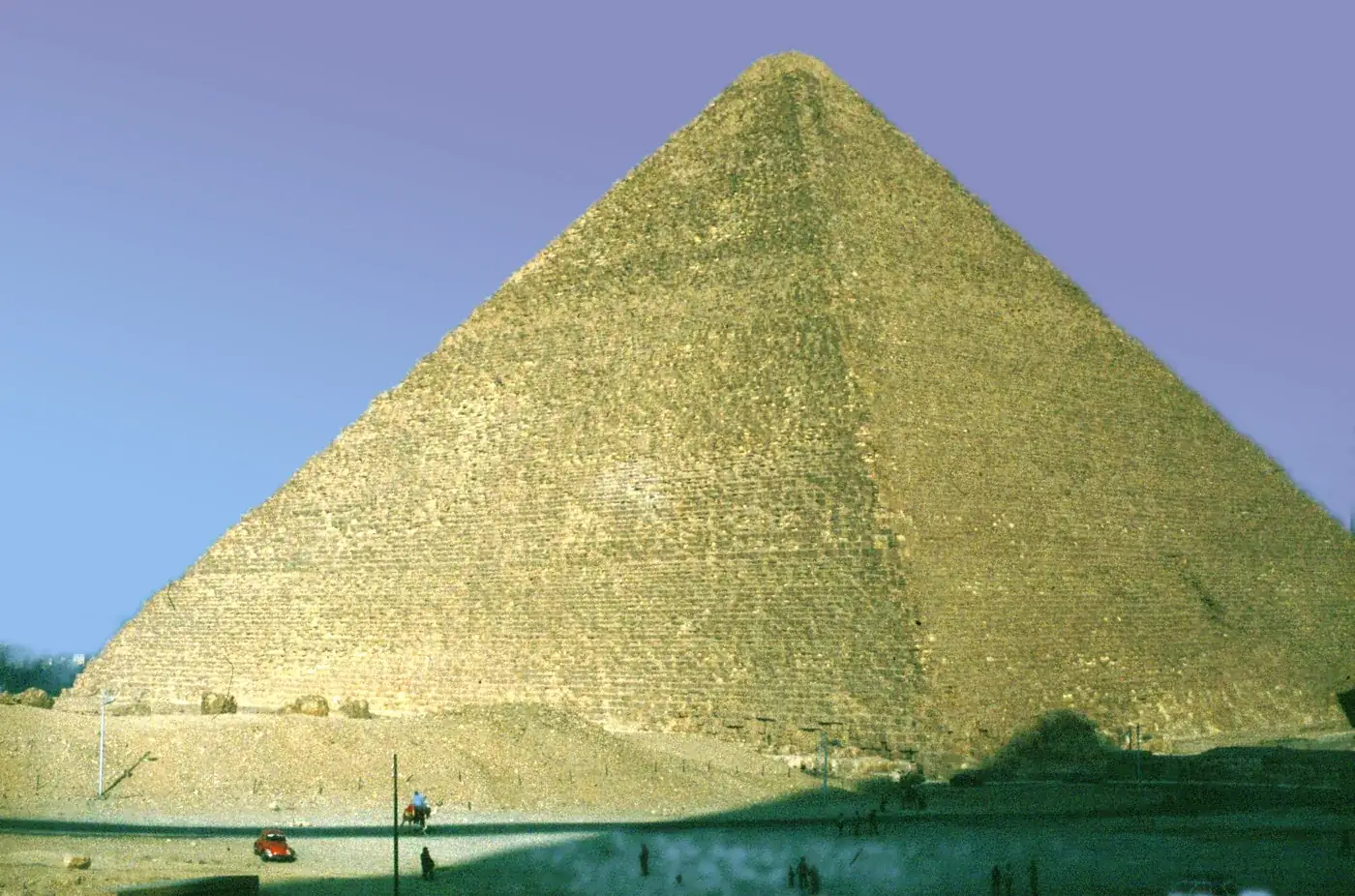
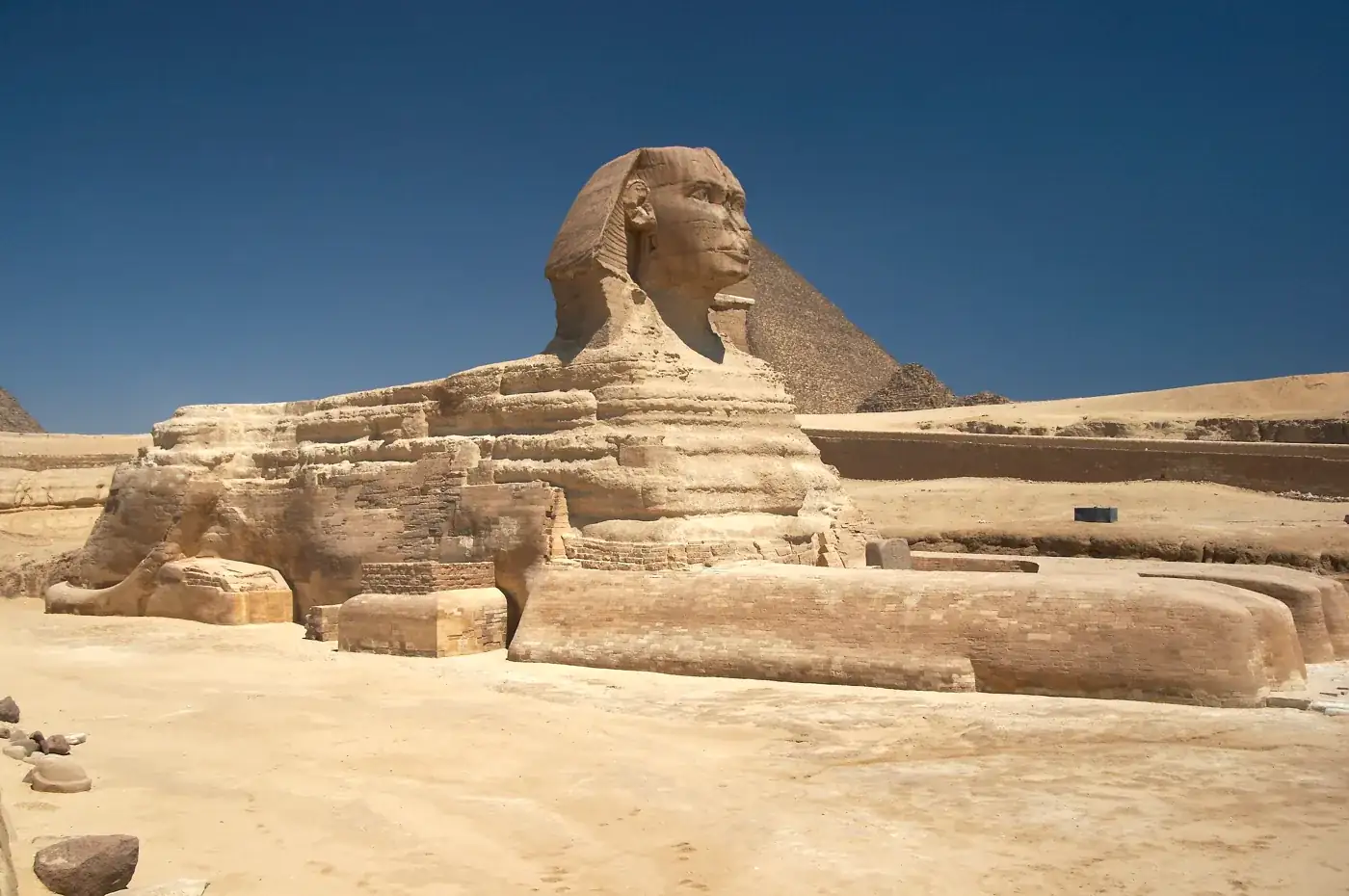
The three pyramids of Giza belong to the 4th-dynasty kings Khufu, Khafre and Menkaure; Khufu's Great Pyramid is the largest and oldest of the three.1
The Great Pyramid's base averages about 230 metres, its original height was about 147 metres, and it now stands about 138 metres.2 The stepped stone surface visible today is what remains after the white limestone casing was stripped away.
Khufu's pyramid used about 2.3 million blocks of stone and weighs about 5.75 million tons.3 Such a mass was not piled up by one gang; it required long-term coordination of quarrying, transport, surveying and rations.
Herodotus says the Great Pyramid took 20 years and 100,000 men; modern archaeological research suggests as few as about 20,000 workers, plus support staff such as bakers and physicians.4 The two figures differ greatly: the first is an ancient narrative, the second an archaeological estimate.
Workers' districts have been found near the pyramids, including bakeries, storage areas, workshops and the small tombs of artisans.5
Writing the pyramids off as 'built by slaves' misses the real capacity: the organisation of quarrying, transport, rations, surveying and seasonal labour.6
Evidence ledger
6 claims5 sourced0 unsourced1 author judgment
Every hard fact in the narrative above is registered here. A claim may also record source-only details that the narrative does not repeat; the related-narrative line points to the corresponding passage, not a guarantee that the source supports every word of the body. A claim without a source stays visibly unsourced.
- Pyramids of GizaBritannica, Pyramids of Giza, main text
The northernmost and oldest pyramid of the group was built for Khufu … The middle pyramid was built for Khafre … The southernmost and last pyramid to be built was that of Menkaure.
Accessed 2026-11-25 · human read
Ownership and Khufu's largest/oldest status follow the entry; no claim that all three were Khufu's.
- Pyramids of GizaBritannica, Pyramids of Giza, main text
The Great Pyramid's base averages about 230 metres, its original height was about 147 metres, and it now stands about 138 metres.
Related narrativeThe Great Pyramid's base averages about 230 metres, its original height was about 147 metres, and it now stands about 138 metres.
- Pyramids of GizaBritannica, Pyramids of Giza, main text
The length of each side at the base averaging 755.75 feet (230 meters) and its original height being 481.4 feet (147 meters). … the Great Pyramid, for example, is now only 451.4 feet (138 meters) high.
Accessed 2026-11-25 · human read
Base, original and current height follow the entry; no centimetre precision.
- Pyramids of GizaBritannica, Pyramids of Giza, main text
Khufu's pyramid used about 2.3 million blocks of stone and weighs about 5.75 million tons.
Related narrativeKhufu's pyramid used about 2.3 million blocks of stone and weighs about 5.75 million tons.
- Pyramids of GizaBritannica, Pyramids of Giza, main text
Approximately 2.3 million blocks of stone were cut, transported, and assembled to create the 5.75-million-ton structure, which is a masterpiece of technical skill and engineering ability.
Accessed 2026-11-25 · human read
Block count and total weight follow the entry; no claim that every block weighed the same.
- Pyramids of GizaBritannica, Pyramids of Giza, main text
Herodotus says the Great Pyramid took 20 years and 100,000 men; modern archaeological research suggests as few as about 20,000 workers, plus support staff such as bakers and physicians.
Related narrativeHerodotus says the Great Pyramid took 20 years and 100,000 men; modern archaeological research suggests as few as about 20,000 workers, plus support staff such as bakers and physicians.
- Pyramids of GizaBritannica, Pyramids of Giza, 'How did the Egyptians build the pyramids?'
According to the ancient Greek historian Herodotus the Great Pyramid took 20 years to construct and demanded the labor of 100,000 men. … It was suggested that as few as 20,000 workers, with accompanying support personnel (bakers, physicians, priests, etc.), would have been adequate for the task.
Accessed 2026-11-25 · human read
The two figures are marked as ancient narrative and archaeological estimate; they are not merged into one certain number.
- Pyramids of GizaBritannica, Pyramids of Giza, 'How did the Egyptians build the pyramids?'
Workers' districts have been found near the pyramids, including bakeries, storage areas, workshops and the small tombs of artisans.
Related narrativeWorkers' districts have been found near the pyramids, including bakeries, storage areas, workshops and the small tombs of artisans.
- Pyramids of GizaBritannica, Pyramids of Giza, excavations paragraph
In the late 1980s and ’90s, excavations in the environs of the pyramids revealed laborers’ districts that included bakeries, storage areas, workshops and the small tombs of workers and artisans.
Accessed 2026-11-25 · human read
Only the archaeological finds; no claim that all workers were free or all slaves.
- Pyramids of GizaBritannica, Pyramids of Giza, excavations paragraph
Writing the pyramids off as 'built by slaves' misses the real capacity: the organisation of quarrying, transport, rations, surveying and seasonal labour.
Related narrativeWriting the pyramids off as 'built by slaves' misses the real capacity: the organisation of quarrying, transport, rations, surveying and seasonal labour.
Editorial judgment, not a historical fact.
Author judgment: replaces the single-cause 'slave labour' explanation with organisational capacity.
Sources and review
Key claims rely on a single source record
- Pyramids of Giza · Encyclopaedia Britannica (accessed 2026-11-25) Original source ↗
Locations
- Egypt· 29.979, 31.134· Approximate
evt-e1bed80933ef8019Source file:
events/evt-e1bed80933ef8019/event.md