
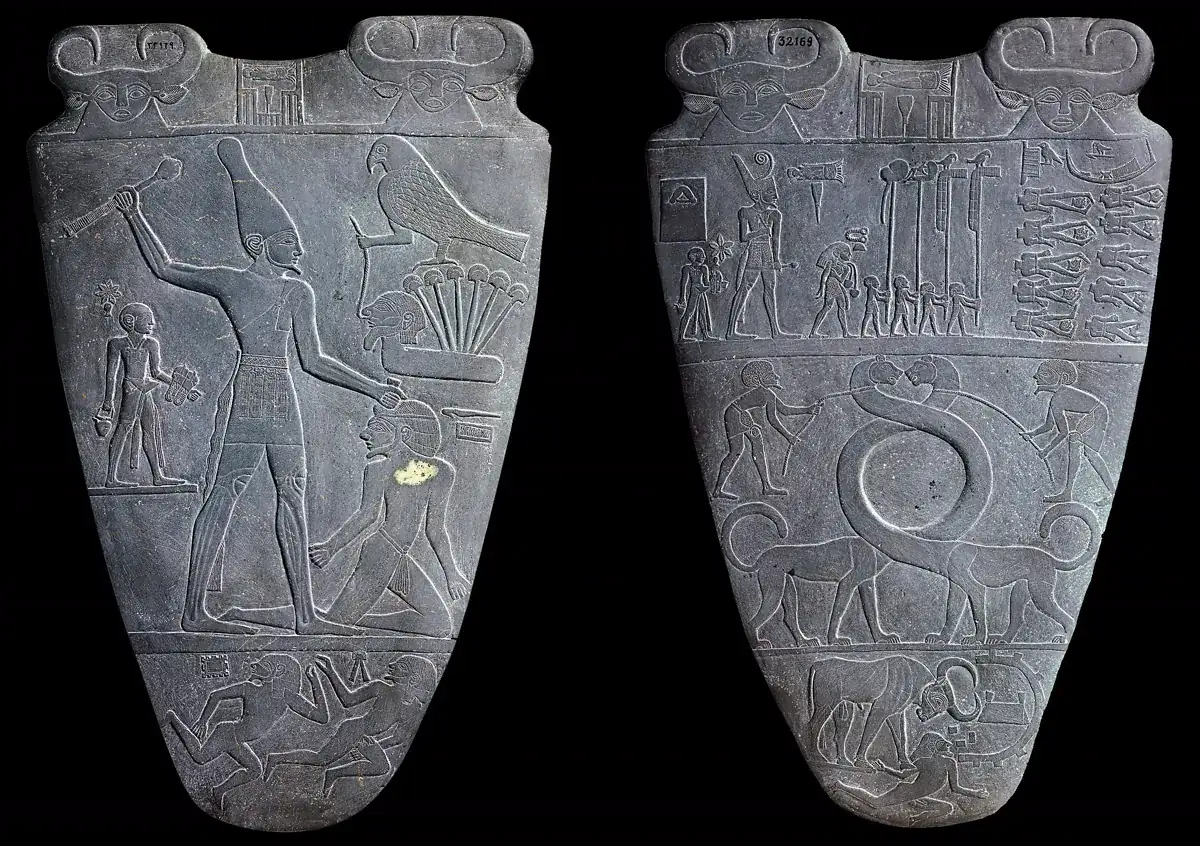
Tradition makes Menes the first king to unify Upper and Lower Egypt and credits him with founding the 1st dynasty.1 The name appears in later king lists and later histories, not in a contemporary coronation record.
Modern scholars have not conclusively identified Menes with Narmer, Aha or other early kings.2
The Narmer Palette was found at Hierakonpolis, dates to the beginning of the 1st dynasty, c. 2900 BCE, and shows Narmer wearing the White Crown.3
The other side is usually read as the Red Crown; the two crowns place Upper and Lower Egypt under one royal name, but this is commemorative imagery, not an administrative record.4
Unification more likely took several generations: the real integration lay in tax rolls, borders, a capital and local officials, not in the aftermath of one battle.5
Evidence ledger
5 claims3 sourced0 unsourced2 author judgment
Every hard fact in the narrative above is registered here. A claim may also record source-only details that the narrative does not repeat; the related-narrative line points to the corresponding passage, not a guarantee that the source supports every word of the body. A claim without a source stays visibly unsourced.
- Menes and the unification of EgyptBritannica, Menes, first paragraph
Menes (flourished c. 2900 bce) was the legendary first king of unified Egypt, who, according to tradition, joined Upper and Lower Egypt in a single centralized monarchy and established ancient Egypt’s 1st dynasty.
Accessed 2026-11-25 · human read
Says 'tradition', not proven fact; no contemporary archive left by Menes.
- Menes and the unification of EgyptBritannica, Menes, first paragraph
Modern scholars have not conclusively identified Menes with Narmer, Aha or other early kings.
Related narrativeModern scholars have not conclusively identified Menes with Narmer, Aha or other early kings.
- Menes and the unification of EgyptBritannica, Menes, first paragraph
Modern scholars have inconclusively identified the legendary Menes with one or more of the archaic Egyptian kings bearing the names Scorpion, Narmer, and Aha.
Accessed 2026-11-25 · human read
Keeps the inconclusive identification; no 'Menes was Narmer'.
- Menes and the unification of EgyptBritannica, Menes, first paragraph
The Narmer Palette was found at Hierakonpolis, dates to the beginning of the 1st dynasty, c. 2900 BCE, and shows Narmer wearing the White Crown.
Related narrativeThe Narmer Palette was found at Hierakonpolis, dates to the beginning of the 1st dynasty, c. 2900 BCE, and shows Narmer wearing the White Crown.
- Menes and the unification of EgyptBritannica, Menes, Narmer Palette image caption
Narmer Palette From Hierakonpolis, beginning of 1st dynasty, c. 2900 bce; in the Egyptian Museum, Cairo. Reverse, showing a victory motive, King Narmer, wearing the crown of Upper Egypt, striking down an enemy held by the hair.
Accessed 2026-11-25 · human read
Only place, date and White Crown stated in the caption; the Red Crown is treated as interpretation.
- Menes and the unification of EgyptBritannica, Menes, Narmer Palette image caption
The other side is usually read as the Red Crown; the two crowns place Upper and Lower Egypt under one royal name, but this is commemorative imagery, not an administrative record.
Related narrativeThe other side is usually read as the Red Crown; the two crowns place Upper and Lower Egypt under one royal name, but this is commemorative imagery, not an administrative record.
Editorial judgment, not a historical fact.
Author judgment: distinguishes artifact imagery from administrative record.
Unification more likely took several generations: the real integration lay in tax rolls, borders, a capital and local officials, not in the aftermath of one battle.
Related narrativeUnification more likely took several generations: the real integration lay in tax rolls, borders, a capital and local officials, not in the aftermath of one battle.
Editorial judgment, not a historical fact.
Author judgment: turns 'unification' from one battle into generations of administrative integration.
Sources and review
Key claims rely on a single source record
- Menes and the unification of Egypt · Encyclopaedia Britannica (accessed 2026-11-25) Original source ↗
Locations
- Egypt· 29.85, 31.25· Approximate
evt-7fb5614b71cb7c5eSource file:
events/evt-7fb5614b71cb7c5e/event.md