
The Mongol Empire: From the Onon to the Volga
StoryTwo generations, and a steppe power whose wars reached Central Asia, the Rus' lands and Central Europe
In 1206 Temujin was proclaimed Genghis Khan at the source of the Onon River. He divided the steppe population into ninety-five thousands and drew ten thousand sons of noble families into the keshig guard. Over the next thirty-six years Mongol armies pressured Western Xia, broke the Jin central capital, turned west against Khwarazm, pursued the campaign into the Rus' steppe, and reached Central Europe in 1241. In 1242 news of Ögedei's death brought the western army back from Hungary and Poland to the lower Volga. This story links twelve nodes along that line, attending to organization, mounted archery and coordinated columns, but also to the killing, burning and forced movement that followed the fall of cities; it does not turn conquest into pure romance.
The thousand-household system turned scattered steppe tribes into mobilizable military-administrative units; the keshig supplied a cross-tribal command cadre; craftsmen and siege technology taken from conquered peoples filled a gap. The Khwarazmian caravan massacre supplied a casus belli, and coordinated columns carried the war from Central Asia to the Danube. What stopped the European front was not a battlefield defeat but the death of the great khan in 1241 and the succession order that followed.
Chapter-level sources; key claims checked.
Chapter timeline
Chapters in reading orderAll anchors are approximate region-level placements; they are not precise sites. Chapters without coordinates are listed below by region only.
Chapter contents12 chapters
- The kurultai by the Onon
- Striking Western Xia first, opening the southern flank
- Yehuling: the collapse of the Jin field army
- The fall of Zhongdu and the abandonment of North China
- Khwarazm: the caravan massacre and the first western campaign
- Samarkand: five days and thirty thousand craftsmen
- The Kalka: feigned retreat and two wings
- The deathbed orders below Liupan Mountain
- The princes' campaign: from the steppe to the Rus'
- Kiev: the disappearance of a capital
- Legnica: the destruction of the European host
- Turning back at the Volga
The story, chapter by chapter
Each chapter opens the underlying event- 01
The kurultai by the Onon
At a kurultai convened at the source of the Onon River, the Mongol tribes elected Temüjin as 'Genghis Khan', meaning 'Khan of the Oceans' or 'Universal Ruler'. He promulgated the 'Great Yassa' (Mongol code of laws) and established a strict military-civilian 'thousand-unit' system: the entire Mongol population was divided into 95 thousand-units, each under a hereditary commander from among his founding generals. He al…
The kurultai turns a tribal confederation into a military-administrative state; ninety-five thousands and a ten-thousand-strong keshig become the organizational base for expansion.
In 1206 the Mongol tribes held a kurultai at the source of the Onon River. Temujin was proclaimed Genghis Khan, "the khan who possesses the four quarters of the ocean". This was not an ordinary tribal election: it placed formerly warring tribes under one supreme khan.
The new polity did three things at once. It issued the Great Yassa, putting law into an executable text; it divided the whole Mongol population into ninety-five thousands, each granted to a founding commander on a hereditary basis; and it took ten thousand sons of noble families into the keshig, a guard that also trained senior commanders. A thousand was both a productive unit and a mobilization unit, so scattered steppe households could be assembled into armies.
For later western campaigns, the value of this system lay in its reproducibility: conquered regions could be organized into thousands, old and surrendered troops could be broken up and reassigned, and the guard supplied a cross-tribal command cadre. 1206 was therefore a beginning, not an end.
Sources: 5 event claims, 5 sourced; source cards src-b3w-mongol-rise-02, src-b3w-mongol-rise-05 (background only).
SourcesMongol Empire — Wikipedia backgroundGenghis Khan — Wikipedia background
- 02
Striking Western Xia first, opening the southern flank
Genghis Khan launched his first campaign against Western Xia to punish it for refusing to send troops to aid the Mongols against the Jin and to open a western route for attacking the Jin. The Mongol army advanced swiftly, reaching the Western Xia capital Zhongxing (present-day Yinchuan, Ningxia). Emperor Xiangzong of Western Xia was forced to give a daughter in marriage, agree to become a Mongol vassal, and pledge tr…
Punishing Western Xia and opening a flank against Jin is the starting point; its submission is temporary, and the Hexi corridor will change hands repeatedly.
In 1209 Genghis Khan campaigned against Western Xia for the first time. The event record gives two reasons: Western Xia had refused to send troops to help the Mongols attack Jin, and the Mongols needed to open the western route into Jin territory. The campaign moved along the Hexi corridor and brought the Mongol army before Xingqing, the Western Xia capital (present-day Yinchuan).
Emperor Xiangzong, Li Anquan, did not choose a long defense. He offered his daughter, submitted as a vassal, promised tribute and undertook to send troops with the Mongols against Jin. For the Mongols this was a corridor and a client obtained by military pressure; for Western Xia it was a temporary expedient.
In the following decades the two states did not settle into stability after this submission; they fought repeatedly. This chapter marks the first direction of Mongol expansion: cut away Jin's northwestern flank before entering North China head-on.
Sources: 6 event claims, 6 sourced; source cards src-b3w-mongol-rise-05, src-b3w-mongol-rise-02 (background only).
SourcesGenghis Khan — Wikipedia backgroundMongol Empire — Wikipedia background
- 03
Yehuling: the collapse of the Jin field army
Genghis Khan personally led about 100,000 Mongol troops in their first major invasion of the Jin. The Jin deployed 450,000 men (claimed 500,000) to defend at Yehuling (present-day Wanquan District, Zhangjiakou, Hebei). The Mongol general Muqali proposed avoiding the main force and sent a cavalry detachment through a mountain path to surprise the Jin command. The Jin commander Wanyan Chengyu fled the battlefield, caus…
A hundred thousand Mongols against four hundred and fifty thousand Jin troops; Muqali strikes the command post from behind, the Jin commander flees, and the field army is spent in one battle.
In 1211 Genghis Khan led roughly a hundred thousand Mongol troops in the first great invasion of Jin. Jin forces fortified Yehuling (present-day Wanquan district, Zhangjiakou, Hebei); the event record puts their number at four hundred and fifty thousand, styled five hundred thousand. The disparity was plain, and the Mongols could not simply push through the front.
Muqali proposed striking the weak point rather than the strong: elite cavalry would leave the road, come around through the mountain paths and hit the Jin command post directly. The Jin commander Wanyan Chengyu fled the field, the command system collapsed, and the front-line units disintegrated. Yehuling was therefore not a slow attrition but a raid aimed at the brain of the army.
After this battle Jin's best field troops were almost gone, and it could no longer organize large-scale resistance in the open. The Mongols gained the operational initiative in North China; but Zhongdu remained in Jin hands, and the next chapter had to settle the capital and the will to defend it.
Sources: 7 event claims, 7 sourced; source cards src-b3w-mongol-rise-04, src-b3w-mongol-rise-02 (background only).
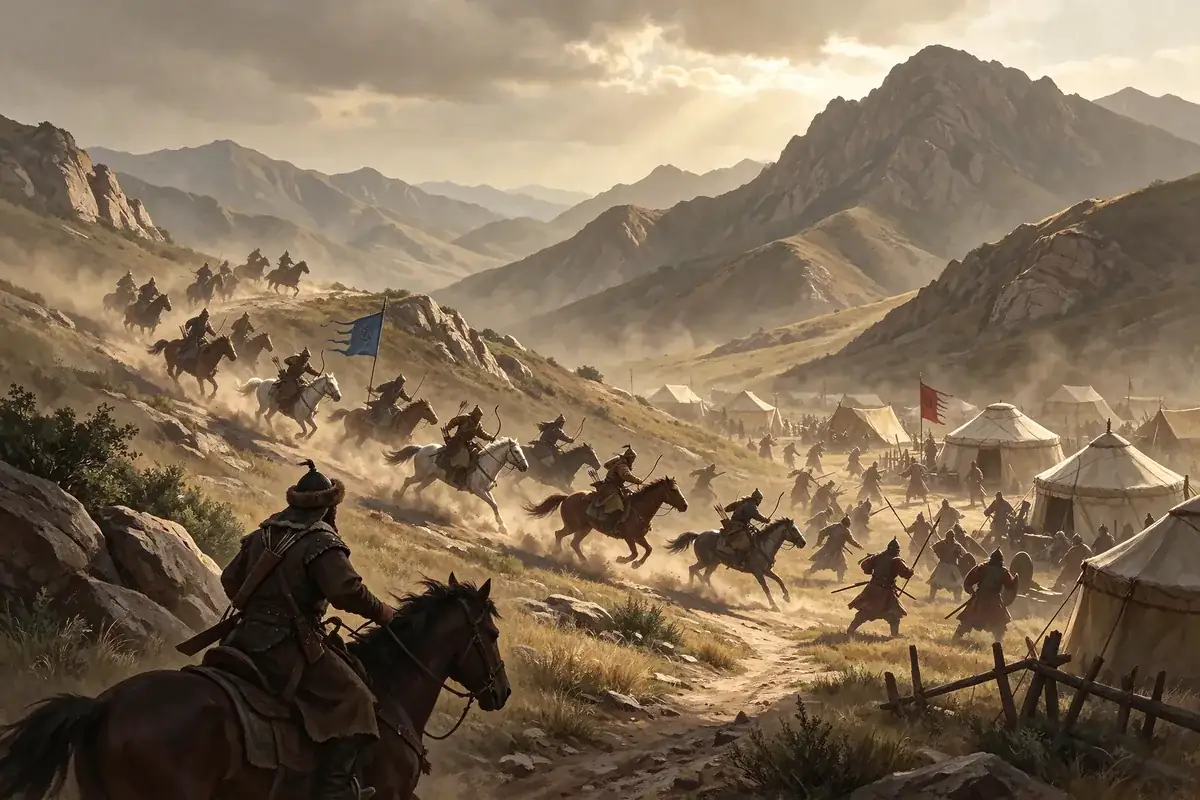
AI-generated illustration: The Mongol general Muqali proposed avoiding the main force and sent a cavalry detachment through a mountain path to surprise the Jin command.实录编辑部 · AI 生成示意图 · CC0 1.0 · CC0-1.0 SourcesBattle of the Kalka River — Wikipedia backgroundMongol Empire — Wikipedia background
- 04
The fall of Zhongdu and the abandonment of North China
After Emperor Xuanzong moved the capital to Bianjing, the Zhongdu garrison commanders Wanyan Cheng-hui and Mo-nian Jin-zhong were unable to defend the city due to a mutiny. On 31 May 1215 the Mongols broke through the outer walls, and the remaining Jin officials committed suicide. The Mongols set fire to the imperial palace, burned the ancestral tablets and books in the imperial temple, and plundered countless treasu…
Emperor Xuanzong has moved south to Bianjing; mutiny breaks the Zhongdu garrison, and the burning and looting after the fall mark Jin's abandonment of North China.
After Emperor Xuanzong moved the capital to Bianjing, the defense of Zhongdu had already become an abandoned task. Left behind were Wanyan Chenghui and Molian Jinzhong; faced with mutiny in the army, they could not maintain order. On 31 May 1215 Mongol forces broke into the outer city, and the remaining officials killed themselves rather than surrender.
After the fall the Mongols set fires in the city and burned the palace; the tablets of Jin emperors and the books in the imperial ancestral temple were destroyed together, and treasures including Liao dynasty regalia were carried off. The event record treats this moment as Jin's definitive abandonment of North China and the Mongols' rise to hegemony in East Asia.
Militarily, the fall of Zhongdu did not mean the end of Jin. The court remained at Bianjing, and resistance continued in Henan and Guanzhong; but the political center of North China had fallen, and the Mongols had acquired a base they could administer over the long term. The turn toward the west came after this stage.
Sources: 6 event claims, 6 sourced; source cards src-b3w-mongol-rise-05, src-b3w-mongol-rise-02 (background only).
SourcesGenghis Khan — Wikipedia backgroundMongol Empire — Wikipedia background
- 05
Khwarazm: the caravan massacre and the first western campaign
Genghis Khan launched his first major western campaign against the Khwarazmian Empire, using as pretext the massacre of a Mongol trade caravan and the humiliation of Mongol envoys. Leading about 150,000 troops divided into four columns, he employed a strategy of converging attacks, quickly capturing the major cities of Otrar, Bukhara, and others. The Khwarazmshah Muhammad, fearful of the Mongols' strength, abandoned…
The killing of a caravan and the insult to envoys become the pretext; a hundred and fifty thousand troops advance in four columns, and the Khwarazmian shah chooses flight.
In 1217 Genghis Khan launched the first large-scale western campaign, citing the Khwarazmian massacre of a Mongol caravan and the insult to Mongol envoys. The event record states that about a hundred and fifty thousand troops advanced in four columns, using converging attacks and taking Otrar, Bukhara and other major towns.
The Khwarazmian shah, Muhammad, did not concentrate his main army for a decisive battle under one city. Fearing Mongol mobility and field strength, he gave up resistance, withdrew toward Persia and finally fled to an island in the Caspian, where he died.
The campaign pushed the empire's frontier into Central Asia and Persia. For the Mongols it was the first transfer of war from the steppe and North China into settled agricultural regions and international trading cities; for Khwarazm, the caravan bloodshed brought not a border reprisal but a process of state destruction.
Sources: 7 event claims, 7 sourced; source cards src-b3w-mongol-rise-05, src-b3w-mongol-rise-07 (background only).
SourcesGenghis Khan — Wikipedia backgroundKhwarazmian Empire — Wikipedia background
- 06
Samarkand: five days and thirty thousand craftsmen
Genghis Khan personally led the main Mongol army to besiege Samarkand, the new capital of Khwarazm (present-day Samarkand, Uzbekistan). Although the city had a reported 110,000 defenders and 20 war elephants, the Khwarazmshah Muhammad had already fled. The Mongols attacked with counterweight trebuchets and fire pots; the defenders surrendered after only five days. Genghis Khan enslaved 30,000 artisans and strong men…
A hundred and ten thousand defenders and twenty war elephants do not hold Samarkand; the city falls in five days, thirty thousand craftsmen are taken, and the outer wall is destroyed.
In 1220 Genghis Khan led the main army against Samarkand, the new Khwarazmian capital (present-day Samarkand, Uzbekistan). The event record states that the city had a nominal garrison of a hundred and ten thousand and twenty war elephants, but Shah Muhammad had already fled, leaving the defenders without a single supreme command.
The Mongols attacked with trebuchets and incendiary oil jars; the garrison surrendered after five days. After the fall, thirty thousand craftsmen and able-bodied men were taken as slaves, and the outer wall was destroyed. The figures come from the event record, which does not explain how they were counted.
The fall of Samarkand stripped Khwarazm of its political and commercial center; the empire's destruction was now a foregone conclusion. But the war did not end with the walls: the fleeing shah, the scattered cities and the surrounding regions would draw the Mongols into a longer pursuit.
Sources: 7 event claims, 7 sourced; source cards src-b3w-mongol-rise-08, src-b3w-mongol-rise-02 (background only).
SourcesSiege of Samarkand (1220) — Wikipedia backgroundMongol Empire — Wikipedia background
- 07
The Kalka: feigned retreat and two wings
The Mongol forces of Subutai and Jebe met the coalition of the Kievan Rus' and Kipchaks at the Kalka River (present-day Kalmius River, Ukraine). The Rus' coalition had about 80,000 men, the Mongols about 30,000. The Mongols feigned retreat, luring the Rus' cavalry into pursuit, then used horse archers to envelop and annihilate the main Rus' army. Grand Prince Mstislav of Kiev was captured and executed; six other prin…
Thirty thousand Mongols feign retreat and envelop eighty thousand Rus' and Kipchak troops; the Rus' elite is destroyed and the road is opened for conquest more than a decade later.
In 1223 a Mongol army under Subutai and Jebe fought a combined Kievan Rus' and Kipchak force at the Kalka River (the present-day Kalmius River in Ukraine). The event record puts the Rus' coalition at about eighty thousand and the Mongols at about thirty thousand.
The Mongols did not fight a hard battle at a numerical disadvantage. They feigned retreat, drew the Rus' cavalry out of formation in pursuit, then sent horse archers around both wings and encircled the allied main force against the river. The Kievan grand prince Mstislav was captured and executed; six princes and seventy nobles were killed.
The battle destroyed the elite of the Rus' principalities and opened the road for the princes' campaign fourteen years later. It was not an occupation: the Mongols soon withdrew from the south Russian steppe and the Rus' remained in the hands of local princes; but the balance of field power had been permanently altered.
Sources: 7 event claims, 7 sourced; source cards src-b3w-mongol-rise-04, src-b3w-mongol-rise-01 (background only).
SourcesBattle of the Kalka River — Wikipedia backgroundMongol invasion of Kievan Rus' — Wikipedia background
- 08
The deathbed orders below Liupan Mountain
The founder of the Mongol Empire, Genghis Khan (Temüjin), died in his camp at Qingshui County (present-day Qingshui, Gansu) on the western campaign against Western Xia, at the age of 65. On his deathbed, he left three commands: keep his death secret to avoid resistance from Western Xia and enemies; completely destroy Western Xia to leave no future trouble; exploit the enmity between the Song and Jin to ally with the…
Genghis Khan dies on the Western Xia campaign; three orders, to conceal the death, destroy Western Xia and ally with Song against Jin, hand the war to the next generation.
In 1227 Genghis Khan died on the Western Xia campaign at a palace near Qingshui, below Liupan Mountain; the event record gives his age as sixty-five. His death was not made public at once. On his orders it was concealed, lest Western Xia and enemy forces learn of it and reorganize resistance.
Two further orders followed: destroy Western Xia completely, leaving no future threat; and use the old Song–Jin enmity to ally with Song and destroy Jin. The first concerned the war at hand, the second handed the destruction of Jin to the next generation. The body was taken secretly back to the Mongolian plateau and buried in the Qinian Valley of the Khentii Mountains; the exact place was not left behind, and those who took part in the burial were later killed to keep it secret.
The khan's death put a succession question before the empire. Expansion would not stop because one man died, but who could move the armies of the various princes and who decided the next war became a problem every later western campaign had to settle first.
Sources: 6 event claims, 6 sourced; source cards src-b3w-mongol-rise-02, src-b3w-mongol-rise-05 (background only).
SourcesMongol Empire — Wikipedia backgroundGenghis Khan — Wikipedia background
- 09
The princes' campaign: from the steppe to the Rus'
Great Khan Ögedei decided to launch a second western campaign, with armies commanded by the eldest sons of the imperial clan, hence called the 'Princes' Western Campaign'. The supreme commander was Batu, son of Jochi; his deputy was Subutai. Other participants included Güyük (son of Ögedei), Möngke (son of Tolui), and Büri (grandson of Chagatai). The army of about 120,000 set out from the Mongolian plateau to conquer…
Ögedei sends the eldest sons of the imperial lines, with Batu in command and Subutai as deputy; a hundred and twenty thousand troops move west into the Kipchak steppe and the Rus' lands.
In 1235 Ögedei ordered a second western campaign. Unlike the first, it was led by the eldest sons of the imperial lines, and so became known as the "princes' campaign". Batu, eldest son of Jochi, was commander; Subutai was deputy; also present were Güyük, eldest son of Ögedei, Möngke, eldest son of Tolui, and Büri, eldest grandson of Chagatai.
The event record states that some hundred and twenty thousand troops set out from the Mongolian plateau to conquer the Kipchak steppe and the Rus' principalities. Each imperial line sent its eldest son, which widened the manpower base and gave every branch of the dynasty a stake in the war.
The campaign eventually produced the Golden Horde. It pushed the empire's northwestern frontier to the Volga and into the Rus' heartland; but the "eldest sons" arrangement also brought the tensions of succession politics into the army, and later withdrawal and the division of khanates were bound up with it.
Sources: 6 event claims, 6 sourced; source cards src-b3w-mongol-rise-05, src-b3w-mongol-rise-01 (background only).
SourcesGenghis Khan — Wikipedia backgroundMongol invasion of Kievan Rus' — Wikipedia background
- 10
Kiev: the disappearance of a capital
Batu's western expedition army captured Kiev, the capital of Kievan Rus'. The Mongols used counterweight trebuchets to collapse the walls; the city's defenders fought desperately. After the city fell, the Mongols slaughtered and plundered, killing the metropolitan and most of the inhabitants. The once-glorious capital of the Rus' was almost razed to the ground and never recovered. The Mongol domination of Rus' (the '…
Trebuchets breach the walls and Kiev's people fight to the end; the massacre and destruction that follow open more than two centuries of Mongol rule in the Rus' lands.
In 1238 Batu's western army captured Kiev, capital of Kievan Rus'. Mongol trebuchets breached the walls, and the people fought to the end; after the fall the Mongols killed and looted on a large scale, and the bishop of Kiev and most of the inhabitants perished.
The old Rus' capital was almost leveled and did not recover its former standing for a long time. The event record calls Mongol rule over the Rus' lands the "Tatar yoke" and says it lasted two hundred and forty years. Both the figure and the term come from the record and still need verification at a higher evidence level.
Strategically, the fall of Kiev removed the political center of the Rus' principalities and allowed the Mongol army to continue along the steppe into Central Europe. The next stops were Poland and Hungary, where the war would draw in European coalitions as well.
Sources: 7 event claims, 7 sourced; source cards src-b3w-mongol-rise-01, src-b3w-mongol-rise-05 (background only).
SourcesMongol invasion of Kievan Rus' — Wikipedia backgroundGenghis Khan — Wikipedia background
- 11
Legnica: the destruction of the European host
Baidar's Mongol army encountered a Polish-Teutonic coalition near Legnica in Silesia. The Mongols used their feigned retreat tactic, drawing the heavily armored knights into an ambush and then shooting them from both flanks. Duke Henry II of Silesia was killed; the Grand Master of the Teutonic Order was severely wounded. The European coalition was annihilated, but the Mongols voluntarily withdrew upon learning of Öge…
Baidar lures the Polish and Teutonic heavy cavalry into an ambush; the European host is destroyed, but news of the great khan's death soon turns the campaign back.
In 1241 Baidar's Mongol army met a Polish–Teutonic host near Legnica in Silesia, Poland. The European side relied on heavy cavalry; the Mongols on mobility and mounted archery.
Once again the Mongols feigned retreat: they drew the heavy knights out of formation into a prepared ambush, then shot them down from both wings. Duke Henry II of Poland was killed, the Grand Master of the Teutonic Order was badly wounded, and the European army was destroyed.
The victory did not become a long occupation of Central Europe. News of Ögedei's death arrived and the western army turned back; the event record links Europe's escape from further invasion to this withdrawal. The outcome on the battlefield was finally interrupted by imperial succession politics.
Sources: 6 event claims, 6 sourced; source cards src-b3w-mongol-rise-01, src-b3w-mongol-rise-02 (background only).
SourcesMongol invasion of Kievan Rus' — Wikipedia backgroundMongol Empire — Wikipedia background
- 12
Turning back at the Volga
After the death of Ögedei Khan, Batu withdrew the Mongol western army from Hungary and Poland to the South Russian steppes. Batu established the capital of the Golden Horde at Sarai on the lower Volga (near present-day Astrakhan, Russia). The Golden Horde became one of the four khanates of the Mongol Empire, ruling over Rus' for two and a half centuries.
After Ögedei's death Batu withdraws from Hungary and Poland to the south Russian steppe and builds Sarai on the lower Volga; the Golden Horde takes shape.
In 1242 Batu's western army withdrew from Hungary and Poland to the south Russian steppe. This was not a rout after a tactical defeat but the result of the great khan's death: the armies of the various princes had to return and confirm the order of power.
Batu built Sarai on the lower Volga (near present-day Astrakhan, Russia) as the capital of the Golden Horde. The Golden Horde became one of the four khanates of the Mongol Empire and ruled the Rus' lands for two and a half centuries. The Volga thus became both the end point of this western line and the starting point of a new regime.
Looking back from 1206 to 1242, Mongol expansion rested on three things: the thousand-household system that turned population into armies, the keshig and princely command structure that could operate across tribes, and siege technology and craftsmen absorbed from conquered regions. At the same time, the killing, burning and forced movement that followed the fall of cities are part of this line and cannot be omitted. The turn at the Volga in 1242 shows that how far the empire could go depended not only on the battlefield but on who occupied the khan's seat.
Sources: 5 event claims, 5 sourced; source cards src-b3w-mongol-rise-01, src-b3w-mongol-rise-02 (background only).
SourcesMongol invasion of Kievan Rus' — Wikipedia backgroundMongol Empire — Wikipedia background
Cast
People whose choices move the story. Roles describe this story only.
- Genghis KhanGreat khan · founder
Proclaimed khan after unifying the steppe in 1206, establishes the thousands and the keshig; dies on the Western Xia campaign in 1227.
- ÖgedeiSecond great khan · sponsor of the western campaign
Orders the princes' campaign in 1235; his death in 1241 directly changes the western army's direction.
- SubutaiMongol commander · deputy of the western campaign
With Jebe, destroys the Rus' army at the Kalka in 1223; serves as deputy commander of the princes' campaign in 1235.
- JebeMongol commander · vanguard of the western campaign
Commands at the Kalka with Subutai, using a feigned retreat and envelopment to destroy the allied army.
- MuqaliMongol commander · Jin campaign
At Yehuling proposes the flank attack on the Jin command post, the key to breaking the Jin line.
- BatuCommander of the princes' campaign · founder of the Golden Horde
Captures Kiev, withdraws to the lower Volga in 1242 and builds Sarai.
- Muhammad IIKhwarazmian shah · rival
Abandons resistance to the Mongol campaign, flees to an island in the Caspian and dies there.
- Wanyan ChengyuJin commander · Yehuling
Flees the field at Yehuling, collapsing the Jin command system.
- Henry IIDuke of Poland · Legnica
Leads the Polish–Teutonic host at Legnica and is killed in the defeat.
Evidence and limits
Chapter-level sources; key claims checked.
Source count is the number of distinct source records attached to the event nodes shown here. It does not certify the narrative as a whole.