
The Oceanic Turn: From Cape of Good Hope to Circumnavigation
Story1488–1522: how Europeans joined the Atlantic and Indian Oceans into one route
In 1488 Dias rounded the Cape of Good Hope; in 1492 Columbus crossed the Atlantic to the Caribbean; in 1494 the Treaty of Tordesillas pre-divided the “New World”; in 1498 da Gama reached Calicut; in 1500 Cabral reached Brazil; in 1519 Magellan’s fleet set out to circle the globe. Together these are not one “discovery” but a series of voyages, royal licences, capital and violence.
The “Age of Discovery” was not a sudden increase in European courage but the alignment of navigation, interstate rivalry, commercial capital and religious mission. It forced the Indian Ocean network long maintained by Arab, Indian, Southeast Asian and African merchants into Iberian royal routes; it also dragged existing societies in the Americas, Africa and Asia into conquest, disease and colonisation. For the “discovered,” the story was often a different one.
Chapter-level sources; key claims checked.
Chapter timeline
Chapters in reading orderAll anchors are approximate region-level placements; they are not precise sites. Chapters without coordinates are listed below by region only.
Chapter contents6 chapters
The story, chapter by chapter
Each chapter opens the underlying event- 01
Dias rounds the Cape of Good Hope
Dias sailed south along West Africa with two caravels and, near thirty degrees south, was driven off the coast by a storm for some two weeks; turning east and finding no land, he realised he had passed the tip of the continent and ran north to what is now Mossel Bay. He sighted the headland on the return and named it the Cape of Storms, which King John II renamed the Cape of Good Hope. The voyage proved the Atlantic…
Dias sailed south along West Africa with two caravels and, near thirty degrees south, was driven off the coast by a storm for some two weeks; turning east and finding no land, he realised he had passed the tip of the continent and ran north to what is now Mossel Bay.
Dias sailed south along West Africa with two caravels and, near thirty degrees south, was driven off the coast by a storm for some two weeks; turning east and finding no land, he realised he had passed the tip of the continent and ran north to what is now Mossel Bay. He sighted the headland on the return and named it the Cape of Storms, which King John II renamed the Cape of Good Hope. The voyage proved the Atlantic and Indian oceans connected, opening the way for Vasco da Gama.
Rounding the Cape solved how to enter the Indian Ocean from the Atlantic; it did not solve whom to trade with once there. Opening a route and building commerce are two different things.
Sources: 5 event claims, 5 sourced; source cards src-b3w-oceanic-discovery-05, src-b3w-oceanic-discovery-02 (background only).
SourcesPedro Álvares Cabral — Wikipedia backgroundVasco da Gama — Wikipedia background
- 02
Columbus discovers the Americas
On April 17, 1492, Queen Isabella I of Spain signed the Capitulations of Santa Fe with the Genoese navigator Christopher Columbus, funding his westward voyage to find a route to India and China. On August 3, Columbus set sail from Palos with three ships: the Santa María, the Pinta, and the Niña. On the morning of October 12, lookout Rodrigo de Triana sighted land on an island in the Bahamas (San Salvador). Columbus b…
On April 17, 1492, Queen Isabella I of Spain signed the Capitulations of Santa Fe with the Genoese navigator Christopher Columbus, funding his westward voyage to find a route to India and China.
On April 17, 1492, Queen Isabella I of Spain signed the Capitulations of Santa Fe with the Genoese navigator Christopher Columbus, funding his westward voyage to find a route to India and China. On August 3, Columbus set sail from Palos with three ships: the Santa María, the Pinta, and the Niña. On the morning of October 12, lookout Rodrigo de Triana sighted land on an island in the Bahamas (San Salvador). Columbus believed he had reached the East Indies and called the natives "Indians." He brought back gold, spices, and captives, opening sustained European contact with the Americas.
Columbus did not arrive in an empty land. The Caribbean already held Taíno, Kalinago and other societies; the European “discovery” narrative rewrote those people and their land as resources available for possession.
Sources: 6 event claims, 6 sourced; source cards src-b3w-oceanic-discovery-01, src-b3w-oceanic-discovery-04 (background only).
SourcesChristopher Columbus — Wikipedia backgroundTreaty of Tordesillas — Wikipedia background
- 03
Treaty of Tordesillas signed
On June 7, 1494, Spain and Portugal, mediated by the papacy, signed the Treaty of Tordesillas, fixing the line of demarcation 370 leagues west of the Cape Verde islands (about 46° W longitude). The treaty granted Portugal all lands east and Spain all lands west, essentially dividing the non-European world into two colonial empires. Brazil later became Portuguese because of this treaty.
On June 7, 1494, Spain and Portugal, mediated by the papacy, signed the Treaty of Tordesillas, fixing the line of demarcation 370 leagues west of the Cape Verde islands (about 46° W longitude).
On June 7, 1494, Spain and Portugal, mediated by the papacy, signed the Treaty of Tordesillas, fixing the line of demarcation 370 leagues west of the Cape Verde islands (about 46° W longitude). The treaty granted Portugal all lands east and Spain all lands west, essentially dividing the non-European world into two colonial empires. Brazil later became Portuguese because of this treaty.
The Treaty of Tordesillas divided the world between Spain and Portugal before accurate maps existed. It shows that “discovery” was from the start an inter-state accounting exercise, not a private adventure.
Sources: 4 event claims, 4 sourced; source cards src-b3w-oceanic-discovery-04, src-b3w-oceanic-discovery-07 (background only).
SourcesTreaty of Tordesillas — Wikipedia backgroundMagellan expedition — Wikipedia background
- 04
Vasco da Gama’s fleet reaches Calicut
Vasco da Gama’s fleet reached Calicut in India in 1498 during the voyage that departed in 1497. This entry records the arrival and does not retain unverified claims about a trading post or profit multiples.
Vasco da Gama’s fleet reached Calicut in India in 1498 during the voyage that departed in 1497. This entry records the arrival and does not retain unverified claims about a trading post or profit multiples.
Vasco da Gama’s fleet reached Calicut in India in 1498 during the voyage that departed in 1497. This entry records the arrival and does not retain unverified claims about a trading post or profit multiples.
Da Gama reached Calicut within an Indian Ocean trading system centuries old. Europeans did not bring trade into existence; they used cannon and royal charters to rewrite existing rules.
Sources: 7 event claims, 7 sourced; source cards src-b3w-oceanic-discovery-05, src-b3w-oceanic-discovery-02 (background only).
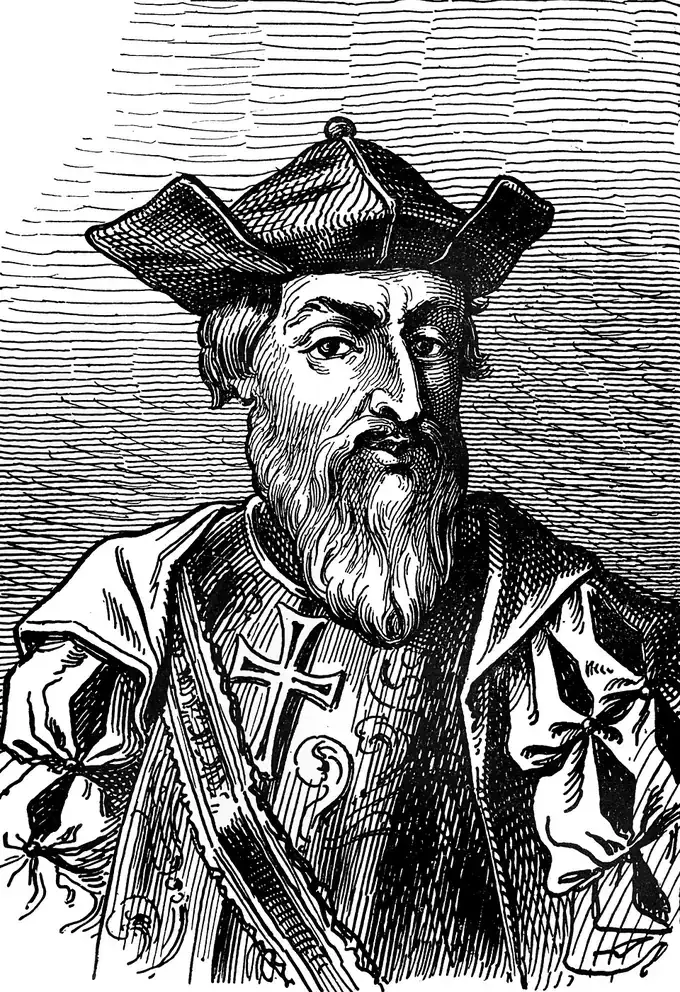
Vasco da Gama.Scribner's Sons, c. 1913 · Wikimedia Commons · Public Domain · PD SourcesPedro Álvares Cabral — Wikipedia backgroundVasco da Gama — Wikipedia background
- 05
Cabral reaches Brazil
Pedro Cabral, bound for India, veers off course and reaches Brazil, claiming it for Portugal.
Pedro Cabral, bound for India, veers off course and reaches Brazil, claiming it for Portugal.
Pedro Cabral, bound for India, veers off course and reaches Brazil, claiming it for Portugal.
Cabral’s arrival in Brazil quickly linked landing, naming, proclamation and factory into one procedure. For the Portuguese crown it was a repeatable template for claims and trade.
Sources: 6 event claims, 6 sourced; source cards src-b3w-oceanic-discovery-05, src-b3w-oceanic-discovery-02 (background only).
SourcesPedro Álvares Cabral — Wikipedia backgroundVasco da Gama — Wikipedia background
- 06
Magellan's Fleet Begins Circumnavigation
On 10 August 1519, Portuguese navigator Ferdinand Magellan set sail from Seville with five ships and about 270 men, heading west to find a westward route to the Spice Islands (Maluku Islands). This was the first circumnavigation of the Earth.
On 10 August 1519, Portuguese navigator Ferdinand Magellan set sail from Seville with five ships and about 270 men, heading west to find a westward route to the Spice Islands (Maluku Islands). This was the first circumnavigation of the Earth.
On 10 August 1519, Portuguese navigator Ferdinand Magellan set sail from Seville with five ships and about 270 men, heading west to find a westward route to the Spice Islands (Maluku Islands). This was the first circumnavigation of the Earth.
Magellan’s circumnavigation proved that the oceans could be joined into one route, at the cost of ships, supplies, disease and death. A global route was not a romantic world map but expensive infrastructure.
Sources: 6 event claims, 6 sourced; source cards src-b3w-oceanic-discovery-07, src-b3w-oceanic-discovery-01 (background only).
SourcesMagellan expedition — Wikipedia backgroundChristopher Columbus — Wikipedia background
Cast
People whose choices move the story. Roles describe this story only.
- Bartolomeu DiasNavigator and Cape route
Led the fleet that rounded southern Africa in 1488, proving the Atlantic and Indian Oceans could be joined via the Cape.
- Christopher ColumbusNavigator and Caribbean
Crossed the Atlantic to the Caribbean in 1492, opening the European conquest and colonisation of the Americas.
- Vasco da GamaNavigator and India route
Reached Calicut in 1498, linking the Cape route to the trading networks of India’s west coast.
Evidence and limits
Chapter-level sources; key claims checked.
Source count is the number of distinct source records attached to the event nodes shown here. It does not certify the narrative as a whole.