
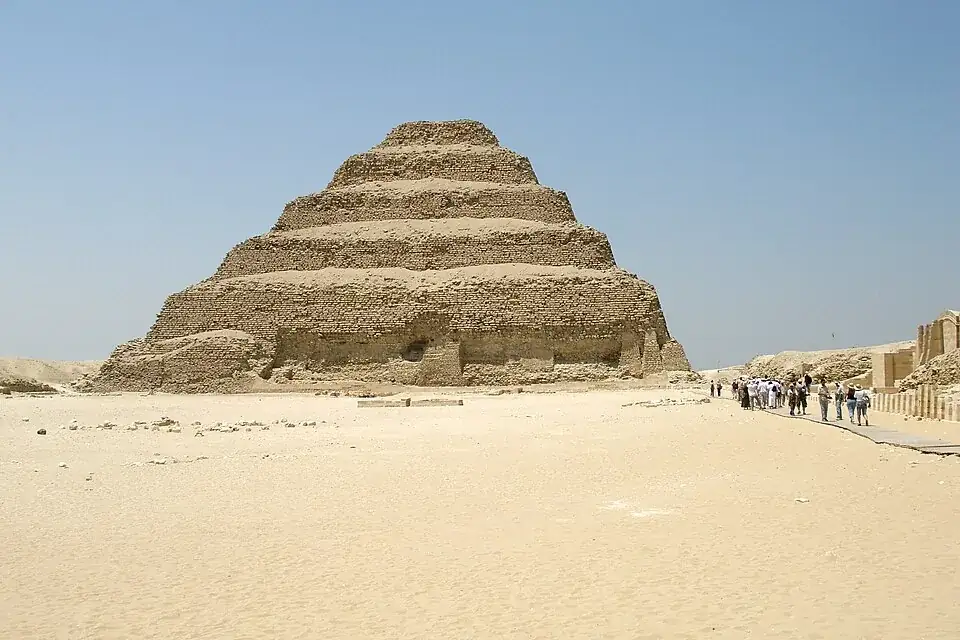
Djoser was the first king of the 3rd dynasty and built Egypt's earliest important stone building at Saqqara.1 His tomb began as a traditional rectangular mastaba and ended as a six-tier step pyramid.
Imhotep was Djoser's architect and physician, and later generations deified him.2 His name became linked with wisdom, medicine and writing, but at the time he was first a royal official.
The Step Pyramid consists of six tiers of stone and clay, rises about 61 metres, and was originally covered in white limestone.3 It is not an isolated tower but the centre of a whole funerary complex.
Beneath the pyramid are galleries and some 400 rooms; the wall around the complex is about 1.6 kilometres long and was originally about 11 metres high.4
The Step Pyramid was more than a royal tomb: it turned quarrying, transport, craftsmen, rations and ritual into a repeatable engineering template.5
Evidence ledger
5 claims4 sourced0 unsourced1 author judgment
Every hard fact in the narrative above is registered here. A claim may also record source-only details that the narrative does not repeat; the related-narrative line points to the corresponding passage, not a guarantee that the source supports every word of the body. A claim without a source stays visibly unsourced.
- Djoser and the Step PyramidBritannica, Djoser, first paragraph
Djoser, was the first king of the 3rd dynasty (c. 2592–c. 2566 bce) of ancient Egypt, who undertook the construction of the earliest important stone building in Egypt.
Accessed 2026-11-25 · human read
Says 'earliest important stone building', not 'first pyramid'.
- Djoser and the Step PyramidBritannica, Djoser, first paragraph
Imhotep was Djoser's architect and physician, and later generations deified him.
Related narrativeImhotep was Djoser's architect and physician, and later generations deified him.
- Djoser and the Step PyramidBritannica, Djoser, first paragraph
His minister, Imhotep, a talented architect and physician, was himself deified in later periods.
Accessed 2026-11-25 · human read
Only architect/physician and deified; no invented divine offices.
- Djoser and the Step PyramidBritannica, Djoser, first paragraph
The Step Pyramid consists of six tiers of stone and clay, rises about 61 metres, and was originally covered in white limestone.
Related narrativeThe Step Pyramid consists of six tiers of stone and clay, rises about 61 metres, and was originally covered in white limestone.
- Djoser and the Step PyramidBritannica, Step Pyramid of Djoser, description
Its diminishing six-tier “step” layers of stone and clay rose to a height of about 200 feet (61 m) and were originally covered in gleaming white limestone.
Accessed 2026-11-25 · human read
Six tiers, about 61 m and white limestone follow the entry.
- Djoser and the Step PyramidBritannica, Step Pyramid of Djoser, description
Beneath the pyramid are galleries and some 400 rooms; the wall around the complex is about 1.6 kilometres long and was originally about 11 metres high.
Related narrativeBeneath the pyramid are galleries and some 400 rooms; the wall around the complex is about 1.6 kilometres long and was originally about 11 metres high.
- Djoser and the Step PyramidBritannica, Step Pyramid of Djoser, description
Beneath the pyramid was an underground structure of unprecedented size and complexity, with galleries and some 400 rooms. … The wall around the complex was more than 1 mile (1.6 km) long and originally 34 feet (11 m) high.
Accessed 2026-11-25 · human read
Underground rooms and wall figures follow the entry; no claim that all are open.
- Djoser and the Step PyramidBritannica, Step Pyramid of Djoser, description
The Step Pyramid was more than a royal tomb: it turned quarrying, transport, craftsmen, rations and ritual into a repeatable engineering template.
Related narrativeThe Step Pyramid was more than a royal tomb: it turned quarrying, transport, craftsmen, rations and ritual into a repeatable engineering template.
Editorial judgment, not a historical fact.
Author judgment: links architectural form to engineering organisation.
Sources and review
Key claims rely on a single source record
- Djoser and the Step Pyramid · Encyclopaedia Britannica (accessed 2026-11-25) Original source ↗
Locations
- Egypt· 29.87, 31.22· Approximate
evt-60362ea34a8c51d2Source file:
events/evt-60362ea34a8c51d2/event.md