
Byzantium: Walls, Code and Hagia Sophia
Story324–537: how New Rome packed an empire into one city
In 324 Constantine founded New Rome on the old site of Byzantium by the Bosporus, and the city was inaugurated in 330; in 413 and 447 the Theodosian Walls enclosed it in two stages; in 438 the Theodosian Code was published; in 451 the Council of Chalcedon affirmed two natures in Christ; from 529 to 565 Justinian's Corpus Juris Civilis was compiled; in 537 Hagia Sophia was completed. Six events correspond to a city's site, defence, law, religion and symbolism.
Byzantine endurance did not rest on the name “Rome” alone but on repeatable institutions: taxation from control of the straits, security from the walls, predictable governance from the codes and legitimacy from the church. Separating hard infrastructure from soft institutions explains how the city survived nearly a millennium after the western empire collapsed.
Chapter-level sources; key claims checked.
Chapter timeline
Chapters in reading orderAll anchors are approximate region-level placements; they are not precise sites. Chapters without coordinates are listed below by region only.
Chapter contents6 chapters
- Constantine founds New Rome on the site of Byzantium
- The Theodosian Walls turn Constantinople into a fortress
- The Theodosian Code turns imperial rulings into an official code
- Council of Chalcedon: two natures become orthodox
- The Code of Justinian: Roman law in four books
- Hagia Sophia: imperial power and patriarchate under one dome
The story, chapter by chapter
Each chapter opens the underlying event- 01
Constantine founds New Rome on the site of Byzantium
On September 18, 324, Constantine defeated Licinius at Chrysopolis; within three weeks the foundation rites of New Rome were held, and the city was officially inaugurated on May 11, 330. The move shifted the empire's power centre eastward.
On September 18, 324, Constantine defeated Licinius at Chrysopolis and became sole emperor of the Roman Empire, east and west. Within three weeks the foundation rites of New Rome were held; on May 11, 330, the enlarged city was officially inaugurated.
On September 18, 324, Constantine defeated Licinius at Chrysopolis on the Asian shore of the Bosporus and became sole emperor of the Roman Empire, east and west. Within three weeks the foundation rites of New Rome were held; on May 11, 330, the enlarged city was officially inaugurated.
He made the old Greek city of Byzantium his capital.
The empire's power centre moved eastward.
The site commanded the Bosporus and linked the Black Sea with the Mediterranean; the peninsula and the Golden Horn offered harbours and defence.
The choice also brought the first lasting unification of Greece.
After 330, Constantinople became one of the empire's principal capitals: the emperor's residence and administrative centre, a stage for church power, and a city famed for wealth and buildings.
But the new capital carried costs. It had to feed a large court, army and population through distant grain and taxes; the old western aristocracy and the new eastern court also competed for power.
The decision of 324 was therefore not a simple move of residence but a recalibration of the empire's political geography; New Rome became the container of eastern power.
Sources: 9 event claims, 6 sourced; source cards src-b7-constantine-capital-324 (background only).
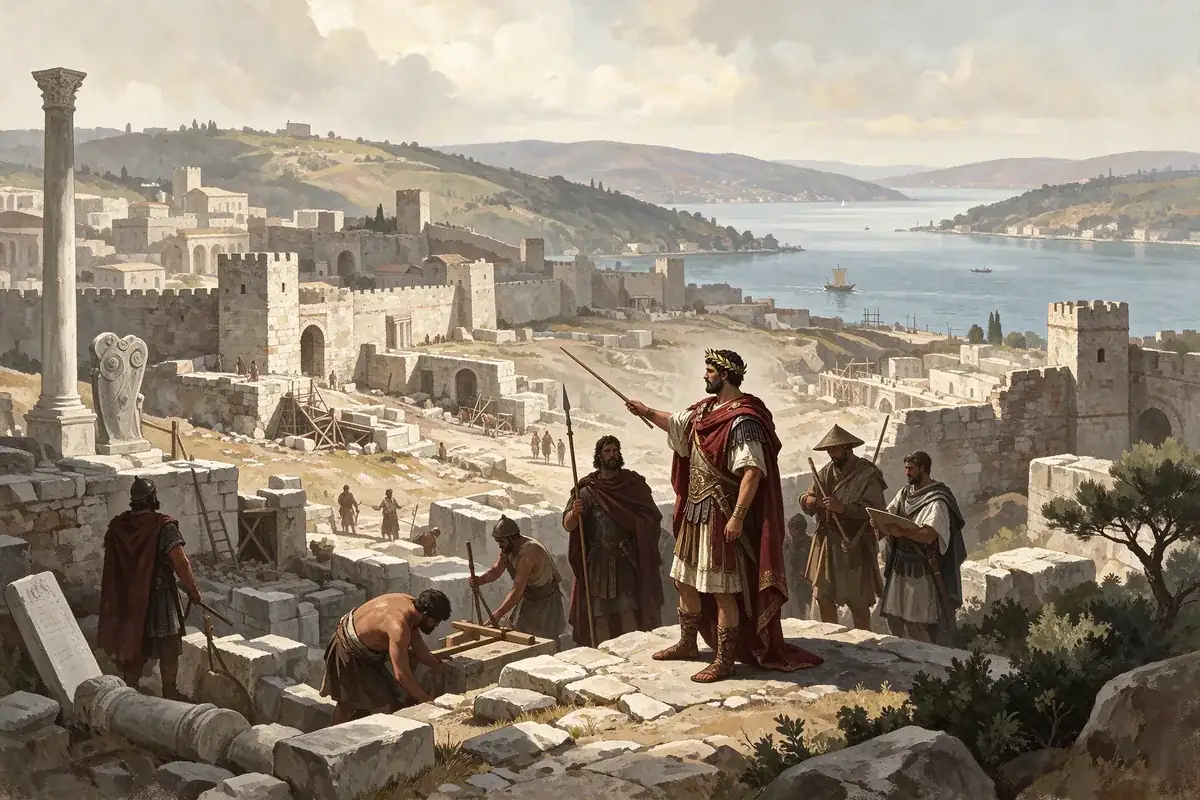
AI-generated illustration: the founding of New Rome.实录编辑部 · AI 生成示意图 · CC0 1.0 · CC0-1.0 - 02
The Theodosian Walls turn Constantinople into a fortress
In 413, under Theodosius II, the inner land wall was built; in 447 the outer wall was added. The land walls ran about 7 km, with an inner wall about 9 metres high and 5 metres thick, fronted by a moat; they were breached only in 1453 by Ottoman cannon.
In 413, under Theodosius II, the inner land wall was built; in 447 the outer wall was added. The land walls ran about 7 km, with an inner wall about 9 metres high and 5 metres thick and towers about 18 metres high, roughly 55 metres apart; they were breached only in 1453 by Ottoman cannon.
In 413, during the reign of Theodosius II, the inner land wall of Constantinople was begun; in 447 the outer wall was added. A moat ran in front.
The two lines ran across the western end of the peninsula, separating the city from the mainland.
The land walls were about 7 km long. The inner wall was about 9 metres high and 5 metres thick; its towers were about 18 metres high and roughly 55 metres apart.
The outer wall originally had 92 towers, of which 56 still stand. The line was breached only in 1453, by the cannon of the Ottoman sultan Mehmed II; earlier land sieges failed to break it.
But walls do not guarantee safety by themselves. They need soldiers, grain, repairs and sea supply; they fix resources at the capital and tie the empire's fate to one city.
Sources: 6 event claims, 5 sourced; source cards src-b7-theodosian-walls (background only).
- 03
The Theodosian Code turns imperial rulings into an official code
In 438, under Theodosius II, the Theodosian Code was published in the Eastern Empire. It codified imperial constitutions from Constantine I onward, banned paganism and penalized heresy.
In 438, under Theodosius II, the Theodosian Code was published in the Eastern Empire. It codified imperial constitutions from Constantine I onward, including laws issued after 312; it banned paganism, penalized heresy and was a major step in organizing Roman law.
In 438, under Theodosius II, the Theodosian Code was published in the Eastern Empire. It codified imperial constitutions from the reign of Constantine I onward, including laws issued after 312.
The code did more than arrange rules: it banned paganism and penalized heresy.
It was a major step in organizing and standardizing Roman law.
But it was not a wholly new code; it was a compilation of imperial laws, arranged by subject so that officials could cite one set of rules.
Legal unification had another side: the empire used law to separate orthodoxy from heresy, and religious dissent became a political matter.
Sources: 5 event claims, 4 sourced; source cards src-b7-theodosian-code-438 (background only).
SourcesTheodosian Code background
- 04
Council of Chalcedon: two natures become orthodox
In 451 Marcian convoked the fourth ecumenical council at Chalcedon; about 520 bishops or representatives attended. It affirmed two natures in Christ, rejected monophysitism, issued disciplinary decrees and established patriarchates.
In 451 Marcian convoked the fourth ecumenical council at Chalcedon; about 520 bishops or representatives attended. It affirmed two natures in Christ, rejected monophysitism, issued disciplinary decrees and declared Jerusalem and Constantinople patriarchates.
In 451, Emperor Marcian convoked the fourth ecumenical council at Chalcedon, modern Kadıköy in Turkey. About 520 bishops or their representatives attended; it was the largest and best-documented of the early councils.
The council approved the creed of Nicaea, the creed of Constantinople, two letters of Cyril of Alexandria against Nestorius, and Leo I's Tome. It confirmed two distinct natures in Christ and rejected the monophysite doctrine of one nature.
Its formula spoke of Christ as perfect in deity and perfect in humanity, "in two natures, without being mixed, transmuted, divided, or separated."
The council also issued disciplinary decrees for monks and clergy and declared Jerusalem and Constantinople patriarchates, giving the church a more stable institutional character.
Defining orthodoxy was also drawing a line: the rejection of monophysitism left part of the eastern Christian world outside the settlement, and the dispute over Chalcedon endured.
Sources: 5 event claims, 4 sourced; source cards src-b7-chalcedon-451 (background only).
- 05
The Code of Justinian: Roman law in four books
In 529 the first Codex Constitutionum was promulgated in 10 books; in 534 it was revised to 12 books. The Digesta was compiled in 530–533 in 50 books, the Institutiones appeared in 533, and the Novels were collected from 534 to 565. Together they form the Corpus Juris Civilis.
In 529 the first Codex Constitutionum was promulgated in 10 books; in 534 it was revised to 12 books. The Digesta was compiled in 530–533 in 50 books, the Institutiones appeared in 533, and the Novels were collected from 534 to 565. Together they form the Corpus Juris Civilis.
In 529, Justinian promulgated the first Codex Constitutionum in 10 books; imperial ordinances not included in it were repealed.
In 534, a new commission issued a revised Codex of 12 books, partly based on Justinian's own legislation.
Between 530 and 533, 16 lawyers under Tribonian compiled the Digesta in 50 books, selecting, cutting and rephrasing extracts from the authorized jurists into a citable text.
The Institutiones appeared in 533 as an elementary textbook.
The Novels collected Justinian's new ordinances from 534 to 565.
Together the four works are known as the Corpus Juris Civilis. They were not a wholly new code but a compilation, pruning and restatement of existing law.
The unified text concentrated interpretation at court: it reduced local discretion and made the emperor the final interpreter of the law; law became a teachable, citable body of official knowledge.
Layer Institutional move What remained Site New Rome founded 324, inaugurated 330 straits revenue and an eastern administrative centre Defence inner wall 413, outer wall 447 a maintainable defensive system Law Theodosian Code 438; Corpus Juris Civilis 529–565 citable imperial statutes and teaching texts Religion Chalcedon defines two natures 451 patriarchates and the boundary of orthodoxy Table: four institutional layers of one city. The six chapters are not isolated events; site, defence, law and religion supported one another.
Sources: 7 event claims, 6 sourced; source cards src-b7-justinian-code-529 (background only).
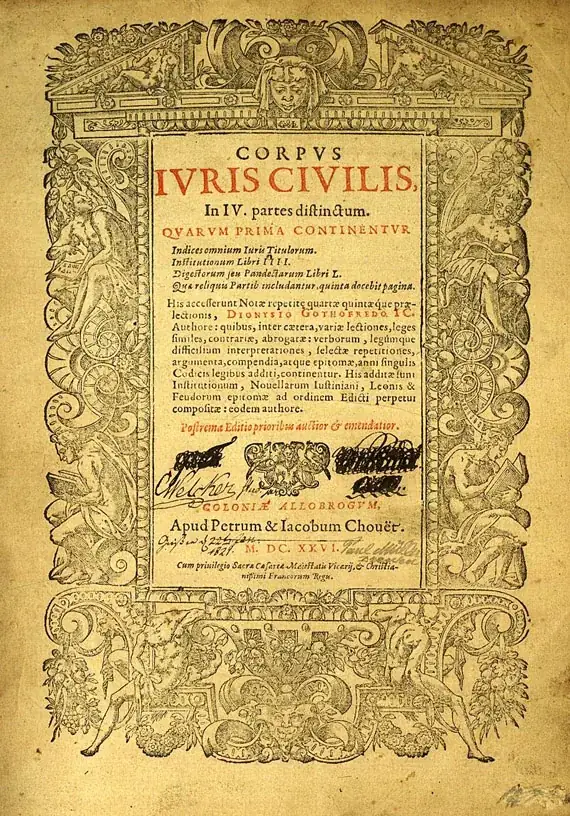
Title page of a printed edition of the Corpus Juris Civilis.Dionysius Gothofredus, 1626 · Wikimedia Commons · Public Domain · PD SourcesCode of Justinian background
- 06
Hagia Sophia: imperial power and patriarchate under one dome
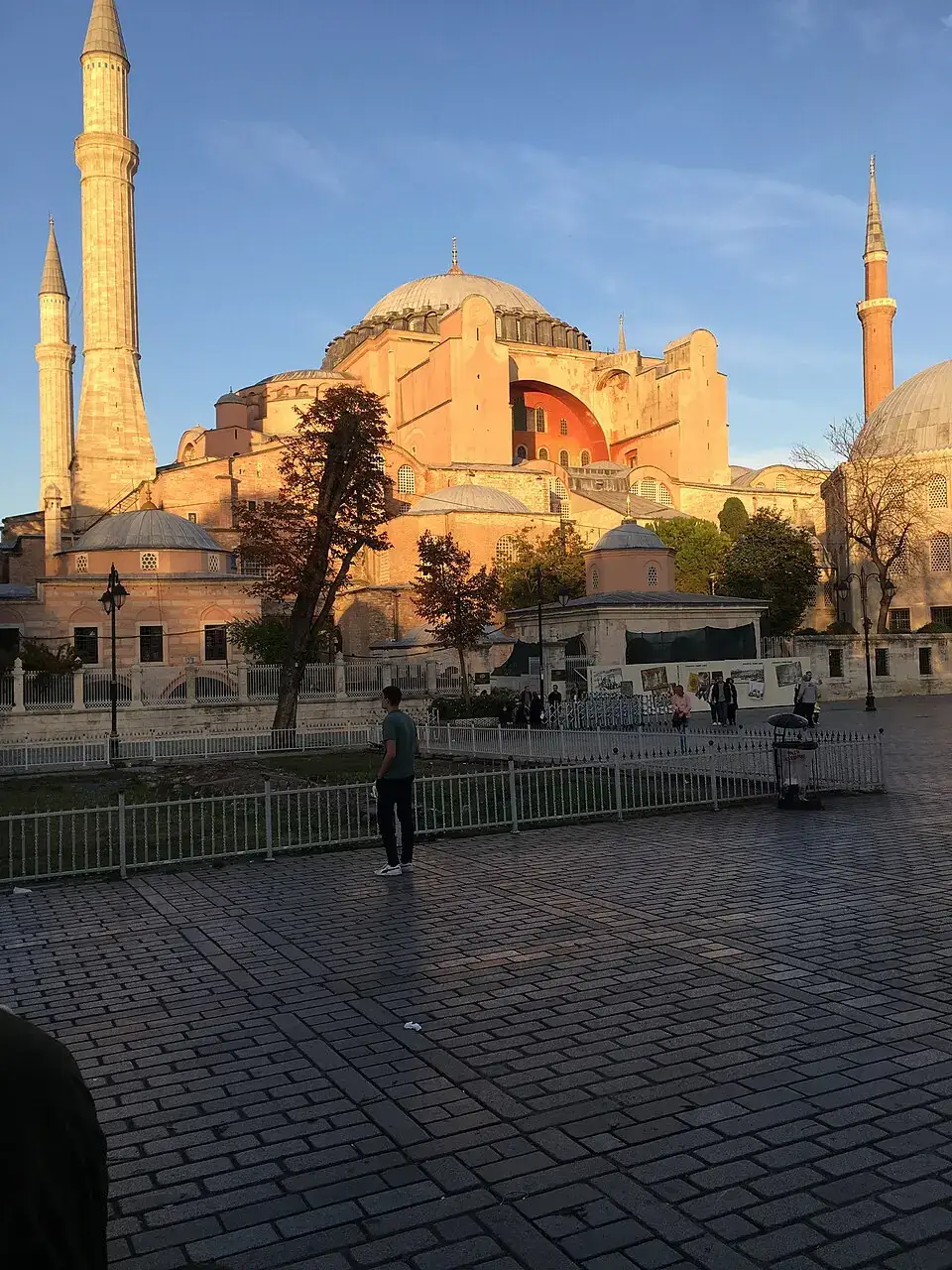
After the Nika revolt burned the old church in 532, Justinian rebuilt Hagia Sophia. Anthemius of Tralles and Isidorus of Miletus designed it; it was completed in about six years, in 537. The dome partly collapsed in 558 and was restored in 562.
After the Nika revolt burned the old church in 532, Justinian rebuilt Hagia Sophia. Anthemius of Tralles and Isidorus of Miletus designed it; it was completed in about six years, in 537. The dome partly collapsed in 558 and was restored in 562.
In January 532 the Nika insurrection burned the church on the site; Justinian then commissioned a more splendid replacement.
The new Hagia Sophia was built between 532 and 537 under Justinian, designed by Anthemius of Tralles and Isidorus of Miletus. It was completed in about six years, in 537.
An earthquake caused a partial collapse of the dome in 558; it was restored in 562, and after two further partial collapses the church was rebuilt to a smaller scale and reinforced from outside.
For more than a millennium it served as the cathedral of the Ecumenical Patriarchate of Constantinople; later it became a Roman Catholic cathedral, an Eastern Orthodox church again, a mosque, a museum, and a mosque again.
Hagia Sophia placed imperial power, the patriarchate and civic ritual under one dome. It was not decoration but the spatial form of imperial legitimacy.
Sources: 5 event claims, 4 sourced; source cards src-b7-hagia-sophia-537 (background only).
Exterior and dome of Hagia Sophia.Alena Belova / Exhibo / Wikimedia Commons / CC BY-SA 4.0 · CC-BY-SA-4.0 SourcesHagia Sophia background
Cast
People whose choices move the story. Roles describe this story only.
- Constantine IEmperor and founder of the new capital
Founded New Rome on the site of Byzantium in 324 and inaugurated it in 330, moving the empire's political centre east.
- Theodosius IIEmperor, code and walls
Oversaw the Theodosian Code; the inner wall of 413 and outer wall of 447 were built in his reign.
- Justinian IEmperor, code and Hagia Sophia
Promoted the compilation of the Corpus Juris Civilis and rebuilt Hagia Sophia after the Nika revolt of 532.
Evidence and limits
Chapter-level sources; key claims checked.
Source count is the number of distinct source records attached to the event nodes shown here. It does not certify the narrative as a whole.