
In 529, Justinian promulgated the first Codex Constitutionum in 10 books; imperial ordinances not included in it were repealed.1
In 534, a new commission issued a revised Codex of 12 books, partly based on Justinian's own legislation.2
Between 530 and 533, 16 lawyers under Tribonian compiled the Digesta in 50 books, selecting, cutting and rephrasing extracts from the authorized jurists into a citable text.3
The Institutiones appeared in 533 as an elementary textbook.4
The Novels collected Justinian's new ordinances from 534 to 565.5
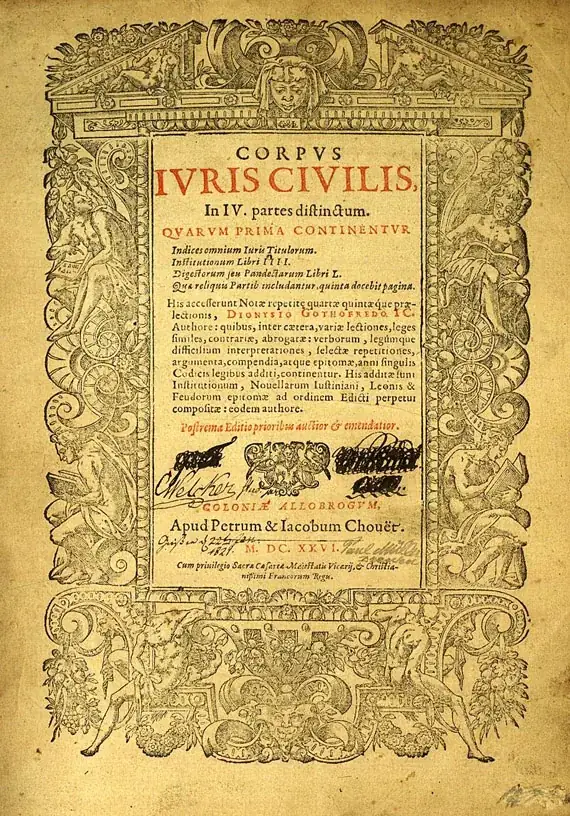
Together the four works are known as the Corpus Juris Civilis. They were not a wholly new code but a compilation, pruning and restatement of existing law.6
The unified text concentrated interpretation at court: it reduced local discretion and made the emperor the final interpreter of the law; law became a teachable, citable body of official knowledge.7
Evidence ledger
7 claims6 sourced0 unsourced1 author judgment
Every hard fact in the narrative above is registered here. A claim may also record source-only details that the narrative does not repeat; the related-narrative line points to the corresponding passage, not a guarantee that the source supports every word of the body. A claim without a source stays visibly unsourced.
- Code of JustinianHistory — Codex Constitutionum
The resultant 10-book Codex Constitutionum was promulgated in 529, all imperial ordinances not included in it being repealed.
Accessed 2026-11-25 · machine excerpt · pending human review
'First version' distinguishes the 534 revision; the excerpt gives the 10-book edition of 529.
- Code of JustinianHistory — Codex Constitutionum
In 534, a new commission issued a revised Codex of 12 books, partly based on Justinian's own legislation.
Related narrativeIn 534, a new commission issued a revised Codex of 12 books, partly based on Justinian's own legislation.
- Code of JustinianHistory — revised Codex
In 534 a new commission issued a revised Codex (Codex Repetitae Praelectionis) containing 12 books; the revisions were based partly on Justinian’s own new legislation.
Accessed 2026-11-25 · machine excerpt · pending human review
No claim that the whole Corpus was re-promulgated in 534.
- Code of JustinianHistory — revised Codex
Between 530 and 533, 16 lawyers under Tribonian compiled the Digesta in 50 books, selecting, cutting and rephrasing extracts from the authorized jurists into a citable text.
Related narrativeBetween 530 and 533, 16 lawyers under Tribonian compiled the Digesta in 50 books, selecting, cutting and rephrasing extracts from the authorized jurists into a citable text.
- Code of JustinianHistory — Digesta
The Digesta was drawn up between 530 and 533 by a commission of 16 lawyers, under the presidency of the jurist Tribonian. They collected and examined all the known writings of all the authorized jurists; extracted from them whatever was deemed valuable, generally selecting only one extract on any given legal point; and rephrased the originals whenever necessary for clarity and conciseness. The results were published in 50 books, each book subdivided into titles.
Accessed 2026-11-25 · machine excerpt · pending human review
'Cutting and rephrasing' follows extracted and rephrased; no claim of verbatim copying.
- Code of JustinianHistory — Digesta
The Institutiones appeared in 533 as an elementary textbook.
Related narrativeThe Institutiones appeared in 533 as an elementary textbook.
- Code of JustinianHistory — Institutiones
The Institutiones compiled and published in 533 under Tribonian’s supervision and relying on such earlier texts as those of Gaius, was an elementary textbook, or outline, of legal institutions for the use of first-year law students.
Accessed 2026-11-25 · machine excerpt · pending human review
'Elementary textbook' follows first-year law students.
- Code of JustinianHistory — Institutiones
The Novels collected Justinian's new ordinances from 534 to 565.
Related narrativeThe Novels collected Justinian's new ordinances from 534 to 565.
- Code of JustinianHistory — Novellae
The Novellae Constitutiones Post Codicem (or simply, in English, the Novels) comprised several collections of new ordinances issued by Justinian himself between 534 and 565, after publication of the revised Codex.
Accessed 2026-11-25 · machine excerpt · pending human review
The source says several collections; the body uses 'collected'.
- Code of JustinianHistory — Novellae
Together the four works are known as the Corpus Juris Civilis. They were not a wholly new code but a compilation, pruning and restatement of existing law.
Related narrativeTogether the four works are known as the Corpus Juris Civilis. They were not a wholly new code but a compilation, pruning and restatement of existing law.
- Code of JustinianArticle opening, paragraph 1
Code of Justinian, collections of laws and legal interpretations developed under the sponsorship of the Byzantine emperor Justinian I from 529 to 565 ce. Strictly speaking, the works did not constitute a new legal code. Rather, Justinian’s committees of jurists provided basically two reference works containing collections of past laws and extracts of the opinions of the great Roman jurists.
Accessed 2026-11-25 · machine excerpt · pending human review
The four works are the Codex, Digesta, Institutiones and Novellae; the source lists the four books.
- Code of JustinianArticle opening, paragraph 1
The unified text concentrated interpretation at court: it reduced local discretion and made the emperor the final interpreter of the law; law became a teachable, citable body of official knowledge.
Related narrativeThe unified text concentrated interpretation at court: it reduced local discretion and made the emperor the final interpreter of the law; law became a teachable, citable body of official knowledge.
Editorial judgment, not a historical fact.
Institutional analysis; no claim that the emperor personally judged every case.
Sources and review
Key claims rely on a single source record
Locations
- Byzantine Empire· 41.01, 28.98· Approximate
evt-dc21a4cabde65970Source file:
events/evt-dc21a4cabde65970/event.md