
Baghdad: Translation, Algebra and the Golden Age of Medicine
Story751–925: how paper, translation and institutions turned knowledge into usable tools
In 751 CE, Tang papermakers captured after the Battle of Talas carried papermaking into Samarkand; Arabs soon established paper works in Baghdad, Damascus and Cairo. In the later eighth century al-Mansur and Harun al-Rashid supported a translation movement that rendered Greek, Persian and Indian works in philosophy, medicine, mathematics and astronomy into Arabic. In 775 Baghdad established the House of Wisdom, where observatories, libraries and a medical school gathered scholars; in 803 the first official paper mill appeared in Baghdad, making paper cheaper and books less costly. In 807 al-Khwarizmi entered the House of Wisdom; in 816 he completed the Sindhind Zij, and in 825 wrote the Algebra, systematising Indian numerals and algebraic methods. In 818 the translation movement reached its peak with key works of Aristotle, Ptolemy and Hippocrates; in 829 al-Farghani completed the Elements of Astronomy, later a European university textbook. Around 902 al-Razi became director of the Baghdad hospital and promoted clinical observation and case records; in 910 he wrote On Smallpox and Measles, separating the two diseases; he died in 925, and his Continens was translated into Latin in 1279 and shaped European medical teaching into the seventeenth century. This story uses twelve nodes to show how a knowledge centre was built: not by one genius, but by paper, translation, institutions and reusable methods.
The intellectual flowering of the Abbasid world was not a “golden age” that appeared from nowhere. It rested on three kinds of infrastructure: paper, translation and institutions. Paper made texts cheaper and easier to copy; translation rewrote Greek, Persian and Indian knowledge in Arabic and brought it into new contexts of teaching and research; the House of Wisdom, observatories, libraries and hospitals gathered scattered scholars, manuscripts and instruments. Al-Khwarizmi's importance lies not only in “preserving the classics” but in turning Indian numerals, algebraic operations and astronomical tables into teachable, calculable, reusable methods. Al-Razi's importance lies not only in writing many books but in writing clinical observation, case records and disease differentiation into medical practice. To preserve classical civilisation was not to lock books in a storeroom but to rewrite foreign knowledge into tools one could teach, calculate and heal with, and then to pass them back to Europe through translation.
Chapter-level sources; key claims checked.
Chapter timeline
Chapters in reading orderAll anchors are approximate region-level placements; they are not precise sites. Chapters without coordinates are listed below by region only.
Chapter contents12 chapters
- After Talas: paper enters the Islamic world
- The translation movement: Greek, Persian and Indian works in Arabic
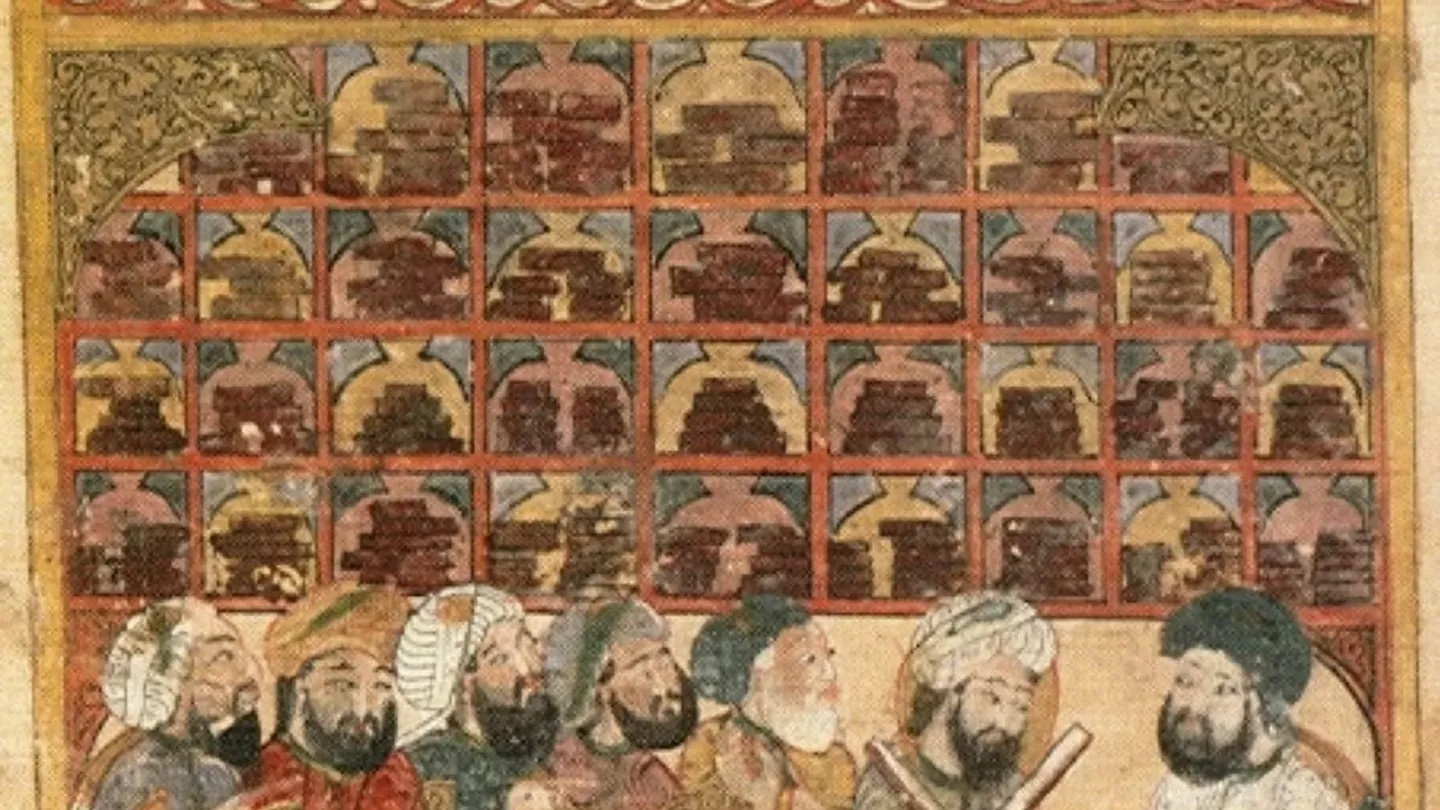
- Baghdad: the House of Wisdom and a scholarly centre
- The paper mill: why books became cheaper
- Al-Khwarizmi: from Indian numerals to algebra
- The Sindhind Zij: calculating the heavens
- The House of Wisdom at its height: Aristotle, Ptolemy and Hippocrates
- The Algebra: restoration and balancing
- Al-Farghani's Elements of Astronomy: a textbook across centuries
- Al-Razi: hospitals, clinical observation and cases
- Smallpox and measles: two diseases separated
- The death of al-Razi: the Continens and later reputation
The story, chapter by chapter
Each chapter opens the underlying event- 01
After Talas: paper enters the Islamic world
After the Battle of Talas in 751, captured Tang paper-making craftsmen brought the technology to Samarkand. The Arabs quickly mastered paper-making and established paper mills in Baghdad, Damascus, and Cairo. The spread of paper greatly promoted the Arab translation movement, allowing Greek, Indian, and Persian scientific works to be preserved and disseminated. Paper-making then spread via North Africa to Spain and I…
After the Battle of Talas in 751, captured Tang papermakers carried papermaking to Samarkand; Arabs mastered the technique and established paper works in Baghdad, Damascus and Cairo. Cheaper paper supported the translation movement and the preservation of Greek, Indian and Persian works, and the craft later reached Spain and Italy through North Africa.
In 751 CE, Tang papermakers captured after the Battle of Talas carried papermaking into Samarkand. Arabs quickly mastered the technique and established paper works in Baghdad, Damascus and Cairo. The spread of paper later became one of the material conditions for the flourishing of the Arabic translation movement.
There are many versions of how papermaking travelled west, and the Talas captives are the most popular one. It need not explain every route by which paper spread, but it makes one crucial point: techniques travel with people. When craftsmen are captured, migrate or are hired, a craft moves from one empire into another. What is scarce is not a “secret formula” but people who can operate the whole process.
Paper mattered for more than “being able to write”. It was cheaper than parchment, lighter than bamboo slips, easy to copy in quantity and easy to bind into books. A scholar reading ten books, a bookseller copying twenty, a hospital keeping case records — all needed lower costs. Paper turned knowledge from a treasure of the few into a commodity that could circulate, and only then could translation, teaching and research operate at scale.
Sources: 6 event claims, 6 sourced; source cards src-b3w-baghdad-translation-06, src-b3w-baghdad-translation-04 (background only).
SourcesAl-Khwarizmi — Wikipedia backgroundHouse of Wisdom — Wikipedia background
- 02
The translation movement: Greek, Persian and Indian works in Arabic
In the mid-to-late 8th century, Abbasid caliphs al-Mansur and Harun al-Rashid strongly supported the translation movement in Baghdad. Scholars at the House of Wisdom translated Greek, Persian, and Indian philosophical, medical, mathematical, and astronomical works into Arabic. The works of Aristotle, Plato, Euclid, Ptolemy, and Galen were preserved. This translation movement lasted about two hundred years and preserv…
In the later eighth century al-Mansur and Harun al-Rashid supported translation in Baghdad; scholars associated with the House of Wisdom rendered Greek, Persian and Indian philosophy, medicine, mathematics and astronomy into Arabic, preserving works of Aristotle, Plato, Euclid, Ptolemy and Galen.
In the later eighth century the Abbasid caliphs al-Mansur and Harun al-Rashid strongly supported translation in Baghdad. Scholars associated with the House of Wisdom rendered Greek, Persian and Indian works in philosophy, medicine, mathematics and astronomy into Arabic; the works of Aristotle, Plato, Euclid, Ptolemy and Galen were thereby preserved.
The word “preserved” can make translation sound like putting old books into another language for storage. In practice, translation was a reassembly. Greek philosophical argument, Persian administrative and court culture, Indian numerals and astronomical methods entered Arabic and collided with a new religion, language and set of scholarly problems. Translators had to decide which concepts could be rendered literally, which required new words, and which had to be altered.
The movement lasted about two centuries. It was not because a caliph suddenly loved reading, but because an expanding empire needed law, medicine, calendars, architecture and administration. Translation turned foreign learning into a resource the empire could use, and it placed Baghdad's scholars within a much longer chain of knowledge.
Sources: 6 event claims, 6 sourced; source cards src-b3w-baghdad-translation-04, src-b3w-baghdad-translation-06 (background only).
SourcesHouse of Wisdom — Wikipedia backgroundAl-Khwarizmi — Wikipedia background
- 03
Baghdad: the House of Wisdom and a scholarly centre
In 775, Abbasid Caliph al-Mansur established the House of Wisdom in Baghdad, the earliest academic research institution in the Islamic world. The House of Wisdom gathered scholars of various ethnicities for translation and research. An observatory, library, and medical school were established there, and Baghdad replaced Alexandria as the academic center of the world. The Islamic Golden Age began.
In 775 al-Mansur established the House of Wisdom in Baghdad; it gathered scholars of different backgrounds for translation and research, with an observatory, library and medical school. The event record says Baghdad thereby replaced Alexandria as the world's scholarly centre and that the Islamic Golden Age began.
In 775 al-Mansur established the House of Wisdom in Baghdad. It gathered scholars from different communities for translation and research; an observatory, a library and a medical school were established there. The event record says Baghdad thereby replaced Alexandria as the world's scholarly centre and that the Islamic Golden Age began.
“World scholarly centre” is a very strong claim; a safer formulation is that Baghdad became one of the most important knowledge hubs of the Islamic world. Its advantage lay not in a single building but in the connections among institutions. The library collected books, the observatory watched the sky, the hospital treated patients, and the translation office turned foreign texts into usable teaching material. Scholars could move among these institutions, and a question could travel from philosophy to medicine and from medicine to astronomy.
The importance of the House of Wisdom also lay in turning “individual talent” into “sustainable production”. When a scholar died, the manuscript remained; when a translation was completed, later scholars could revise it; when a set of observations was recorded, the next generation could calculate from it. Institutions meant knowledge did not have to start from zero every time.
Sources: 6 event claims, 6 sourced; source cards src-b3w-baghdad-translation-04, src-b3w-baghdad-translation-02 (background only).
SourcesHouse of Wisdom — Wikipedia backgroundAbbasid Caliphate — Wikipedia background
- 04
The paper mill: why books became cheaper
In 803, under the patronage of Caliph Harun al-Rashid, the first official paper mill was established in Baghdad, using craftsmen captured from Samarkand. The Arabs improved Chinese papermaking techniques, using flax and rags instead of tree bark to produce cheaper, smoother paper. The spread of papermaking reduced the cost of books, promoting the Translation Movement and Islamic scholarly flourishing.
In 803 Harun al-Rashid funded Baghdad's first official paper mill with craftsmen from among the Samarkand captives; Arabs improved the technique by using flax and rags instead of bark, producing cheaper, smoother paper. Book costs fell, supporting translation and scholarly activity.
In 803, with Harun al-Rashid's patronage, Baghdad established its first official paper mill, with craftsmen drawn from the Samarkand captives. Arabs improved the Chinese technique by using flax and rags instead of tree bark, producing cheaper and smoother paper.
The improvement was practical. Tree bark was limited, while flax and rags were waste materials available everywhere in a city. Turning waste into pulp gave book production a stable supply of raw material. Smoother paper made writing and binding easier, and books changed from expensive luxuries into goods that could be produced in quantity.
Cheaper books made scholarship denser. Translating a large work required multiple copies, repeated collation and long preservation; a medical school needed accumulated cases; an observatory needed records; courts and administrators needed archives. Without cheap paper, all these activities would be constrained by material cost. The paper mill looked like a craft workshop, but it was lowering the cost of the entire knowledge economy.
Sources: 5 event claims, 5 sourced; source cards src-b3w-baghdad-translation-04, src-b3w-baghdad-translation-02 (background only).
SourcesHouse of Wisdom — Wikipedia backgroundAbbasid Caliphate — Wikipedia background
- 05
Al-Khwarizmi: from Indian numerals to algebra
In 807, the Persian mathematician Muhammad al-Khwarizmi entered the House of Wisdom in Baghdad as an astronomer and translator. He later wrote 'The Compendious Book on Calculation by Completion and Balancing' (algebra) and 'On the Calculation with Hindu Numerals', introducing Indian numerals (Arabic numerals) and algebra to the Islamic world. 'Algebra' derives from the Arabic 'al-jabr' (completion), and his Latinized…
In 807 the Persian mathematician Muhammad al-Khwarizmi entered Baghdad's House of Wisdom as astronomer and translator; he later wrote the Algebra and the Book on Indian Numerals, bringing Indian numerals and algebra into the Islamic world.
In 807 the Persian mathematician Muhammad al-Khwarizmi entered Baghdad's House of Wisdom as an astronomer and translator. He later wrote the Algebra and the Book on Indian Numerals, bringing Indian numerals and algebra into the Islamic world.
Al-Khwarizmi's contribution was not merely to “move knowledge across”. Indian numerals offered a more efficient way of calculating, while algebra offered a method for handling unknown quantities. He placed both within the Arabic mathematical tradition and wrote them into texts that could be taught and calculated. Europeans later Latinised his name as Algoritmi, and the word “algorithm” grew from there.
This also shows what the translation movement really achieved: not the preservation of Greek books as they were, but the reaction of knowledge from different sources on one table. Indian numerals, Greek geometry and Persian administrative mathematics met in al-Khwarizmi's work and became a new set of calculating tools. The value of a knowledge centre lies in its ability to produce such reactions.
Sources: 5 event claims, 5 sourced; source cards src-b3w-baghdad-translation-06, src-b3w-baghdad-translation-02 (background only).
SourcesAl-Khwarizmi — Wikipedia backgroundAbbasid Caliphate — Wikipedia background
- 06
The Sindhind Zij: calculating the heavens
In 816, al-Khwarizmi completed the 'Sindhind Zij' (Astronomical Tables of the Sindhind) at the House of Wisdom. This work introduced Indian sine functions and decimal place-value arithmetic, improving on Ptolemy's models. Its Latin translation, 'Algoritmi de numero Indorum', later spread to Europe and promoted the revival of European astronomy.
In 816 al-Khwarizmi completed the Sindhind Zij at the House of Wisdom, introducing Indian sine functions and decimal counting and improving Ptolemy's celestial model; its Latin translation returned to Europe in the twelfth century and helped renew European astronomy.
In 816 al-Khwarizmi completed the Sindhind Zij at the House of Wisdom. The work introduced Indian sine functions and decimal counting and improved Ptolemy's celestial model. Its Latin translation returned to Europe in the twelfth century and helped renew European astronomy.
An astronomical table is not a “record of looking at stars” but a predictive tool. When the sun rises, where the moon goes, how the planets move, how the calendar should be arranged — all require turning observations into numbers and numbers into tables. Whoever possessed more accurate and usable tables could better organise religious festivals, agricultural seasons and maritime schedules.
Al-Khwarizmi's tables joined Indian mathematics to Greek astronomy. India supplied calculating tools, Greece supplied geometric models, and Arabic supplied a new platform for synthesis. This “mixture” was not a compromise but an upgrade: the strengths of different traditions were taken apart, reassembled and turned into tables others could use.
Sources: 5 event claims, 5 sourced; source cards src-b3w-baghdad-translation-06, src-b3w-baghdad-translation-05 (background only).
SourcesAl-Khwarizmi — Wikipedia backgroundAl-Farghani — Wikipedia background
- 07
The House of Wisdom at its height: Aristotle, Ptolemy and Hippocrates
In 818, Caliph al-Ma'mun personally oversaw the House of Wisdom in Baghdad, generously employing the translator Hunayn ibn Ishaq to translate Greek philosophical and medical works into Arabic. That year, translations of Aristotle's 'Metaphysics', Ptolemy's 'Geography', and Hippocrates' 'Aphorisms' were completed. These translations profoundly influenced Islamic philosophy and European scholasticism.
In 818 Caliph al-Ma'mun presided over the House of Wisdom and paid translator Hunayn ibn Ishaq generously to render Greek philosophy and medicine into Arabic; that year saw translations of Aristotle's Metaphysics, Ptolemy's Geography and Hippocrates' Aphorisms.
In 818 Caliph al-Ma'mun presided over the House of Wisdom and paid the translator Hunayn ibn Ishaq generously to render Greek philosophy and medicine into Arabic. The event record says that translations of Aristotle's Metaphysics, Ptolemy's Geography and Hippocrates' Aphorisms were completed that year.
Putting these books together reveals the scope of the translation movement: philosophy asked about being and cause, geography described the known world, medicine dealt with the body and disease. They were not the same kind of text, yet together they formed a knowledge skeleton for an empire. Al-Ma'mun's lavish hiring shows that translation was no longer a private hobby but a state project.
The work of translators such as Hunayn ibn Ishaq was far more complex than literal comparison. They had to find reliable copies, collate versions, solve the problem of Greek terms with no Arabic equivalent, and make the result intelligible to philosophers, physicians and students. Translation here was scholarly creation, not simple language conversion.
Sources: 5 event claims, 5 sourced; source cards src-b3w-baghdad-translation-02, src-b3w-baghdad-translation-04 (background only).
SourcesAbbasid Caliphate — Wikipedia backgroundHouse of Wisdom — Wikipedia background
- 08
The Algebra: restoration and balancing
In 825, the Arab mathematician al-Khwarizmi wrote 'Al-Kitāb al-mukhtaṣar fī ḥisāb al-jabr wa-l-muqābala', systematically explaining the solution of six standard forms of quadratic equations, such as 'square equals root', 'square plus root equals number', and so on. He used algebraic symbols for 'root' and 'square'. The book was translated into Latin in the 12th century, and the word 'algebra' comes from the Arabic 'a…
In 825 al-Khwarizmi completed the Compendious Book on Calculation by Completion and Balancing, systematically solving six standard forms of quadratic equations with “root” and “square” for the unknown; it reached Europe in the twelfth century, and algebra comes from the Arabic al-jabr.
In 825 al-Khwarizmi wrote the Compendious Book on Calculation by Completion and Balancing, later known as the Algebra. He systematically explained the solutions of six standard forms of quadratic equations, using “root” and “square” for the unknown. After it reached Europe in the twelfth century, algebra took its name from the Arabic al-jabr, meaning “restoration”.
The book's importance lies not in a few formulas but in turning the process of solution into a general procedure. Ancient mathematics had many tricks for “this problem, this calculation”; al-Khwarizmi organised them into “this kind of problem, this kind of calculation”. Unknown quantities could be moved, combined, restored; equations could be classified and solved. Mathematics changed from scattered tricks into a trainable technique.
“Restoration” and “balancing” sound abstract, but they mean arranging an equation into standard form: moving terms to the other side, combining like terms. Because the steps could be repeated, algebra could detach itself from a particular situation and become an independent discipline. Many later European algebra books grew out of the Latin translation of this work.
Sources: 5 event claims, 5 sourced; source cards src-b3w-baghdad-translation-06, src-b3w-baghdad-translation-07 (background only).
SourcesAl-Khwarizmi — Wikipedia backgroundAlgebra — Wikipedia background
- 09
Al-Farghani's Elements of Astronomy: a textbook across centuries
In 829, the Arab astronomer Ahmad al-Farghani (Alfraganus) wrote 'Elements of Astronomy', summarizing the Ptolemaic system and explaining planetary motion, day length, and calendar reckoning. Translated into Latin in the 12th century, it became a standard university astronomy textbook in Europe, cited by Copernicus and Dante.
In 829 al-Farghani wrote the Elements of Astronomy, summarising the Ptolemaic system and explaining planetary motion, the length of day and night, and calendar calculation; translated into Latin in the twelfth century, it became a standard European university astronomy textbook, cited by Copernicus and Dante.
In 829 the astronomer al-Farghani completed the Elements of Astronomy. He summarised the Ptolemaic system and explained planetary motion, the length of day and night and calendar calculation. In the twelfth century the book was translated into Latin and became a standard European university astronomy textbook; Copernicus and Dante both cited it.
A textbook is different from a research paper. A research paper need only persuade colleagues; a textbook must be intelligible to generation after generation of students. Al-Farghani compressed the complex Ptolemaic system into an orderly exposition, placing planetary motion, the changes of day and night and calendar calculation in one framework. A reader did not have to finish all the Greek originals first to grasp a usable astronomy.
This is also the most underestimated achievement of the translation movement: it did not only preserve originals, it produced “second-hand classics”. Al-Farghani's book was not a copy of Ptolemy but an Arabic-language organisation of the Ptolemaic system; what European universities later used was this organised, teaching-ready version. Knowledge often travels not as original texts but as textbooks.
Sources: 4 event claims, 4 sourced; source cards src-b3w-baghdad-translation-06, src-b3w-baghdad-translation-05 (background only).
SourcesAl-Khwarizmi — Wikipedia backgroundAl-Farghani — Wikipedia background
- 10
Al-Razi: hospitals, clinical observation and cases
Around 902 the Persian physician al-Razi (Latin: Rhazes) was summoned from his native Ray to Baghdad by the caliph al-Muktafi, becoming chief physician of the city's great hospital and being commissioned to build the largest new hospital of the Abbasid Caliphate. Tradition holds that he chose its site by hanging pieces of meat around the city and observing where they decayed most slowly. He pioneered the systematic u…
Around 902 the Persian physician al-Razi came to Baghdad at the summons of Caliph al-Muktafi, became director of the city's great hospital and was charged with building the largest new hospital of the Abbasid state; he systematically used clinical observation and case records and separated wards by disease.
Around 902 the Persian physician al-Razi came to Baghdad at the summons of Caliph al-Muktafi, became director of the city's great hospital and was charged with building the largest new hospital of the Abbasid state. He systematically used clinical observation and case records and separated wards by disease.
Al-Razi's medical method centred on “observe first, record next, compare afterwards”. When did the fever begin, when did the rash appear, how did the course change, which treatments worked and which did not — all had to be written down rather than inferred from authoritative books. Case records allowed doctors to compare across patients, so clinical experience no longer disappeared with the death of an individual physician.
Separating wards by disease was not merely an administrative convenience. Putting similar patients together made it easier to observe variations within one disease; separating different patients reduced cross-infection. Al-Razi's hospital was therefore not just a place to shelter the sick but a machine for producing medical knowledge.
The event record also preserves a “legend” about the choice of the new hospital site: al-Razi is said to have hung pieces of fresh meat in different parts of the city and observed which spoiled most slowly, judging the air by that test. It may not be a real procedure, but it reflects later imagination of his observational skill: even the choice of a site should rest on comparable evidence, not solely on authority.
Sources: 5 event claims, 5 sourced; source cards src-b3w-baghdad-translation-02, src-b3w-baghdad-translation-04 (background only).
SourcesAbbasid Caliphate — Wikipedia backgroundHouse of Wisdom — Wikipedia background
- 11
Smallpox and measles: two diseases separated
Around 910, al-Razi completed 'On Smallpox and Measles', establishing that the two were distinct diseases and describing their prodromal symptoms, rash patterns, course, and nursing care, while recommending cooling diets and protection of the eyes to limit complications. It was the first monograph devoted to differential diagnosis in the history of infectious disease, and its Latin translation was reprinted in Europe…
Around 910 al-Razi completed On Smallpox and Measles, arguing that the two diseases were distinct and describing their prodromes, rashes, courses and care, with cooling diet and eye protection to reduce sequelae; it was the first monograph devoted to differential diagnosis in the history of infectious disease.
Around 910 al-Razi completed On Smallpox and Measles, stating clearly that the two diseases were distinct. He described separately their prodromal symptoms, rash forms, courses and nursing, and advocated cooling diet and eye protection to reduce sequelae.
Before virology and modern diagnostic equipment, separating the two diseases was not easy. Their fever, rash and general symptoms could resemble one another; a doctor who classified them together merely because they “looked similar” would misjudge treatment and care. Al-Razi's work was to break “similarity” into comparable differences: how the prodrome differed, how the rash appeared, how the course unfolded.
The book is therefore regarded as the first monograph devoted to differential diagnosis in the history of infectious disease. Differential diagnosis is not giving diseases more names; it is finding different mechanisms beneath similar appearances so that different handling can be given. Al-Razi's method still resonates with clinical thinking today.
Sources: 4 event claims, 4 sourced; source cards src-b3w-baghdad-translation-02, src-b3w-baghdad-translation-06 (background only).
SourcesAbbasid Caliphate — Wikipedia backgroundAl-Khwarizmi — Wikipedia background
- 12
The death of al-Razi: the Continens and later reputation
In 925 the Persian physician al-Razi died in his native Ray (modern Rey, near Tehran, Iran), having gone blind from cataracts in old age and refused surgery. He wrote more than two hundred works and insisted on clinical observation and empirical verification, earning the later title 'the Galen of the Arabs'. The vast 'Kitab al-Hawi', compiled by his students after his death, was translated into Latin as the 'Continen…
In 925 al-Razi died in his native Rayy, having refused surgery after losing his sight to cataracts; he wrote more than two hundred works, stressed clinical observation and empirical testing, and was called “the Galen of the Arabs.” His Continens was translated into Latin in 1279 and remained a European university medical textbook into the seventeenth century.
In 925 al-Razi died in his native Rayy. In later life he lost his sight to cataracts and refused surgery. He wrote more than two hundred works, stressed clinical observation and empirical testing, and was called “the Galen of the Arabs”. The Continens, compiled by his disciples, was translated into Latin in 1279 and remained a European university medical textbook into the seventeenth century.
The title “Galen of the Arabs” was both an acknowledgment of his learning and a framework of comparison. Galen was the authority of Greek medicine; al-Razi wrote in Arabic, observed in hospitals and tested in case records. He inherited Galen but did not treat him as an unquestionable endpoint. Clinical observation matters precisely because it makes authority answer to the patient's actual response.
Al-Razi's later influence travelled mainly through texts. The Continens was vast and gathered a large body of cases and medical knowledge; once translated into Latin, it entered the European university curriculum and became a reference for generations of doctors. One physician's clinical experience, through recording, editing, translation and reprinting, became a medical tradition across continents.
Sources: 5 event claims, 5 sourced; source cards src-b3w-baghdad-translation-06, src-b3w-baghdad-translation-04 (background only).
SourcesAl-Khwarizmi — Wikipedia backgroundHouse of Wisdom — Wikipedia background
Cast
People whose choices move the story. Roles describe this story only.
- Al-KhwarizmiMathematician and astronomer
Entered Baghdad's House of Wisdom in 807, completed the Sindhind Zij in 816 and wrote the Algebra in 825; his methods made Indian numerals, algebra and astronomical calculation teachable and reusable.
- Al-RaziPhysician and clinical observer
Became director of the Baghdad hospital around 902, wrote On Smallpox and Measles around 910 and died in 925; stressed clinical observation, case records and disease differentiation.
Evidence and limits
Chapter-level sources; key claims checked.
Source count is the number of distinct source records attached to the event nodes shown here. It does not certify the narrative as a whole.