
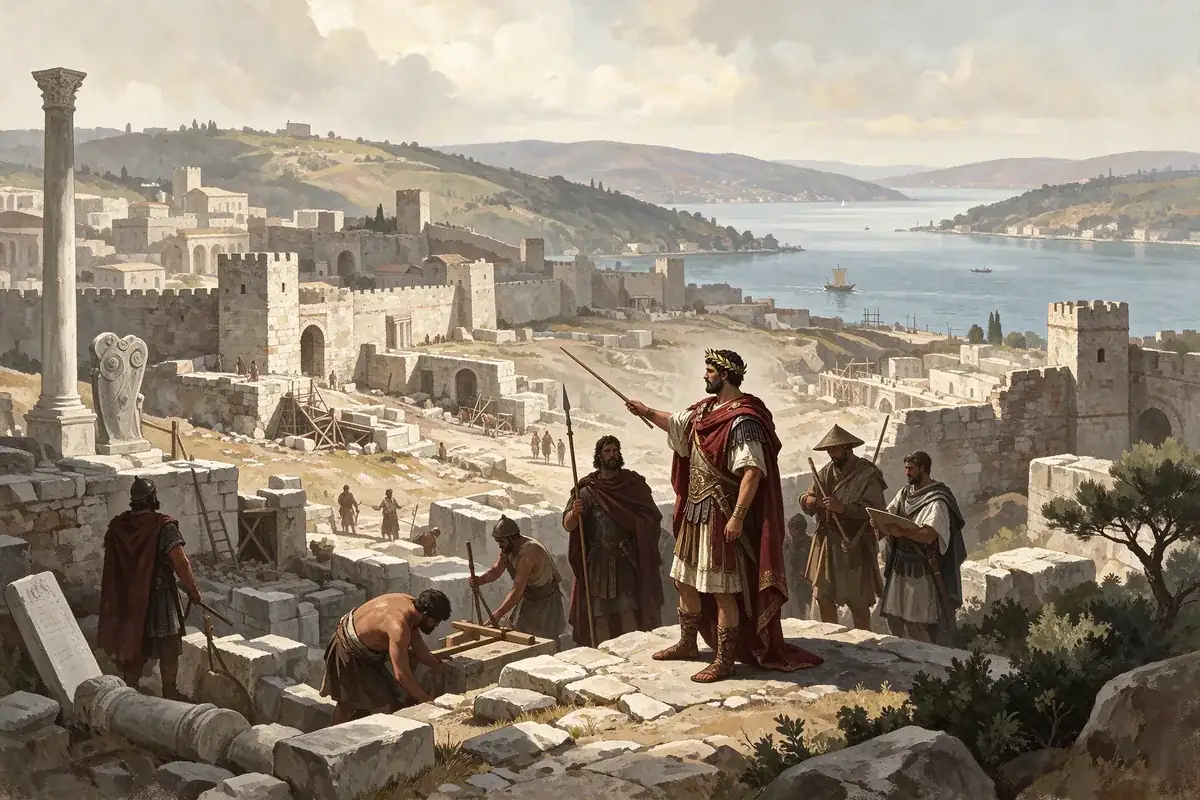
On September 18, 324, Constantine defeated Licinius at Chrysopolis on the Asian shore of the Bosporus and became sole emperor of the Roman Empire, east and west.1 Within three weeks the foundation rites of New Rome were held; on May 11, 330, the enlarged city was officially inaugurated.2
He made the old Greek city of Byzantium his capital.3
The empire's power centre moved eastward.4
The site commanded the Bosporus and linked the Black Sea with the Mediterranean; the peninsula and the Golden Horn offered harbours and defence.7
The choice also brought the first lasting unification of Greece.5
After 330, Constantinople became one of the empire's principal capitals: the emperor's residence and administrative centre, a stage for church power, and a city famed for wealth and buildings.6
But the new capital carried costs. It had to feed a large court, army and population through distant grain and taxes; the old western aristocracy and the new eastern court also competed for power.8
The decision of 324 was therefore not a simple move of residence but a recalibration of the empire's political geography; New Rome became the container of eastern power.9
Evidence ledger
9 claims6 sourced0 unsourced3 author judgment
Every hard fact in the narrative above is registered here. A claim may also record source-only details that the narrative does not repeat; the related-narrative line points to the corresponding passage, not a guarantee that the source supports every word of the body. A claim without a source stays visibly unsourced.
- Istanbul: Byzantium and ConstantinopleSection: Cultural life — Byzantium and Constantinople, paragraph 1
Overcoming the army of the rival emperor, Licinius, at nearby Chrysopolis, on September 18, 324, Constantine became head of the whole Roman Empire, east and west.
Accessed 2026-11-25 · machine excerpt · pending human review
Date, place, rival and outcome are all in the card excerpt.
- Istanbul: Byzantium and ConstantinopleSection: Cultural life — Byzantium and Constantinople, paragraph 1
Within three weeks the foundation rites of New Rome were held; on May 11, 330, the enlarged city was officially inaugurated.
Related narrativeWithin three weeks the foundation rites of New Rome were held; on May 11, 330, the enlarged city was officially inaugurated.
- Istanbul: Byzantium and ConstantinopleSection: Cultural life — Byzantium and Constantinople, paragraph 2
Within three weeks of his victory, the foundation rites of New Rome were performed, and the much-enlarged city was officially inaugurated on May 11, 330.
Accessed 2026-11-25 · machine excerpt · pending human review
Foundation and inauguration dates follow the card; the city was not 'completed' in 324.
- Istanbul: Byzantium and ConstantinopleSection: Cultural life — Byzantium and Constantinople, paragraph 2
He made the old Greek city of Byzantium his capital.
Related narrativeHe made the old Greek city of Byzantium his capital.
- Istanbul: Byzantium and ConstantinopleSection: Cultural life — Byzantium and Constantinople, paragraph 1
He decided to make Byzantium his capital.
Accessed 2026-11-25 · machine excerpt · pending human review
Only the choice of site; no unsupported detail about personal surveying.
- Istanbul: Byzantium and ConstantinopleSection: Cultural life — Byzantium and Constantinople, paragraph 1
The empire's power centre moved eastward.
Related narrativeThe empire's power centre moved eastward.
- Istanbul: Byzantium and ConstantinopleSection: Cultural life — Byzantium and Constantinople, paragraph 3
It displaced the power centre of the Roman Empire, moving it eastward, and achieved the first lasting unification of Greece.
Accessed 2026-11-25 · machine excerpt · pending human review
The eastward shift is directly supported by the card.
- Istanbul: Byzantium and ConstantinopleSection: Cultural life — Byzantium and Constantinople, paragraph 3
The choice also brought the first lasting unification of Greece.
Related narrativeThe choice also brought the first lasting unification of Greece.
- Istanbul: Byzantium and ConstantinopleSection: Cultural life — Byzantium and Constantinople, paragraph 3
It displaced the power centre of the Roman Empire, moving it eastward, and achieved the first lasting unification of Greece.
Accessed 2026-11-25 · machine excerpt · pending human review
Keeps the card's 'first lasting unification'; does not inflate it into a Mediterranean union.
- Istanbul: Byzantium and ConstantinopleSection: Cultural life — Byzantium and Constantinople, paragraph 3
After 330, Constantinople became one of the empire's principal capitals: the emperor's residence and administrative centre, a stage for church power, and a city famed for wealth and buildings.
Related narrativeAfter 330, Constantinople became one of the empire's principal capitals: the emperor's residence and administrative centre, a stage for church power, and a city famed for wealth and buildings.
- Istanbul: Byzantium and ConstantinopleSection: Cultural life — Byzantium and Constantinople, paragraph 4
Constantinople was to become one of the great world capitals, a font of imperial and religious power, a city of vast wealth and beauty, and the chief city of the Western world.
Accessed 2026-11-25 · machine excerpt · pending human review
'Residence and administrative centre' unpacks imperial power; avoids 'largest city in the world'.
- Istanbul: Byzantium and ConstantinopleSection: Cultural life — Byzantium and Constantinople, paragraph 4
The site commanded the Bosporus and linked the Black Sea with the Mediterranean; the peninsula and the Golden Horn offered harbours and defence.
Related narrativeThe site commanded the Bosporus and linked the Black Sea with the Mediterranean; the peninsula and the Golden Horn offered harbours and defence.
Editorial judgment, not a historical fact.
Geographical analysis, not a sourced factual claim; no specific harbour works.
But the new capital carried costs. It had to feed a large court, army and population through distant grain and taxes; the old western aristocracy and the new eastern court also competed for power.
Related narrativeBut the new capital carried costs. It had to feed a large court, army and population through distant grain and taxes; the old western aristocracy and the new eastern court also competed for power.
Editorial judgment, not a historical fact.
Structural analysis; no invented grain-ship counts or tax figures.
The decision of 324 was therefore not a simple move of residence but a recalibration of the empire's political geography; New Rome became the container of eastern power.
Related narrativeThe decision of 324 was therefore not a simple move of residence but a recalibration of the empire's political geography; New Rome became the container of eastern power.
Editorial judgment, not a historical fact.
Chapter-level judgment, not a factual substitute.
Sources and review
Key claims rely on a single source record
Locations
- Byzantine Empire· 41, 29· Approximate
evt-3593da7bd1f92864Source file:
events/evt-3593da7bd1f92864/event.md