
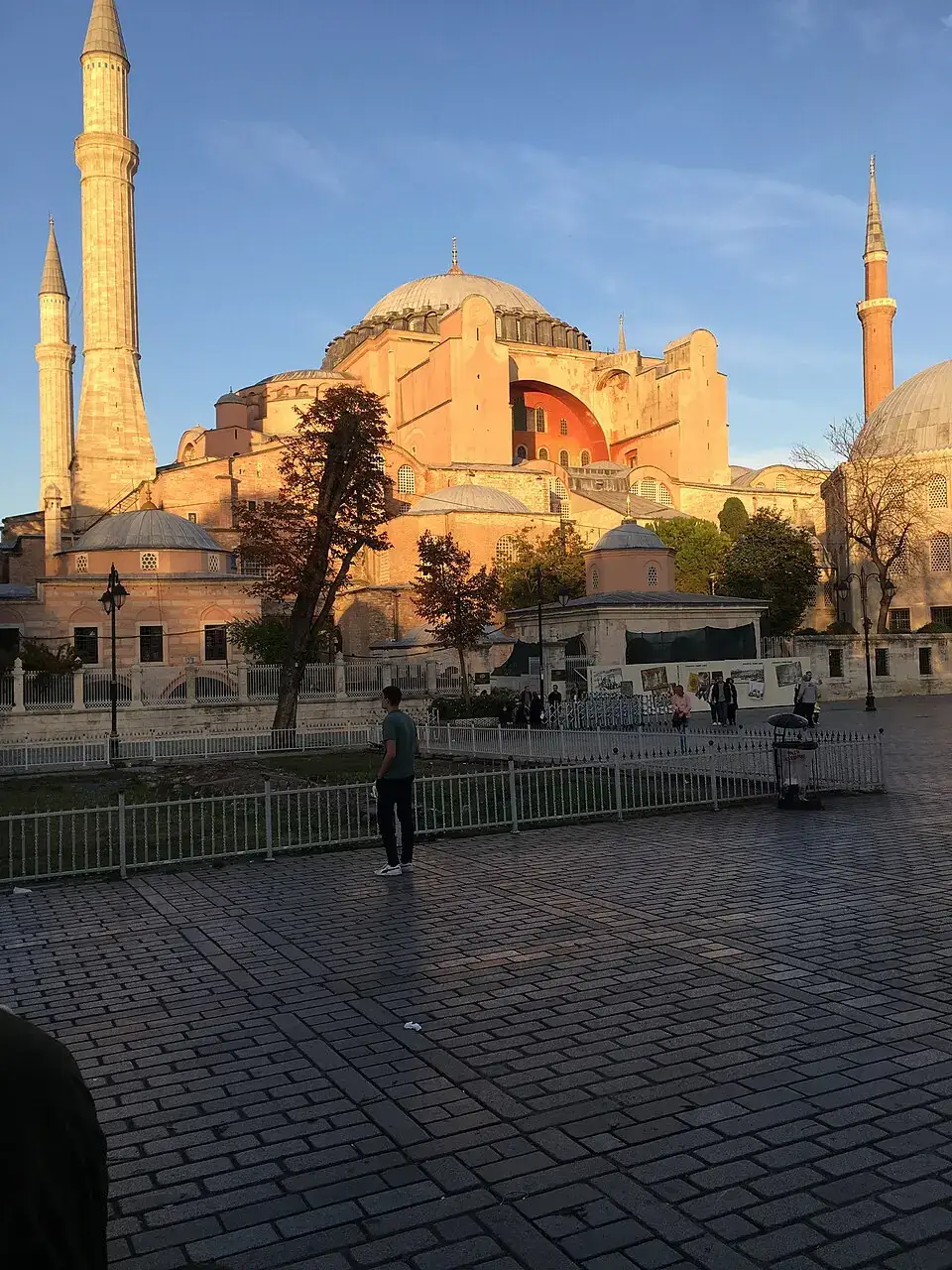
In January 532 the Nika insurrection burned the church on the site; Justinian then commissioned a more splendid replacement.1
The new Hagia Sophia was built between 532 and 537 under Justinian, designed by Anthemius of Tralles and Isidorus of Miletus. It was completed in about six years, in 537.2
An earthquake caused a partial collapse of the dome in 558; it was restored in 562, and after two further partial collapses the church was rebuilt to a smaller scale and reinforced from outside.3
For more than a millennium it served as the cathedral of the Ecumenical Patriarchate of Constantinople; later it became a Roman Catholic cathedral, an Eastern Orthodox church again, a mosque, a museum, and a mosque again.4
Hagia Sophia placed imperial power, the patriarchate and civic ritual under one dome. It was not decoration but the spatial form of imperial legitimacy.5
Evidence ledger
5 claims4 sourced0 unsourced1 author judgment
Every hard fact in the narrative above is registered here. A claim may also record source-only details that the narrative does not repeat; the related-narrative line points to the corresponding passage, not a guarantee that the source supports every word of the body. A claim without a source stays visibly unsourced.
- Hagia SophiaHistory — Nika insurrection
The church stood for more than a century when it was burned again in the Nika insurrection of January 532, a circumstance that gave the then emperor Justinian I an opportunity to envision a splendid replacement.
Accessed 2026-11-25 · machine excerpt · pending human review
'The church on the site' is the burned predecessor; not called the first church.
- Hagia SophiaHistory — Nika insurrection
The new Hagia Sophia was built between 532 and 537 under Justinian, designed by Anthemius of Tralles and Isidorus of Miletus. It was completed in about six years, in 537.
Related narrativeThe new Hagia Sophia was built between 532 and 537 under Justinian, designed by Anthemius of Tralles and Isidorus of Miletus. It was completed in about six years, in 537.
- Hagia SophiaHistory — construction, 532–537
The resultant Hagia Sophia was built in the remarkably short time of about six years, being completed in 537 ce. Unusual for the period in which it was built, the names of the building’s architects—Anthemius of Tralles and Isidorus of Miletus—are well known, as is their familiarity with mechanics and mathematics.
Accessed 2026-11-25 · machine excerpt · pending human review
'532–537' follows the entry's dates of construction; no exact day.
- Hagia SophiaHistory — construction, 532–537
An earthquake caused a partial collapse of the dome in 558; it was restored in 562, and after two further partial collapses the church was rebuilt to a smaller scale and reinforced from outside.
Related narrativeAn earthquake caused a partial collapse of the dome in 558; it was restored in 562, and after two further partial collapses the church was rebuilt to a smaller scale and reinforced from outside.
- Hagia SophiaHistory — dome collapse and restoration
The structure now standing is essentially the 6th-century edifice, although an earthquake caused a partial collapse of the dome in 558 (restored 562) and there were two further partial collapses, after which it was rebuilt to a smaller scale and the whole church reinforced from the outside.
Accessed 2026-11-25 · machine excerpt · pending human review
No claim of total dome collapse or a wholly new building.
- Hagia SophiaHistory — dome collapse and restoration
For more than a millennium it served as the cathedral of the Ecumenical Patriarchate of Constantinople; later it became a Roman Catholic cathedral, an Eastern Orthodox church again, a mosque, a museum, and a mosque again.
Related narrativeFor more than a millennium it served as the cathedral of the Ecumenical Patriarchate of Constantinople; later it became a Roman Catholic cathedral, an Eastern Orthodox church again, a mosque, a museum, and a mosque again.
- Hagia SophiaOpening summary and History — later uses
It was built as an Eastern Orthodox church between 532 and 537 ce under the direction of the Byzantine emperor Justinian I. In subsequent centuries it became a Roman Catholic cathedral, an Eastern Orthodox church again, a mosque, a museum, and a mosque again.
Accessed 2026-11-25 · machine excerpt · pending human review
'More than a millennium' follows the source; no invented 916-year figure.
- Hagia SophiaOpening summary and History — later uses
Hagia Sophia placed imperial power, the patriarchate and civic ritual under one dome. It was not decoration but the spatial form of imperial legitimacy.
Related narrativeHagia Sophia placed imperial power, the patriarchate and civic ritual under one dome. It was not decoration but the spatial form of imperial legitimacy.
Editorial judgment, not a historical fact.
Analysis of architecture and politics, not a factual source claim.
Sources and review
Key claims rely on a single source record
Locations
- Byzantine Empire· 41.01, 28.98· Approximate
evt-f5728424efc30c4bSource file:
events/evt-f5728424efc30c4b/event.md