
The American Revolution: From Stamp Duty to Constitution
Story1765–1789: how a tax protest became a nation-state
In 1765 Parliament passed the Stamp Act, and the North American colonies protested through their first intercolonial congress; in 1773 the Boston Tea Party turned conflict into open confrontation; in 1775 shots were fired at Lexington; in 1776 the Declaration of Independence was signed; in 1777 Saratoga brought France into the war; in 1781 Cornwallis surrendered at Yorktown; in 1787 the Constitutional Convention drafted a constitution in Philadelphia. Together these are not an inevitable road to freedom but a series of choices, compromises and exclusions.
The American Revolution was first an imperial crisis over who had the right to tax and legislate, and only then a war for independence. Colonial elites used the language of the British constitution against Parliament while excluding women, Native Americans, indentured servants and most enslaved Africans from “the people.” The Constitution of 1787 resolved some conflicts between state and federal power and also wrote slavery into the new national structure.
Chapter-level sources; key claims checked.
Chapter timeline
Chapters in reading orderAll anchors are approximate region-level placements; they are not precise sites. Chapters without coordinates are listed below by region only.
Chapter contents7 chapters
- Britain passes Stamp Act; North American colonies protest
- Boston Tea Party
- Shot heard round the world: American Revolutionary War begins
- Declaration of Independence signed
- Saratoga victory: turning point of the American Revolutionary War
- Battle of Yorktown: American victory in Revolutionary War
- Constitutional Convention; U.S. Constitution born
The story, chapter by chapter
Each chapter opens the underlying event- 01
Britain passes Stamp Act; North American colonies protest
To pay off the Seven Years' War debt, the British Parliament passes the Stamp Act, requiring all printed materials in the North American colonies (newspapers, legal documents, licenses, playing cards) to bear a stamped tax. The colonists, with the slogan 'No taxation without representation', form the Sons of Liberty, burn stamps, and beat tax collectors. In October 1765, representatives from nine colonies meet in New…
To pay off the Seven Years' War debt, the British Parliament passes the Stamp Act, requiring all printed materials in the North American colonies (newspapers, legal documents, licenses, playing cards) to bear a stamped tax.
To pay off the Seven Years' War debt, the British Parliament passes the Stamp Act, requiring all printed materials in the North American colonies (newspapers, legal documents, licenses, playing cards) to bear a stamped tax. The colonists, with the slogan 'No taxation without representation', form the Sons of Liberty, burn stamps, and beat tax collectors. In October 1765, representatives from nine colonies meet in New York for the Stamp Act Congress and adopt a Declaration of Rights. In March 1766, Parliament, under pressure, repeals the act. This struggle is an important prelude to the American independence movement.
The Stamp Act caused an explosion not because of the amount but because it reached into every printed sheet of colonial life: newspapers, contracts and court papers all needed a stamp.
Sources: 7 event claims, 7 sourced; source cards src-b3w-american-revolution-05, src-b3w-american-revolution-01 (background only).
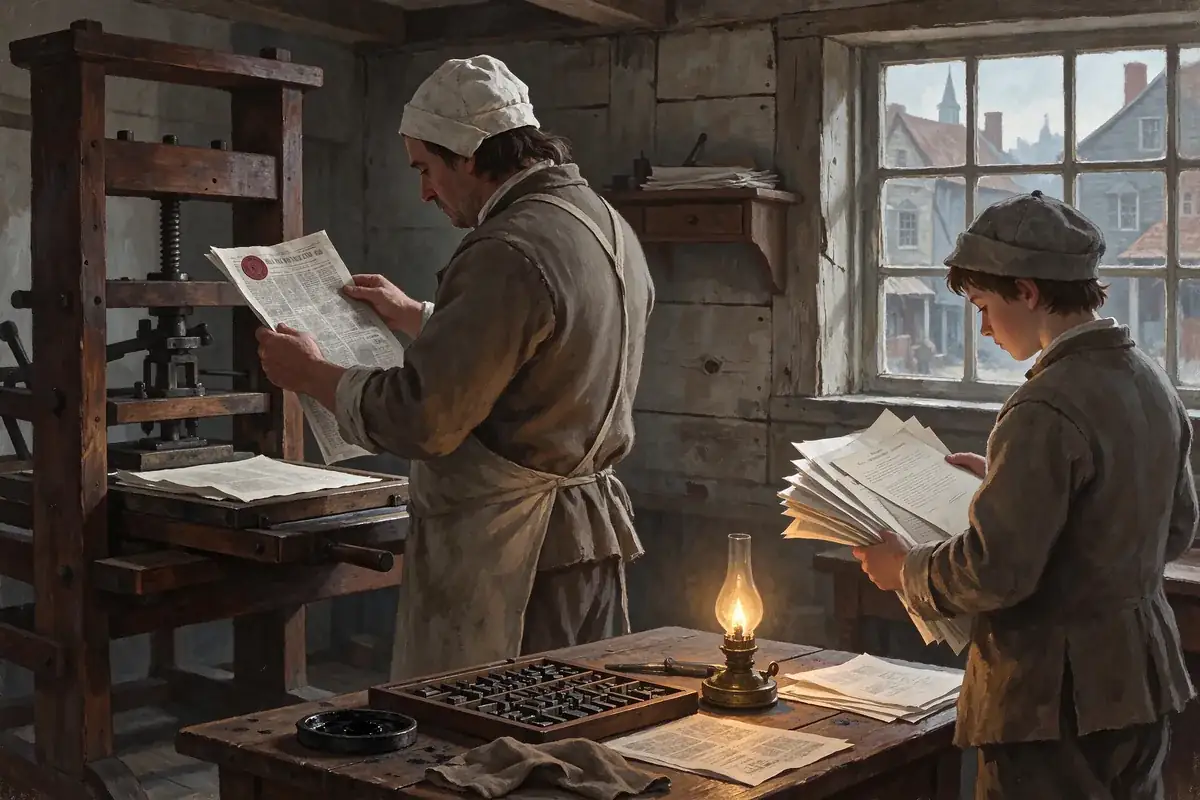
AI-generated illustration: Parliament passed the Stamp Act, requiring printed materials in the North American colonies to bear a stamp.实录编辑部 · AI 生成示意图 · CC0 1.0 · CC0-1.0 SourcesStamp Act 1765 — Wikipedia backgroundAmerican Revolution — Wikipedia background
- 02
Boston Tea Party
The British Parliament passes the Tea Act, allowing the East India Company to sell tea directly to the colonies (still retaining the three-pence-per-pound tea tax). Members of the Sons of Liberty in Boston, disguised as Native Americans, board three East India Company ships at night and throw 342 chests of tea into the harbor. The event enrages the British government, which then passes the Coercive Acts (called the '…
The British Parliament passes the Tea Act, allowing the East India Company to sell tea directly to the colonies (still retaining the three-pence-per-pound tea tax).
The British Parliament passes the Tea Act, allowing the East India Company to sell tea directly to the colonies (still retaining the three-pence-per-pound tea tax). Members of the Sons of Liberty in Boston, disguised as Native Americans, board three East India Company ships at night and throw 342 chests of tea into the harbor. The event enrages the British government, which then passes the Coercive Acts (called the 'Intolerable Acts' by the colonists), closing Boston harbor and revoking Massachusetts's self-government. These coercive measures directly lead to the convening of the First Continental Congress in 1774.
The Boston Tea Party turned tax resistance into public theatre. It destroyed property but won propaganda; Britain’s decision to punish Massachusetts pushed other colonies toward union.
Sources: 6 event claims, 6 sourced; source cards src-b3w-american-revolution-07, src-b3w-american-revolution-01 (background only).
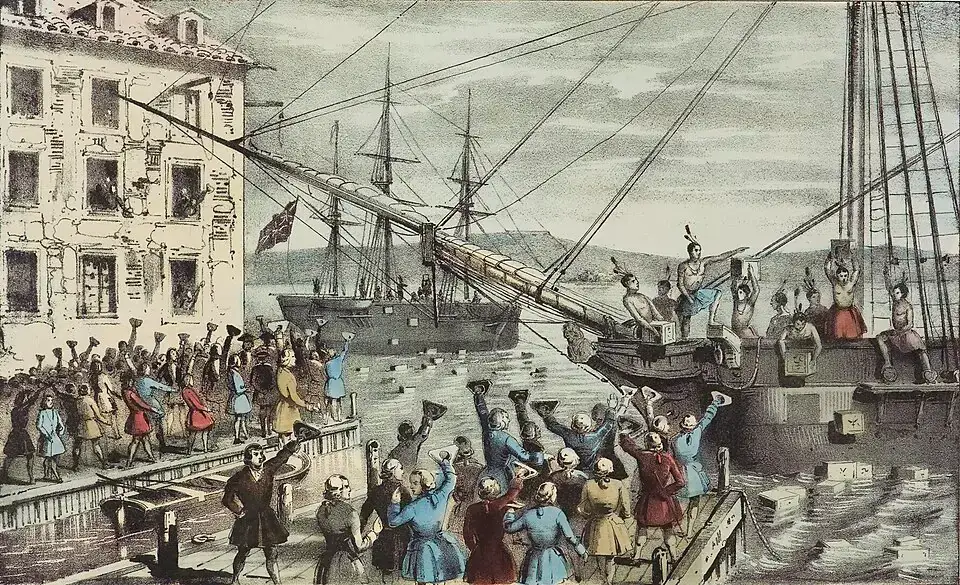
Tea Act protest in Boston.Nathaniel Currier / Wikimedia Commons / Public Domain · PD SourcesBoston Tea Party — Wikipedia backgroundAmerican Revolution — Wikipedia background
- 03
Shot heard round the world: American Revolutionary War begins
Massachusetts Governor Gage sends troops to Concord to seize a colonial militia arsenal. At dawn on April 19, British troops encounter militia at Lexington; shots are fired (the 'shot heard round the world'), and eight militia are killed. The British continue to Concord, where they meet resistance and lose 273 on their retreat. News spreads throughout the colonies, militias surround Boston, and the war for independen…
Massachusetts Governor Gage sends troops to Concord to seize a colonial militia arsenal. At dawn on April 19, British troops encounter militia at Lexington; shots are fired (the 'shot heard round the world'), and eight militia are killed.
Massachusetts Governor Gage sends troops to Concord to seize a colonial militia arsenal. At dawn on April 19, British troops encounter militia at Lexington; shots are fired (the 'shot heard round the world'), and eight militia are killed. The British continue to Concord, where they meet resistance and lose 273 on their retreat. News spreads throughout the colonies, militias surround Boston, and the war for independence begins.
The shots at Lexington were not a declaration of independence but an armed clash between imperial troops and colonial militia. Once war began, independence moved gradually from option to objective.
Sources: 6 event claims, 6 sourced; source cards src-b3w-american-revolution-01, src-b3w-american-revolution-02 (background only).
SourcesAmerican Revolution — Wikipedia backgroundUnited States Declaration of Independence — Wikipedia background
- 04
Declaration of Independence signed
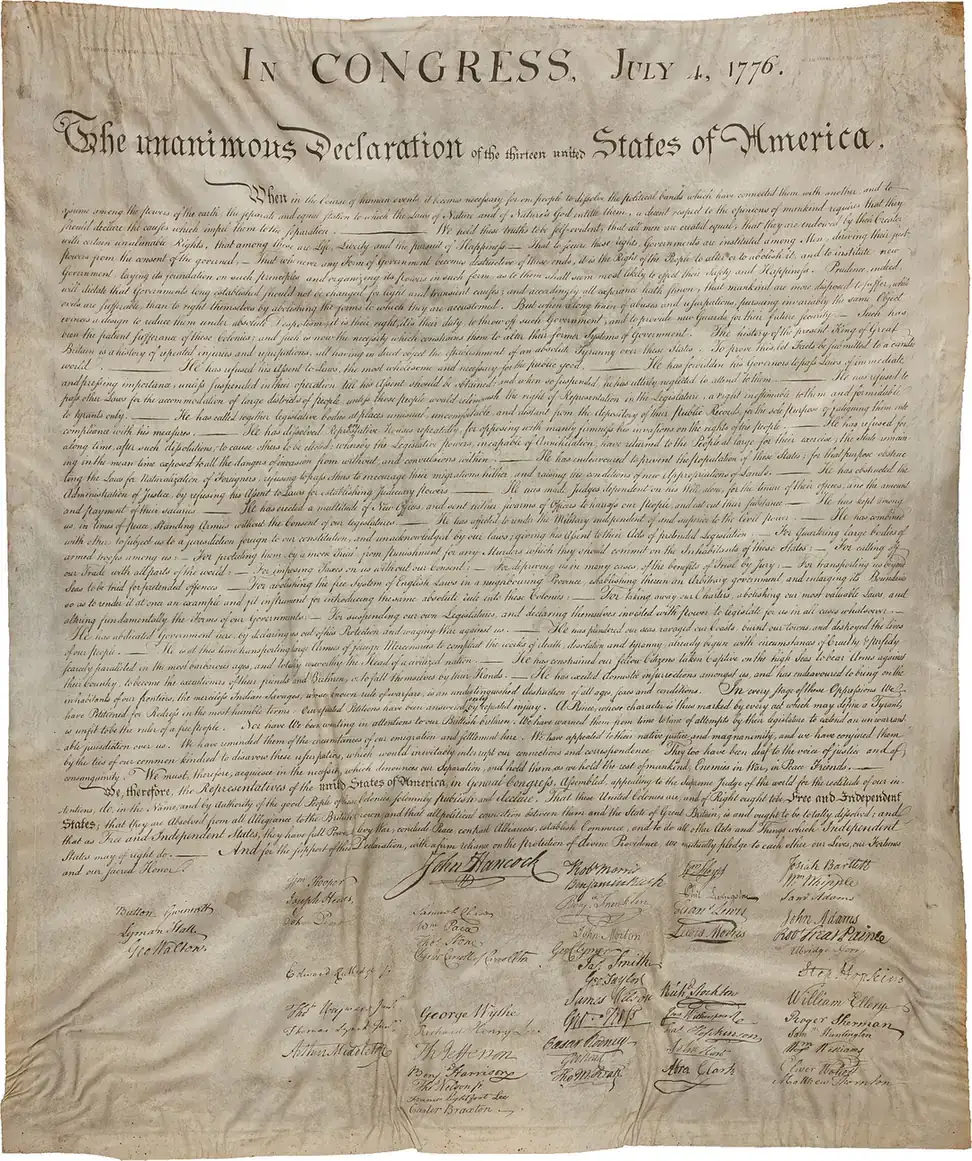
The Continental Congress formally adopts the Declaration of Independence, drafted by Thomas Jefferson, in Philadelphia. The declaration announces the separation of the thirteen North American colonies from Britain and the formation of the 'United States of America'. The preamble states: 'We hold these truths to be self-evident, that all men are created equal, that they are endowed by their Creator with certain unalie…
The Continental Congress formally adopts the Declaration of Independence, drafted by Thomas Jefferson, in Philadelphia.
The Continental Congress formally adopts the Declaration of Independence, drafted by Thomas Jefferson, in Philadelphia. The declaration announces the separation of the thirteen North American colonies from Britain and the formation of the 'United States of America'. The preamble states: 'We hold these truths to be self-evident, that all men are created equal, that they are endowed by their Creator with certain unalienable Rights, that among these are Life, Liberty and the pursuit of Happiness.' July 4 becomes Independence Day in the United States. The declaration inspires national liberation movements around the world.
The Declaration raised specific imperial grievances to the language of universal rights. It wrote that all men are created equal and also called Native Americans “savages”; one text opened both universal and exclusionary directions.
Sources: 7 event claims, 7 sourced; source cards src-b3w-american-revolution-02, src-b3w-american-revolution-01 (background only).
Declaration of Independence.William J. Stone (engraver); original by Thomas Jefferson et al., 1823 (engraving of the 1776 document) · Wikimedia Commons · Public Domain · PD SourcesUnited States Declaration of Independence — Wikipedia backgroundAmerican Revolution — Wikipedia background
- 05
Saratoga victory: turning point of the American Revolutionary War
American Generals Horatio Gates and Benedict Arnold surround and force the surrender of 5,700 British troops under General John Burgoyne at Saratoga, New York. The victory captures all the British weapons and supplies. The battle prompts France to sign a treaty of alliance with the United States in 1778; Spain and the Netherlands later join the anti-British war, transforming the conflict from a British civil war into…
American Generals Horatio Gates and Benedict Arnold surround and force the surrender of 5,700 British troops under General John Burgoyne at Saratoga, New York. The victory captures all the British weapons and supplies.
American Generals Horatio Gates and Benedict Arnold surround and force the surrender of 5,700 British troops under General John Burgoyne at Saratoga, New York. The victory captures all the British weapons and supplies. The battle prompts France to sign a treaty of alliance with the United States in 1778; Spain and the Netherlands later join the anti-British war, transforming the conflict from a British civil war into a European intervention.
Saratoga mattered less for its scale than for diplomacy: it convinced France that the colonies might win, turning a local rebellion into an international war.
Sources: 5 event claims, 5 sourced; source cards src-b3w-american-revolution-03, src-b3w-american-revolution-04 (background only).
SourcesBattles of Saratoga — Wikipedia backgroundSiege of Yorktown — Wikipedia background
- 06
Battle of Yorktown: American victory in Revolutionary War
American General Washington and French General Rochambeau command 17,000 Franco-American forces (8,000 Americans, 9,000 French) and, with the help of French Admiral de Grasse, surround 8,000 British troops under General Cornwallis at Yorktown, Virginia. On October 17, Cornwallis, deeming his situation 'desperate', surrenders. The British band plays 'The World Turned Upside Down'. After the battle, Britain ceases majo…
American General Washington and French General Rochambeau command 17,000 Franco-American forces (8,000 Americans, 9,000 French) and, with the help of French Admiral de Grasse, surround 8,000 British troops under General Cornwallis at Yorktown, Virginia.
American General Washington and French General Rochambeau command 17,000 Franco-American forces (8,000 Americans, 9,000 French) and, with the help of French Admiral de Grasse, surround 8,000 British troops under General Cornwallis at Yorktown, Virginia. On October 17, Cornwallis, deeming his situation 'desperate', surrenders. The British band plays 'The World Turned Upside Down'. After the battle, Britain ceases major military operations, and the Treaty of Paris in 1783 recognizes American independence.
Yorktown was a joint land-sea operation: the French fleet closed the sea route while American and French troops surrounded Cornwallis. Without the French navy, Yorktown would not have ended in surrender.
Sources: 6 event claims, 6 sourced; source cards src-b3w-american-revolution-04, src-b3w-american-revolution-01 (background only).
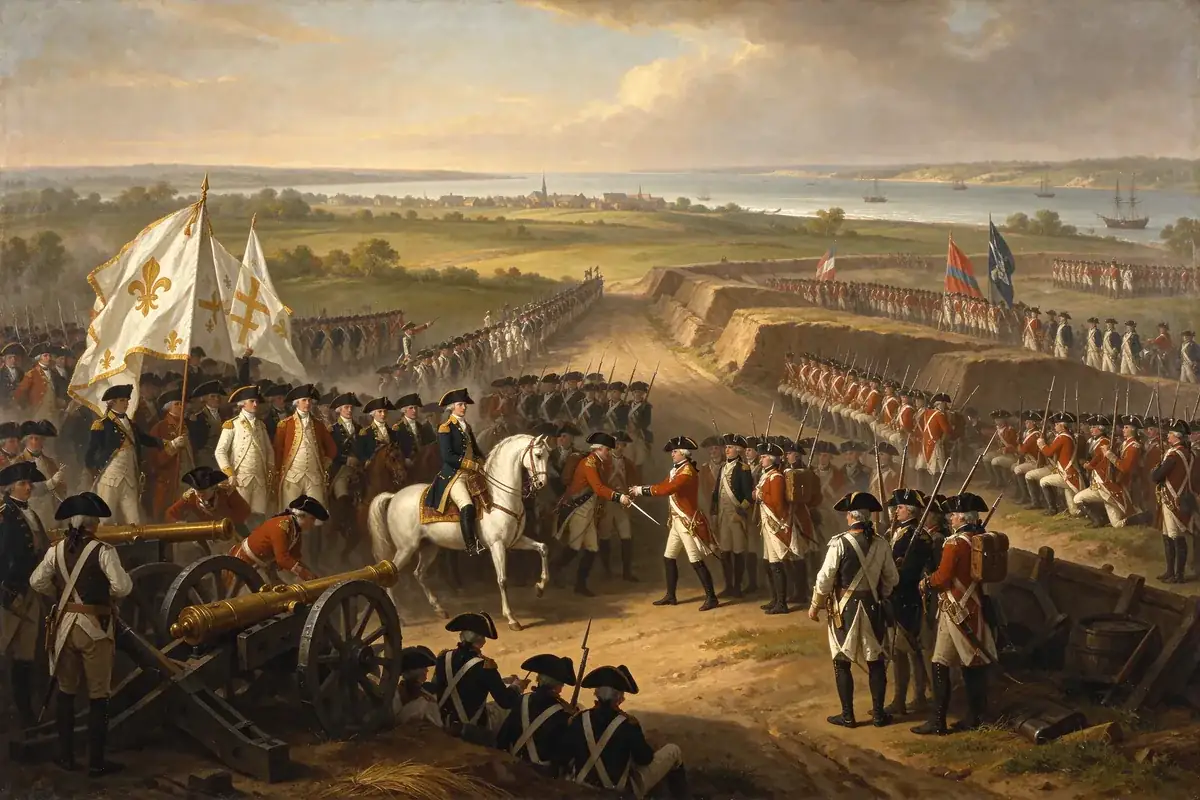
AI-generated illustration: On October 17, Cornwallis, deeming his situation 'desperate', surrenders.实录编辑部 · AI 生成示意图 · CC0 1.0 · CC0-1.0 SourcesSiege of Yorktown — Wikipedia backgroundAmerican Revolution — Wikipedia background
- 07
Constitutional Convention; U.S. Constitution born
To remedy the weaknesses of the central government under the Articles of Confederation, 55 delegates from twelve states (Rhode Island refuses to attend) meet in Philadelphia for the Constitutional Convention. After 116 days of intense debate, they adopt the Constitution of the United States, establishing separation of powers (legislative, executive, judicial) and federalism. The Constitution provides for a president…
To remedy the weaknesses of the central government under the Articles of Confederation, 55 delegates from twelve states (Rhode Island refuses to attend) meet in Philadelphia for the Constitutional Convention.
To remedy the weaknesses of the central government under the Articles of Confederation, 55 delegates from twelve states (Rhode Island refuses to attend) meet in Philadelphia for the Constitutional Convention. After 116 days of intense debate, they adopt the Constitution of the United States, establishing separation of powers (legislative, executive, judicial) and federalism. The Constitution provides for a president as head of state, a bicameral Congress, and a Supreme Court as the highest judicial authority. The Constitution goes into effect in 1788, and Washington is elected first president in 1789.
The Constitutional Convention was not a popular assembly but a negotiation among state elites. Representation for large and small states, federal versus state power and how slavery counted in population were all parts of the bargain.
Sources: 6 event claims, 6 sourced; source cards src-b3w-american-revolution-06, src-b3w-american-revolution-01 (background only).
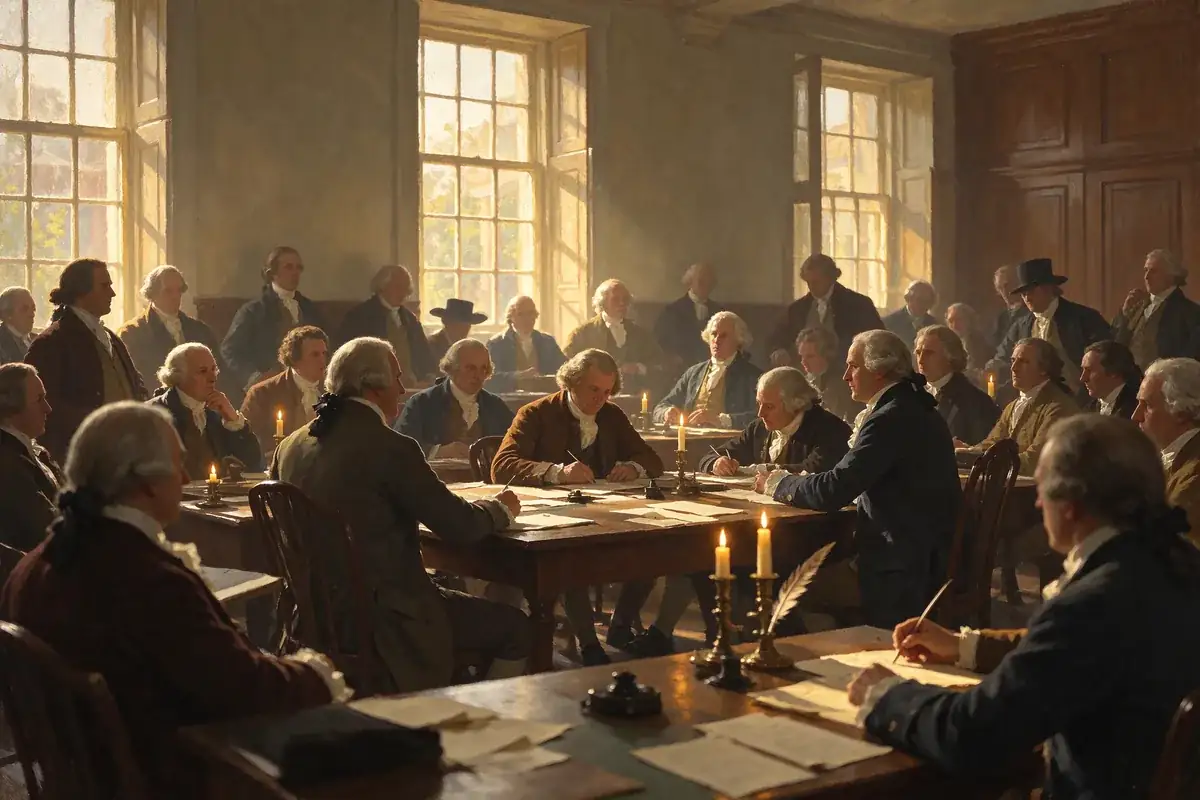
AI-generated illustration: 55 delegates from twelve states met in Philadelphia for the Constitutional Convention.实录编辑部 · AI 生成示意图 · CC0 1.0 · CC0-1.0 SourcesConstitutional Convention (United States) — Wikipedia backgroundAmerican Revolution — Wikipedia background
Cast
People whose choices move the story. Roles describe this story only.
- George WashingtonCommander of the Continental Army and first president
Known for preserving army legitimacy and civilian control; elected first president in 1789.
- Thomas JeffersonPrincipal author of the Declaration
Turned colonial grievances into universal rights language while remaining a Virginia slaveholder.
- James MadisonConvention leader and constitutional designer
Promoted federalism and separation of powers and played a key role in the slavery compromises.
Evidence and limits
Chapter-level sources; key claims checked.
Source count is the number of distinct source records attached to the event nodes shown here. It does not certify the narrative as a whole.