
Refined at the event level; this event stays on its event page and has no separate curated story page.
The short version
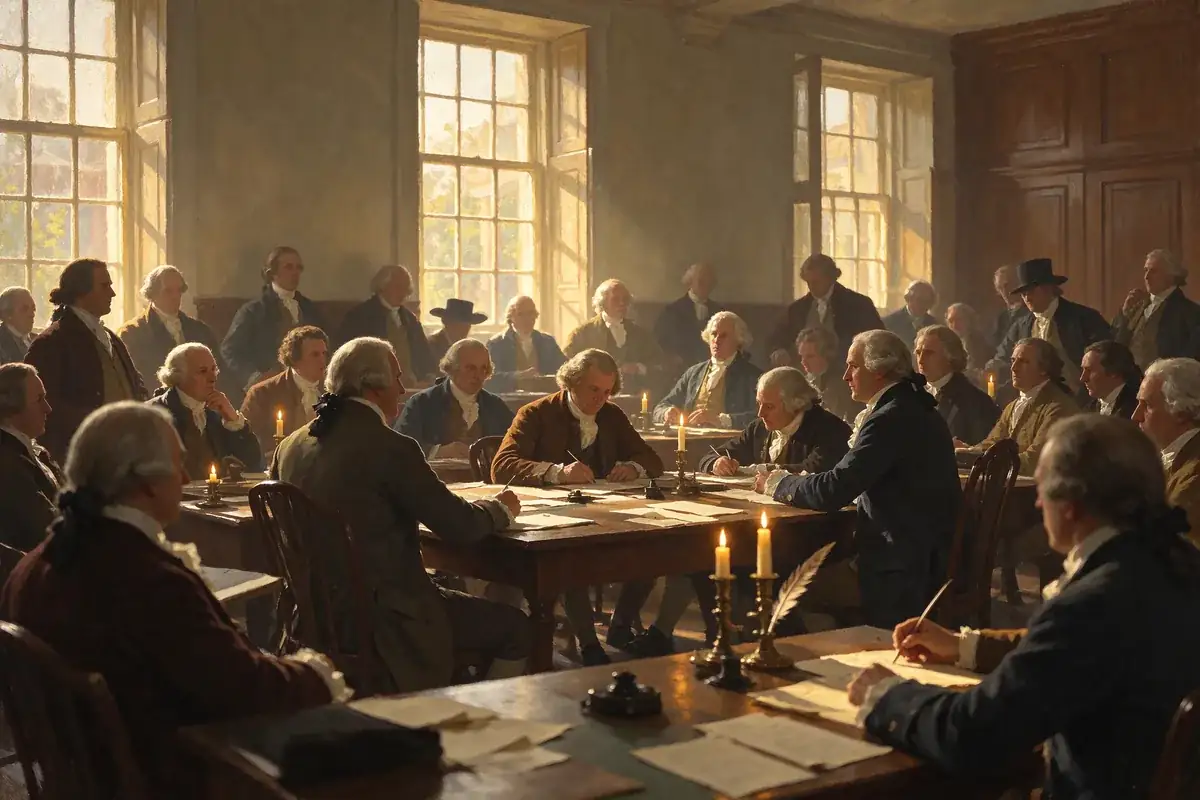
Philadelphia, summer 1787, the Pennsylvania State House. It was hot outside; inside, the doors were shut and the session ran for months. The source leaves a clean set of numbers: May 25 to September 17, delegates from twelve states, 55 participants, 39 signatures on the Constitution. The legacy entry adds that the states chose 74 deputies in all and that Rhode Island refused to attend.
This was not a routine gathering. It had to answer the most awkward question facing a country that had just won its independence: each state had its own government, tariffs and militia, while the centre could barely make anyone do anything.
Why it happened
The legacy entry describes the background as the weakness of the central government under the Articles of Confederation. In practice that meant Congress could not tax directly, could not raise troops reliably, and could not settle trade disputes between states. After the war, debt, land and taxation conflicts surfaced; in Massachusetts, Shays' Rebellion broke out. Only then did the states agree to send delegates to Philadelphia to renegotiate the arrangement of power.
What the source confirms is the meeting itself: the dates, twelve states, 55 participants, 39 signers. Why those twelve came, and why Rhode Island stayed away, is only partly explained by the source; the legacy additions are background, not minutes.
What happened
The legacy entry describes 116 days of intense debate that produced separation of powers, federalism, a bicameral Congress and a Supreme Court. That summary captures the outcome, but it is not the source's text. The source confirms the dates and the numbers; it does not list the Constitution clause by clause.
The hard part was not whether to have a federation, but how to seat its parts. Large states wanted representation by population; small states wanted one vote per state. North and south argued over how enslaved people should be counted. Whether the executive should be one person, and whether he could be re-elected, had no ready answer. What emerged was a bundle of compromises, not a blueprint derived straight from principle. The legacy phrase “separation of powers” is a later summary; it does not replace the story of the bargaining.
What changed
The Constitution was ratified by the states and took effect in 1788; Washington was elected first president in 1789. The legacy entry joins the dots neatly. The source covers only the 1787 convention, not ratification or the first election. What can be confirmed is that 39 men signed on September 17 and that the convention produced a text to send to the states.
The Constitution did not solve every American problem at once. It created a federal government and preserved state power; it wrote rules for representation and elections without giving everyone the vote; it compromised over slavery and left the heaviest conflict to later generations. To say it “brought a nation into being” is not wrong, but it is more accurate to say that it fitted a loose confederation with a working frame, and left several sharp nails inside that frame.
How to read the evidence
This entry carries one source, Britannica's “Constitutional Convention”. It directly supports the dates May 25 to September 17, 1787, the twelve states, the 55 participants and the 39 signatures. The specific debates, the separation-of-powers clauses, ratification in 1788 and Washington's election in 1789 remain legacy copy pending further research; the page keeps the “legacy copy · source pending” label.
Read it by separating “how long the meeting lasted, who came, who signed” from “what the Constitution said and why”. The first has a source; the second still needs the convention records, delegates' letters and the constitutional text. Do not turn a later summary into words spoken in that Philadelphia room.
Sources behind this read
- Constitutional Convention · Encyclopaedia Britannica (accessed 2026-11-21) Original source ↗
Original entry and sentence-level review
To remedy the weaknesses of the central government under the Articles of Confederation, 55 delegates from 12 states (Rhode Island refuses to attend) meet in Philadelphia for the Constitutional Convention.1 After 116 days of intense debate, they adopt the Constitution of the United States, establishing separation of powers (legislative, executive, judicial) and federalism.2 The Constitution provides for a president as head of state, a bicameral Congress, and a Supreme Court as the highest judicial authority.3 The Constitution goes into effect in 1788, and Washington is elected first president in 1789.4
Evidence ledger
4 claims4 sourced0 unsourced
Every hard fact in the narrative above is registered here. A claim may also record source-only details that the narrative does not repeat; the related-narrative line points to the corresponding passage, not a guarantee that the source supports every word of the body. A claim without a source stays visibly unsourced.
To remedy the weaknesses of the central government under the Articles of Confederation, 55 delegates from 12 states (Rhode Island refuses to attend) meet in Philadelphia for the Constitutional Convention.
Related narrativeTo remedy the weaknesses of the central government under the Articles of Confederation, 55 delegates from 12 states (Rhode Island refuses to attend) meet in Philadelphia for the Constitutional Convention.
- Constitutional Convention (United States) — WikipediaWikipedia, "Constitutional Convention (United States)", full article, evidence sentence 372
Many of the states' older and more experienced leaders may have simply been too busy with the local affairs of their states to attend the convention, which had originally been planned to strengthen the existing Articles of Confederation, not to write a constitution for a completely new national government.
Accessed 2026-11-26 · machine excerpt · pending human review
L2: machine-extracted from the Wikipedia lead/full article and compared with the prose; not promoted to L3.
- Constitutional Convention (United States) — WikipediaWikipedia, "Constitutional Convention (United States)", full article, evidence sentence 372
After 116 days of intense debate, they adopt the Constitution of the United States, establishing separation of powers (legislative, executive, judicial) and federalism.
Related narrativeAfter 116 days of intense debate, they adopt the Constitution of the United States, establishing separation of powers (legislative, executive, judicial) and federalism.
- Constitutional Convention (United States) — WikipediaWikipedia, "Constitutional Convention (United States)", full article, evidence sentence 24
During the American Revolution, Thirteen Colonies replaced their colonial governments with republican constitutions based on the principle of separation of powers, organizing government into legislative, executive, and judicial branches.
Accessed 2026-11-26 · machine excerpt · pending human review
L2: machine-extracted from the Wikipedia lead/full article and compared with the prose; not promoted to L3.
- Constitutional Convention (United States) — WikipediaWikipedia, "Constitutional Convention (United States)", full article, evidence sentence 24
The Constitution provides for a president as head of state, a bicameral Congress, and a Supreme Court as the highest judicial authority.
Related narrativeThe Constitution provides for a president as head of state, a bicameral Congress, and a Supreme Court as the highest judicial authority.
- Constitutional Convention (United States) — WikipediaWikipedia, "Constitutional Convention (United States)", full article, evidence sentence 89
To prevent state interference with the federal government's authority, Madison believed there needed to be a way to enforce the federal supremacy, such as an explicit right of Congress to use force against non-compliant states and the creation of a federal court system.
Accessed 2026-11-26 · machine excerpt · pending human review
L2: machine-extracted from the Wikipedia lead/full article and compared with the prose; not promoted to L3.
- Constitutional Convention (United States) — WikipediaWikipedia, "Constitutional Convention (United States)", full article, evidence sentence 89
The Constitution goes into effect in 1788, and Washington is elected first president in 1789.
Related narrativeThe Constitution goes into effect in 1788, and Washington is elected first president in 1789.
- Constitutional Convention (United States) — WikipediaWikipedia, "Constitutional Convention (United States)", full article, evidence sentence 3
Delegates elected George Washington of Virginia, former commanding general of the Continental Army in the American Revolutionary War and a proponent of a stronger national government, to serve as president of the convention.
Accessed 2026-11-26 · machine excerpt · pending human review
L2: machine-extracted from the Wikipedia lead/full article and compared with the prose; not promoted to L3.
- Constitutional Convention (United States) — WikipediaWikipedia, "Constitutional Convention (United States)", full article, evidence sentence 3
Sources and review
English translation predates the current source revision; Key claims rely on a single source record
- Constitutional Convention (United States) — Wikipedia · Wikipedia contributors · Wikipedia lead and full article (accessed 2026-11-26) Original source ↗
- American Revolution — Wikipedia · Wikipedia contributors · Wikipedia lead and full article (accessed 2026-11-26) Original source ↗
L2 claims and source binding
L2 machine extraction plus manual comparison; no L3 two-source human confirmation.
Locations
- United States· 39.9, -75.2· Approximate
evt-1c7e80fafb41642bSource file:
events/evt-1c7e80fafb41642b/event.md