
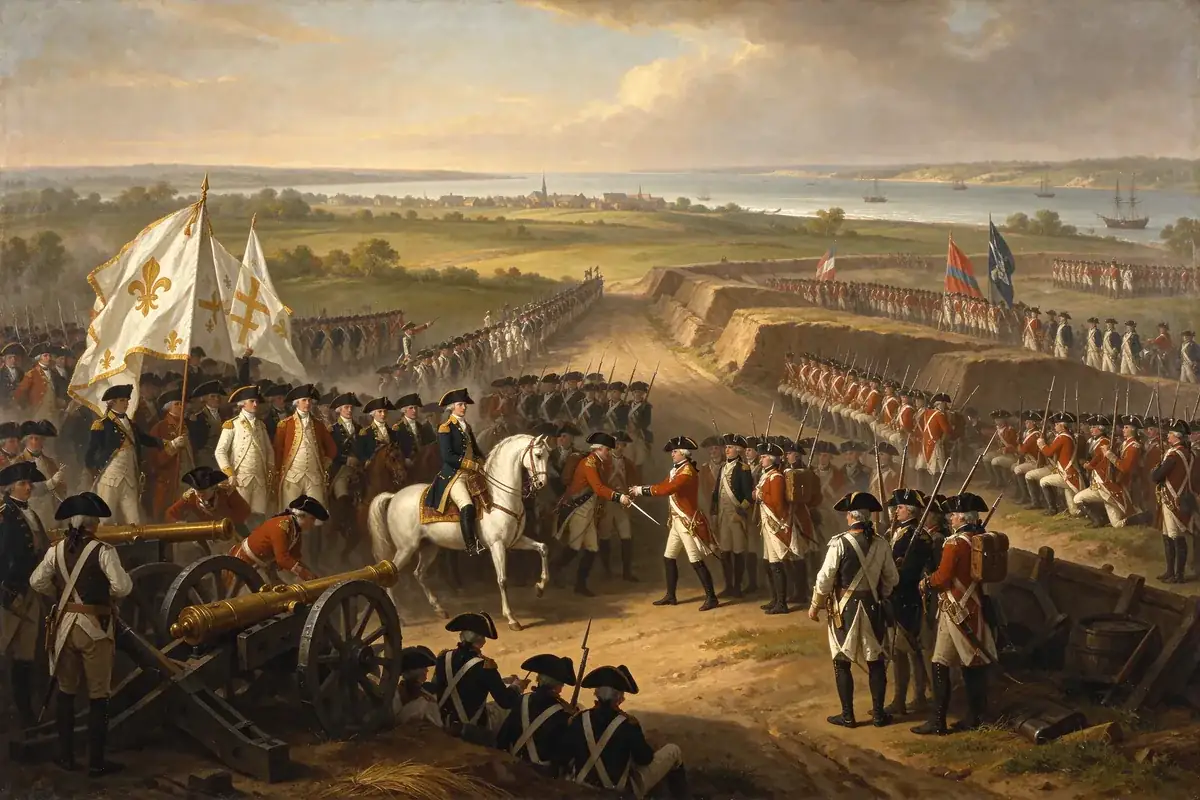
American General Washington and French General Rochambeau command 17,000 Franco-American forces (8,000 Americans, 9,000 French) and, with the help of French Admiral de Grasse, surround 8,000 British troops under General Cornwallis at Yorktown, Virginia.1 On October 17, Cornwallis, deeming his situation 'desperate', surrenders.2 The British band plays 'The World Turned Upside Down'.3 After the battle, Britain ceases major military operations, and the Treaty of Paris in 1783 recognizes American independence.4
The chronology also references 1787 CE.5
Evidence ledger
5 claims4 sourced1 unsourced
Every hard fact in the narrative above is registered here. A claim may also record source-only details that the narrative does not repeat; the related-narrative line points to the corresponding passage, not a guarantee that the source supports every word of the body. A claim without a source stays visibly unsourced.
- Siege of Yorktown — WikipediaWikipedia, "Siege of Yorktown", full article, evidence sentence 2
It was won decisively by the Continental Army, led by George Washington, with support from the Marquis de Lafayette and French Army troops, led by Comte de Rochambeau, and a French Navy force commanded by the Comte de Grasse, making the British Army commanded by British Lieutenant General Charles Cornwallis surrender.
Accessed 2026-11-26 · machine excerpt · pending human review
L2: machine-extracted from the Wikipedia lead/full article and compared with the prose; not promoted to L3.
- Siege of Yorktown — WikipediaWikipedia, "Siege of Yorktown", full article, evidence sentence 2
On October 17, Cornwallis, deeming his situation 'desperate', surrenders.
Related narrativeOn October 17, Cornwallis, deeming his situation 'desperate', surrenders.
- Siege of Yorktown — WikipediaWikipedia, "Siege of Yorktown", full article, evidence sentence 1
The Siege of Yorktown, also known as the Battle of Yorktown and the surrender at Yorktown, took place in 1781 and was the final major land engagement of the American Revolutionary War.
Accessed 2026-11-26 · machine excerpt · pending human review
L2: machine-extracted from the Wikipedia lead/full article and compared with the prose; not promoted to L3.
- Siege of Yorktown — WikipediaWikipedia, "Siege of Yorktown", full article, evidence sentence 1
The British band plays 'The World Turned Upside Down'.
Related narrativeThe British band plays 'The World Turned Upside Down'.
- Siege of Yorktown — WikipediaWikipedia, "Siege of Yorktown", full article, evidence sentence 1
The Siege of Yorktown, also known as the Battle of Yorktown and the surrender at Yorktown, took place in 1781 and was the final major land engagement of the American Revolutionary War.
Accessed 2026-11-26 · machine excerpt · pending human review
L2: machine-extracted from the Wikipedia lead/full article and compared with the prose; not promoted to L3.
- Siege of Yorktown — WikipediaWikipedia, "Siege of Yorktown", full article, evidence sentence 1
After the battle, Britain ceases major military operations, and the Treaty of Paris in 1783 recognizes American independence.
Related narrativeAfter the battle, Britain ceases major military operations, and the Treaty of Paris in 1783 recognizes American independence.
- Siege of Yorktown — WikipediaWikipedia, "Siege of Yorktown", full article, evidence sentence 155
Washington moved the Continental Army to New Windsor, New York, where they remained until the Treaty of Paris was signed on September 3, 1783, bringing the eight-year war to an end and establishing the independence of the colonies.
Accessed 2026-11-26 · machine excerpt · pending human review
L2: machine-extracted from the Wikipedia lead/full article and compared with the prose; not promoted to L3.
- Siege of Yorktown — WikipediaWikipedia, "Siege of Yorktown", full article, evidence sentence 155
The chronology also references 1787 CE.
Related narrativeThe chronology also references 1787 CE.
No source registered. This assertion remains unverified.
Sources and review
English translation predates the current source revision; 1 key claims have no binding source; Unsourced key claims keep the event at structure level
- Siege of Yorktown — Wikipedia · Wikipedia contributors · Wikipedia lead and full article (accessed 2026-11-26) Original source ↗
- American Revolution — Wikipedia · Wikipedia contributors · Wikipedia lead and full article (accessed 2026-11-26) Original source ↗
L2 claims and source binding
L2 machine extraction plus manual comparison; no L3 two-source human confirmation.
Locations
- United States· 37.2, -76.5· Approximate
evt-c07f5241b3a4e8e9Source file:
events/evt-c07f5241b3a4e8e9/event.md