
Civilizations of the Americas: Caral, Maya and the Inca
Story2700 BCE–1521 CE: how cities arose in a world without horses or iron
Around 2700 BCE the coastal Peruvian site of Caral began building pyramid platforms; around 1400 BCE the Olmec civilisation rose in Mesoamerica; in 100 CE Teotihuacan became one of the earliest great cities of the Americas; in 250 the Maya Classic period began; in 1325 Tenochtitlan was founded on a lake; in 1450 the Inca built Machu Picchu; in 1521 the Spanish captured Tenochtitlan. Together these show how cities and states arose in the Americas without horses, iron or wheeled vehicles, through human labour, water management, terraces and trade.
The civilizations of the Americas were not copies of one civilisation. Caral relied on coastal fishing and irrigation, the Olmec on rivers and trade, Teotihuacan on volcanic obsidian and regional markets, the Maya on water management and competing city-states in the rainforest, the Aztecs on artificial lake fields and tribute, the Inca on terraces, roads and labour service. Their common ground was not identical technology but the ability to organise labour beyond village scale.
Chapter-level sources; key claims checked.
Chapter timeline
Chapters in reading orderAll anchors are approximate region-level placements; they are not precise sites. Chapters without coordinates are listed below by region only.
Chapter contents7 chapters
The story, chapter by chapter
Each chapter opens the underlying event- 01
Construction of pyramid platforms at Caral
Around 2700 BCE, the Norte Chico center of Caral began building large stepped pyramid platforms (the largest about 18 m high) in the arid valleys of Peru. Caral people based their society on cotton-fish exchange and developed a peaceful trade society with no fortifications. Caral is one of the oldest urban sites in the Americas, dating back to 3000 BCE.
Around 2700 BCE, the Norte Chico center of Caral began building large stepped pyramid platforms (the largest about 18 m high) in the arid valleys of Peru.
Around 2700 BCE, the Norte Chico center of Caral began building large stepped pyramid platforms (the largest about 18 m high) in the arid valleys of Peru. Caral people based their society on cotton-fish exchange and developed a peaceful trade society with no fortifications. Caral is one of the oldest urban sites in the Americas, dating back to 3000 BCE.
Caral’s pyramid platforms were not royal tombs but centres of public ritual and labour organisation. They show that a city could arise without writing or metal, on human labour and fishing surplus.
Sources: 4 event claims, 4 sourced; source cards src-b3w-americas-before-columbus-04, src-b3w-americas-before-columbus-06 (background only).
SourcesTeotihuacan — Wikipedia backgroundCaral — Wikipedia background
- 02
Olmec civilization: the mother culture of Mesoamerica
From roughly 1400 to 400 BCE, the Olmec civilization flourished along the Gulf Coast of Mexico (present‑day Veracruz and Tabasco). The Olmec carved colossal basalt heads (up to 3 metres high and 20‑50 tonnes), developed a calendar and the earliest writing in Mesoamerica, and worshipped the jaguar god and the feathered serpent. San Lorenzo and La Venta served as political and religious centres. The Olmecs are recognis…
From roughly 1400 to 400 BCE, the Olmec civilization flourished along the Gulf Coast of Mexico (present‑day Veracruz and Tabasco).
From roughly 1400 to 400 BCE, the Olmec civilization flourished along the Gulf Coast of Mexico (present‑day Veracruz and Tabasco). The Olmec carved colossal basalt heads (up to 3 metres high and 20‑50 tonnes), developed a calendar and the earliest writing in Mesoamerica, and worshipped the jaguar god and the feathered serpent. San Lorenzo and La Venta served as political and religious centres. The Olmecs are recognised as the 'mother culture' of Mesoamerica, influencing the Maya, Zapotec, and Aztec civilisations.
The Olmec are often called the “mother civilisation,” a term that compresses a complex region into one origin. More cautiously, they supplied a shareable language of symbols, ritual and art.
Sources: 5 event claims, 5 sourced; source cards src-b3w-americas-before-columbus-02, src-b3w-americas-before-columbus-04 (background only).
SourcesOlmecs — Wikipedia backgroundTeotihuacan — Wikipedia background
- 03
Teotihuacan: The First Great Metropolis of the Americas
From roughly AD 100 to 650, Teotihuacan in the Valley of Mexico developed into one of the largest cities in the Americas, with a peak population of about 125,000. The city was laid out on a strict grid plan, with major structures including the Pyramid of the Sun (63 m high), the Pyramid of the Moon, and the Temple of the Feathered Serpent. Teotihuacan's influence extended throughout Mesoamerica, with trade and politi…
From roughly AD 100 to 650, Teotihuacan in the Valley of Mexico developed into one of the largest cities in the Americas, with a peak population of about 125,000.
From roughly AD 100 to 650, Teotihuacan in the Valley of Mexico developed into one of the largest cities in the Americas, with a peak population of about 125,000. The city was laid out on a strict grid plan, with major structures including the Pyramid of the Sun (63 m high), the Pyramid of the Moon, and the Temple of the Feathered Serpent. Teotihuacan's influence extended throughout Mesoamerica, with trade and political ties to Maya cities. The city mysteriously declined around AD 650, but its cultural and religious heritage was inherited by later cultures such as the Aztecs.
Teotihuacan sustained a huge city through grid planning, apartment compounds and obsidian trade without leaving a king’s name. Its power may have lain in markets and ritual rather than a palace.
Sources: 6 event claims, 6 sourced; source cards src-b3w-americas-before-columbus-04, src-b3w-americas-before-columbus-07 (background only).
SourcesTeotihuacan — Wikipedia backgroundMaya civilization — Wikipedia background
- 04
Maya Classic period begins
Circa 250–950 AD, Maya civilization entered the Classic period. The Maya built dozens of city‑states in the lowlands of Mesoamerica (modern Guatemala, Belize, Mexico's Yucatán Peninsula), including Tikal, Palenque, Copán, and Calakmul. The Maya developed a full writing system, precise calendars (the Long Count), mathematics (including the concept of zero), and astronomy. Maya pyramids, palaces, and ballcourts covered…
Circa 250–950 AD, Maya civilization entered the Classic period. The Maya built dozens of city‑states in the lowlands of Mesoamerica (modern Guatemala, Belize, Mexico's Yucatán Peninsula), including Tikal, Palenque, Copán, and Calakmul.
Circa 250–950 AD, Maya civilization entered the Classic period. The Maya built dozens of city‑states in the lowlands of Mesoamerica (modern Guatemala, Belize, Mexico's Yucatán Peninsula), including Tikal, Palenque, Copán, and Calakmul. The Maya developed a full writing system, precise calendars (the Long Count), mathematics (including the concept of zero), and astronomy. Maya pyramids, palaces, and ballcourts covered the jungles of Mesoamerica. Around 900 AD, the Classic Maya civilization collapsed, likely due to drought, warfare, and environmental degradation.
The Maya Classic period was not one empire but many city-states competing in the rainforest. Writing, calendars, ballcourts and war together formed a shared language among them.
Sources: 7 event claims, 7 sourced; source cards src-b3w-americas-before-columbus-07, src-b3w-americas-before-columbus-04 (background only).
SourcesMaya civilization — Wikipedia backgroundTeotihuacan — Wikipedia background
- 05
Foundation of Tenochtitlan: Beginning of the Aztec Empire
In 1325 the Aztecs (Mexica) founded Tenochtitlan on a small island in Lake Texcoco (present-day Mexico City), following the sign of an eagle eating a snake on a cactus. Through the Triple Alliance (with Texcoco and Tlacopan), the Aztecs built the most powerful empire in Mesoamerica. By the time the Spanish arrived (1519), Tenochtitlan had about 200,000 inhabitants, making it one of the world's largest cities.
In 1325 the Aztecs (Mexica) founded Tenochtitlan on a small island in Lake Texcoco (present-day Mexico City), following the sign of an eagle eating a snake on a cactus.
In 1325 the Aztecs (Mexica) founded Tenochtitlan on a small island in Lake Texcoco (present-day Mexico City), following the sign of an eagle eating a snake on a cactus. Through the Triple Alliance (with Texcoco and Tlacopan), the Aztecs built the most powerful empire in Mesoamerica. By the time the Spanish arrived (1519), Tenochtitlan had about 200,000 inhabitants, making it one of the world's largest cities.
Tenochtitlan was built on a lake, turning water into infrastructure through artificial fields, causeways and canals. Aztec expansion rested on tribute and alliance and on control of water and roads.
Sources: 6 event claims, 6 sourced; source cards src-b3w-americas-before-columbus-01, src-b3w-americas-before-columbus-04 (background only).
SourcesTenochtitlan — Wikipedia backgroundTeotihuacan — Wikipedia background
- 06
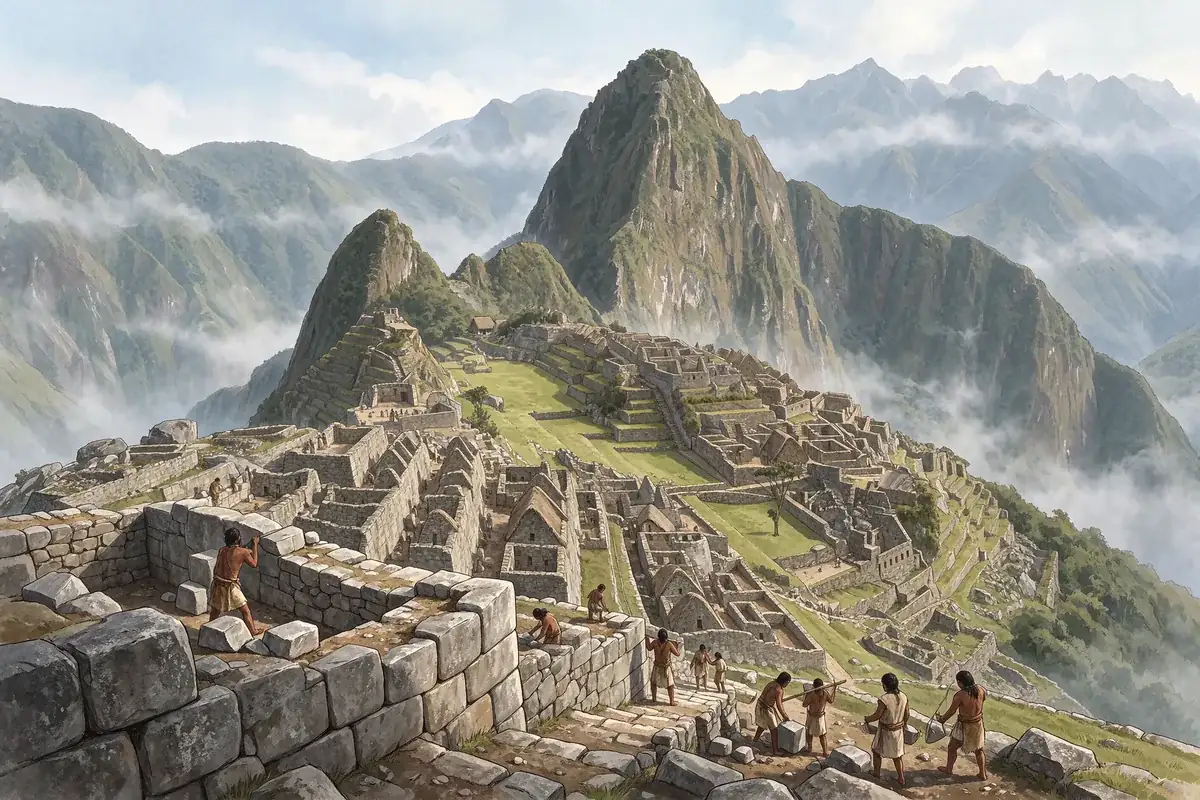
The Inca build Machu Picchu
Machu Picchu sits on a ridge some 2,430 metres above the Urubamba valley and is generally taken to have been a royal estate of Pachacuti. Divided into farming and urban sectors, its roughly two hundred structures are dry-laid in finely dressed granite whose joints admit no blade; terraces over layered drainage cope with rain on the steep slope, and the Temple of the Sun and the Intihuatana stone served solstice obser…
Machu Picchu sits on a ridge some 2,430 metres above the Urubamba valley and is generally taken to have been a royal estate of Pachacuti.
Machu Picchu sits on a ridge some 2,430 metres above the Urubamba valley and is generally taken to have been a royal estate of Pachacuti. Divided into farming and urban sectors, its roughly two hundred structures are dry-laid in finely dressed granite whose joints admit no blade; terraces over layered drainage cope with rain on the steep slope, and the Temple of the Sun and the Intihuatana stone served solstice observation. The Spanish never reached it, and so it survived.
Machu Picchu was an Inca royal estate and religious landscape, not an ordinary city. It displays the state’s ability to combine labour, stonework and mountain terrain.
Sources: 5 event claims, 5 sourced; source cards src-b3w-americas-before-columbus-03, src-b3w-americas-before-columbus-06 (background only).
AI-generated illustration: Machu Picchu sits on a ridge some 2,430 metres above the Urubamba valley.实录编辑部 · AI 生成示意图 · CC0 1.0 · CC0-1.0 SourcesMachu Picchu — Wikipedia backgroundCaral — Wikipedia background
- 07
Fall of the Aztec capital Tenochtitlan
Spanish conquistador Hernán Cortés captures Tenochtitlan after a prolonged siege; the last ruler Cuauhtémoc is taken prisoner, ending the Aztec Empire, the dominant power of Mesoamerica.
Spanish conquistador Hernán Cortés captures Tenochtitlan after a prolonged siege; the last ruler Cuauhtémoc is taken prisoner, ending the Aztec Empire, the dominant power of Mesoamerica.
Spanish conquistador Hernán Cortés captures Tenochtitlan after a prolonged siege; the last ruler Cuauhtémoc is taken prisoner, ending the Aztec Empire, the dominant power of Mesoamerica.
The fall of 1521 was not the disappearance of a civilisation but the conquest of an empire, with populations devastated by disease and war and religion and writing suppressed. American cities and peoples continued, now inside a colonial order.
Sources: 3 event claims, 3 sourced; source cards src-b3w-americas-before-columbus-07, src-b3w-americas-before-columbus-01 (background only).
SourcesMaya civilization — Wikipedia backgroundTenochtitlan — Wikipedia background
Cast
People whose choices move the story. Roles describe this story only.
- PachacutiInca empire builder
Expanded the Inca from a local Cusco polity into an Andean empire; Machu Picchu is linked to his royal works.
- Moctezuma IIAztec emperor
Faced the Spanish conquest in 1521; his decisions and misjudgements became central to the empire’s collapse.
Evidence and limits
Chapter-level sources; key claims checked.
Source count is the number of distinct source records attached to the event nodes shown here. It does not certify the narrative as a whole.