
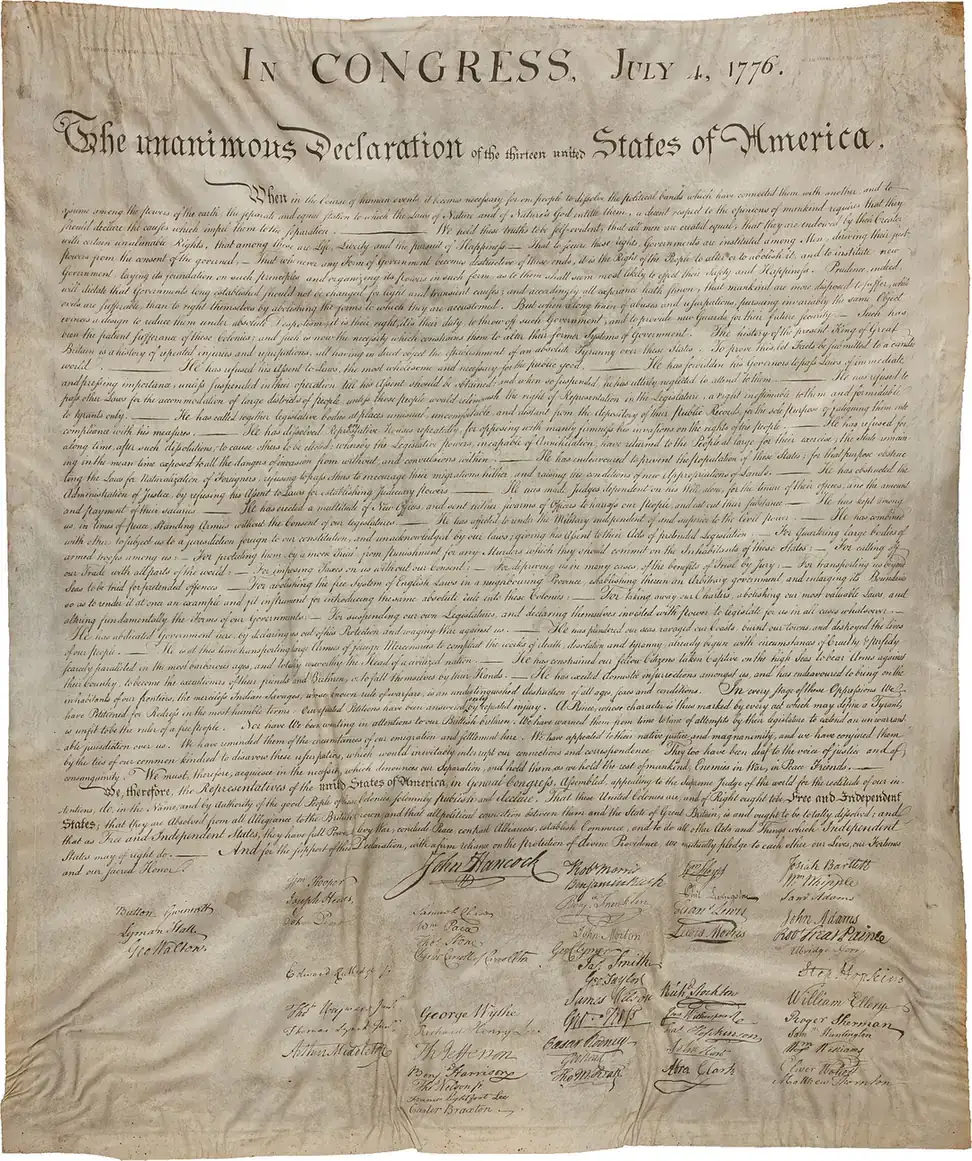
The Continental Congress formally adopts the Declaration of Independence, drafted by Thomas Jefferson, in Philadelphia.1 The declaration announces the separation of the thirteen North American colonies from Britain and the formation of the 'United States of America'.2 The preamble states: 'We hold these truths to be self-evident, that all men are created equal, that they are endowed by their Creator with certain unalienable Rights, that among these are Life, Liberty and the pursuit of Happiness.' July 4 becomes Independence Day in the United States.3 The declaration inspires national liberation movements around the world.4
The chronology also references 1787 CE.5
Evidence ledger
5 claims5 sourced0 unsourced
Every hard fact in the narrative above is registered here. A claim may also record source-only details that the narrative does not repeat; the related-narrative line points to the corresponding passage, not a guarantee that the source supports every word of the body. A claim without a source stays visibly unsourced.
- United States Declaration of Independence — WikipediaWikipedia, "United States Declaration of Independence", full article, evidence sentence 2
On July 4, 1776, it was adopted unanimously by the Second Continental Congress, who were convened at the Pennsylvania State House, later renamed Independence Hall, in Philadelphia.
Accessed 2026-11-26 · machine excerpt · pending human review
L2: machine-extracted from the Wikipedia lead/full article and compared with the prose; not promoted to L3.
- United States Declaration of Independence — WikipediaWikipedia, "United States Declaration of Independence", full article, evidence sentence 2
The declaration announces the separation of the thirteen North American colonies from Britain and the formation of the 'United States of America'.
Related narrativeThe declaration announces the separation of the thirteen North American colonies from Britain and the formation of the 'United States of America'.
- American Revolution — WikipediaWikipedia, "American Revolution", full article, evidence sentence 1
The American Revolution (1765–1789) was a political movement in the Thirteen Colonies of Great Britain.
Accessed 2026-11-26 · machine excerpt · pending human review
L2: machine-extracted from the Wikipedia lead/full article and compared with the prose; not promoted to L3.
- American Revolution — WikipediaWikipedia, "American Revolution", full article, evidence sentence 1
The preamble states: 'We hold these truths to be self-evident, that all men are created equal, that they are endowed by their Creator with certain unalienable Rights, that among these are Life, Liberty and the pursuit of Happiness.' July 4 becomes Independence Day in the United States.
Related narrativeThe preamble states: 'We hold these truths to be self-evident, that all men are created equal, that they are endowed by their Creator with certain unalienable Rights, that among these are Life, Liberty and the pursuit of Happiness.' July 4 becomes Independence Day in the United States.
- United States Declaration of Independence — WikipediaWikipedia, "United States Declaration of Independence", full article, evidence sentence 25
The Declaration's second sentence—"We hold these truths to be self-evident, that all men are created equal, that they are endowed by their Creator with certain unalienable Rights, that among these are Life, Liberty and the pursuit of Happiness"—is considered one of the most significant and famed lines in world history.
Accessed 2026-11-26 · machine excerpt · pending human review
L2: machine-extracted from the Wikipedia lead/full article and compared with the prose; not promoted to L3.
- United States Declaration of Independence — WikipediaWikipedia, "United States Declaration of Independence", full article, evidence sentence 25
The declaration inspires national liberation movements around the world.
Related narrativeThe declaration inspires national liberation movements around the world.
- United States Declaration of Independence — WikipediaWikipedia, "United States Declaration of Independence", full article, evidence sentence 229
The document signed by Congress and enshrined in the National Archives is usually regarded as the Declaration of Independence, but historian Julian P.
Accessed 2026-11-26 · machine excerpt · pending human review
L2: machine-extracted from the Wikipedia lead/full article and compared with the prose; not promoted to L3.
- United States Declaration of Independence — WikipediaWikipedia, "United States Declaration of Independence", full article, evidence sentence 229
The chronology also references 1787 CE.
Related narrativeThe chronology also references 1787 CE.
- American Revolution — WikipediaWikipedia, "American Revolution", full article, evidence sentence 2
It began as a colonial rebellion and evolved into a revolution, the result of which was the creation of the United States following the colonies' victory in the American Revolutionary War (1775–1783) and British recognition of their sovereign independence in the Treaty of Paris.
Accessed 2026-11-26 · machine excerpt · pending human review
L2: machine-extracted from the Wikipedia lead/full article and compared with the prose; not promoted to L3.
- American Revolution — WikipediaWikipedia, "American Revolution", full article, evidence sentence 2
Sources and review
English translation predates the current source revision
- United States Declaration of Independence — Wikipedia · Wikipedia contributors · Wikipedia lead and full article (accessed 2026-11-26) Original source ↗
- American Revolution — Wikipedia · Wikipedia contributors · Wikipedia lead and full article (accessed 2026-11-26) Original source ↗
L2 claims and source binding
L2 machine extraction plus manual comparison; no L3 two-source human confirmation.
Locations
- United States· 39.95, -75.15· Approximate
evt-c7215175867f1f18Source file:
events/evt-c7215175867f1f18/event.md