
The Yuan Dynasty: From Steppe Khan to Emperor of China
Story1251–1294: how Kublai turned one branch of the Mongol Empire into a Central Plains dynasty
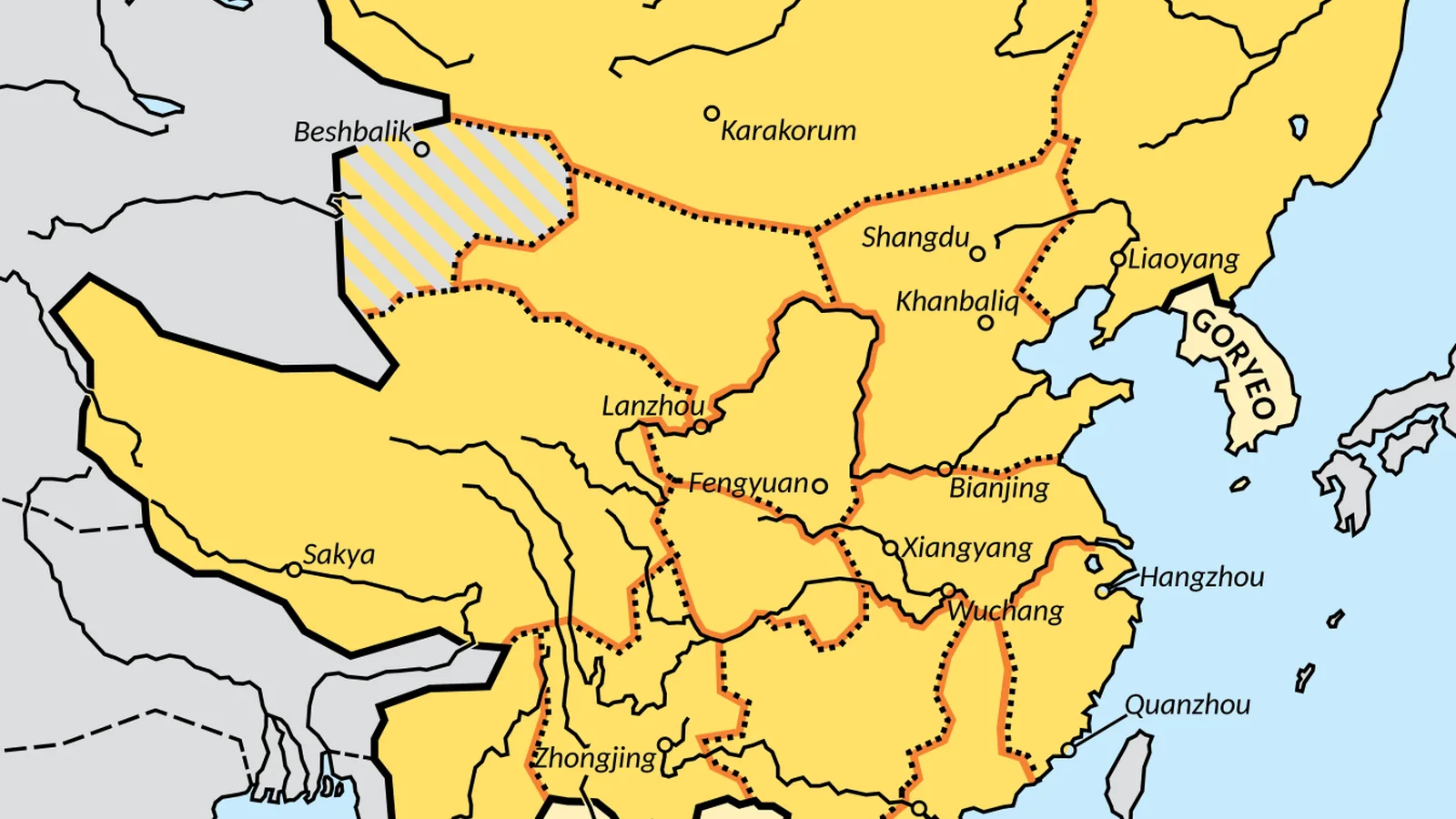
In 1251 Möngke was proclaimed great khan by the Altai River; two years later Kublai campaigned against Dali, and in 1258 Hulagu took Baghdad. In 1260 Kublai and his brother Ariq Böke each claimed the throne, and the empire fell into civil war. Kublai won with the resources of the Han lands, moved his capital to Dadu and changed the dynastic name to Yuan. Marco Polo reached Shangdu in 1275; Lin'an surrendered in 1276; Wen Tianxiang was executed at Dadu in 1279; in 1280 the Yuan completed its unification and promulgated the Shoushi calendar. Kublai died in 1294. This story uses twelve nodes to trace the birth of the Yuan, including the destruction wrought by conquest and the resistance of the conquered; it does not present "unification" as a single-line victory.
The Yuan was not a natural continuation of the Mongol Empire. Kublai won a succession war by attaching Han resources, capital planning, a dynastic name and bureaucratic institutions to the Mongol military machine. The conquest of the Southern Song and the Shoushi calendar display governing capacity; the burning of Baghdad and Wen Tianxiang's refusal mark the other side of conquest. The great khan's death in 1294 and the separation of the khanates show that the Yuan was only one part of the Mongol world.
Chapter-level sources; key claims checked.
Chapter timeline
Chapters in reading orderAll anchors are approximate region-level placements; they are not precise sites. Chapters without coordinates are listed below by region only.
Chapter contents12 chapters
- The kurultai by the Altai River
- The Dali campaign: outflanking the Southern Song
- Seven days in Baghdad
- Kaiping and Karakorum: two great khans
- Dadu: a capital laid out on an axis
- Great Yuan: the turn behind a dynastic name
- Marco Polo arrives at Shangdu
- Lin'an surrenders without a battle
- Wen Tianxiang: refusing to serve a second house
- After Yamen: the unification of China
- The Shoushi calendar: 365.2425 days
- The end at the Zitan Hall in Dadu
The story, chapter by chapter
Each chapter opens the underlying event- 01
The kurultai by the Altai River
Batu convened a kurultai on the banks of the Alataw River, which elected Möngke, the eldest son of Tolui, as the fourth Great Khan of the Mongol Empire. Princes of the Ögedei and Chagatai lineages refused to recognize him, but Möngke, backed by Batu's strong military support, forcibly assumed the throne. He then launched a great purge, executing dozens of princes and generals from the Ögedei and Chagatai lines, conso…
Möngke takes the throne with Batu's military backing; the Ögedei and Chagatai lines refuse to recognize him, and the purges turn the succession into an imperial fracture.
In 1251 Batu convened a kurultai by the Altai River and raised Möngke, eldest son of Tolui, as the fourth great khan of the Mongol Empire. The princes of the Ögedei and Chagatai lines refused to recognize him, but Batu's military backing allowed Möngke to take the throne anyway.
Möngke then launched a purge, executing dozens of princes and commanders from the Ögedei and Chagatai lines. The succession was not a formal election but a power settlement imposed by armies and reprisals.
This accession made the empire's succession conflict public: the princely lines were no longer merely obeying; at the next kurultai they could refuse, or raise another khan. The seeds of the dual khanate and civil war between Kublai and Ariq Böke were planted here.
Sources: 5 event claims, 5 sourced; source cards src-b3w-yuan-founding-07, src-b3w-yuan-founding-08 (background only).
SourcesYuan dynasty — Wikipedia backgroundKublai Khan — Wikipedia background
- 02
The Dali campaign: outflanking the Southern Song
Möngke sent his brother Kublai to conquer the Dali Kingdom in present-day Yunnan. Kublai advanced in three columns and took the city of Dali in 1253. The last king, Duan Xingzhi, fled to Shanchan and was later captured; the Dali Kingdom, which had ruled Yunnan for more than three centuries, came to an end. Yunnan came under direct Mongol control, while the Duan family continued to govern locally as hereditary oversee…
Kublai marches from Lintao through Sichuan and eastern Tibet to Dali; Duan Xingzhi is captured, and Yunnan enters direct central administration for the first time.
In 1253 Möngke sent his brother Kublai against the Dali kingdom. Instead of pushing along the Southern Song front, Kublai marched from Lintao in Gansu through Sichuan and eastern Tibet, covering more than three thousand li in a flanking march to Dali (present-day Dali, Yunnan).
The last ruler of Dali, Duan Xingzhi, was captured, and a kingdom that had lasted more than three hundred years (937–1253) ended. The event record says Yunnan entered direct central administration for the first time.
For the Mongols this was not a raid on a borderland but the opening of a southwestern flank against the Southern Song. Dali's mountains, population and roads toward Southeast Asia entered the empire's military map; for the local polity, it was the beginning of absorption into a larger empire.
Sources: 6 event claims, 6 sourced; source cards src-b3w-yuan-founding-02, src-b3w-yuan-founding-04 (background only).
SourcesMarco Polo — Wikipedia backgroundDadu (Beijing) — Wikipedia background
- 03
Seven days in Baghdad
In January 1258 Hulagu's Mongol army encircled Baghdad, capital of the Abbasid Caliphate, battering the walls with counterweight trebuchets and incendiaries until the eastern defences collapsed after some ten days. Caliph al-Musta'sim surrendered on 10 February and the Mongols entered the city on the 13th, beginning a massacre that lasted seven days and killed hundreds of thousands. The caliph was rolled in a carpet…
Hulagu breaches Baghdad with trebuchets and incendiaries; the caliph surrenders and is killed, and seven days of massacre and the burning of the House of Wisdom end the Abbasid dynasty.
In January 1258 Hulagu's Mongol army encircled Baghdad, capital of the Abbasid dynasty, and battered the walls with trebuchets and incendiaries. The eastern wall collapsed after more than ten days; the caliph al-Musta'sim surrendered on 10 February, and the Mongols entered the city on the 13th.
What followed was seven days of massacre; the event record puts the dead in the tens of thousands. The caliph was wrapped in a carpet and trampled by horses, since the Mongols avoided shedding royal blood on the ground. The House of Wisdom and the great libraries were burned, their books thrown into the Tigris, which was said to be darkened by ink.
The Abbasid dynasty, more than five centuries old, came to an end; the event record calls this the end of the Islamic Golden Age. The destruction of Baghdad is not a margin of conquest but a part this chapter must face directly: a city, its books and its people disappeared in war.
Sources: 7 event claims, 7 sourced; source cards src-b3w-yuan-founding-02, src-b3w-yuan-founding-03 (background only).
SourcesMarco Polo — Wikipedia backgroundBattle of Yamen — Wikipedia background
- 04
Kaiping and Karakorum: two great khans
Kublai convened a kurultai at his summer capital Kaiping (present-day Duolun, Inner Mongolia) and declared himself Great Khan of the Mongol Empire. His younger brother Ariq Böke was meanwhile proclaimed Great Khan at Karakorum by the princes of the Ögedei and Chagatai lines. The Mongol Empire descended into a four-year civil war (1260-1264). Kublai, relying on resources from China, ultimately defeated Ariq Böke.
Kublai takes the title at Kaiping while Ariq Böke is raised at Karakorum; a four-year civil war is decided by Han resources.
In 1260 Kublai convened his own kurultai at Kaiping (present-day Duolun, Inner Mongolia) and claimed the title of great khan. His brother Ariq Böke was raised as great khan at Karakorum by princes of the Ögedei and Chagatai lines.
The empire now had two great khans, and civil war lasted four years (1260–1264). Kublai relied on the grain, finances and armies of the Han lands and finally defeated Ariq Böke. The decisive factor was not the steppe heartland but his ability to mobilize settled regions.
The civil war shifted the empire's center of gravity. Kublai was no longer merely one prince among the steppe aristocracy; he moved his base toward North China and the Central Plains. The Mongol Empire could no longer operate through a single unified court.
Sources: 6 event claims, 6 sourced; source cards src-b3w-yuan-founding-07, src-b3w-yuan-founding-08 (background only).
SourcesYuan dynasty — Wikipedia backgroundKublai Khan — Wikipedia background
- 05
Dadu: a capital laid out on an axis
Kublai decided to move his capital from Kaiping to Yanjing (present-day Beijing) and ordered the construction of a new city, Dadu, in the northeast of the former Jin capital of Zhongdu. The design was by the Han Chinese Liu Bingzhong, featuring a north-south axis and a triple structure of outer city, imperial city, and palace city. Dadu had a perimeter of 28.6 km and 11 gates, making it one of the grandest cities in…
Liu Bingzhong plans the north–south axis and the triple city; a 28.6-kilometre wall with eleven gates gives the Yuan a new political center.
In 1267 Kublai decided to move the capital from Kaiping to Yanjing (present-day Beijing) and to build a new capital, Dadu, northeast of the old Jin central capital. The planning was entrusted to the Han official Liu Bingzhong: a north–south axis, with outer city, imperial city and palace city in three rings.
The event record gives Dadu a wall of 28.6 kilometres and eleven gates, calling it one of the grandest cities in the world at the time. Streets and palaces unfolded along the axis, and the court of a steppe empire acquired the physical form of a settled dynasty's capital.
The move was not a simple change of residence. It shifted the administrative center from the steppe edge to the North China plain, made Han resources easier to mobilize, and anchored Kublai's legitimacy in a city that could tax, garrison and receive envoys.
Sources: 5 event claims, 5 sourced; source cards src-b3w-yuan-founding-04, src-b3w-yuan-founding-06 (background only).
SourcesDadu (Beijing) — Wikipedia backgroundKarakorum — Wikipedia background
- 06
Great Yuan: the turn behind a dynastic name
Following the advice of Liu Bingzhong, Kublai changed the state name from 'Great Mongol State' to 'Great Yuan', taken from the 'Book of Changes' phrase 'Great is the Qian, the primal.' The establishment of the Yuan dynasty marked Kublai's transformation from a steppe nomadic empire to a Chinese-style dynasty. Kublai proclaimed himself Emperor Shizu of Yuan and posthumously honored Genghis Khan as Emperor Taizu of Yua…
Taking "Great indeed is the Qian Yuan" from the Book of Changes, the state changes its name from the Mongol Empire to Great Yuan; a steppe empire begins to describe itself as a Central Plains dynasty.
In 1271 Kublai adopted Liu Bingzhong's proposal and changed the state name from "Great Mongol State" to "Great Yuan", taking the phrase "Great indeed is the Qian Yuan" from the Book of Changes. With the name, the regime's self-description changed as well.
The event record presents this as a transition from a steppe nomadic empire to a Central Plains dynasty. Kublai called himself Yuan Shizu and posthumously honored Genghis Khan as Yuan Taizu; the Yuan is described as the first nationwide unified dynasty in Chinese history founded by a minority.
But "transition" did not erase steppe tradition. The thousands, the keshig and princely appanages remained, while Han bureaucracy, a capital and a dynastic name were attached to them. Yuan governance was from the start an assembly of two traditions.
Sources: 6 event claims, 6 sourced; source cards src-b3w-yuan-founding-07, src-b3w-yuan-founding-08 (background only).
SourcesYuan dynasty — Wikipedia backgroundKublai Khan — Wikipedia background
- 07
Marco Polo arrives at Shangdu
Marco Polo, together with his father and uncle, arrived at Yuan Shangdu (present-day Zhenglan Banner, Inner Mongolia) and was warmly received by Kublai. Marco was clever and quick to learn Mongolian and Chinese, winning Kublai's favor. He then lived in China for 17 years, holding posts such as Inspector of Yangzhou, and traveled to Hangzhou, Chengdu, Kunming, Quanzhou, and other places.
Marco Polo reaches Shangdu with his father in 1275 and stays seventeen years; his account brings the Yuan to Europe, though its details have long been disputed.
In 1275 Marco Polo reached Shangdu (present-day Zhenglan Banner, Inner Mongolia) with his father and was received by Kublai. The event record says he quickly learned Mongolian and Chinese and then stayed in China for seventeen years.
He traveled to Hangzhou, Chengdu, Kunming and Quanzhou, and the record also says he served as a governor of Yangzhou and in other posts. For a traveler from Venice, the Yuan was a network of post stations, cities, paper money and transcontinental trade.
Marco Polo's account brought the wealth and institutions of the East to Europe, but its details have long been disputed: what he saw himself and what he repeated from others is still unsettled. This chapter follows the event record and does not treat every sentence of the travel account as independent evidence.
Sources: 5 event claims, 5 sourced; source cards src-b3w-yuan-founding-02, src-b3w-yuan-founding-08 (background only).
SourcesMarco Polo — Wikipedia backgroundKublai Khan — Wikipedia background
- 08
Lin'an surrenders without a battle
The Yuan army approached the Southern Song capital Lin'an (present-day Hangzhou). Empress Dowager Xie and Emperor Gong submitted a surrender, and Lin'an surrendered without a fight. The Yuan army escorted Empress Dowager Xie, Emperor Gong, the Song imperial clan, and officials to Dadu. Kublai named Emperor Gong the Duke of Ying and later sent him to Tibet to become a monk. The Song's rule in Lin'an came to an end.
Empress Dowager Xie and Emperor Gongdi submit; the Southern Song court at Lin'an ends, and Gongdi is taken to Dadu and later sent to Tibet to become a monk.
In 1276 Yuan forces reached Lin'an (present-day Hangzhou), capital of the Southern Song. Empress Dowager Xie and Emperor Gongdi submitted, and Lin'an surrendered without a battle. The Yuan army sent the empress dowager, the boy emperor, the imperial clan and officials to Dadu.
Kublai made Emperor Gongdi the Duke of Yingguo and later sent him to Tibet to become a monk. The Southern Song court at Lin'an ended; but the remnants of the dynasty did not all disappear, and resistance continued in Fujian, Guangdong and at sea.
The surrender of Lin'an was the collapse of a political center, not the end of the war. It gave the Yuan the legitimating symbols of the Southern Song and pushed the next question forward: how to deal with Song forces still holding out in the south and on the sea.
Sources: 7 event claims, 7 sourced; source cards src-b3w-yuan-founding-07, src-b3w-yuan-founding-03 (background only).
SourcesYuan dynasty — Wikipedia backgroundBattle of Yamen — Wikipedia background
- 09
Wen Tianxiang: refusing to serve a second house
Wen Tianxiang was imprisoned in Dadu for three years; Kublai sent former Song officials, Yuan officials, and Wen's younger brother to persuade him to surrender, but Wen remained unmoved. Kublai personally tried to persuade him, offering high office, but Wen replied, 'I received the favor of the Song dynasty as a chancellor; how could I serve two dynasties? I ask only to die.' In the end, after the Southern Song had a…
After three years of imprisonment and repeated attempts to make him submit, Wen Tianxiang is executed at Caishi in Dadu; his refusal becomes central to the memory of Southern Song resistance.
After the fall of Lin'an, Wen Tianxiang continued to resist, was defeated and captured, and was imprisoned at Dadu for three years. Kublai repeatedly sent former Song officials, Yuan officers and Wen's brother to persuade him; he refused them all.
Kublai himself offered high office and wealth. Wen replied: "I received the Song's grace and became its chancellor; how can I serve a second house? Grant me one death and that is enough." The event record says he refused to submit after the Southern Song had been destroyed and was executed at Caishi in Dadu at the age of forty-seven.
In prison he wrote "Song of Righteous Spirit", which became a symbol of integrity. For the Yuan, he was a symbol of resistance that had to be dealt with; for Song loyalists, he was a refusal that conquest could not absorb. The record places the execution in 1279; accounts of the exact date differ, and this chapter does not change the recorded year.
Sources: 7 event claims, 7 sourced; source cards src-b3w-yuan-founding-07, src-b3w-yuan-founding-02 (background only).
SourcesYuan dynasty — Wikipedia backgroundMarco Polo — Wikipedia background
- 10
After Yamen: the unification of China
After the Battle of Yamen, the remnants of the Southern Song were wiped out. The Yuan dynasty completed the reunification that had been absent since the end of the Tang dynasty, with a territory covering present-day China, the Mongolian plateau, southern Siberia, eastern Central Asia, the northern Korean Peninsula, and northern Myanmar. The Yuan dynasty was one of the largest in Chinese history and the first national…
After the Southern Song remnants are destroyed at Yamen, the Yuan completes unification; the record places this in 1280, and the territorial and "first minority unified dynasty" claims follow the record.
In 1279 the Southern Song remnants were destroyed after the battle of Yamen. The event record places the Yuan's completion of unification in 1280: more than four centuries of division since the late Tang ended, and the realm included present-day China, the Mongolian plateau, southern Siberia, eastern Central Asia, northern Korea and northern Myanmar.
The Yuan is therefore described as one of the largest dynasties in Chinese history and the first nationwide unified dynasty founded by a minority. Unification brought provinces, post roads and a nationwide fiscal system, but also garrisons, migrations and local reorganization after conquest.
"Unification" is not a word without cost. It ended the Southern Song court and executed resisters such as Wen Tianxiang; it connected regions within one administrative frame, and brought the conflict between Mongol princes and Han officials into that frame.
Sources: 5 event claims, 5 sourced; source cards src-b3w-yuan-founding-07, src-b3w-yuan-founding-02 (background only).
SourcesYuan dynasty — Wikipedia backgroundMarco Polo — Wikipedia background
- 11
The Shoushi calendar: 365.2425 days
The 'Shoushi Calendar', compiled by astronomers Guo Shoujing and Wang Xun, was formally promulgated. It set the year length as 365.2425 days, the same as the Gregorian calendar, but more than 300 years earlier. The 'Shoushi Calendar' used advanced mathematical methods such as arc-sector circular cutting and the finite difference method. It was one of the most accurate calendars in ancient China and remained in use un…
Guo Shoujing and Wang Xun direct the calendar; its year length matches the Gregorian calendar more than three centuries earlier, and it remains in use into the Qing.
In 1280 the Shoushi calendar, compiled under the direction of Guo Shoujing, Wang Xun and other astronomers, was formally promulgated. It took 365.2425 days for a year, the same as the later Gregorian calendar but more than three centuries earlier.
It used mathematical methods such as arc-vector circle division and finite differences; the event record calls it one of the most accurate calendars in ancient China, used into the Qing. For a unified dynasty, a calendar was the temporal basis of taxation, farming and ritual.
The Shoushi calendar belongs with Dadu, the provinces and paper money as evidence of Yuan governing capacity. It reminds the reader that conquest was not the only story; but whether institutions could keep working depended on succession and finances, not on a single promulgation.
Sources: 6 event claims, 6 sourced; source cards src-b3w-yuan-founding-07, src-b3w-yuan-founding-02 (background only).
SourcesYuan dynasty — Wikipedia backgroundMarco Polo — Wikipedia background
- 12
The end at the Zitan Hall in Dadu
The founding emperor of the Yuan dynasty, Kublai Khan, died at the Zitan Palace in Dadu at age 80. He reigned for 35 years, completed the unification of China, established the Yuan dynasty, and implemented the provincial system and paper currency. After his death, his grandson Temür (son of Zhenjin) succeeded him as Emperor Chengzong. Temür ended large-scale external campaigns and adopted a policy of recuperation.
Kublai dies after thirty-five years on the throne; his grandson Temür succeeds, halts large-scale campaigns and turns to recovery.
In 1294 Yuan Shizu, Kublai, died at the Zitan Hall in Dadu at the age of eighty, after thirty-five years on the throne. The event record lists his legacy as the unification of China, the founding of the Yuan, the provincial system and paper money.
His grandson Temür, son of Zhenjin, succeeded him as Yuan Chengzong. Chengzong halted large-scale foreign campaigns and turned to recovery; the empire's expansion phase gave way to consolidation.
What Kublai left was not a closed capital but a composite polity spanning steppe and farmland. The Yuan was only one of the Mongol khanates; with the great khan dead, the separation of the khanates continued, and the next story has to start there.
Sources: 6 event claims, 6 sourced; source cards src-b3w-yuan-founding-02, src-b3w-yuan-founding-04 (background only).
SourcesMarco Polo — Wikipedia backgroundDadu (Beijing) — Wikipedia background
Cast
People whose choices move the story. Roles describe this story only.
- MöngkeGreat khan · acceded in 1251
Takes the throne with Batu's support, launches the Dali and West Asian campaigns and purges rival princes during his reign.
- KublaiYuan Shizu · founder of the Yuan
Claims the khanate in 1260, renames the state Yuan in 1271, makes Dadu the capital, completes unification in 1280 and dies in 1294.
- Ariq BökeKublai's brother · rival khan
Raised as khan at Karakorum by the Ögedei and Chagatai lines, fighting Kublai in a four-year civil war.
- HulaguMongol commander · Baghdad
Captures Baghdad in 1258, executes the caliph and ends the Abbasid dynasty.
- Liu BingzhongPlanner of Dadu · adviser on the dynastic name
Directs the axis and triple-city plan of Dadu; proposes the name "Great Yuan" to Kublai.
- Guo ShoujingAstronomer · Shoushi calendar
With Wang Xun and others directs the Shoushi calendar, with a year of 365.2425 days.
- Wen TianxiangSouthern Song chancellor · resister
Continues resistance after Lin'an surrenders, is imprisoned for three years, refuses Kublai's offers and is executed at Dadu.
- Marco PoloVenetian traveler · witness to the Yuan
Arrives at Shangdu in 1275 and stays seventeen years; the reliability of his account remains disputed.
- Empress Dowager XieSouthern Song court at Lin'an · capitulator
Submits to the Yuan with Emperor Gongdi, ending the Southern Song court at Lin'an.
Related stories
Possible relevance from shared year, place, people or category; not causation.
Evidence and limits
Chapter-level sources; key claims checked.
Source count is the number of distinct source records attached to the event nodes shown here. It does not certify the narrative as a whole.