
Zheng He's Seven Voyages: Treasure Ships, Monsoons and Tribute
Story1405–1433: how a state fleet turned the South China Sea and Indian Ocean into a repeatable route
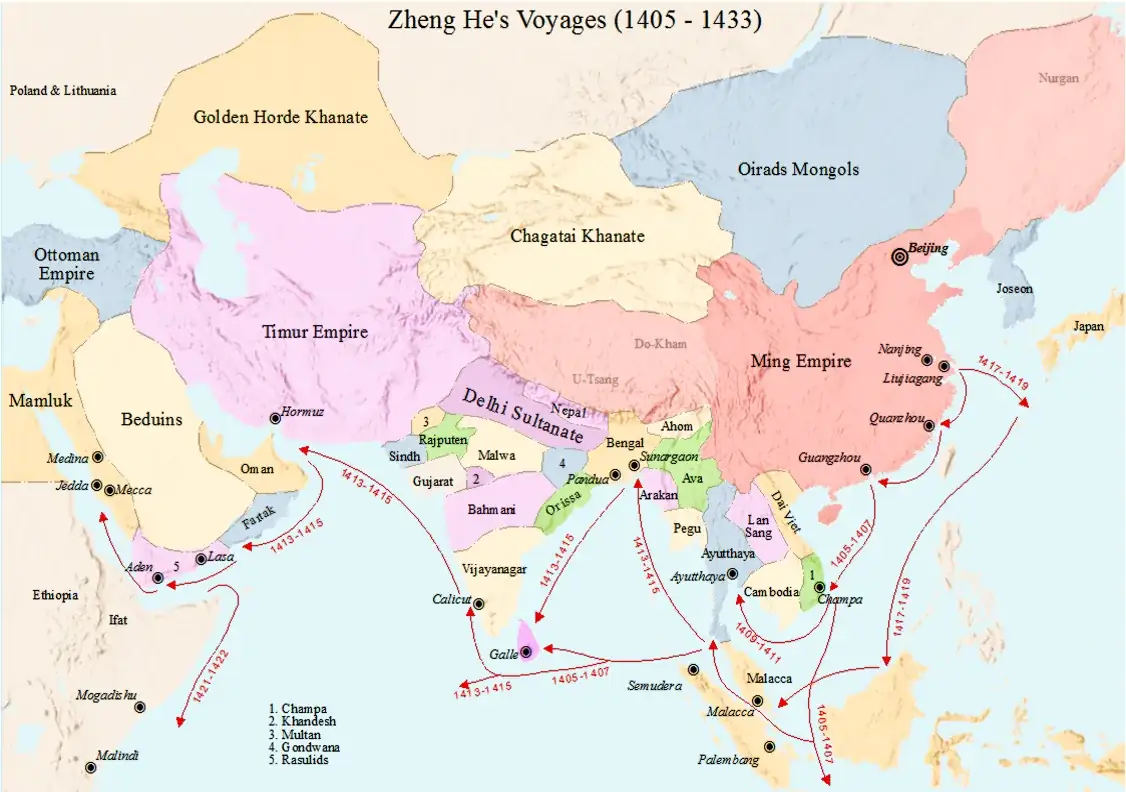
In 1405 a Ming fleet sailed beyond Chinese waters through Champa, Malacca, Java and Ceylon to Calicut on the Malabar Coast. For nearly three decades Zheng He sailed six more times, reaching East Africa; the seventh voyage left in 1430, and after the fleet returned the state did not continue the series. The Ming History records 62 large ships and 27,800 soldiers and sailors on the first voyage; later accounts often inflate the total number of vessels, and this story keeps the original wording separate from later summaries.
The significance of Zheng He’s voyages is not the “discovery” of a new world but the conversion of an existing monsoon route into a repeatable state operation. The fleet depended on port networks, supplies, interpreters and diplomatic ritual; it founded no colonies and did not turn the Indian Ocean into a Ming lake. The end after seven voyages had more than one cause: fiscal cost, northern defence, court politics and a change of emperors all played a part.
Chapter-level sources; key claims checked.
All seven chapters now have source cards and claim-level bindings and are upgraded to L2 under Content Quality Gate v1; images remain the route map and the chapter 1 schematic, with room for chapter-by-chapter additions.
Chapter timeline
Chapters in reading orderAll anchors are approximate region-level placements; they are not precise sites. Chapters without coordinates are listed below by region only.
Chapter contents7 chapters
- Zheng He's first voyage to the Western Ocean
- Zheng He's second voyage: returning envoys and the Ceylon donation
- Zheng He's third voyage: the Malacca depot and the Ceylon episode
- Zheng He's fourth voyage reaches Hormuz
- Zheng He's fifth voyage reaches East Africa
- Zheng He's sixth voyage: escorting envoys from sixteen states
- Zheng He's seventh voyage and his death at Calicut
The story, chapter by chapter
Each chapter opens the underlying event- 01
Zheng He's first voyage to the Western Ocean
In June 1405 (the third year of the Yongle reign), the Yongle Emperor ordered Zheng He and Wang Jinghong to sail to the Western Ocean. According to the Ming History, the fleet carried 27,800 soldiers and sailors and included 62 large ships, each "44 zhang long and 18 zhang wide." It left from Liujiahe in Suzhou, sailed out through the Wuhumen passage in Fujian, reached Champa first, then visited the various states an…
L2 pilot: checked against the primary Ming History and Britannica; unsourced date, ship-count and dimension assertions have been removed.
In June 1405 (the third year of the Yongle reign), the Yongle Emperor ordered Zheng He and Wang Jinghong to sail to the Western Ocean. According to the Ming History, the fleet carried 27,800 soldiers and sailors and included 62 large ships, each "44 zhang long and 18 zhang wide." It left from Liujiahe in Suzhou, sailed out through the Wuhumen passage in Fujian, reached Champa first, then visited the various states and ports, including Calicut and Ceylon. It returned in September 1407, accompanied by envoys from several states.
The motives were not singular. The Ming History places two side by side at the head of the biography: the court suspected the Jianwen Emperor had fled overseas and wanted to trace him, and it also wanted to display its power abroad and demonstrate China's wealth. The first is political anxiety; the second is a dynastic display. To explain the voyages only as a search for Jianwen, or only as a display of power, is to lose half of the record.
Item Ming History Encyclopaedia Britannica How this story handles it Date of departure June of the third Yongle year (1405) 1405 "June 1405," no invented day Large ships 62 62 ships "62 large ships" Personnel 27,800 soldiers and sailors 27,800 men "27,800 soldiers and sailors" Hull dimensions 44 zhang long, 18 zhang wide Not given Keep the original wording; no forced conversion Motives Trace Jianwen; display power abroad Show maritime power; build tributary relations Keep both side by side The table is not a scoreboard of "who is right." It shows how far a primary source and a modern encyclopedia can each support the same event. The more precise a number looks, the more important it is to ask whether it counts the whole fleet or only the large ships, soldiers or all hands.
The fleet's real capacity lay less in the legend of the "treasure ship" than in converting a monsoon route already sailed by Arab, Indian and Southeast Asian merchants into an operation supplied, translated, gifted and escorted by the state. It founded no colonies and did not turn the Indian Ocean into a Ming lake; it left behind a set of reusable port relationships and nautical records.
Sources: primary, Ming History, "Biography of Zheng He" (entries for June 1405 and September 1407); comparison, Britannica, "Zheng He," Naval expeditions. The route map at the top is a modern drawing, not a Ming-era original; see the credit note above.
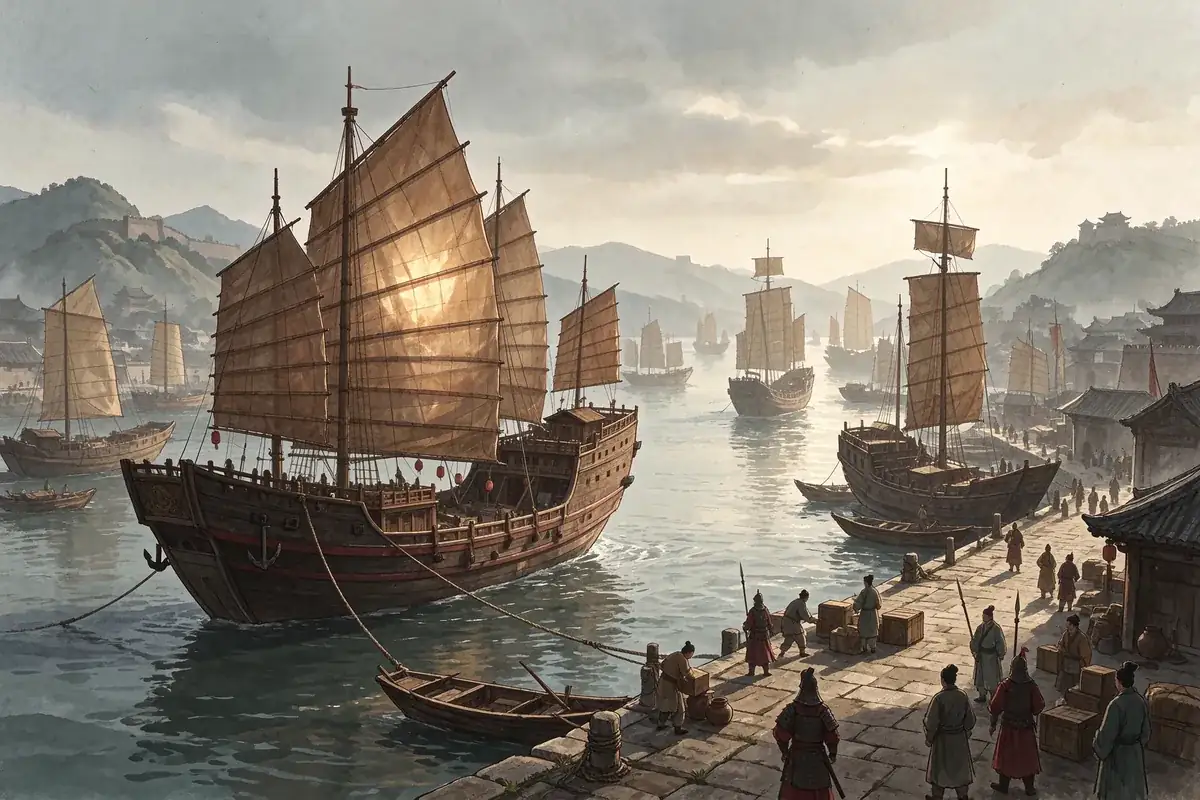
AI-generated illustration of a harbour departure. It is an imagined reconstruction, not a historical photograph, and cannot be used as evidence of hull dimensions.实录编辑部 · AI 生成示意图 · CC0 1.0 · CC0-1.0 SourcesMing History, juan 304: Biography of Zheng He primaryZheng He background
- 02
Zheng He's second voyage: returning envoys and the Ceylon donation
On 13 October 1407 Zheng He's fleet left Liujiahe in Taicang on its second voyage, mainly to escort foreign envoys home. It visited Champa, Borneo, Siam, Chenla, Java, Malacca, Ceylon, Kollam and Calicut, returning in the summer of 1409. At Ceylon, Zheng He made offerings of gold, silver, silk and oil to a Buddhist monastery and, on 15 February 1409, erected the Ceylon trilingual inscription with Wang Jinghong.
L2: checked against the CCTV seven-voyage date card and the Ming History; the Ceylon episode is dated separately in the Ming History and not counted twice.
On 13 October 1407 Zheng He's fleet left Liujiahe in Taicang on its second voyage, mainly to return foreign envoys home. It called at Champa, Borneo, Siam, Chenla, Java, Malacca, Ceylon, Kollam and Calicut, returning in the summer of 1409.
At Ceylon the fleet donated gold, silver, silk and fragrant oil. On 15 February 1409 Zheng He and Wang Jinghong erected the Ceylon donation stele, inscribed in Chinese, Tamil and Persian and addressing the Buddha, Vishnu and Allah respectively.
The second voyage's public purpose was to return envoys, but it also made a religious contact on the ground. The fleet did not simply impose Ming ritual on the port; it left a marker legible within the existing religious order.
Sources: CCTV, "The main countries and regions Zheng He's seven voyages passed through, and their dates," second voyage section (departure 13 October 1407, return summer 1409, Ceylon donation); Ming History, "Biography of Zheng He," entry for the sixth year, ninth month (the Ceylon capture). The two sources do not fully agree on the dating of the Ceylon episode; the text keeps the difference.
SourcesThe dates and destinations of Zheng He's seven voyages backgroundMing History, juan 304: Biography of Zheng He primary
- 03
Zheng He's third voyage: the Malacca depot and the Ceylon episode
In October 1409 Zheng He's fleet left Liujiahe in Taicang on its third voyage, visiting Champa, Chenla, Java, Malacca, Sumatra, Ceylon and Calicut, and returning on 6 July 1411. At Malacca the fleet built warehouses for money, grain and goods, using the port as a staging and supply base. The Ming History separately records the Ceylon king Alagakkonara's attempt to seize the fleet, his capture by Zheng He, and his rel…
L2: checked against CCTV and the Ming History; the Malacca depot and the Ceylon capture are bound to separate claims, and the dating discrepancy is explained in the text.
In October 1409 Zheng He's fleet left Liujiahe in Taicang on its third voyage, visiting Champa, Chenla, Java, Malacca, Sumatra, Ceylon and Calicut, and returning on 6 July 1411.
At Malacca the fleet built warehouses for money, grain and goods, using the port as a staging and supply base. From Malacca it sailed via Aru, Sumatra and Lambri to Ceylon, then to Calicut.
The Ming History separately records the Ceylon king Alagakkonara's attempt to seize the fleet, his capture by Zheng He, and his release after being brought to court in 1411. That passage is dated to the "sixth year, ninth month", which does not map neatly onto the common second/third numbering.
The Malacca depot turned "passing through" into "storing": the fleet did not have to carry all its supplies from China on every leg, and could regroup goods, gifts and people when the monsoon turned. The Ceylon episode shows that port networks were not always cooperative; the fleet had to prepare for both ritual and force.
Sources: CCTV, "The main countries and regions Zheng He's seven voyages passed through, and their dates," third voyage section (departure October 1409, the Malacca depot, return 6 July 1411); Ming History, "Biography of Zheng He," entry for the sixth year, ninth month (the Ceylon capture and the 1411 presentation of prisoners).
SourcesThe dates and destinations of Zheng He's seven voyages backgroundMing History, juan 304: Biography of Zheng He primary
- 04
Zheng He's fourth voyage reaches Hormuz
In the winter of 1413 Zheng He's fleet began its fourth voyage, sailing via Champa, Java, Palembang, Malacca, Sumatra, Ceylon and Calicut, then directly from Calicut to Hormuz at the mouth of the Persian Gulf. It returned on 12 August 1415. The Ming History records that in the winter of the fourteenth year envoys from Malacca, Calicut and nineteen other states came to court, and Zheng He was sent back with them to gi…
L2: checked against CCTV and the Ming History; the fourth voyage reached Hormuz only, and the East African material has been moved to chapter 5.
In the winter of 1413 Zheng He's fleet began its fourth voyage. It sailed via Champa, Java, Palembang, Malacca, Sumatra, Ceylon and Calicut, then directly from Calicut to Hormuz, returning on 12 August 1415.
Hormuz was a commercial centre at the mouth of the Persian Gulf. There the fleet encountered local merchants and information about markets further west. The Ming History records that in the winter of the fourteenth year envoys from Malacca, Calicut and nineteen other states came to court, and Zheng He was sent back with them to give gifts to their rulers, returning in the seventh month of the seventeenth year.
This voyage is often described as "reaching East Africa", but putting another detached squadron's destination into this voyage mixes two expeditions together; this story keeps them separate.
Hormuz mattered less as a "furthest point" than as an entry into the commercial language of the Persian Gulf. Ming gifts and patents entered a network already maintained by local merchants; the fleet did not build a new order from zero.
Sources: CCTV, "The main countries and regions Zheng He's seven voyages passed through, and their dates," fourth voyage section (departure winter 1413, direct passage from Calicut to Hormuz, return 12 August 1415); Ming History, "Biography of Zheng He," entries from the winter of the fourteenth year to the seventh month of the seventeenth year (the nineteen states).
SourcesThe dates and destinations of Zheng He's seven voyages backgroundMing History, juan 304: Biography of Zheng He primary
- 05
Zheng He's fifth voyage reaches East Africa
In May 1417 Zheng He's fleet began its fifth voyage, escorting envoys from nineteen states home. The fleet called at Champa, Java, Pahang, Palembang, Malacca, Sumatra, Ceylon, Kollam and Calicut; detached squadrons sailed to the Maldives, Mogadishu, Barawa, Malindi, Dhofar, Aden, Lasa and Hormuz. It returned on 8 August 1419.
L2: checked against CCTV and the Ming History; this is the East Africa chapter, with locators and excerpts for the nineteen states, Mogadishu, Barawa and Malindi.
In May 1417 Zheng He's fleet began its fifth voyage, escorting envoys from nineteen states home. The fleet called at Champa, Java, Pahang, Palembang, Malacca, Sumatra, Ceylon, Kollam and Calicut; detached squadrons sailed to the Maldives, Mogadishu, Barawa, Malindi, Dhofar, Aden, Lasa and Hormuz. It returned on 8 August 1419.
The Ming History dates this voyage to the "nineteenth year, spring" and the return to the "following year, eighth month", which converts to 1421–1422; the common numbering places it in 1417–1419. The two reckonings differ by two years, and this story keeps the difference instead of merging them.
The voyage placed the ports of the western Indian Ocean and the Arabian Peninsula within one language of gifts and tribute. The detached squadrons were not "side expeditions"; they allowed the fleet to reach several ports within different monsoon windows.
Sources: CCTV, "The main countries and regions Zheng He's seven voyages passed through, and their dates," fifth voyage section (departure May 1417, nineteen states, the three East African ports, return 8 August 1419); Ming History, "Biography of Zheng He," entries from the nineteenth year, spring, to the following year, eighth month (the dating difference).
SourcesThe dates and destinations of Zheng He's seven voyages backgroundMing History, juan 304: Biography of Zheng He primary
- 06
Zheng He's sixth voyage: escorting envoys from sixteen states
On 3 March 1421 the Yongle Emperor ordered Zheng He to escort envoys from sixteen states home on the sixth voyage. The fleet called at Champa, Siam, Hormuz, Aden, Dhofar, Lasa, Barawa, Mogadishu, Jubba, Malindi, Calicut, Kollam, Kayal, Ceylon, the Maldives, Lambri, Sumatra, Aru, Malacca, Coimbatore and Mombasa, returning on 3 September 1422.
L2: checked against CCTV and the Ming History; distinguishes the sixteen states of this escort from the thirty-plus cumulative destinations.
On 3 March 1421 the Yongle Emperor ordered Zheng He to escort envoys from sixteen states home on the sixth voyage. The fleet called at Champa, Siam, Hormuz, Aden, Dhofar, Lasa, Barawa, Mogadishu, Jubba, Malindi, Calicut, Kollam, Kayal, Ceylon, the Maldives, Lambri, Sumatra, Aru, Malacca, Coimbatore and Mombasa, returning on 3 September 1422.
The immediate task was to carry people, not to open a new route. The fleet returned the envoys of sixteen states and brought back envoys from Siam, Sumatra and Aden. The Ming History records only that in the first month of the twenty-second year the chief of Palembang, Shi Jisun, asked to inherit the office of pacification commissioner, and that Zheng He was sent with the seal and patent; by the time he returned, the Yongle Emperor had died.
"Sixteen states" and "more than thirty states" are not the same count: the former refers to the envoys carried on this voyage, the latter to the cumulative destinations of all seven voyages. Mixing the two inflates one voyage into the whole enterprise.
This voyage turned diplomatic escort into routine transport rather than a new geographical discovery. The fleet's main work was to return foreign personnel on schedule and bring the next group of envoys back.
Sources: CCTV, "The main countries and regions Zheng He's seven voyages passed through, and their dates," sixth voyage section (departure 3 March 1421, sixteen states, port list, return 3 September 1422); Ming History, "Biography of Zheng He," entry for the first month of the twenty-second year (Shi Jisun of Palembang).
SourcesThe dates and destinations of Zheng He's seven voyages backgroundMing History, juan 304: Biography of Zheng He primary
- 07
Zheng He's seventh voyage and his death at Calicut
On 29 June 1430 the Xuande Emperor ordered Zheng He's seventh voyage. The fleet sailed in 1431, calling at Champa, Java, Palembang, Malacca, Sumatra, Ceylon, Calicut and Hormuz, and returned to Nanjing on 22 July 1433. Zheng He died at Calicut in the fourth month of 1433, and Wang Jinghong led the fleet home.
L2: checked against CCTV and the Ming History; the dates, the death at Calicut, Wang Jinghong's return and the seventeen-state figure are all bound to claims.
On 29 June 1430 the Xuande Emperor ordered Zheng He's seventh voyage. The fleet sailed in 1431, calling at Champa, Java, Palembang, Malacca, Sumatra, Ceylon, Calicut and Hormuz, and returned to Nanjing on 22 July 1433.
Zheng He died at Calicut in the fourth month of 1433, and Wang Jinghong led the fleet home. The Ming History records that in the sixth month of the fifth year of Xuande the emperor, noting that distant states had still not sent tribute, again ordered Zheng He and Wang Jinghong to visit Hormuz and seventeen other states.
"More than thirty states" is the cumulative total of all seven voyages, not the score of the seventh alone. The seventh voyage has fewer clearly recorded ports than the earlier ones; its main task was to restore an interrupted tributary relationship, not to open new routes.
The end of the voyages had more than one cause. A long voyage required the simultaneous coordination of navigation, diplomacy and court resources; after the leading figure died, that coordination was hard to reproduce, and criticism of the cost among civil officials was growing. Reducing all this to "Ming China closed its doors" hides the specific people and accounts involved.
Sources: CCTV, "The main countries and regions Zheng He's seven voyages passed through, and their dates," seventh voyage section (order 29 June 1430, sailing 1431, return to Nanjing 22 July 1433, death at Calicut, Wang Jinghong's return); Ming History, "Biography of Zheng He," entry for the sixth month of the fifth year of Xuande (seventeen states).
SourcesThe dates and destinations of Zheng He's seven voyages backgroundMing History, juan 304: Biography of Zheng He primary
Cast
People whose choices move the story. Roles describe this story only.
- Zheng HeFleet commander and eunuch
Ordered to sea repeatedly from the Yongle to Xuande reigns, extending Ming diplomatic and trade networks across the South China Sea, Indian Ocean and East Africa.
- Yongle EmperorDecision-maker and Ming emperor
After seizing the throne he moved the capital to Beijing and focused on the north while supporting Zheng He’s voyages; the fleet and frontier shared the same state resources.
Evidence and limits
Chapter-level sources; key claims checked.
Source count is the number of distinct source records attached to the event nodes shown here. It does not certify the narrative as a whole.