
Gold Empires of West Africa: Ghana, Mali and Songhai
Story500–1591: how trans-Saharan trade sustained empires and cities
Around the fifth century CE the Ghana Empire rose in the Sahel between the Senegal and Niger rivers; it controlled the trans-Saharan trade in gold and salt and by the ninth century was one of the richest polities in West Africa. In the thirteenth century Mali replaced Ghana; in 1312 Mansa Musa carried gold to Cairo on his pilgrimage to Mecca; in 1352 Ibn Battuta reached the Malian court; in the fifteenth century Songhai expanded from Gao; in 1591 a Moroccan army destroyed Songhai. Together these are not “Africa without history” but a long interaction of rivers, desert routes, Islamic scholarship and imperial governance.
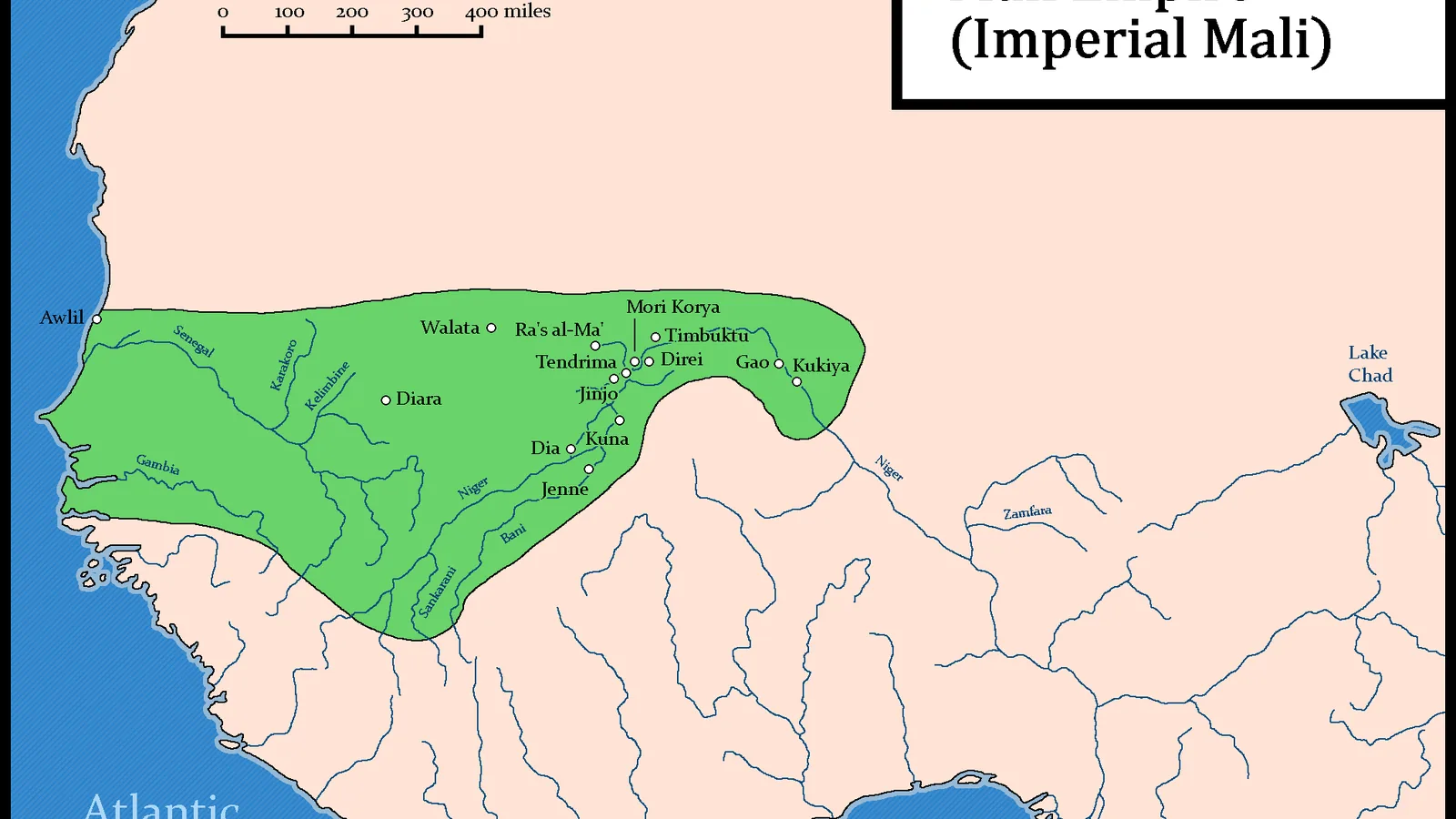
West African imperial wealth came less from the legend of “streets paved with gold” than from control of route nodes: whoever could move gold north and salt south could tax, pay soldiers and build cities. Mali and Songhai converted trade revenue into Islamic scholarship, mosques and court institutions, but succession and frontier governance remained fragile; the defeat of Songhai by Morocco in 1591 did not end West African history.
Chapter-level sources; key claims checked.
Chapter timeline
Chapters in reading orderAll anchors are approximate region-level placements; they are not precise sites. Chapters without coordinates are listed below by region only.
Chapter contents7 chapters
The story, chapter by chapter
Each chapter opens the underlying event- 01
Rise of the Ghana Empire: first empire in West Africa
Approximately 500–1200 CE, the Ghana Empire (located in present-day Mauritania and western Mali) became the first empire in West Africa. Its king was called 'Ghana' (war leader). The empire amassed immense wealth by controlling the West African gold trade and trans-Saharan trade routes. The capital, Koumbi Saleh, was divided into a merchants' city and a royal city, with a population of about 20,000. Arab travelers no…
Approximately 500–1200 CE, the Ghana Empire (located in present-day Mauritania and western Mali) became the first empire in West Africa. Its king was called 'Ghana' (war leader).
Approximately 500–1200 CE, the Ghana Empire (located in present-day Mauritania and western Mali) became the first empire in West Africa. Its king was called 'Ghana' (war leader). The empire amassed immense wealth by controlling the West African gold trade and trans-Saharan trade routes. The capital, Koumbi Saleh, was divided into a merchants' city and a royal city, with a population of about 20,000. Arab travelers noted that 'gold was weighed with a scale.' Ghana declined after being conquered by the Almoravids around 1076.
Ghana’s “empire” was more a coalition controlling routes and clients than a modern centralised state. Its power came from location: desert caravans to the north and gold-producing regions to the south.
Sources: 7 event claims, 7 sourced; source cards src-b3w-west-african-empires-03, src-b3w-west-african-empires-02 (background only).
SourcesMali Empire — Wikipedia backgroundMansa Musa — Wikipedia background
- 02
The Ghana Empire controls West African gold trade
In 805, the king of the Ghana Empire (Ghana meaning 'war lord') tightened control over the southern gold-producing regions, decreeing that all gold nuggets be submitted to the treasury and only gold dust be used among the people. The gold trade brought enormous tax revenue to Ghana, and its capital Kumbi Saleh became the terminal of trans-Saharan trade routes, where camel caravans brought salt and textiles in exchang…
In 805, the king of the Ghana Empire (Ghana meaning 'war lord') tightened control over the southern gold-producing regions, decreeing that all gold nuggets be submitted to the treasury and only gold dust be used among the people.
In 805, the king of the Ghana Empire (Ghana meaning 'war lord') tightened control over the southern gold-producing regions, decreeing that all gold nuggets be submitted to the treasury and only gold dust be used among the people. The gold trade brought enormous tax revenue to Ghana, and its capital Kumbi Saleh became the terminal of trans-Saharan trade routes, where camel caravans brought salt and textiles in exchange for gold.
The key to the gold trade was not the mine but the ability to move gold from producing areas to route nodes. Transport, taxation and caravan protection were each harder than “owning a mine.”
Sources: 4 event claims, 3 sourced; source cards src-b3w-west-african-empires-02, src-b3w-west-african-empires-03 (background only).
SourcesMansa Musa — Wikipedia backgroundMali Empire — Wikipedia background
- 03
Mali Empire established: Mansa Musa's golden age
In 1235 Sundiata Keita defeated the Sosso king Sumanguru at Kirina and founded the Mali Empire. Mali controlled the West African gold and salt trade, and its capital at Niani became a centre of learning. In 1324 Mansa Musa travelled to Mecca with a vast quantity of gold; his spending in Cairo depressed the local gold price for years. The Sankore mosque and university in Timbuktu became a major centre of Islamic learn…
In 1235, the Mandinka leader Sundiata Keita defeated King Sumanguru of Sosso at the Battle of Kirina and established the Mali Empire. Mali controlled the West African gold and salt trades, with its capital at Niani becoming a center of learning.
In 1235, the Mandinka leader Sundiata Keita defeated King Sumanguru of Sosso at the Battle of Kirina and established the Mali Empire. Mali controlled the West African gold and salt trades, with its capital at Niani becoming a center of learning. The empire reached its zenith under Mansa Musa (1312-1337); during his pilgrimage to Mecca in 1324 he distributed so much gold in Cairo that the Egyptian gold price dropped for a decade. The Sankore University in Timbuktu became one of the world's most famous Islamic centers of learning.
Mali replaced Ghana and extended West African networks south to the upper Niger. An empire’s durability depended on keeping different routes and peoples within one order.
Sources: 6 event claims, 6 sourced; source cards src-b3w-west-african-empires-03, src-b3w-west-african-empires-02 (background only).
SourcesMali Empire — Wikipedia backgroundMansa Musa — Wikipedia background
- 04
Mansa Musa's hajj
Mali's emperor Mansa Musa undertakes a Mecca pilgrimage of unparalleled splendor, his vast wealth astonishing the world.
Mali's emperor Mansa Musa undertakes a Mecca pilgrimage of unparalleled splendor, his vast wealth astonishing the world.
Mali's emperor Mansa Musa undertakes a Mecca pilgrimage of unparalleled splendor, his vast wealth astonishing the world.
Mansa Musa’s pilgrimage placed Mali on the map of the Islamic world. Cairo remembered the gold; Mali remembered legitimacy, scholarly connections and diplomatic prestige.
Sources: 4 event claims, 4 sourced; source cards src-b3w-west-african-empires-02, src-b3w-west-african-empires-03 (background only).
SourcesMansa Musa — Wikipedia backgroundMali Empire — Wikipedia background
- 05
Ibn Battuta reaches Mali
The Moroccan traveller Ibn Battuta reaches the Malian capital and records its wealth and the learning of Timbuktu.
The Moroccan traveller Ibn Battuta reaches the Malian capital and records its wealth and the learning of Timbuktu.
The Moroccan traveller Ibn Battuta reaches the Malian capital and records its wealth and the learning of Timbuktu.
Ibn Battuta’s travel account offers an outsider’s view of court ritual, law, security and routes. It also contains bias and hearsay and must be read alongside local evidence.
Sources: 4 event claims, 4 sourced; source cards src-b3w-west-african-empires-03, src-b3w-west-african-empires-04 (background only).
SourcesMali Empire — Wikipedia backgroundSonghai Empire — Wikipedia background
- 06
Rise of the Songhai Empire: West Africa's largest empire
In 1464, Sonni Ali became king of the Songhai Empire and began massive military expansion. He built a powerful river fleet (Niger River flotilla) and captured Timbuktu and Djenné. In 1493, Muhammad Ture (Askia Muhammad) seized the throne, perfected the administrative system, and promoted Islam. The Songhai Empire became the largest empire in West African history, stretching from the Atlantic to central Niger. It coll…
In 1464, Sonni Ali became king of the Songhai Empire and began massive military expansion. He built a powerful river fleet (Niger River flotilla) and captured Timbuktu and Djenné.
In 1464, Sonni Ali became king of the Songhai Empire and began massive military expansion. He built a powerful river fleet (Niger River flotilla) and captured Timbuktu and Djenné. In 1493, Muhammad Ture (Askia Muhammad) seized the throne, perfected the administrative system, and promoted Islam. The Songhai Empire became the largest empire in West African history, stretching from the Atlantic to central Niger. It collapsed after being defeated by Moroccan musketeers in 1591.
Songhai expanded from Gao and made the Niger bend the imperial core. It inherited Mali’s trade and scholarly networks and also its fragile frontiers and succession problems.
Sources: 7 event claims, 7 sourced; source cards src-b3w-west-african-empires-03, src-b3w-west-african-empires-04 (background only).
SourcesMali Empire — Wikipedia backgroundSonghai Empire — Wikipedia background
- 07
Morocco destroys Songhai
Saadian Morocco defeats Songhai near Timbuktu, shifting West Sudan hegemony.
Saadian Morocco defeats Songhai near Timbuktu, shifting West Sudan hegemony.
Saadian Morocco defeats Songhai near Timbuktu, shifting West Sudan hegemony.
In 1591 a Moroccan army with firearms defeated Songhai, showing a changing balance of power across the Sahara. Songhai collapsed, but Timbuktu’s scholarly and commercial traditions did not vanish overnight.
Sources: 5 event claims, 5 sourced; source cards src-b3w-west-african-empires-02, src-b3w-west-african-empires-04 (background only).
SourcesMansa Musa — Wikipedia backgroundSonghai Empire — Wikipedia background
Cast
People whose choices move the story. Roles describe this story only.
- Sundiata KeitaFounder of the Mali Empire
In traditional narrative united Mali’s clans, defeated the Susu and established Malian authority.
- Mansa MusaMalian emperor and pilgrim
Pilgrimage to Mecca in 1312 and distributed gold along the way, bringing Mali into the view of the Islamic world.
- Ibn BattutaTraveler and jurist
Reached Mali in 1352 and recorded court, law and routes; an important but not neutral outsider source.
Evidence and limits
Chapter-level sources; key claims checked.
Source count is the number of distinct source records attached to the event nodes shown here. It does not certify the narrative as a whole.