
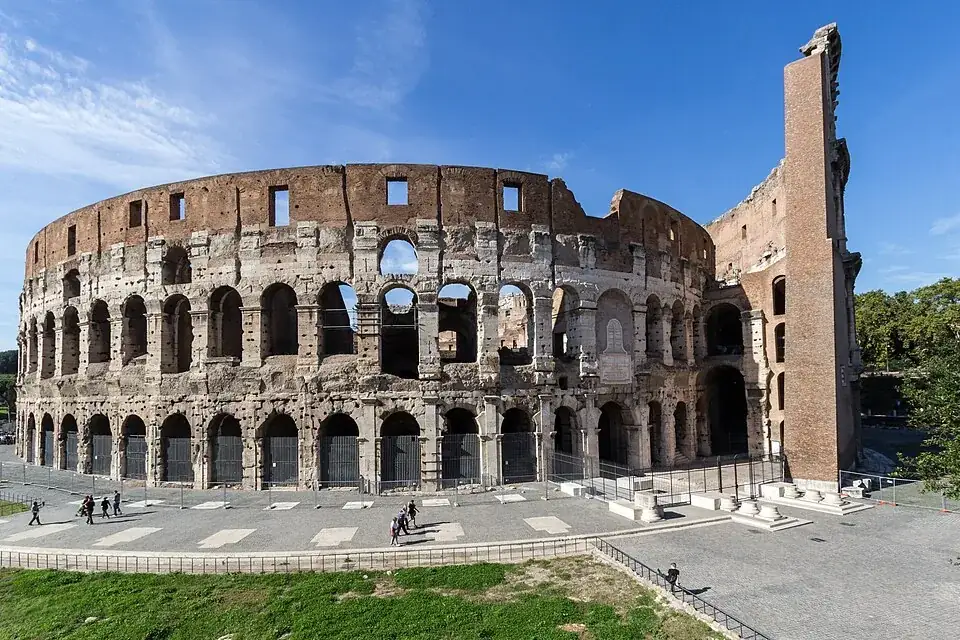
The Colosseum, also called the Flavian Amphitheatre, was begun under the Flavian emperor Vespasian between 70 and 72 CE.1 Titus dedicated it in 80 CE with 100 days of games, and Domitian added the fourth story in 82 CE.1
It is an elliptical structure of stone, concrete and tuff, four stories high, measuring 189 by 156 metres and holding as many as 50,000 spectators.2
It was paid for with the spoils of Titus's sack of Jerusalem in 70 CE and built by enslaved Jewish people from Judaea; it was sited on the artificial lake of Nero's Golden House, replacing a private imperial pleasure ground with a public amphitheatre.3
It hosted gladiatorial combat, animal hunts and mock naval battles; a retractable awning above the seating was worked by sailors.4
The Colosseum was not only an engineering marvel but also a device through which the emperor converted public entertainment into prestige; its construction and upkeep depended on imperial finance and slave labour.5
Evidence ledger
5 claims4 sourced0 unsourced1 author judgment
Every hard fact in the narrative above is registered here. A claim may also record source-only details that the narrative does not repeat; the related-narrative line points to the corresponding passage, not a guarantee that the source supports every word of the body. A claim without a source stays visibly unsourced.
- Colosseum (dedicated 80 CE)Britannica, Colosseum, 'Who built the Colosseum?'
Construction of the Colosseum began under the Roman emperor Vespasian between 70 and 72 CE. The completed structure was dedicated in 80 CE by Titus, Vespasian’s son and successor. The Colosseum’s fourth story was added by the emperor Domitian in 82 CE. Importantly, the arena was paid for with plunder from Titus’s sack of Jerusalem in 70 CE, and it was built by enslaved Jewish people from Judaea.
Accessed 2026-11-25 · human read - Colosseum (dedicated 80 CE)Britannica, Colosseum, 'Characteristics'
The structure was officially dedicated in 80 CE by Titus in a ceremony that included 100 days of games.
Accessed 2026-11-25 · human read
Construction, dedication and the fourth story are kept as three distinct dates.
- Colosseum (dedicated 80 CE)Britannica, Colosseum, 'Who built the Colosseum?'
It is an elliptical structure of stone, concrete and tuff, four stories high, measuring 189 by 156 metres and holding as many as 50,000 spectators.
Related narrativeIt is an elliptical structure of stone, concrete and tuff, four stories high, measuring 189 by 156 metres and holding as many as 50,000 spectators.
- Colosseum (dedicated 80 CE)Britannica, Colosseum, 'What is the Colosseum?'
The Colosseum is an amphitheater built in Rome under the Flavian emperors of the Roman Empire. It is also called the Flavian Amphitheatre. It is an elliptical structure made of stone, concrete, and tuff, and it stands four stories tall at its highest point. It measures 620 by 513 feet (189 by 156 meters) and could hold as many as 50,000 spectators.
Accessed 2026-11-25 · human read
Capacity is 'as many as 50,000', not a fixed 80,000.
- Colosseum (dedicated 80 CE)Britannica, Colosseum, 'What is the Colosseum?'
It was paid for with the spoils of Titus's sack of Jerusalem in 70 CE and built by enslaved Jewish people from Judaea; it was sited on the artificial lake of Nero's Golden House, replacing a private imperial pleasure ground with a public amphitheatre.
Related narrativeIt was paid for with the spoils of Titus's sack of Jerusalem in 70 CE and built by enslaved Jewish people from Judaea; it was sited on the artificial lake of Nero's Golden House, replacing a private imperial pleasure ground with a public amphitheatre.
- Colosseum (dedicated 80 CE)Britannica, Colosseum, 'Who built the Colosseum?'
Construction of the Colosseum began under the Roman emperor Vespasian between 70 and 72 CE. The completed structure was dedicated in 80 CE by Titus, Vespasian’s son and successor. The Colosseum’s fourth story was added by the emperor Domitian in 82 CE. Importantly, the arena was paid for with plunder from Titus’s sack of Jerusalem in 70 CE, and it was built by enslaved Jewish people from Judaea.
Accessed 2026-11-25 · human read - Colosseum (dedicated 80 CE)Britannica, Colosseum, 'Characteristics'
It is located just east of the Palatine Hill, on the grounds of what was Nero’s Golden House. The artificial lake that was the centerpiece of that palace complex was drained, and the Colosseum was sited there, a decision that was as much symbolic as it was practical. Vespasian, whose path to the throne had relatively humble beginnings, chose to replace the tyrannical emperor’s private lake with a public amphitheater that could host tens of thousands of Romans.
Accessed 2026-11-25 · human read
Funding, builders and site follow the entry; no claim that all workers were prisoners of war.
- Colosseum (dedicated 80 CE)Britannica, Colosseum, 'Who built the Colosseum?'
It hosted gladiatorial combat, animal hunts and mock naval battles; a retractable awning above the seating was worked by sailors.
Related narrativeIt hosted gladiatorial combat, animal hunts and mock naval battles; a retractable awning above the seating was worked by sailors.
- Colosseum (dedicated 80 CE)Britannica, Colosseum, 'Why was the Colosseum built?'
The Colosseum was built as part of an imperial effort to revitalize Rome after the tumultuous year of the four emperors, 69 CE. As with other amphitheaters, the emperor Vespasian intended the Colosseum to be an entertainment venue, hosting gladiator fights, animal hunts, and even mock naval battles.
Accessed 2026-11-25 · human read - Colosseum (dedicated 80 CE)Britannica, Colosseum, 'Characteristics'
The amphitheater seated some 50,000 spectators, who were shielded from the sun by a massive retractable velarium (awning).
Accessed 2026-11-25 · human read
The three uses and the awning follow the entry; no 'Christians fed to lions' detail.
- Colosseum (dedicated 80 CE)Britannica, Colosseum, 'Why was the Colosseum built?'
The Colosseum was not only an engineering marvel but also a device through which the emperor converted public entertainment into prestige; its construction and upkeep depended on imperial finance and slave labour.
Related narrativeThe Colosseum was not only an engineering marvel but also a device through which the emperor converted public entertainment into prestige; its construction and upkeep depended on imperial finance and slave labour.
Editorial judgment, not a historical fact.
Author judgment: public entertainment as political language, not neutral engineering.
Sources and review
Key claims rely on a single source record
- Colosseum (dedicated 80 CE) · Encyclopaedia Britannica (accessed 2026-11-25) Original source ↗
Locations
- Roman Empire· 41.89, 12.49· Approximate
evt-cae05dfaf0386c93Source file:
events/evt-cae05dfaf0386c93/event.md