
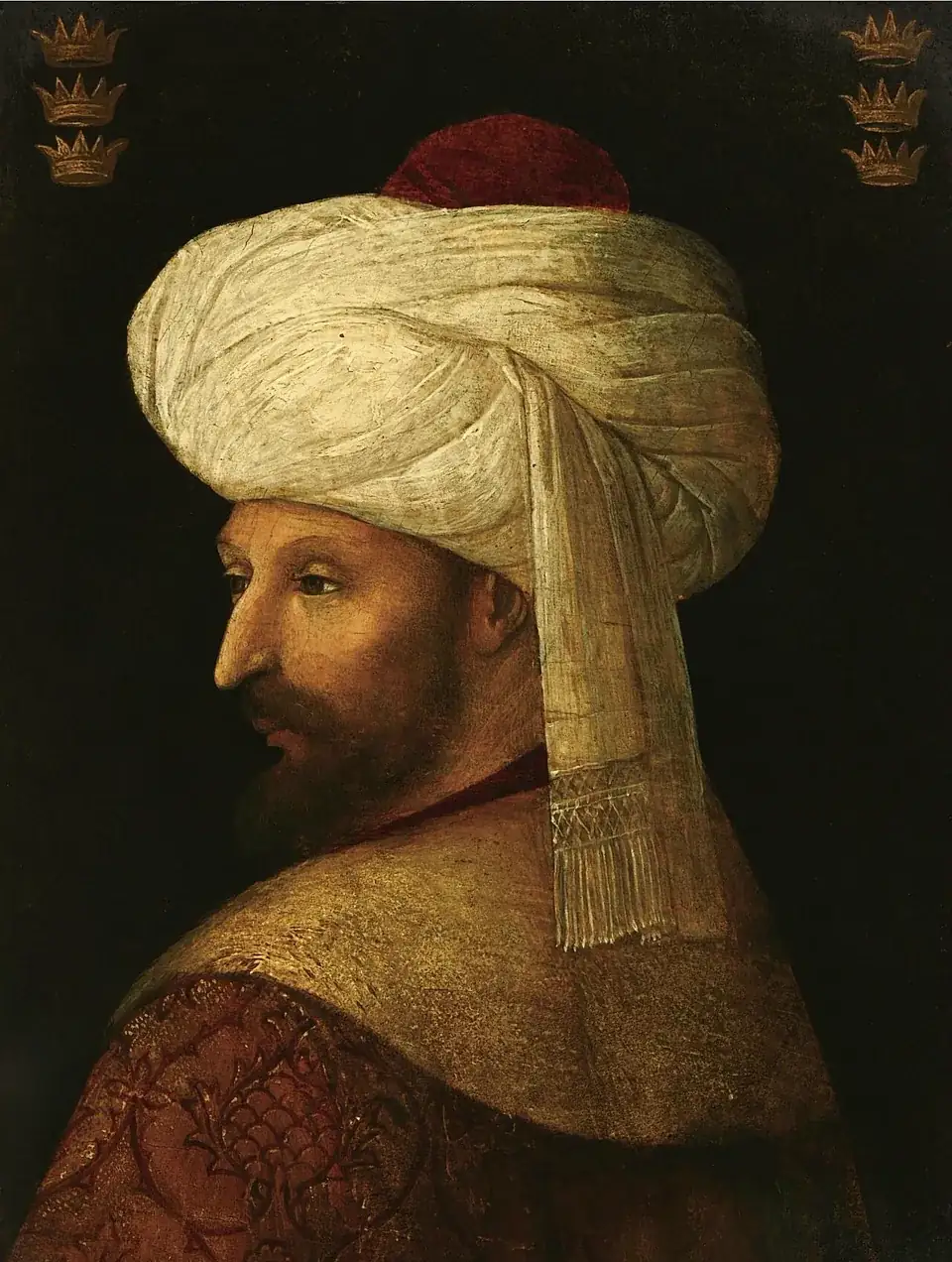
On April 6, 1453, the Ottoman army began bombarding Constantinople; the siege lasted 55 days and the city fell on May 29.1 Mehmed II blockaded the city by land and sea with about 60,000–80,000 soldiers and 69 cannon.2
The defenders repaired breaches on the walls at night. Giustiniani, a Genoese commander, was mortally wounded on the ramparts and withdrew, lowering morale; Mehmed II then sent about 3,000 Janissaries through the Gate of St. Romanus and took the inner wall.3
Constantine XI died. The city was sacked for three days; Mehmed II then stopped the looting, entered Hagia Sophia and converted it into a mosque.4
'Renamed Istanbul and made the capital at once' is a simplification. The city's population had fallen to about 40,000–50,000 in 1453; the Ottoman capital was transferred from Edirne to Constantinople in 1457.5
Evidence ledger
5 claims5 sourced0 unsourced
Every hard fact in the narrative above is registered here. A claim may also record source-only details that the narrative does not repeat; the related-narrative line points to the corresponding passage, not a guarantee that the source supports every word of the body. A claim without a source stays visibly unsourced.
- Fall of Constantinople (1453)Britannica, Fall of Constantinople, summary and 'Battle' section
The Fall of Constantinople occurred on May 29, 1453, when the city was conquered by Sultan Mehmed II of the Ottoman Empire. The Ottomans breached Constantinople's ancient land wall after a 55-day siege, ending the dwindling Byzantine Empire. On April 6 the Ottomans began their artillery barrage.
Accessed 2026-11-25 · human read
Date and siege length follow the source; no '1,123-year empire' claim.
- Fall of Constantinople (1453)Britannica, Fall of Constantinople, summary and 'Battle' section
Mehmed II blockaded the city by land and sea with about 60,000–80,000 soldiers and 69 cannon.
Related narrativeMehmed II blockaded the city by land and sea with about 60,000–80,000 soldiers and 69 cannon.
- Fall of Constantinople (1453)Britannica, Fall of Constantinople, 'Battle' section, paragraph 2
Between 60,000 and 80,000 soldiers fought on land, accompanied by 69 cannon.
Accessed 2026-11-25 · human read
Troops are given as a range; no fabricated 7,000 defenders.
- Fall of Constantinople (1453)Britannica, Fall of Constantinople, 'Battle' section, paragraph 2
The defenders repaired breaches on the walls at night. Giustiniani, a Genoese commander, was mortally wounded on the ramparts and withdrew, lowering morale; Mehmed II then sent about 3,000 Janissaries through the Gate of St. Romanus and took the inner wall.
Related narrativeThe defenders repaired breaches on the walls at night. Giustiniani, a Genoese commander, was mortally wounded on the ramparts and withdrew, lowering morale; Mehmed II then sent about 3,000 Janissaries through the Gate of St. Romanus and took the inner wall.
- Fall of Constantinople (1453)Britannica, Fall of Constantinople, 'Battle' section, final assault
The city's defenders continued to repair the walls at night. Mehmed ordered a third attack on the gate, this time with one of his own palace regiments of 3,000 Janissaries. Giustiniani was mortally wounded by Ottoman gunfire while on the ramparts. He was carried to the rear, and his absence sowed confusion and lowered morale among the ranks. This allowed the sultan to send in another Janissary regiment and take the inner wall at the Gate of St. Romanus.
Accessed 2026-11-25 · human read
No 'Basilica cannon' name; the source says cannon.
- Fall of Constantinople (1453)Britannica, Fall of Constantinople, 'Battle' section, final assault
Constantine XI died. The city was sacked for three days; Mehmed II then stopped the looting, entered Hagia Sophia and converted it into a mosque.
Related narrativeConstantine XI died. The city was sacked for three days; Mehmed II then stopped the looting, entered Hagia Sophia and converted it into a mosque.
- Fall of Constantinople (1453)Britannica, Fall of Constantinople, final assault and aftermath
Emperor Constantine XI is reported to have been killed while either fighting near the breach or fleeing to an escape boat. The city was then pillaged for three days before Mehmed II restored order. Mehmed himself rode through the streets of the city to the great cathedral of Hagia Sophia and converted it into the mosque Ayasofya.
Accessed 2026-11-25 · human read
The manner of Constantine's death is disputed; the body says only that he died.
- Fall of Constantinople (1453)Britannica, Fall of Constantinople, final assault and aftermath
'Renamed Istanbul and made the capital at once' is a simplification. The city's population had fallen to about 40,000–50,000 in 1453; the Ottoman capital was transferred from Edirne to Constantinople in 1457.
Related narrative'Renamed Istanbul and made the capital at once' is a simplification. The city's population had fallen to about 40,000–50,000 in 1453; the Ottoman capital was transferred from Edirne to Constantinople in 1457.
- Fall of Constantinople (1453)Britannica, Fall of Constantinople, summary
Constantinople's population had dropped from roughly 400,000 in the 12th century to between 40,000 and 50,000 by the 1450s.
Accessed 2026-11-25 · human read - Istanbul: The Theodosian Land WallsBritannica, Istanbul, 'Centuries of growth'
The capital of the Ottoman Empire was transferred to Constantinople from Adrianople (Edirne) in 1457.
Accessed 2026-11-25 · human read
Population comes from the Fall entry, the capital transfer from the Istanbul entry; this claim uses the Istanbul card for the transfer.
- Fall of Constantinople (1453)Britannica, Fall of Constantinople, summary
Sources and review
English translation predates the current source revision
- Fall of Constantinople (1453) · Encyclopaedia Britannica (accessed 2026-11-25) Original source ↗
- Istanbul: The Theodosian Land Walls · Encyclopaedia Britannica (accessed 2026-11-25) Original source ↗
Locations
- Ottoman Empire· 41.01, 28.98· Approximate
evt-5c1c714b29876dc3Source file:
events/evt-5c1c714b29876dc3/event.md