
The Three Kingdoms of Korea: Buddhism, the Han River and Unified Silla
Story372–751: how Buddhism, the Han River and the Tang alliance remade the peninsula
In 372 CE, influenced by China, Buddhism entered Goguryeo as ideological backing for a centralising bureaucracy; in the late 5th century Goguryeo took Baekje's Han River territory, Baekje moved its capital to Ungjin and allied with Silla; in 642 Yeon Gaesomun killed the Goguryeo king and took power as regent; in 660 and 668 Silla used Tang armies to destroy Baekje and Goguryeo, then fought nearly a decade to expel Tang; around 751 Kim Dae-seong began Bulguksa and Seokguram. Together these nodes show how three kingdoms competed through Buddhism, relocation, alliance and war, and how they rewrote “unification” after Tang intervention.
The competition of the three kingdoms was not three isolated local histories but part of the Northeast Asian international system. Buddhism supplied legitimacy and literate personnel, the Han River supplied agriculture and strategic depth, and Tang supplied the military lever for unification along with the risk of dependence. Silla's unification was not a single feat but two steps: first use Tang to destroy Baekje and Goguryeo, then fight Tang's forces out. After unification the old aristocracy still held power. “Unified Silla” was both a local re-integration of the peninsula and a survival technique that used and then rejected an outside empire.
Chapter-level sources; key claims checked.
Five chapters carry 16 claims, 11 of them bound to source cards. Britannica, UNESCO and New World Encyclopedia are used as secondary sources, explicitly labelled as background. The 668 unification is described as the former three kingdoms, not the whole peninsula; Bulguksa and Seokguram follow UNESCO's text on construction, structure and materials.
Chapter timeline
Chapters in reading orderAll anchors are approximate region-level placements; they are not precise sites. Chapters without coordinates are listed below by region only.
Chapter contents5 chapters
The story, chapter by chapter
Each chapter opens the underlying event- 01
Buddhism enters Goguryeo: a new language for royal power
In 372 CE, influenced by China, Buddhism was introduced into Goguryeo as ideological backing for a newly centralised bureaucracy; at about the same time, Confucian education began to be emphasised. King Sosurim (r. 371–384) issued laws and decrees aimed partly at centralising royal authority, and Goguryeo emerged as a full-fledged aristocratic state.
In 372 CE, influenced by China, Buddhism entered Goguryeo as ideological backing for a centralising bureaucracy; Confucian education was emphasised at about the same time. King Sosurim (r. 371–384) issued laws and decrees to centralise royal authority.
In 372 CE, influenced by China, Buddhism entered Goguryeo. It did not spread first among villagers; it was taken up by a newly centralising bureaucracy as ideological backing. Royal power needed a language higher than tribal custom, and monks, scriptures and monasteries supplied it. At about the same time, Confucian education began to be emphasised, giving officials literacy and ritual training.
King Sosurim (r. 371–384) issued laws and decrees aimed partly at centralising royal authority. Goguryeo emerged as a full-fledged aristocratic state: throne, officials and religious elites needed one another, and also limited one another.
Religion and education were not ornaments. They gave the new officials a shared language and gave the throne a basis beyond tribal custom; but they also meant that Goguryeo's politics increasingly depended on a grammar of legitimacy borrowed from China.
Sources: 3 claims (2 sourced); Britannica “Goguryeo”, History section, the Sosurim laws and the introduction of Buddhism.
SourcesGoguryeo background
- 02
The Han River changes hands: Baekje moves its capital to Ungjin
In the late 5th century the northern kingdom of Goguryeo deprived Baekje of the Han River basin, and Baekje moved its capital south to Ungjin (present Gongju). To contain Goguryeo and recover the Han River basin, Baekje allied with its southern neighbour Silla; but the region eventually passed to Silla.
In the late 5th century Goguryeo deprived Baekje of its Han River territory and Baekje moved its capital to Ungjin (present Gongju); Baekje allied with Silla, but the Han River basin eventually passed to Silla.
In the late 5th century the northern kingdom of Goguryeo deprived Baekje of the Han River basin. The Han was not just a river: it linked Yellow Sea trade, inland agriculture and capital defence. Losing it cut away much of Baekje's strategic depth, and the court moved south to Ungjin (present Gongju).
Moving the capital was not a court relocation. Administration, stores, army and rituals moved south with it, and the country's centre of gravity changed. To contain Goguryeo and recover the Han River basin, Baekje allied with its southern neighbour Silla.
The alliance helped hold Goguryeo back, but it did not recover the Han River for Baekje. The region eventually passed to Silla; Baekje paid the price of the alliance, and Silla gained the strategic depth.
Sources: 3 claims (2 sourced); Britannica “Paekche”, History section, the late 5th-century loss and the Silla alliance.
SourcesPaekche background
- 03
Yeon Gaesomun's coup: a general takes hold of royal power
In the winter of 642, Yeon Gaesomun, Eastern Governor of Goguryeo, learned that King Yeongnyu and some officials planned to remove powerful military officers including himself, and struck first. At Pyongyang his forces killed the king and one hundred officials; he placed the king's nephew Bojang on the throne and made himself Dae Mangniji, holding military and political power.
In 642 Yeon Gaesomun killed King Yeongnyu and one hundred officials, placed Bojang on the throne and made himself Dae Mangniji, holding military and political power.
In the winter of 642, Yeon Gaesomun, Eastern Governor of Goguryeo, learned that King Yeongnyu and some officials planned to remove powerful military officers including himself, and struck first. At Pyongyang his forces killed the king and one hundred officials, and he placed the king's nephew Bojang on the throne.
He did not take the throne himself. He became Dae Mangniji, holding Goguryeo's military and political power. The king remained, but royal authority had moved into a general's hands; Goguryeo's foreign policy now depended more on one military strongman than on stable court procedure.
The coup did not immediately drag the kingdom into war, but it changed who had the right to decide war and peace. Northeast Asia now had a less predictable variable.
Sources: 2 claims (1 sourced); New World Encyclopedia “Yeon Gaesomun”, the coup section.
- 04
Unified Silla: borrow Tang, then expel Tang
In 660 the allied forces of Silla and Tang destroyed Baekje; in 668 they destroyed Goguryeo. Silla thus unified the former territories of the three kingdoms, the first occasion in historical times that the Korean peninsula was unified under indigenous leadership. For nearly a decade afterwards Silla fought Tang and finally expelled its forces.
In 660 Silla and Tang destroyed Baekje; in 668 they destroyed Goguryeo, and Silla unified the former three kingdoms. For nearly a decade Silla fought Tang and finally expelled its forces; the state was reorganised on the Chinese bureaucratic model, but the old aristocracy remained in control.
In 660 the allied forces of Silla and Tang destroyed Baekje; in 668 they destroyed Goguryeo. Silla thus unified the former territories of the three kingdoms, the first occasion in historical times that the Korean peninsula was unified under indigenous leadership.
But unification was not completed in one move. For nearly a decade afterwards Silla fought Tang and finally expelled its forces: a two-track operation of borrowing an army and then pushing it out.
After unification the country was reorganised on the Chinese bureaucratic model: ministries and bureaus were created, the peninsula was divided into nine administrative provinces, and garrisons were stationed across the country. Yet a bureaucracy based on merit was never firmly established, and the old aristocracy remained in control. “Unified Silla” was both a local re-integration of the peninsula and a survival technique that used and then rejected an outside empire.
Sources: 4 claims (3 sourced); Britannica “Unified Silla Dynasty”, the Silla–Tang alliance, the expulsion of Tang and the administrative reorganisation.
- 05
Bulguksa and Seokguram: faith carved in granite
In the 8th century the Silla prime minister Kim Dae-seong initiated and supervised the construction of Bulguksa and Seokguram; Bulguksa was built in 774. Bulguksa consists of wooden halls on raised stone terraces, stone bridges and two pagodas, while Seokguram is an artificial grotto of granite.
In the 8th century the Silla prime minister Kim Dae-seong initiated and supervised Bulguksa and Seokguram; Bulguksa was built in 774. Bulguksa consists of wooden halls, stone terraces, bridges and two pagodas, while Seokguram is an artificial granite grotto.
In the 8th century the Silla prime minister Kim Dae-seong initiated and supervised the construction of Bulguksa and Seokguram; Bulguksa was built in 774. Bulguksa stands on the slopes of Mount Toham and consists of wooden halls on raised stone terraces, stone bridges and two pagodas, its layout intended to represent the land of Buddha.
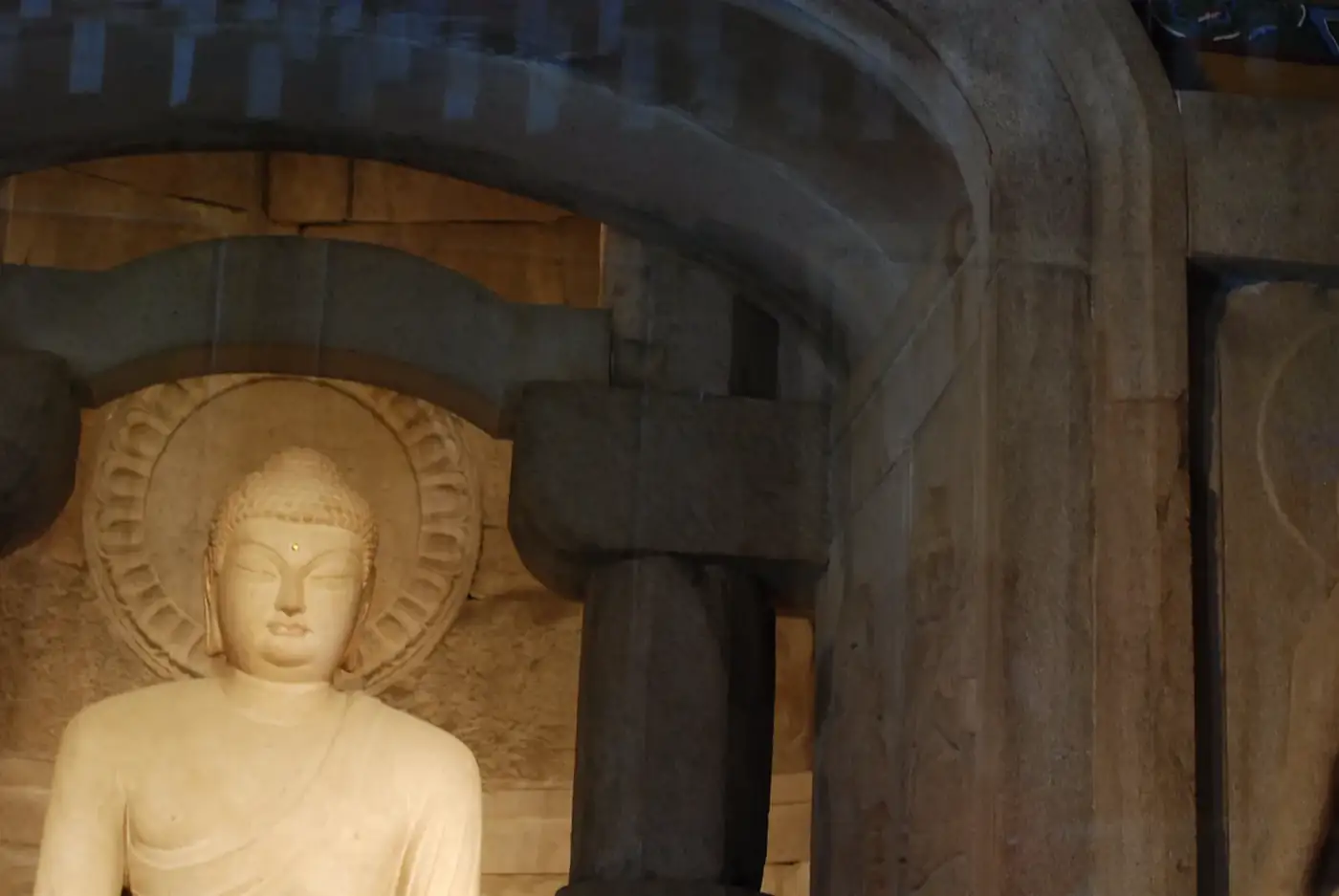
Seokguram is an artificial grotto of granite with an antechamber, a corridor and a main rotunda, enshrining a seated Sakyamuni Buddha. Its dome and entrance passage use more than 360 stone slabs; the reliefs of bodhisattvas, disciples and guardian deities around the Buddha are regarded as a masterpiece of East Asian Buddhist art.
Stone and wood have different jobs here: wooden halls can be repaired, while terraces, bridges and pagodas fix the skeleton of the sacred space to the hillside; the grotto seals sculpture, worship route and engineering calculation inside one circular chamber. Unified Silla concentrated state wealth, Buddhist faith and engineering skill around Gyeongju, leaving a set of spaces one can still walk into.
Sources: 4 claims (3 sourced); UNESCO World Heritage “Seokguram Grotto and Bulguksa Temple”, the passages on construction, structure and materials.
The main rotunda of Seokguram enshrines a seated Sakyamuni Buddha; its dome and entrance passage use more than 360 stone slabs.myllissa / Wikimedia Commons · CC BY 2.0 · CC-BY-2.0 SourcesSeokguram Grotto and Bulguksa Temple — UNESCO World Heritage Centre background
Cast
People whose choices move the story. Roles describe this story only.
- Yeon GaesomunGoguryeo regent and military strongman
In 642 killed King Yeongnyu and one hundred officials, placed Bojang on the throne and became Dae Mangniji, holding military and political power.
- Kim Dae-seongSilla prime minister and patron of Bulguksa and Seokguram
Initiated and supervised the construction of Bulguksa and Seokguram in the 8th century; Bulguksa was completed in 774 and Seokguram is an artificial granite grotto.
Evidence and limits
Chapter-level sources; key claims checked.
Source count is the number of distinct source records attached to the event nodes shown here. It does not certify the narrative as a whole.