
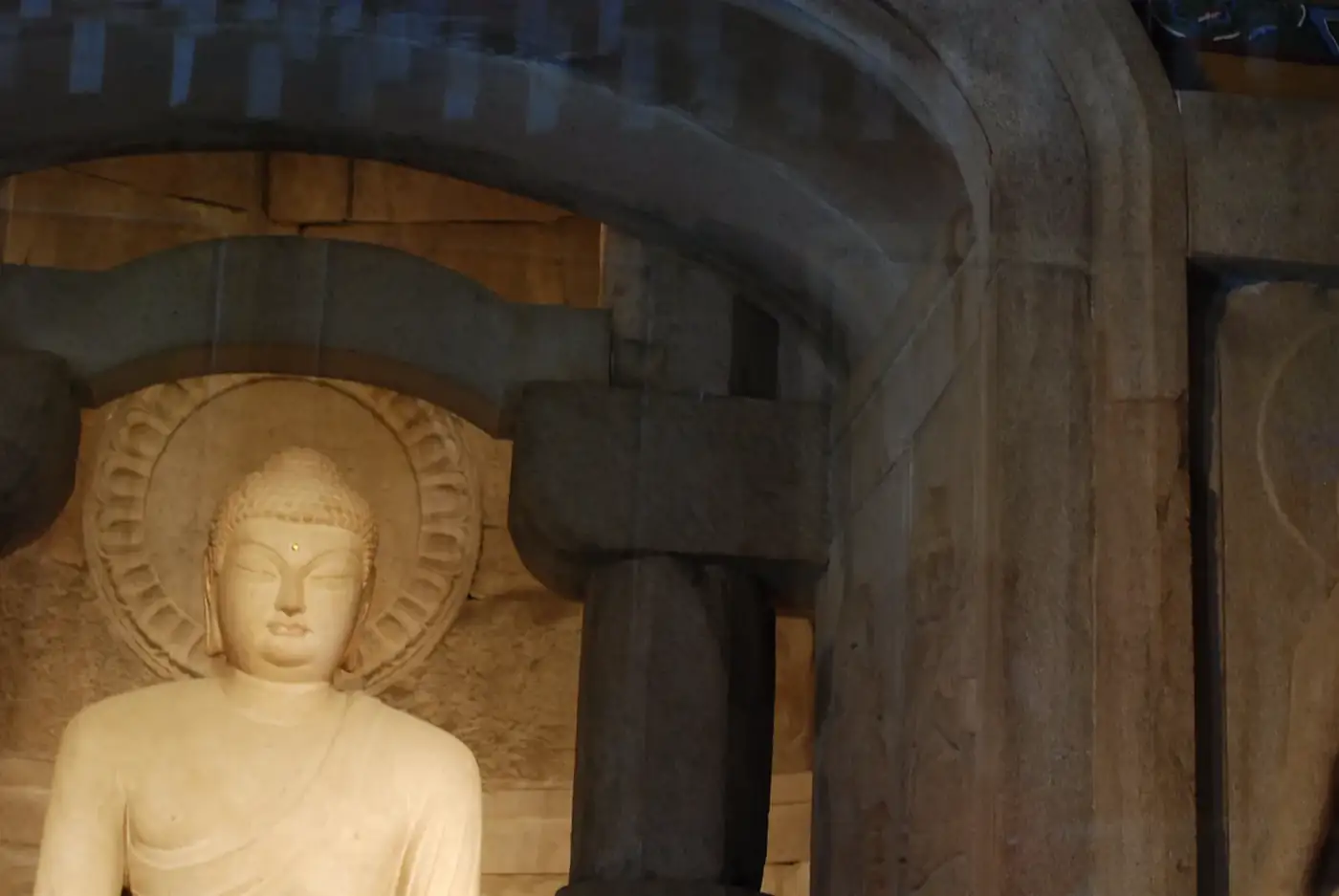
In the 8th century the Silla prime minister Kim Dae-seong initiated and supervised the construction of Bulguksa and Seokguram; Bulguksa was built in 7741. Bulguksa stands on the slopes of Mount Toham and consists of wooden halls on raised stone terraces, stone bridges and two pagodas, its layout intended to represent the land of Buddha; the wooden buildings have been repaired several times, while the stone terraces, bridges and pagodas survive2. Seokguram is an artificial grotto of granite with an antechamber, a corridor and a main rotunda, enshrining a seated Sakyamuni Buddha; its dome and entrance passage use more than 360 stone slabs, and the reliefs of bodhisattvas, disciples and guardian deities around the Buddha are regarded as a masterpiece of East Asian Buddhist art3.
Stone and wood have different jobs here: wooden halls can be repaired, while terraces, bridges and pagodas fix the skeleton of the sacred space to the hillside; the grotto seals sculpture, worship route and engineering calculation inside one circular chamber4.
Evidence ledger
4 claims3 sourced0 unsourced1 author judgment
Every hard fact in the narrative above is registered here. A claim may also record source-only details that the narrative does not repeat; the related-narrative line points to the corresponding passage, not a guarantee that the source supports every word of the body. A claim without a source stays visibly unsourced.
- Seokguram Grotto and Bulguksa Temple — UNESCO World Heritage CentreBrief synthesis,Kim Dae-seong 与 Bulguksa 774 句
Prime Minister Kim Dae-seong initiated and supervised the construction of the temple and the grotto, the former built in memory of his parents in his present life and the latter in memory of his parents from a previous life. ... The Temple of Bulguksa (built in 774) and the Seokguram Grotto form a religious architectural complex of exceptional significance.
Accessed 2026-11-25 · human read
- Seokguram Grotto and Bulguksa Temple — UNESCO World Heritage CentreBrief synthesis,Kim Dae-seong 与 Bulguksa 774 句
Bulguksa consists of wooden halls on raised stone terraces, stone bridges and two pagodas, its layout representing the land of Buddha; the wooden buildings were repaired, while the stone elements survive.
Related narrativeBulguksa stands on the slopes of Mount Toham and consists of wooden halls on raised stone terraces, stone bridges and two pagodas, its layout intended to represent the land of Buddha; the wooden buildings have been repaired several times, while the stone terraces, bridges and pagodas survive
- Seokguram Grotto and Bulguksa Temple — UNESCO World Heritage CentreOutstanding Universal Value,Bulguksa 结构与净土句
Bulguksa is a Buddhist temple complex that comprises a series of wooden buildings on raised stone terraces. The grounds of Bulguksa are divided into three areas ... These areas and the stone terraces were designed to represent the land of Buddha. The stone terraces, bridges and the two pagodas – Seokgatap (Pagoda of Sakyamuni) and Dabotap (Pagoda of Bountiful Treasures) – facing the Daeungjeon attest to the fine masonry work of the Silla.
Accessed 2026-11-25 · human read
- Seokguram Grotto and Bulguksa Temple — UNESCO World Heritage CentreOutstanding Universal Value,Bulguksa 结构与净土句
Seokguram is an artificial granite grotto with an antechamber, corridor and circular rotunda; its dome and entrance use more than 360 stone slabs, and the Buddha with surrounding reliefs is regarded as a masterpiece of East Asian Buddhist art.
Related narrativeSeokguram is an artificial grotto of granite with an antechamber, a corridor and a main rotunda, enshrining a seated Sakyamuni Buddha; its dome and entrance passage use more than 360 stone slabs, and the reliefs of bodhisattvas, disciples and guardian deities around the Buddha are regarded as a masterpiece of East Asian Buddhist art
- Seokguram Grotto and Bulguksa Temple — UNESCO World Heritage CentreOutstanding Universal Value,Seokguram 结构与石板句
Seokguram is an artificial grotto constructed of granite that comprises an antechamber, a corridor and a main rotunda. It enshrines a monumental statue of the Sakyamuni Buddha ... The domed ceiling of the rotunda and the entrance corridor employed an innovative construction technique that involved the use of more than 360 stone slabs.
Accessed 2026-11-25 · human read - Seokguram Grotto and Bulguksa Temple — UNESCO World Heritage CentreOutstanding Universal Value,Criterion (i) 句
The Seokguram Grotto, with its statue of Buddha surrounded by Bodhisattvas, the Ten Disciples, Eight Divine Guardians, two Devas, and two Vajrapanis all carved from white granite, is a masterpiece of East Asian Buddhist Art.
Accessed 2026-11-25 · human read
- Seokguram Grotto and Bulguksa Temple — UNESCO World Heritage CentreOutstanding Universal Value,Seokguram 结构与石板句
Wooden halls can be repaired; stone elements fix the skeleton of the sacred space to the hillside; the grotto seals sculpture, worship route and engineering calculation inside one circular chamber.
Related narrativeStone and wood have different jobs here: wooden halls can be repaired, while terraces, bridges and pagodas fix the skeleton of the sacred space to the hillside; the grotto seals sculpture, worship route and engineering calculation inside one circular chamber
Editorial judgment, not a historical fact.
Sources and review
Key claims rely on a single source record
- Seokguram Grotto and Bulguksa Temple — UNESCO World Heritage Centre · UNESCO World Heritage Centre (accessed 2026-11-25) Original source ↗
Locations
- Silla· 35.79, 129.33· Approximate
evt-5923674ae1f044fdSource file:
events/evt-5923674ae1f044fd/event.md