
Japan's Ritsuryo State: Buddhism, Prince Shotoku and Nara
Story552–784: from clan coalition to a code-based bureaucracy
In 552 King Seong of Baekje sent Buddhist scriptures, an image, and liturgical ornaments to the Japanese court; 538 is also cited. Prince Shōtoku became regent in 593 and later instituted the twelve court ranks; in 604 he issued the Seventeen-Article Constitution. After the 645 coup, the reform rescript declared land and people public; the Taihō code was compiled in 701; in 710 the capital moved to Heijō-kyō, in 741 the kokubunji system was established, and in 752 the Great Buddha of Tōdai-ji was dedicated.
Japan's ritsuryō state was not a copy of Tang China. Buddhism supplied a sacred language for kingship, legal codes supplied formats for taxation and appointment, and the capital supplied a spatial order of power; but clans, local notables and succession still operated inside the system. Centralisation was more a continuous negotiation between centre and locality.
Chapter-level sources; key claims checked.
Chapter timeline
Chapters in reading orderAll anchors are approximate region-level placements; they are not precise sites. Chapters without coordinates are listed below by region only.
Chapter contents6 chapters
- Buddhism enters Japan: court diplomacy and clan rivalry
- Shōtoku's regency: the twelve ranks and the beginning of a bureaucracy
- The Seventeen-Article Constitution: a moral charge to officials
- The Taika reforms: writing land and people as "public"
- The Taihō code: Tang institutions become Japanese law
- Heijō-kyō and Tōdai-ji: Buddhism inside the state machine
The story, chapter by chapter
Each chapter opens the underlying event- 01
Buddhism enters Japan: court diplomacy and clan rivalry
King Seong of Baekje sent Buddhist scriptures, an image, and liturgical ornaments to the Japanese court; 552 is the traditional year of official introduction, while 538 is also cited. Buddhism spread first among the elite and through clan competition, then took root through art and ritual.
In 552 King Seong of Baekje sent Buddhist scriptures, an image, and liturgical ornaments to the Japanese court; 538 is also cited. Buddhism was first resisted by Shintō priests and aristocrats, then took root through monasteries, ceremonies, and continental art.
552 is the date traditionally given for the official introduction of Buddhism into Japan: King Seong of Baekje sent Buddhist scriptures, an image, and liturgical ornaments to the Japanese court; 538 is also cited and the two years coexist.
Buddhism was first resisted by Shintō priests and aristocrats, then took root through monasteries, ceremonies, and the appeal of continental art. The introduction was not a single nationwide conversion; it was the product of court diplomacy, clan competition, and the attraction of Buddhist art.
Sources: 4 event claims, 3 sourced; source cards src-b7-asuka-buddhism-552 (background only).
SourcesJapanese religion: the introduction of Buddhism background
- 02
Shōtoku's regency: the twelve ranks and the beginning of a bureaucracy
In 593 Shōtoku became crown prince and regent after his aunt Empress Suiko came to the throne, and he held that position until his death in 622. During the regency he instituted twelve court ranks marked by cap colour, opening an institutional path toward appointment by merit.
In 593 Shōtoku became crown prince and regent after his aunt Empress Suiko came to the throne, and held the position until his death in 622. During the regency he instituted the twelve court ranks marked by cap colour; Hōryū-ji was built in 607.
In 593, after his aunt Empress Suiko came to the throne, Shōtoku became crown prince and regent, and he remained in that position until his death in 622. He resumed the interrupted envoys to Sui China and brought continental craftsmen and clerks into Japan.
During the regency he instituted the twelve court ranks: each was marked by the colour of the cap, and rank no longer depended solely on uji birth. That did not abolish the clans, but it opened an institutional path toward appointment by merit; Hōryū-ji was built in 607 and became a representative of Asuka Buddhism and wooden architecture.
Sources: 6 event claims, 4 sourced; source cards src-b7-shotoku-regency (background only).
SourcesTaishi Shōtoku background
- 03
The Seventeen-Article Constitution: a moral charge to officials
In 604 Shōtoku issued the Seventeen-Article Constitution. It was not a modern written constitution but a code of conduct for the ruling class, upholding a unified sovereign, appointment by merit, official responsibility, and obedience from subjects.
In 604 Shōtoku issued the Seventeen-Article Constitution. It was not a modern written constitution but a code of conduct for the ruling class: a unified sovereign, appointment by merit, and official responsibility. Most provisions took effect later, and authorship is disputed.
In 604 Shōtoku issued the Seventeen-Article Constitution. It was not a modern written constitution but a code of conduct for the ruling class: it upheld a unified sovereign, appointment by merit, official responsibility toward the governed, and obedience from subjects.
The articles also urged adherence to the Buddhist treasures—Buddha, dharma, and saṃgha—and forbade local officials from collecting taxes or exacting corvée on their own. Most provisions took effect only much later; some historians also doubt whether the extant text is wholly Shōtoku's work. To read it as a modern constitution is to misunderstand Asuka politics.
Sources: 5 event claims, 4 sourced; source cards src-b7-shotoku-constitution-604 (background only).
- 04
The Taika reforms: writing land and people as "public"
In 645 Prince Nakano Ōe and Nakatomi Kamatari launched a coup and destroyed the Soga clan; the following year's rescript proclaimed that land and people belonged to the public, and set out central organs, a census, and a poll tax. The reforms copied Tang models, though many measures took effect only decades later.
In 645 Prince Nakano Ōe and Nakatomi Kamatari launched a coup and destroyed the Soga clan; the following year's rescript declared land and people public and set out central organs, a census, and a poll tax. The reforms copied Tang models, though many measures took effect only decades later.
In 645 Prince Nakano Ōe and Nakatomi Kamatari launched a coup and destroyed the Soga clan. In the first month of the following year the court issued the reform rescript in four articles: land and people were no longer private property but belonged to the "public," that is, the emperor; administrative and military organs answerable to the emperor were to be set up in the capital and provinces; a census was to be taken and land distributed fairly; and a new, more equitable tax system was to be created.
The reforms also copied Tang institutions, codified laws, and began a nationwide road network. Many measures later attributed to "Taika" may have taken effect only decades afterwards. But the phrase "land and people belong to the public" became the fulcrum for the continuing law-state programme.
Sources: 5 event claims, 4 sourced; source cards src-b7-taika-645 (background only).
SourcesTaika era reforms background
- 05
The Taihō code: Tang institutions become Japanese law
The Taihō code was compiled in 701 as the administrative and penal code of the early Nara period, modelled on Tang codes. It turned central organs, the kuni–gun–ri hierarchy, and local appointments into executable articles.
The Taihō code was compiled in 701 as the administrative and penal code of the early Nara period, modelled on Tang codes and in force until the late 8th century. The original is lost; its content survives largely in the Yōrō code of 718.
The Taihō code was compiled in 701 as the administrative and penal code of the early Nara period, modelled on Tang codes and in force until the late 8th century. It turned central government organs, the kuni–gun–ri hierarchy, and the appointment of local officials into executable articles.
The code included administrative ryō and penal ritsu. The original is lost; its content survives largely in the Yōrō code of 718. It gave Japan a common bureaucratic language, but the practical power of local gentry did not disappear.
Dimension Ritsuryō format Japanese landing Central central administrative organs Council of State and ministries Local kuni–gun–ri governors appointed centrally; district governors from local gentry Law ryō and ritsu Taihō code 701; Yōrō code 718 Religion Shintō ceremony Office of Deities alongside kokubunji Table: four faces of the ritsuryō state. It was not a copy of Tang institutions but a combination of central appointment, local power and Shintō ceremony.
Sources: 5 event claims, 4 sourced; source cards src-b7-taiho-code-701 (background only).
SourcesTaihō code background
- 06
Heijō-kyō and Tōdai-ji: Buddhism inside the state machine
In 710 the capital moved to Heijō-kyō (Nara), the first permanent capital, laid out like Tang Chang'an. In 741 the kokubunji system was established, in 743 Tōdai-ji and its Great Buddha were initiated, and in 752 the image was dedicated.
In 710 the capital moved to Heijō-kyō (Nara), the first permanent capital, laid out like Tang Chang'an. In 741 the kokubunji system was established, in 743 Tōdai-ji and its Great Buddha were initiated, and in 752 the image was dedicated.
In 710 the capital was moved to Heijō-kyō (Nara). It was the first permanent capital, laid out on the model of Tang Chang'an; the Nara period lasted until 784, when Sinicization and Buddhism both reached a high point.
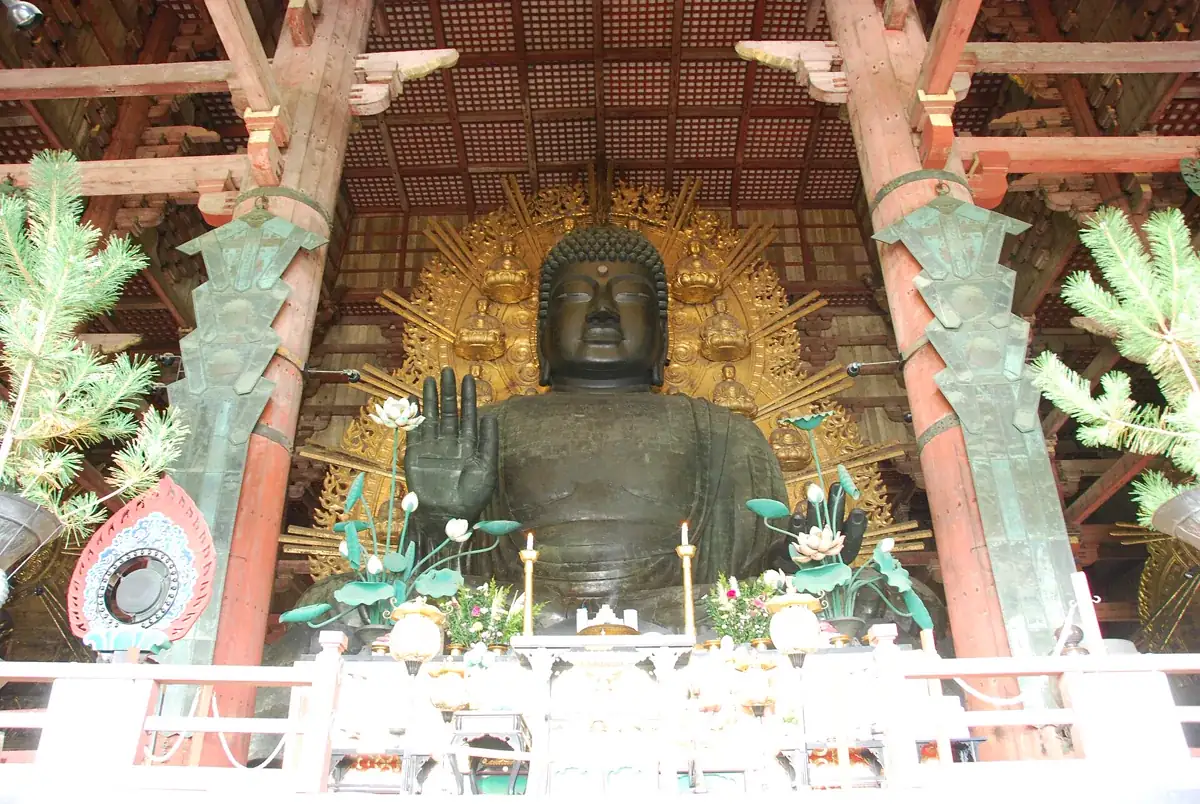
In 741 Emperor Shōmu established a monastery and a nunnery in each province, tying local temples to a Nara-centred system; in 743 he initiated Tōdai-ji and its Vairocana Great Buddha. Construction of the Great Buddha Hall began in 745, dedication was held in 752, and the seated figure stands nearly 15 metres high. The Nara central government had a Council of State and ministries, plus an Office of Deities; the sovereign took the title tennō and stood both at the apex of the bureaucracy and at the centre of Shintō ceremony. Religion was not a private matter; it was part of the state project.
Sources: 6 event claims, 5 sourced; source cards src-b7-nara-capital-710, src-b7-todaiji-daibutsu-752 (background only).
Great Buddha of Tōdai-jiMaarten Heerlien / Wikimedia Commons · CC BY 2.0 · CC-BY-2.0 SourcesNara period backgroundJapanese architecture: Tōdai-ji and the Nara period background
Cast
People whose choices move the story. Roles describe this story only.
- Prince ShōtokuRegent and institutional reformer
Promoted the twelve court ranks and the Seventeen-Article Constitution; later remembered as a symbol of Japanese Buddhism and kingship.
- Naka no ŌeTaika reformer and Emperor Tenji
Led the 645 coup and the Taika reforms, later becoming Emperor Tenji.
- Emperor ShōmuPatron of the kokubunji system and Tōdai-ji
Established the kokubunji system in 741, initiated Tōdai-ji and its Vairocana Buddha in 743, and saw the image dedicated in 752.
Evidence and limits
Chapter-level sources; key claims checked.
Source count is the number of distinct source records attached to the event nodes shown here. It does not certify the narrative as a whole.