
The Kushans: Gold, Gandhara and Silk Road Buddhism
Story37–143: how a Central Asian empire put Greece, India and Buddhism on one coin
In the first century CE the Kushans rose from the Yuezhi confederation; in 37 Kujula Kadphises took the title of king; around 60 Vima Kadphises issued gold coinage, linking the empire’s trade and money to Rome, India and Central Asia; in 78 Kanishka I ascended and the empire reached its height; in 102 Gandharan Buddhist art peaked; around 110 Buddhist art entered China through the Western Regions; in 143 Kushan culture and art reached their height. Together these show a “crossroads empire” joining civilisations through gold, cities and Buddhist art.
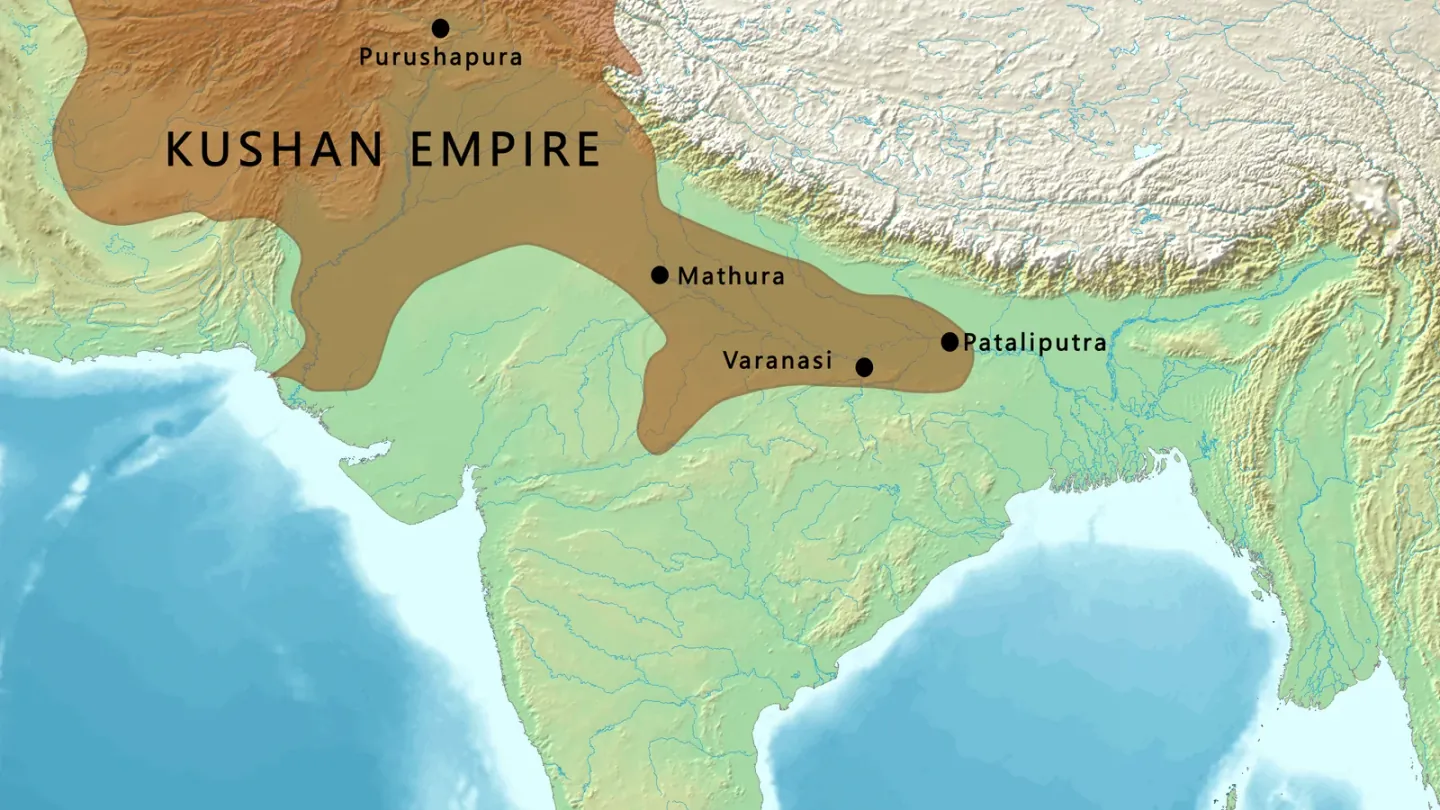
Kushan power lay less in a large contiguous territory than in control of key passages: from the Indian Ocean over the Hindu Kush into Central Asia and onto the Silk Roads. Gold coins were instruments of commercial credit, Gandharan art mixed Hellenistic form with Indian Buddhist content, and Buddhism’s eastward spread depended on monks, translations and trade routes, not a single decree. The Kushans turned difference into circulating signs.
Chapter-level sources; key claims checked.
Chapter timeline
Chapters in reading orderAll anchors are approximate region-level placements; they are not precise sites. Chapters without coordinates are listed below by region only.
Chapter contents6 chapters
The story, chapter by chapter
Each chapter opens the underlying event- 01
Kujula Kadphises of the Kushan Formally Proclaimed King
Around AD 37, Kujula Kadphises, chief of the Kushan tribe (one of the five Yuezhi Xihou), united the other four tribes, established the Kushan Empire in the Bactria region, and formally proclaimed himself 'King of Kings', establishing his capital at Bactra (modern Balkh, Afghanistan). He issued coins in the Roman style and amassed vast wealth through Silk Road trade. At its peak, the Kushan Empire encompassed parts o…
Around AD 37, Kujula Kadphises, chief of the Kushan tribe (one of the five Yuezhi Xihou), united the other four tribes, established the Kushan Empire in the Bactria region, and formally proclaimed himself 'King of Kings', establishing his capital at Bactra (modern Balkh, Afghanistan).
Around AD 37, Kujula Kadphises, chief of the Kushan tribe (one of the five Yuezhi Xihou), united the other four tribes, established the Kushan Empire in the Bactria region, and formally proclaimed himself 'King of Kings', establishing his capital at Bactra (modern Balkh, Afghanistan). He issued coins in the Roman style and amassed vast wealth through Silk Road trade. At its peak, the Kushan Empire encompassed parts of modern Afghanistan, Pakistan, and northern India.
Kujula’s royal title marked the Kushans’ move from one clan in the Yuezhi confederation to a polity with a formal kingship. Title, coin and city were the minimal toolkit for turning a clan coalition into a state.
Sources: 5 event claims, 5 sourced; source cards src-b3w-kushan-silk-road-03, src-b3w-kushan-silk-road-05 (background only).
SourcesKushan Empire — Wikipedia backgroundKujula Kadphises — Wikipedia background
- 02
Kushan King Vima Kadphises Minted Gold Coins
During the reign of the Kushan Empire's King Vima Kadphises (c. AD 60-80), large-scale minting of gold and copper coins began. His gold coins featured a Hellenistic design, with the king's portrait on the obverse and Indian deities like Shiva on the reverse. The weight standard of Vima Kadphises's gold coins (about 8 grams) matched that of Roman gold coins, facilitating international trade across the Silk Road.
During the reign of the Kushan Empire's King Vima Kadphises (c. AD 60-80), large-scale minting of gold and copper coins began.
During the reign of the Kushan Empire's King Vima Kadphises (c. AD 60-80), large-scale minting of gold and copper coins began. His gold coins featured a Hellenistic design, with the king's portrait on the obverse and Indian deities like Shiva on the reverse. The weight standard of Vima Kadphises's gold coins (about 8 grams) matched that of Roman gold coins, facilitating international trade across the Silk Road.
Vima’s gold coinage shows the Kushans entering a transregional credit system. Gold was not a collector’s item but a tool for settling caravans, cities and taxes on one scale.
Sources: 5 event claims, 5 sourced; source cards src-b3w-kushan-silk-road-03, src-b3w-kushan-silk-road-02 (background only).
SourcesKushan Empire — Wikipedia backgroundKanishka — Wikipedia background
- 03
Kanishka I of the Kushan Ascended the Throne
In AD 78, the most famous king of the Kushan Empire, Kanishka I, ascended the throne. He ruled during the golden age of the Kushan Empire, establishing his capital at Purushapura (modern Peshawar, Pakistan) and strongly supporting Buddhism. Kanishka built magnificent stupas and monasteries and presided over the Fourth Buddhist Council. The Kushan Empire reached its zenith under Kanishka's rule.
In AD 78, the most famous king of the Kushan Empire, Kanishka I, ascended the throne. He ruled during the golden age of the Kushan Empire, establishing his capital at Purushapura (modern Peshawar, Pakistan) and strongly supporting Buddhism.
In AD 78, the most famous king of the Kushan Empire, Kanishka I, ascended the throne. He ruled during the golden age of the Kushan Empire, establishing his capital at Purushapura (modern Peshawar, Pakistan) and strongly supporting Buddhism. Kanishka built magnificent stupas and monasteries and presided over the Fourth Buddhist Council. The Kushan Empire reached its zenith under Kanishka's rule.
Under Kanishka I the empire reached its height. His coins show Greek, Indian and Buddhist deities together, indicating a ruler willing to let different religions coexist in one monetary space.
Sources: 6 event claims, 6 sourced; source cards src-b3w-kushan-silk-road-02, src-b3w-kushan-silk-road-03 (background only).
SourcesKanishka — Wikipedia backgroundKushan Empire — Wikipedia background
- 04
Gandharan Buddhist art reaches its peak in the Kushan Empire
Under the patronage of Emperor Kanishka I of the Kushan Empire, Buddhist art in the Gandhara region (present-day northern Pakistan and eastern Afghanistan) entered a golden age. Artisans blended Hellenistic realism with Indian religious symbolism to create the first anthropomorphic statues of the Buddha and Bodhisattvas. Representative works include a colossal standing Buddha about 15 meters tall, draped in a Greek-s…
Under the patronage of Emperor Kanishka I of the Kushan Empire, Buddhist art in the Gandhara region (present-day northern Pakistan and eastern Afghanistan) entered a golden age.
Under the patronage of Emperor Kanishka I of the Kushan Empire, Buddhist art in the Gandhara region (present-day northern Pakistan and eastern Afghanistan) entered a golden age. Artisans blended Hellenistic realism with Indian religious symbolism to create the first anthropomorphic statues of the Buddha and Bodhisattvas. Representative works include a colossal standing Buddha about 15 meters tall, draped in a Greek-style robe with distinctly European facial features. Gandharan art later spread to China along the Silk Road, profoundly influencing the cave temple sculptures at Yungang and Longmen.
Gandharan art used Hellenistic proportions, drapery and faces to tell Buddhist stories. It was not “Greek art plus Buddhism” but a recombination in specific workshops, patronage and markets.
Sources: 6 event claims, 6 sourced; source cards src-b3w-kushan-silk-road-03, src-b3w-kushan-silk-road-04 (background only).
SourcesKushan Empire — Wikipedia backgroundGreco-Buddhist art — Wikipedia background
- 05
Kushan Buddhist art spreads to the Chinese Western Regions
Under Kanishka I, Kushan Buddhist art reached its zenith. Numerous Buddha and Bodhisattva statues and sutras were transmitted via the southern Silk Road to Western Regions kingdoms such as Khotan, Kashgar, and Kucha. Artisans there imitated Gandharan styles, carving the first cave temples (e.g., Kizil Caves) and painting Buddhist murals with Hellenistic features. This Buddhist art later provided models for the Mogao…
Under Kanishka I, Kushan Buddhist art reached its zenith. Numerous Buddha and Bodhisattva statues and sutras were transmitted via the southern Silk Road to Western Regions kingdoms such as Khotan, Kashgar, and Kucha.
Under Kanishka I, Kushan Buddhist art reached its zenith. Numerous Buddha and Bodhisattva statues and sutras were transmitted via the southern Silk Road to Western Regions kingdoms such as Khotan, Kashgar, and Kucha. Artisans there imitated Gandharan styles, carving the first cave temples (e.g., Kizil Caves) and painting Buddhist murals with Hellenistic features. This Buddhist art later provided models for the Mogao Caves and Yungang Grottoes, marking a significant starting point for the Sinification of Buddhism.
Buddhist art entered China through the Western Regions via monks, caravans and oasis cities. A religious route was also a route of translation, patronage and pilgrimage.
Sources: 6 event claims, 6 sourced; source cards src-b3w-kushan-silk-road-04, src-b3w-kushan-silk-road-01 (background only).
SourcesGreco-Buddhist art — Wikipedia backgroundSilk Road — Wikipedia background
- 06
Kushan Empire reaches cultural zenith
Under Kanishka I and his successors, the Kushan Empire entered its golden age. Its capital, Peshawar (present-day Pakistan), became a Buddhist center, with the Kanishka Stupa, about 200 meters high, one of the tallest structures in the world at that time. Gandharan art, blending Greek, Persian, and Indian styles, produced numerous Buddha statues and narrative reliefs. The Kushans also controlled the central Silk Road…
Under Kanishka I and his successors, the Kushan Empire entered its golden age. Its capital, Peshawar (present-day Pakistan), became a Buddhist center, with the Kanishka Stupa, about 200 meters high, one of the tallest structures in the world at that time.
Under Kanishka I and his successors, the Kushan Empire entered its golden age. Its capital, Peshawar (present-day Pakistan), became a Buddhist center, with the Kanishka Stupa, about 200 meters high, one of the tallest structures in the world at that time. Gandharan art, blending Greek, Persian, and Indian styles, produced numerous Buddha statues and narrative reliefs. The Kushans also controlled the central Silk Road trade, enjoyed economic prosperity, and cultural diversity, becoming one of the four great empires of the world at the time (along with Rome, Parthia, and Han China).
The cultural height of 143 was the result of long accumulation and a signal of dispersal. In an empire held together by many nodes, a weak centre lets the edges go their own way.
Sources: 6 event claims, 6 sourced; source cards src-b3w-kushan-silk-road-03, src-b3w-kushan-silk-road-02 (background only).
SourcesKushan Empire — Wikipedia backgroundKanishka — Wikipedia background
Cast
People whose choices move the story. Roles describe this story only.
- Kujula KadphisesFounding Kushan king
Took the royal title in 37, unified the Yuezhi clans and laid the political framework of the Kushan Empire.
- Vima KadphisesKushan emperor and gold coin reformer
Issued gold coinage around 60, linking the Kushans to the trade-credit systems of Rome, India and Central Asia.
- Kanishka IKushan emperor at the height
Ascended in 78, supported Buddhism and Gandharan art; his era is a major problem in Central Asian chronology.
Evidence and limits
Chapter-level sources; key claims checked.
Source count is the number of distinct source records attached to the event nodes shown here. It does not certify the narrative as a whole.