
Indus and Vedic: Cities, Trade and the Origins of Caste
Story3rd millennium–900 BCE: from grid cities to the varna order
The Indus civilisation evolved from irrigated villages, with nuclear dates around 2600–1900 BCE. Harappa and Mohenjo-daro developed grid streets, drainage, public baths and standard brick houses into an urban order without a clear palace. Trade networks reached Mesopotamia, though specific ports and cargo lists remain disputed. By the middle of the 2nd millennium BCE the urban system was dissolving at different times and in different ways. The Vedic society that followed was not a direct continuation; its varna order gradually fixed in the late Vedic period: Brahmans, Kshatriyas, Vaishyas and Shudras.
The most important legacy of the Indus civilisation is not a king list or a royal tomb but an urban order without a palace: grid streets, drainage, public baths, standard bricks and cross-regional trade. It shows that a city could function through shared norms and administrative habits without leaving a clear royal image. Its dissolution was not a single night of destruction by outsiders but the failure of rivers, land, trade and urban networks together. The Vedic society that followed was not a direct continuation of the Indus cities; it came from a different society centred on oral literature, sacrifice and tribal politics. The varna order hardened within that tradition, and priesthood and kingship became interdependent. Putting the two together is not treating them as one dynasty's rise and fall, but seeing how South Asia twice wrote order into urban infrastructure and bodily identity.
Chapter-level sources; key claims checked.
All eight chapters carry 25 claims, 15 of them bound to source cards. UNESCO and Britannica are used as authoritative secondary sources, explicitly labelled as background rather than passed off as primary archaeological records. Dates, urban scale, trade and varna stratification follow the source texts; where institutional accounts differ, both are shown.
Chapter timeline
Chapters in reading orderAll anchors are approximate region-level placements; they are not precise sites. Chapters without coordinates are listed below by region only.
Chapter contents8 chapters
- Indus civilisation grows from villages into cities
- Mohenjo-daro: planning before the city
- Harappa and Mohenjo-daro: urban order without a palace
- Road to Mesopotamia: raw materials, weights and maritime trade
- Living in Mohenjo-daro: wells, baths and drains
- Cities dissolve: a decline without a single cause
- Late Vedic: varna order and kingship
- The shape of caste: four varnas and social stratification
The story, chapter by chapter
Each chapter opens the underlying event- 01
Indus civilisation grows from villages into cities
The Indus civilisation evolved from villages using irrigated agriculture, with nuclear dates around 2600–1900 BCE. Harappa and Mohenjo-daro were the two largest cities, each perhaps about 1.6 km square, with more than 100 towns and villages around them.
The civilisation evolved from irrigated villages, with nuclear dates around 2600–1900 BCE; Harappa and Mohenjo-daro were each about 1.6 km square, with more than 100 towns and villages around them.
The Indus civilisation did not appear all at once. It evolved from villages that used irrigated agriculture; in the urban phase, Harappa and Mohenjo-daro became the two centres, each perhaps about 1.6 km square, with more than 100 smaller towns and villages around them.
The nuclear dates of the civilisation are about 2600–1900 BCE, and southern sites may have lasted longer. Writing the “first cities” as something built in a day hides the long accumulation of villages, irrigation and trade networks.
What matters is that accumulation: irrigation supported more people on the same land, surplus grain supported full-time craftsmen, and exchange networks brought stone, metal and timber from far away. A city was not a monument dropped from the sky but a denser form of organisation that grew when these conditions came together.
Sources: 3 claims (2 sourced); UNESCO World Heritage listing “Archaeological Ruins at Moenjodaro” + Britannica “Indus civilization”.
SourcesArchaeological Ruins at Moenjodaro — UNESCO World Heritage Centre backgroundIndus civilization background
- 02
Mohenjo-daro: planning before the city
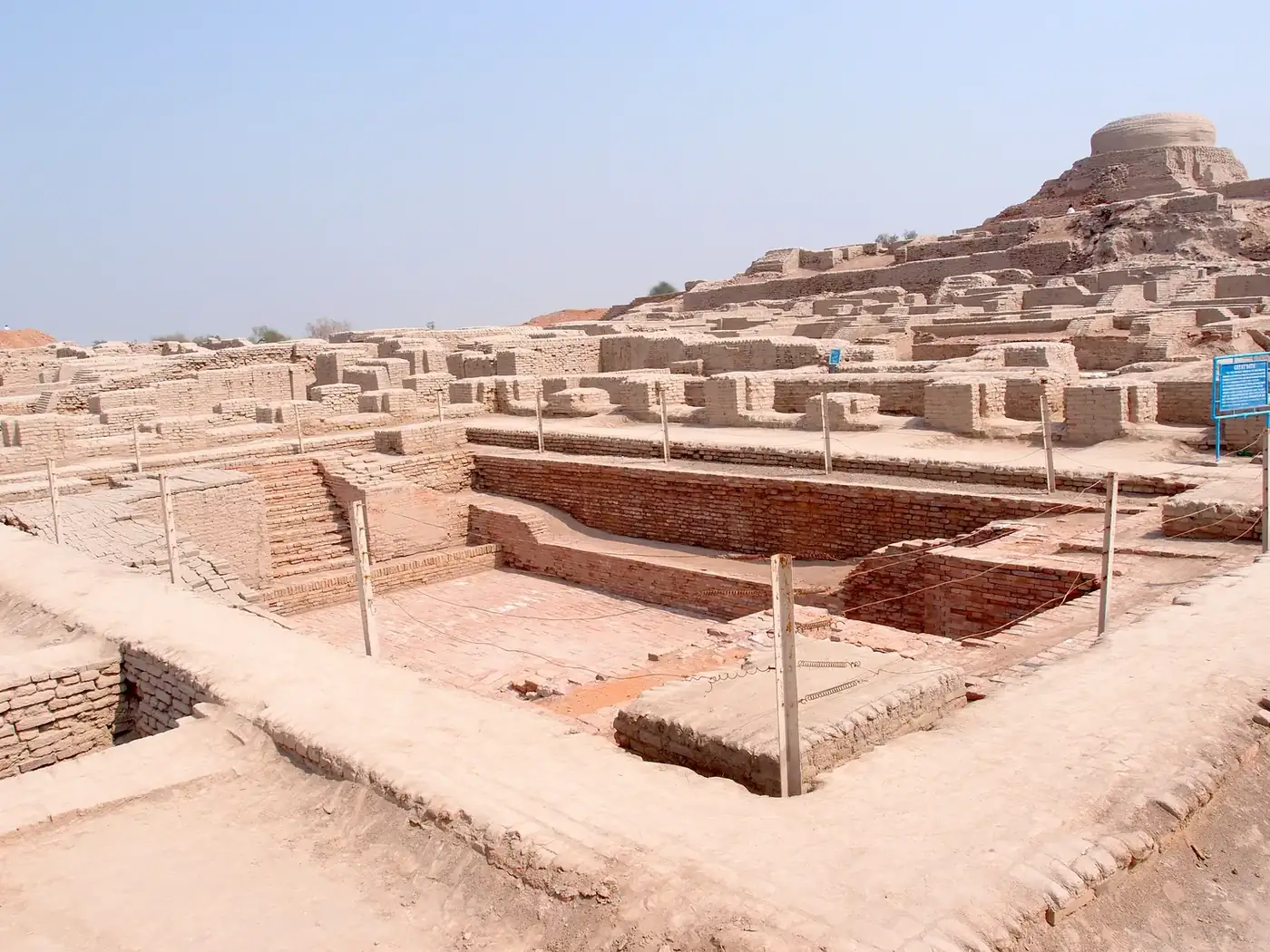
Mohenjo-daro lies in the Indus valley and was built of brick in the third millennium BCE. The acropolis stood on high embankments within ramparts, while the lower town was laid out according to strict rules; streets crossed at right angles, with drainage, public baths, wells, soak pits and a large granary. The ruins cover about 240 ha, of which only about one third has been excavated.
Mohenjo-daro was built of brick, with a raised acropolis, a lower town under strict rules, right-angled streets, drainage and public baths; the ruins cover 240 ha, about one third excavated.
Mohenjo-daro lies in the Indus valley and was built of brick in the 3rd millennium BCE. The acropolis stood on high embankments within ramparts, while the lower town was laid out according to strict rules; streets crossed at right angles, and drainage, public baths, wells, soak pits and a large granary appeared together.
The ruins cover about 240 ha, of which only about one third has been excavated. The city's “planned” quality is not a modern reconstruction drawing but the repeated alignment of streets, brick dimensions and drainage channels in the ruins themselves.
The two authoritative accounts do not line up exactly, which is itself worth showing:
Item UNESCO Britannica How this story handles it Core dates flourished c. 2500–1500 BCE nuclear dates c. 2600–1900 BCE both given, not merged into one date Urban scale 240 ha, about one third excavated each city perhaps 1.6 km square “site area” and “city side” kept separate Planning and power acropolis on embankments, lower town under strict rules, right-angled streets uniform weights and granaries imply administrative control “planning and coordination”, not “empire” Decline salinity and rising water table threaten the ruins decline was not uniform, cause unclear multiple causes and staggered timing The table is not a verdict on who is right. It is a reminder that the same site can produce different numbers because institutions measure differently, write for different purposes and update at different times. In history writing, stating the measure is more useful than forcing one number.
Sources: 4 claims (3 sourced); UNESCO World Heritage listing “Archaeological Ruins at Moenjodaro” + Britannica “Indus civilization”.
Mohenjo-daro, with the public bath in the foreground and the granary in the distance. The photograph records the ruins as they are, not a reconstruction.Saqib Qayyum / Wikimedia Commons · CC BY-SA 3.0 · CC-BY-SA-3.0 SourcesArchaeological Ruins at Moenjodaro — UNESCO World Heritage Centre backgroundIndus civilization background
- 03
Harappa and Mohenjo-daro: urban order without a palace
Both large cities had grid streets and drainage. Uniform weights and measures and great granaries suggest strong administrative coordination, but the form of kingship and government cannot be determined from the surviving evidence.
The two cities shared grid streets and drainage; uniform weights and great granaries imply administrative coordination, but the form of kingship cannot be confirmed.
Harappa and Mohenjo-daro both had grid streets and drainage systems. Uniform weights and measures, great granaries and shared building scales suggest that the cities shared one set of norms; maintaining that set required some form of administrative coordination.
But who gave the orders remains unclear. The ruins have no readable royal inscriptions and no building that can be identified as a palace; describing an Indus city directly as the capital of a king borrows a Mesopotamian template.
No palace does not mean no power. Granaries had to be managed, trade needed standards, public works needed labour, and these affairs themselves produced command relationships. The puzzle of the Indus city is not whether order existed, but why order took such a low-profile form.
Sources: 3 claims (2 sourced); UNESCO World Heritage listing + Britannica “Indus civilization”.
SourcesArchaeological Ruins at Moenjodaro — UNESCO World Heritage Centre backgroundIndus civilization background
- 04
Road to Mesopotamia: raw materials, weights and maritime trade
The trade networks of the Indus cities reached Mesopotamia and Central Asia. Imported raw materials entered local workshops, and finished goods were distributed along river and coastal routes; standard weights and uniform measures were the technical conditions for this cross-regional trade. Specific ports and cargo lists remain disputed.
Trade networks reached Mesopotamia and Central Asia; raw materials were imported and finished goods distributed, with standard weights and measures supporting cross-regional exchange.
The trade networks of the Indus cities reached Mesopotamia and Central Asia. Imported raw materials entered local workshops, and finished goods were distributed along river and coastal routes; standard weights and uniform measures were the technical conditions for this cross-regional trade.
The scale of the trade can be established, but the specific list of ports cannot. Matching a single bead or a single seal directly to a fixed route makes the archaeological evidence sound more certain than it is.
The power of a city therefore was not confined within its walls. It could turn local surplus into transportable goods, bring distant materials back to workshops, and distribute them through inland networks. Trade made the city a node across regions, not an isolated concentration of people.
Sources: 3 claims (2 sourced); Britannica “Indus civilization”, trade and weights sections.
SourcesArchaeological Ruins at Moenjodaro — UNESCO World Heritage Centre backgroundIndus civilization background
- 05
Living in Mohenjo-daro: wells, baths and drains
Houses in Mohenjo-daro were organised around wells, bathrooms and drains; the city also had public baths, soak pits and a large granary. Everyday infrastructure says more about the city's organisational capacity than an unconfirmed “palace”.
Houses were organised around wells, bathrooms and drains; public baths, soak pits and a large granary required city-level maintenance.
Houses in Mohenjo-daro were organised around wells, bathrooms and drains. The city also had public baths, soak pits and a large granary; these facilities could not be maintained by a single household and required city-level arrangements for cleaning, water supply and storage.
Everyday infrastructure says more about the city's organisational capacity than an unconfirmed “palace”. The slope of a drain, the construction of a well shaft and the placing of a rubbish pit are engineering details that can be checked again and again.
Move the camera from the citadel to an ordinary house and the city becomes concrete. Wells had to be dug and repaired, drains cleared, brick walls replaced; as long as the city functioned, a body of people was responsible for this inconspicuous labour. “A highly organised urban civilisation” meant, in daily life, that someone ensured water could be drawn, waste could be removed and streets did not choke.
Sources: 3 claims (1 sourced); UNESCO World Heritage listing, public facilities and drainage section.
SourcesArchaeological Ruins at Moenjodaro — UNESCO World Heritage Centre backgroundIndus civilization background
- 06
Cities dissolve: a decline without a single cause
The decline of the Indus civilisation was not uniform. By the middle of the second millennium BCE, Mohenjo-daro was already declining; southern sites may have lasted longer. Environmental change, rivers and the reorganisation of trade networks may all have contributed, but the exact mechanism remains disputed.
By the middle of the 2nd millennium BCE Mohenjo-daro was already declining and southern sites may have lasted longer; the decline was not uniform and its causes remain disputed.
The decline of the Indus civilisation was not uniform. By the middle of the 2nd millennium BCE, Mohenjo-daro was already declining; southern sites may have lasted longer.
Environmental change, river shifts, the reorganisation of trade networks and outside pressure may all have played a part, but no single one explains every site. Writing the decline as one “civilisation destroyed” ignores the different timing of different cities.
What matters is that staggering. One set of brick sizes, weights and trade habits had once bound many cities together; as different cities stopped using them one after another, the network broke piece by piece rather than going dark at once. A civilisation can dissolve not when its buildings fall first, but when the institutions that connected those buildings fail first.
Sources: 3 claims (1 sourced); Britannica “Indus civilization”, decline section.
SourcesArchaeological Ruins at Moenjodaro — UNESCO World Heritage Centre backgroundIndus civilization background
- 07
Late Vedic: varna order and kingship
In the late Vedic period, Indo-European-speaking settlers in northern India were divided into four groups: Brahmans (priests), Kshatriyas (warriors), Vaishyas (traders) and Shudras (labourers). Brahmans held the highest rank and monopolised the recitation of sacred texts and sacrifice; political power normally belonged to the warrior class.
Late Vedic four varnas: Brahmans, Kshatriyas, Vaishyas and Shudras; Brahmans monopolised the sacred texts, while political power normally belonged to the warrior class.
In the late Vedic period, Indo-European-speaking settlers in northern India were divided into four groups: Brahmans (priests), Kshatriyas (warriors), Vaishyas (traders) and Shudras (labourers). Brahmans held the highest rank, and the ability to recite and study the sacred texts was reserved for this group.
Political power normally belonged to the warrior class, while Brahmans often took part in rule as advisers and priests. The varna order was not a modern legal code but the result of a gradual binding of status, occupation and ritual qualification.
The key word is “gradual”. Status was not a certificate issued in a day; it was confirmed again and again in sacrifice, marriage and teacher-student transmission. Who could perform ritual, who could recite the texts, who could receive offerings and who had to serve was slowly written into “nature”. Once a social division of labour is ritualised, it is no longer only a division of labour.
Sources: 3 claims (2 sourced); Britannica “Brahman (social class)”.
SourcesBrahman background
- 08
The shape of caste: four varnas and social stratification
The four varnas gradually fixed in late Vedic society: Brahmans, Kshatriyas, Vaishyas and Shudras. The Brahman ideal of ritual purity and monopoly over sacred texts depended on the political power of the warrior class, and vice versa; later caste society was far more complex than these four categories.
The four varnas gradually fixed; Brahman ritual purity and textual monopoly depended on warrior political power, and later caste society became more complex.
The four varnas gradually fixed in late Vedic society: Brahmans, Kshatriyas, Vaishyas and Shudras. The Brahman position rested on “ritual purity” and the qualification to recite the sacred texts; the warrior class held political power but needed Brahmans to supply legitimacy.
This stratification was not a legal table written in a day. Later caste society contained many local sub-castes and occupational groups, and the four varnas of the late Vedic period cannot be equated directly with caste as it exists today.
“The shape of caste” is more accurate than “the caste system was complete”. The framework of the four varnas had appeared, but local practice, occupational movement and marriage rules would keep evolving. The Indus cities left streets and drains; the Vedic tradition left identities and narratives. There is no smooth line of inheritance between them, yet together they form a deep layer of South Asian civilisation.
Sources: 3 claims (2 sourced); Britannica “Brahman (social class)”.
SourcesBrahman background
Cast
People whose choices move the story. Roles describe this story only.
Evidence and limits
Chapter-level sources; key claims checked.
Source count is the number of distinct source records attached to the event nodes shown here. It does not certify the narrative as a whole.