
In 710 the capital was moved to Heijō-kyō (Nara).1
It was the first permanent capital, laid out on the model of Tang Chang'an; the Nara period lasted until 784, when Sinicization and Buddhism both reached a high point.2
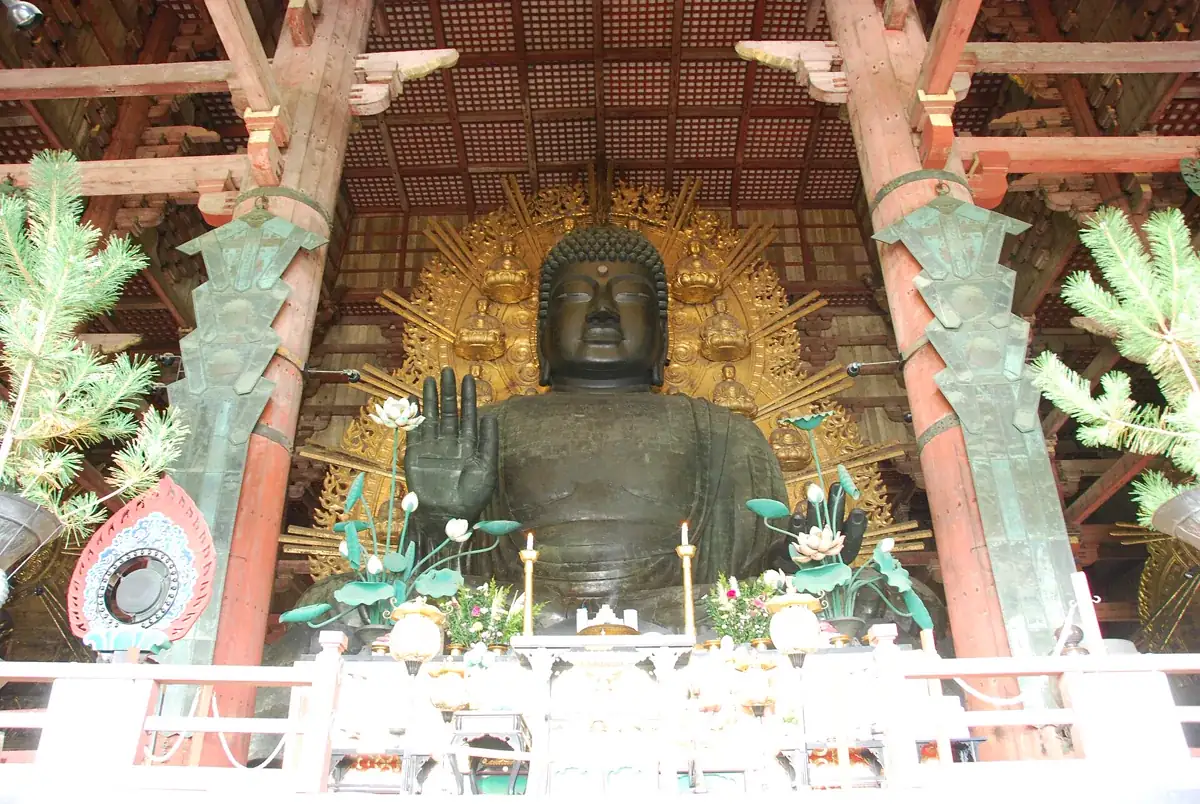
In 741 Emperor Shōmu established a monastery and a nunnery in each province, tying local temples to a Nara-centred system; in 743 he initiated Tōdai-ji and its Vairocana Great Buddha.3
Construction of the Great Buddha Hall began in 745, dedication was held in 752, and the seated figure stands nearly 15 metres high.4
The Nara central government had a Council of State and ministries, plus an Office of Deities; the sovereign took the title tennō and stood both at the apex of the bureaucracy and at the centre of Shintō ceremony.5
Religion was not a private matter; it was part of the state project.6
Evidence ledger
6 claims5 sourced0 unsourced1 author judgment
Every hard fact in the narrative above is registered here. A claim may also record source-only details that the narrative does not repeat; the related-narrative line points to the corresponding passage, not a guarantee that the source supports every word of the body. A claim without a source stays visibly unsourced.
In 710 the capital was moved to Heijō-kyō (Nara).
Related narrativeIn 710 the capital was moved to Heijō-kyō (Nara).
- Nara periodOpening: Nara period 710–784; first permanent capital
Nara period, (ad 710–784), in Japanese history, period in which the imperial government was at Nara, and Sinicization and Buddhism were most highly developed. Nara, the country’s first permanent capital, was modeled on the Chinese T’ang dynasty (618–907) capital, Ch’ang-an.
Accessed 2026-11-25 · human read
- Nara periodOpening: Nara period 710–784; first permanent capital
It was the first permanent capital, laid out on the model of Tang Chang'an; the Nara period lasted until 784, when Sinicization and Buddhism both reached a high point.
Related narrativeIt was the first permanent capital, laid out on the model of Tang Chang'an; the Nara period lasted until 784, when Sinicization and Buddhism both reached a high point.
- Nara periodOpening: first permanent capital; Sinicization and Buddhism
Nara period, (ad 710–784), in Japanese history, period in which the imperial government was at Nara, and Sinicization and Buddhism were most highly developed. Nara, the country’s first permanent capital, was modeled on the Chinese T’ang dynasty (618–907) capital, Ch’ang-an.
Accessed 2026-11-25 · human read
- Nara periodOpening: first permanent capital; Sinicization and Buddhism
In 741 Emperor Shōmu established a monastery and a nunnery in each province, tying local temples to a Nara-centred system; in 743 he initiated Tōdai-ji and its Vairocana Great Buddha.
Related narrativeIn 741 Emperor Shōmu established a monastery and a nunnery in each province, tying local temples to a Nara-centred system; in 743 he initiated Tōdai-ji and its Vairocana Great Buddha.
- Japanese architecture: Tōdai-ji and the Nara periodNara period: kokubunji system and Tōdai-ji
In 741 he established the kokubunji system, building a monastery and a nunnery in each province, all under a central authority at Nara. In 743 he initiated the planning for construction of that central authority—the Tōdai Temple—and of its central image, a massive bronze statue of the Birushana (Vairocana) Buddha, known as the Great Buddha (Daibutsu).
Accessed 2026-11-25 · human read
- Japanese architecture: Tōdai-ji and the Nara periodNara period: kokubunji system and Tōdai-ji
Construction of the Great Buddha Hall began in 745, dedication was held in 752, and the seated figure stands nearly 15 metres high.
Related narrativeConstruction of the Great Buddha Hall began in 745, dedication was held in 752, and the seated figure stands nearly 15 metres high.
- Japanese architecture: Tōdai-ji and the Nara periodGreat Buddha Hall: construction in 745, dedication in 752, height
The construction of the Great Buddha Hall (Daibutsuden) commenced in 745, and dedication ceremonies for the nearly 15-metre- (50-foot-) high seated figure were held in 752.
Accessed 2026-11-25 · human read
- Japanese architecture: Tōdai-ji and the Nara periodGreat Buddha Hall: construction in 745, dedication in 752, height
The Nara central government had a Council of State and ministries, plus an Office of Deities; the sovereign took the title tennō and stood both at the apex of the bureaucracy and at the centre of Shintō ceremony.
Related narrativeThe Nara central government had a Council of State and ministries, plus an Office of Deities; the sovereign took the title tennō and stood both at the apex of the bureaucracy and at the centre of Shintō ceremony.
- Nara periodGovernment: Council of State, ministries, Office of Deities, tennō
With the adoption of the imperial title tennō, translated from the Chinese t’ien-huang, or “heavenly emperor,” the Chinese concept of the emperor as the supreme symbol of central government rule was incorporated into the native Japanese interpretation of the emperor as also the leading Shintō cult figure. Like its T’ang Chinese prototype, the Japanese central government consisted of a Council of State (Dajōkan) and ministries of Rites, Personnel, Public Works, War, Justice and Revenue. An Office of Deities (Jingikan) supervised Shintō official ceremonies.
Accessed 2026-11-25 · human read
- Nara periodGovernment: Council of State, ministries, Office of Deities, tennō
Religion was not a private matter; it was part of the state project.
Related narrativeReligion was not a private matter; it was part of the state project.
Editorial judgment, not a historical fact.
Sources and review
Locations
- Japan· 34.7, 135.8· Approximate
evt-dd1fbee8ad67a6b4Source file:
events/evt-dd1fbee8ad67a6b4/event.md