
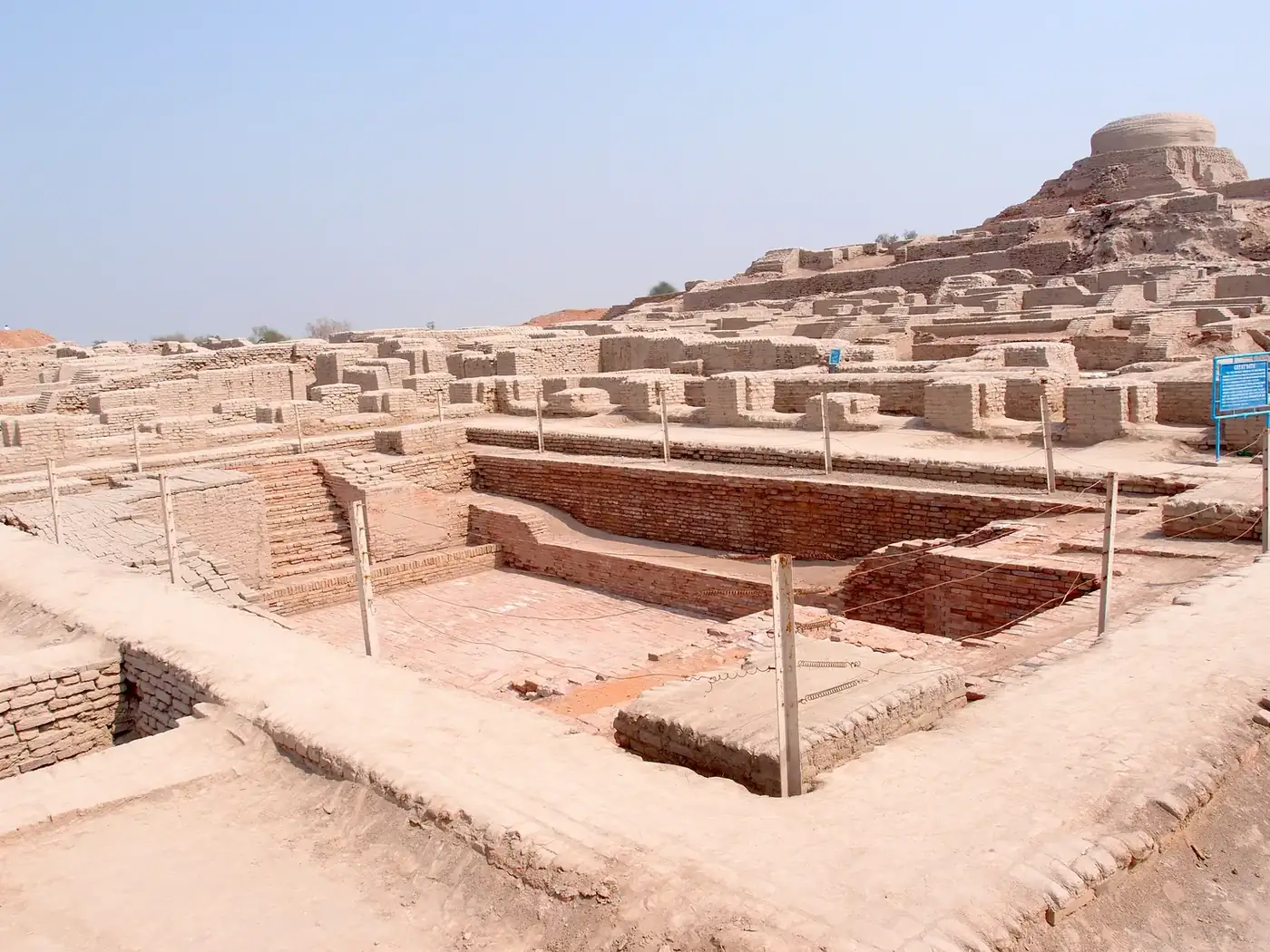
Mohenjo-daro lies in the Indus valley and was built of brick in the third millennium BCE. The acropolis stood on high embankments within ramparts, while the lower town was laid out according to strict rules; streets crossed at right angles, and drainage, public baths, wells, soak pits and a large granary appeared together.
The ruins cover about 240 ha, of which only about one third has been excavated. The city's “planned” quality is not a modern reconstruction drawing but the repeated alignment of streets, brick dimensions and drainage channels in the ruins themselves.1,2,3,4
Evidence ledger
4 claims3 sourced0 unsourced1 author judgment
Every hard fact in the narrative above is registered here. A claim may also record source-only details that the narrative does not repeat; the related-narrative line points to the corresponding passage, not a guarantee that the source supports every word of the body. A claim without a source stays visibly unsourced.
Mohenjo-daro lies in the Indus valley and was built of brick in the 3rd millennium BCE.
Related narrativeMohenjo-daro lies in the Indus valley and was built of brick in the third millennium BCE. The acropolis stood on high embankments within ramparts, while the lower town was laid out according to strict rules; streets crossed at right angles, and drainage, public baths, wells, soak pits and a large granary appeared together. The ruins cover about 240 ha, of which only about one third has been excavated. The city's “planned” quality is not a modern reconstruction drawing but the repeated alignment of streets, brick dimensions and drainage channels in the ruins themselves.
- Archaeological Ruins at Moenjodaro — UNESCO World Heritage CentreBrief synthesis,首句
The ruins of the huge city of Moenjodaro – built entirely of unbaked brick in the 3rd millennium B.C. – lie in the Indus valley.
Accessed 2026-11-25 · human read
- Archaeological Ruins at Moenjodaro — UNESCO World Heritage CentreBrief synthesis,首句
- Archaeological Ruins at Moenjodaro — UNESCO World Heritage CentreBrief synthesis,城市规划与公共设施段
The acropolis, set on high embankments, the ramparts, and the lower town, which is laid out according to strict rules, provide evidence of an early system of town planning... public baths; a college of priests; an elaborate drainage system; wells, soak pits for disposal of sewage, and a large granary... streets intersecting each other at right angles.
Accessed 2026-11-25 · human read
- Archaeological Ruins at Moenjodaro — UNESCO World Heritage CentreBrief synthesis,城市规划与公共设施段
The ruins of Mohenjo-daro cover about 240 ha, of which only about one third has been excavated.
Related narrativeMohenjo-daro lies in the Indus valley and was built of brick in the third millennium BCE. The acropolis stood on high embankments within ramparts, while the lower town was laid out according to strict rules; streets crossed at right angles, and drainage, public baths, wells, soak pits and a large granary appeared together. The ruins cover about 240 ha, of which only about one third has been excavated. The city's “planned” quality is not a modern reconstruction drawing but the repeated alignment of streets, brick dimensions and drainage channels in the ruins themselves.
- Archaeological Ruins at Moenjodaro — UNESCO World Heritage CentreBrief synthesis,遗址面积与发掘比例句
The Archaeological Ruins at Moenjodaro comprise burnt brick structures covering 240 ha, of which only about one third has been excavated since 1922.
Accessed 2026-11-25 · human read
- Archaeological Ruins at Moenjodaro — UNESCO World Heritage CentreBrief synthesis,遗址面积与发掘比例句
The city's “planned” quality is not a modern reconstruction drawing but the repeated alignment of streets, brick dimensions and drainage channels in the ruins themselves.
Related narrativeMohenjo-daro lies in the Indus valley and was built of brick in the third millennium BCE. The acropolis stood on high embankments within ramparts, while the lower town was laid out according to strict rules; streets crossed at right angles, and drainage, public baths, wells, soak pits and a large granary appeared together. The ruins cover about 240 ha, of which only about one third has been excavated. The city's “planned” quality is not a modern reconstruction drawing but the repeated alignment of streets, brick dimensions and drainage channels in the ruins themselves.
Editorial judgment, not a historical fact.
Sources and review
English translation predates the current source revision; Key claims rely on a single source record
- Archaeological Ruins at Moenjodaro — UNESCO World Heritage Centre · UNESCO World Heritage Centre (accessed 2026-11-24) Original source ↗
- Indus civilization · Encyclopaedia Britannica (accessed 2026-11-24) Original source ↗
Locations
- Indus Valley· 27.33, 68.14· Approximate
evt-1fad4f03800e5a8eSource file:
events/evt-1fad4f03800e5a8e/event.md