
Israel and Judah: Temple, Schism and Exile
Story1000–732 BCE: how small kingdoms in the shadow of empires left a text
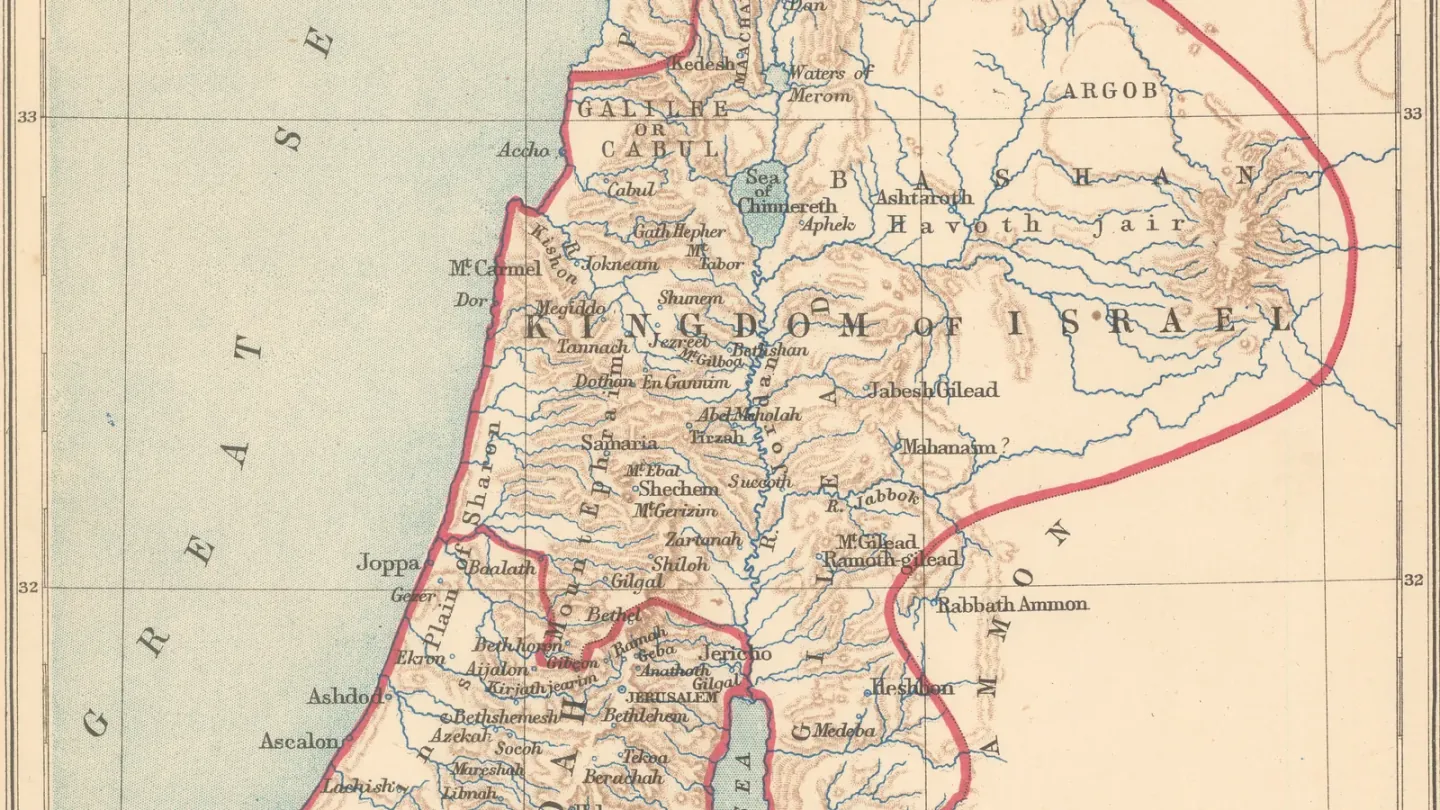
Around 1000 BCE David is presented in traditional narrative as the king who united the twelve tribes and made Jerusalem his capital; in 975 Solomon began the First Temple; it was completed in 966; in 958 the Queen of Sheba visited Solomon; in 931 the kingdom split into Israel and Judah after Solomon’s death; in 732 Assyria captured Samaria and the northern kingdom fell. Together these are not a complete “biblical history” but the story of small kingdoms using temple, kingship and text to build memory between the empires of Egypt, Assyria and Babylon.
The biblical text is a composite of memory, theology and political claim, not a modern archive. The scale of the “united monarchy” of David and Solomon does not fully match archaeological and textual evidence; the centralisation of the Temple was both religious reform and a means of royal taxation and sacrificial monopoly. After the northern kingdom fell, Judah wrote the “lost brothers” into its own history.
Chapter-level sources; key claims checked.
Chapter timeline
Chapters in reading orderAll anchors are approximate region-level placements; they are not precise sites. Chapters without coordinates are listed below by region only.
Chapter contents6 chapters
The story, chapter by chapter
Each chapter opens the underlying event- 01
David unites the twelve tribes of Israel and establishes Jerusalem as capital
After defeating the house of Saul, David united the twelve tribes of Israel, captured the Jebusite city of Jebus, renamed it Jerusalem and made it the capital. He brought the Ark of the Covenant to Jerusalem, making the city the religious and political center of Judaism. David reigned for about 40 years (c. 1010–970 BCE), establishing a united kingdom of Israel from the Euphrates to the Egyptian border through a seri…
After defeating the house of Saul, David united the twelve tribes of Israel, captured the Jebusite city of Jebus, renamed it Jerusalem and made it the capital.
After defeating the house of Saul, David united the twelve tribes of Israel, captured the Jebusite city of Jebus, renamed it Jerusalem and made it the capital. He brought the Ark of the Covenant to Jerusalem, making the city the religious and political center of Judaism. David reigned for about 40 years (c. 1010–970 BCE), establishing a united kingdom of Israel from the Euphrates to the Egyptian border through a series of military conquests, laying the foundation for the prosperity of the Solomonic era.
David made Jerusalem the centre of kingship and sacrifice. The claim of uniting twelve tribes comes from later texts; archaeology can confirm that Jerusalem gradually became a regional political node.
Sources: 5 event claims, 5 sourced; source cards src-b3w-hebrew-kingdoms-03, src-b3w-hebrew-kingdoms-04 (background only).
SourcesKingdom of Judah — Wikipedia backgroundKingdom of Israel (Samaria) — Wikipedia background
- 02
King Solomon begins construction of the First Temple
King Solomon began building the Temple on Mount Moriah in Jerusalem (traditionally where David offered sacrifice to Yahweh). The project used cedar wood and gold from Tyre and took seven years to complete. The Temple became the sole religious center of the Jewish people, housing the Ark of the Covenant and the Ten Commandments, and consolidating the identity of the twelve tribes of Israel.
King Solomon began building the Temple on Mount Moriah in Jerusalem (traditionally where David offered sacrifice to Yahweh). The project used cedar wood and gold from Tyre and took seven years to complete.
King Solomon began building the Temple on Mount Moriah in Jerusalem (traditionally where David offered sacrifice to Yahweh). The project used cedar wood and gold from Tyre and took seven years to complete. The Temple became the sole religious center of the Jewish people, housing the Ark of the Covenant and the Ten Commandments, and consolidating the identity of the twelve tribes of Israel.
Solomon’s Temple centralised sacrifice from local high places into the capital. The Temple was a religious centre and also a space of royal finance, justice and diplomacy; centralisation was never only a matter of faith.
Sources: 5 event claims, 5 sourced; source cards src-b3w-hebrew-kingdoms-07, src-b3w-hebrew-kingdoms-02 (background only).
SourcesSolomon's Temple — Wikipedia backgroundAncient Israel and Judah — Wikipedia background
- 03
Solomon's Temple completed, Ark brought in
After seven years, the First Temple was completed. King Solomon presided over a grand dedication ceremony, moving the Ark of the Covenant from the City of David to the Temple's inner sanctuary. The priests sacrificed 120,000 cattle and sheep, and the entire nation celebrated for fourteen days. The Temple became the spiritual symbol of Israel and the pilgrimage center for the three annual festivals.
After seven years, the First Temple was completed. King Solomon presided over a grand dedication ceremony, moving the Ark of the Covenant from the City of David to the Temple's inner sanctuary.
After seven years, the First Temple was completed. King Solomon presided over a grand dedication ceremony, moving the Ark of the Covenant from the City of David to the Temple's inner sanctuary. The priests sacrificed 120,000 cattle and sheep, and the entire nation celebrated for fourteen days. The Temple became the spiritual symbol of Israel and the pilgrimage center for the three annual festivals.
The Temple’s completion and the transfer of the ark completed a political theology in which God dwelt in the royal capital. Dynastic legitimacy could now be seen, worshipped and taxed.
Sources: 6 event claims, 6 sourced; source cards src-b3w-hebrew-kingdoms-07, src-b3w-hebrew-kingdoms-01 (background only).
SourcesSolomon's Temple — Wikipedia backgroundDavid — Wikipedia background
- 04
Queen of Sheba visits Solomon
According to the Bible, the Queen of Sheba (possibly from modern Yemen or Ethiopia), having heard of Solomon's wisdom, came to Jerusalem with a caravan of camels laden with spices, gold, and precious stones to test him. Solomon answered all her questions, and they exchanged gifts and established trade agreements.
According to the Bible, the Queen of Sheba (possibly from modern Yemen or Ethiopia), having heard of Solomon's wisdom, came to Jerusalem with a caravan of camels laden with spices, gold, and precious stones to test him.
According to the Bible, the Queen of Sheba (possibly from modern Yemen or Ethiopia), having heard of Solomon's wisdom, came to Jerusalem with a caravan of camels laden with spices, gold, and precious stones to test him. Solomon answered all her questions, and they exchanged gifts and established trade agreements.
The Queen of Sheba story writes trade, diplomacy and foreign wisdom into royal narrative. Whether she existed and the scale of her visit cannot be confirmed, but “distant rulers coming to court” is a common language of legitimacy.
Sources: 4 event claims, 4 sourced; source cards src-b3w-hebrew-kingdoms-05, src-b3w-hebrew-kingdoms-06 (background only).
SourcesSolomon — Wikipedia backgroundQueen of Sheba — Wikipedia background
- 05
King Solomon dies, the Kingdom of Israel splits
After Solomon's death, his son Rehoboam succeeded. The northern tribes, led by Jeroboam, demanded a reduction in forced labor. Rehoboam refused and sent an overseer to suppress them. The ten northern tribes then proclaimed Jeroboam as king, forming the Kingdom of Israel (capital Shechem), while the southern tribes of Judah and Benjamin remained with Rehoboam, forming the Kingdom of Judah (capital Jerusalem). The unit…
After Solomon's death, his son Rehoboam succeeded. The northern tribes, led by Jeroboam, demanded a reduction in forced labor.
After Solomon's death, his son Rehoboam succeeded. The northern tribes, led by Jeroboam, demanded a reduction in forced labor. Rehoboam refused and sent an overseer to suppress them. The ten northern tribes then proclaimed Jeroboam as king, forming the Kingdom of Israel (capital Shechem), while the southern tribes of Judah and Benjamin remained with Rehoboam, forming the Kingdom of Judah (capital Jerusalem). The united monarchy of Israel thus split.
After Solomon’s death the northern tribes rejected Jerusalem’s centralisation, and the kingdom split into Israel and Judah. The division was not simply religious apostasy but also taxation, labour service and local elite interests.
Sources: 7 event claims, 7 sourced; source cards src-b3w-hebrew-kingdoms-04, src-b3w-hebrew-kingdoms-05 (background only).
SourcesKingdom of Israel (Samaria) — Wikipedia backgroundSolomon — Wikipedia background
- 06
Assyria Captures Samaria; Kingdom of Israel Falls
The Assyrian army finally captured Samaria. The Assyrian king deported the inhabitants of Israel to various parts of the Assyrian Empire, creating the 'Lost Ten Tribes'. Israelite territory was turned into an Assyrian province, and foreign immigrants were settled there, forming the later Samaritans. The kingdom of Israel was completely destroyed.
The Assyrian army finally captured Samaria. The Assyrian king deported the inhabitants of Israel to various parts of the Assyrian Empire, creating the 'Lost Ten Tribes'.
The Assyrian army finally captured Samaria. The Assyrian king deported the inhabitants of Israel to various parts of the Assyrian Empire, creating the 'Lost Ten Tribes'. Israelite territory was turned into an Assyrian province, and foreign immigrants were settled there, forming the later Samaritans. The kingdom of Israel was completely destroyed.
Assyria captured Samaria and the northern kingdom fell. Much of the population was deported and remaining inhabitants mixed with incoming groups; Judah interpreted the disaster as the consequence of apostasy and wrote it into later texts.
Sources: 6 event claims, 6 sourced; source cards src-b3w-hebrew-kingdoms-04, src-b3w-hebrew-kingdoms-03 (background only).
SourcesKingdom of Israel (Samaria) — Wikipedia backgroundKingdom of Judah — Wikipedia background
Cast
People whose choices move the story. Roles describe this story only.
- DavidKing of Israel and founder of Jerusalem’s capital status
In traditional narrative united the tribes and made Jerusalem his capital; the scale of his kingdom remains debated against archaeology.
- SolomonKing of Israel and builder of the First Temple
Traditionally built the First Temple and was known for wisdom and diplomacy; the textual portrait reflects later theological shaping.
- JeroboamFirst king of northern Israel
Led the northern tribes’ split after Solomon’s death and established an independent northern cult and kingship.
Evidence and limits
Chapter-level sources; key claims checked.
Source count is the number of distinct source records attached to the event nodes shown here. It does not certify the narrative as a whole.