
The Greek Polis: The Limits of Democracy
Story800–404 BCE: how citizen politics grew in the polis, and how alliance and war turned against it
In the eighth century BCE the Greek world consisted of hundreds of independent poleis centred on a town. In 776 BCE the poleis held a festival at Olympia and agreed a sacred truce; in 594 BCE Solon cancelled debts and debt-slavery; in 508 BCE Cleisthenes redrew tribes and constituencies, and Athenian citizen politics took shape. In 490 BCE Athens defeated a larger Persian force at Marathon; in 480 BCE the stand at Thermopylae and the naval battle at Salamis turned the war; in 479 BCE Plataea ended the land threat. After victory, Athens turned the Delian League into its own empire, and in 447 BCE the Parthenon began to rise on the Acropolis. In 431 BCE the Peloponnesian War broke out; in 404 BCE Athens surrendered. This story uses twelve nodes to trace what the polis created, and also the exclusions beyond the citizen body, the hierarchy inside an alliance and the self-destruction of war.
The Greek polis made politics a public affair among citizens, but "citizen" never meant the whole population. Athenian democracy, sea power and the buildings on the Acropolis were bound up with the tribute of the Delian League, with excluded slaves and foreigners, and with coercion against allied states. The Persian threat briefly united the poleis, but the Delian League turned that union into an Athenian empire; the Peloponnesian War then dragged both the empire and the wider Greek world down. The "birth of democracy" was not a straight line: institutional invention and imperial cost happened together.
Chapter-level sources; key claims checked.
Chapter timeline
Chapters in reading orderAll anchors are approximate region-level placements; they are not precise sites. Chapters without coordinates are listed below by region only.
Chapter contents12 chapters
- The polis: a political community centred on a town
- Olympia: the games and the sacred truce
- Solon: debt relief and property classes
- Cleisthenes: redrawing tribes and constituencies
- Marathon: the first victory against the odds
- Thermopylae: three hundred and several hundred allies
- Salamis: a reversal in a narrow strait
- Plataea: the end of the land invasion
- The Delian League: from Persian war to Athenian empire
- The Parthenon: putting the polis in stone
- The Peloponnesian War: cracks in the alliance
- After Aegospotami: Athens surrenders
The story, chapter by chapter
Each chapter opens the underlying event- 01
The polis: a political community centred on a town
In the 8th century BC, the Greek world experienced the formation of the polis (city-state) system. Due to a mountainous geography that hindered land transport, along with numerous natural harbors and islands, Greece gradually developed independent political entities centered on a city and incorporating surrounding rural areas—the poleis. Each polis had its own laws, government, and army, with the collective rule of c…
In the eighth century BCE, a fragmented, sea-facing Greece produced hundreds of independent poleis with their own laws, government and army; Athens, Sparta, Corinth and Thebes rose among them.
In the eighth century BCE the Greek world went through the formation of the polis system. Mountains made land transport difficult, while natural harbours and islands divided the coast into many small units; Greeks organised themselves into independent political entities centred on a town and including the surrounding countryside. Each polis had its own laws, government and army, and the collective rule of citizens was treated as the core political idea.
The polis was not a modern state. It usually centred on a walled town, with farmland, pasture and villages around it; the units were small, but they placed politics, cult and war inside one community. The source record speaks of several hundred poleis, which means that “Greece” was never one unified state but many competing political units.
Athens, Sparta, Corinth, Thebes and other poleis rose one after another and became the basic units of classical Greek civilisation. They shared language, myth and festivals, but fought over borders, allies and hegemony. The polis gave citizens room to take part in public affairs; it also left inside the system the question of who counted as a citizen and who was excluded.
Sources: 6 event claims, 6 sourced; source cards src-b3w-greek-polis-01, src-b3w-greek-polis-03 (background only).
SourcesBattle of Marathon — Wikipedia backgroundPeloponnesian War — Wikipedia background
- 02
Olympia: the games and the sacred truce
The Greek poleis held the first Olympic Games at Olympia in the Peloponnese. The only event initially was a short sprint of about 192 meters (stadion). The winner was Coroebus, a cook from Elis. During the Games, the poleis agreed to a 'sacred truce', stopping wars to allow athletes and spectators to travel safely. The Olympic Games became the most important pan-Hellenic festival, lasting for over a thousand years an…
In 776 BCE the poleis held the first games at Olympia with a single footrace; a truce during the festival made it a shared pan-Hellenic occasion.
In 776 BCE the Greek poleis held the first Olympic Games at Olympia in the Peloponnese. The only event at first was a short sprint of about 192 metres, the stadion. The winner was Coroebus, a cook from Elis.
During the Games the poleis agreed a “sacred truce”: wars stopped so that athletes and spectators could travel safely. For a Greek world made of hundreds of poleis, this was more than a sporting contest. It was a shared time and a shared identity, a place where states could meet without first meeting on a battlefield.
The Olympic festival became the most important pan-Hellenic gathering and lasted more than a thousand years; it also inspired the modern Olympic movement. It proved that the poleis could form a community, but that community was religious and festive, not political. When the Games ended, the poleis returned to their borders and rivalries.
Sources: 7 event claims, 7 sourced; source cards src-b3w-greek-polis-01, src-b3w-greek-polis-03 (background only).
SourcesBattle of Marathon — Wikipedia backgroundPeloponnesian War — Wikipedia background
- 03
Solon: debt relief and property classes
Facing severe wealth disparity and class conflict in Athens, the archon Solon (c. 638–558 BCE) enacted major reforms: the 'Seisachtheia' cancelling all debts and debt-slavery; dividing citizens into four property classes with political rights corresponding to wealth; and creating the Council of Four Hundred and the people's jury courts. Solon's reforms neither fully satisfied the commoners nor preserved aristocratic…
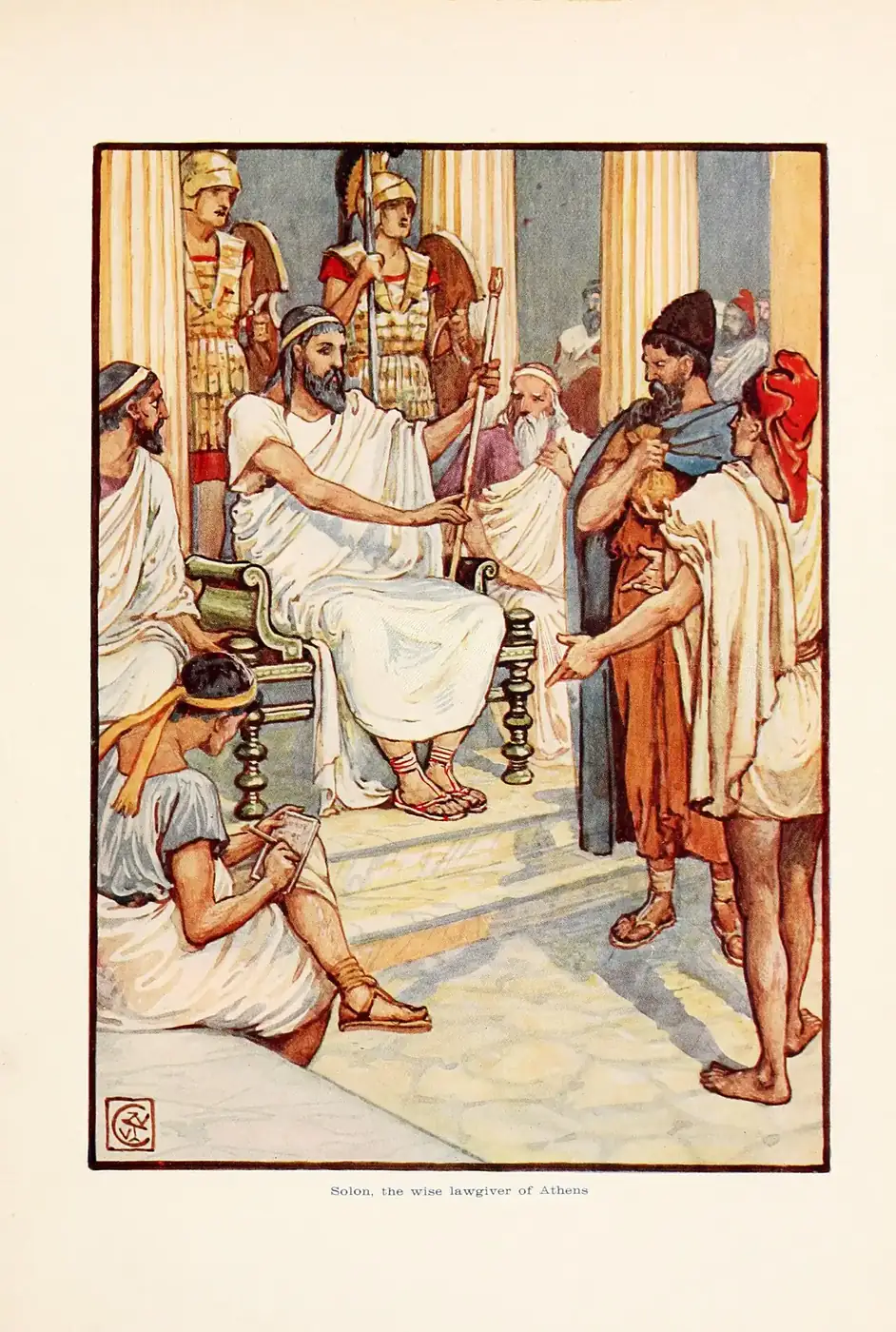
In 594 BCE Solon cancelled debts and debt-slavery, divided citizens into four property classes, and created the Council of Four Hundred and jury courts; the reforms satisfied neither side but laid a foundation for democracy.
In 594 BCE Athens faced severe wealth inequality and class conflict. The archon Solon introduced major reforms: the Seisachtheia cancelled all debts and debt-slavery; citizens were divided into four property classes with political rights corresponding to wealth; and the Council of Four Hundred and the people's jury courts were created.
This was not a reform that simply spoke for the poor. Solon neither fully satisfied the commoners nor preserved aristocratic privilege; he cancelled debts but did not turn the polis into a community of equals. The reforms wrote economic standing into political rights, matching different property classes to different levels of political participation while keeping the classes themselves.
The event record calls Solon's reforms the foundation of Athens' slave-owning democracy. Two words matter here: democracy meant distributing power inside the citizen collective; slave-owning meant that beyond that collective there were people excluded. Political participation widened from Solon onward, but the question of who was entitled to be a citizen did not disappear.
Sources: 4 event claims, 4 sourced; source cards src-b3w-greek-polis-04, src-b3w-greek-polis-09 (background only).
Solon.Walter Crane, c. 1910 · Wikimedia Commons · Public Domain · PD SourcesSolon — Wikipedia backgroundAthenian democracy — Wikipedia background
- 04
Cleisthenes: redrawing tribes and constituencies
The Athenian statesman Cleisthenes redrew tribes and constituencies, laying the foundations of Athenian democracy.
In 508 BCE Cleisthenes redrew tribes and constituencies, cutting political organisation away from older kinship units and laying the foundation of Athenian democracy.
In 508 BCE the Athenian statesman Cleisthenes redrew tribes and constituencies, laying the foundation of Athenian democracy. This was not a simple administrative adjustment. It rearranged how citizens were counted, convened and represented in politics.
The old tribal units carried the power of aristocratic families into public affairs. Cleisthenes cut the tribes and constituencies along new lines, so that political units no longer followed only the old bonds of kinship. Once the organisation changed, who could speak in the council, who could be chosen for office and which local interests were visible all changed with it.
Athenian democracy therefore acquired a clearer organisational base, but it remained a democracy inside the citizen body. Slaves, foreigners and women stood outside that body; the polis gave public power to citizens and left a large part of the population beyond the citizen threshold. The limit of democracy was built in from the start.
Sources: 4 event claims, 4 sourced; source cards src-b3w-greek-polis-09, src-b3w-greek-polis-04 (background only).
SourcesAthenian democracy — Wikipedia backgroundSolon — Wikipedia background
- 05
Marathon: the first victory against the odds
Persian Emperor Darius I dispatched Datis and Artaphernes with an army of about 25,000 that landed on the plain of Marathon. The Athenian general Miltiades led about 10,000 hoplites and 1,000 Plataean allies. Using the terrain and a clever double-envelopment tactic, the Athenians defeated the Persians, killing about 6,400 while losing only 192. This victory greatly boosted Greek confidence against Persia.
In 490 BCE about 11,000 Athenians and Plataeans used a double envelopment to defeat roughly 25,000 Persians; Athens lost 192 men.
In 490 BCE the Persian king Darius I sent Datis and Artaphernes with an army of about 25,000, which landed on the plain of Marathon. The Athenian general Miltiades led about 10,000 hoplites and 1,000 Plataean allies against them.
Using the terrain and a double-envelopment tactic, the Athenians defeated a larger force, killing about 6,400 while losing only 192 of their own. For an army of citizen soldiers, the exchange was extraordinary, and it greatly raised Greek confidence in resisting Persia.
Marathon was not an isolated encounter. It showed that hoplites, in the right terrain and with the right tactics, could beat a larger Persian army. But it did not end the Persian threat. Ten years later Xerxes I returned with a much larger force, and the Greek poleis had to face both land and sea.
Sources: 6 event claims, 6 sourced; source cards src-b3w-greek-polis-01, src-b3w-greek-polis-03 (background only).
SourcesBattle of Marathon — Wikipedia backgroundPeloponnesian War — Wikipedia background
- 06
Thermopylae: three hundred and several hundred allies
Persian Emperor Xerxes I invaded Greece with an army of about 300,000. Spartan King Leonidas led about 7,000 Greek allies (including 300 Spartan hoplites) to block the Persian advance at the narrow pass of Thermopylae. After three days of fierce fighting, a local traitor named Ephialtes showed the Persians a mountain path to outflank the Greeks. Leonidas dismissed the allied troops and remained with 300 Spartans and…
In 480 BCE Leonidas held the pass at Thermopylae with about 7,000 Greeks; a traitor showed the Persians a mountain path, and 300 Spartans with several hundred allies died covering the retreat.
In 480 BCE the Persian king Xerxes I invaded Greece with an army of about 300,000. The Spartan king Leonidas led about 7,000 Greek allies, including 300 Spartan hoplites, to block the Persian advance at the narrow pass of Thermopylae.
After three days of fighting, a local traitor, Ephialtes, showed the Persians a mountain path around the Greek position. Leonidas dismissed the allied troops and stayed with 300 Spartans and several hundred allies to cover the retreat; all of them died. Thermopylae became a symbol of heroic resistance, a defeat that was remembered.
The Chinese and English event records disagree about the identity of this rear guard: one says 700 Thebans, the other 700 Thespians. This chapter does not adjudicate. It keeps only “several hundred allies”. Whether they were Thebans or Thespians, the meaning of Thermopylae lies less in the number than in the time a defeat bought for the Greek coalition.
Sources: 7 event claims, 7 sourced; source cards src-b3w-greek-polis-01, src-b3w-greek-polis-04 (background only).
SourcesBattle of Marathon — Wikipedia backgroundSolon — Wikipedia background
- 07
Salamis: a reversal in a narrow strait
Through Themistocles' stratagem, the Greek allied fleet (about 380 ships) lured the Persian fleet (about 1,000 ships) into the narrow straits of Salamis. The Greeks took advantage of the confined waters to neutralize the Persian numerical advantage, using their more maneuverable triremes to win a decisive victory. The Persians lost about 200 ships, the Greeks only 40. Xerxes I was forced to withdraw to Asia, and the…
In 480 BCE Themistocles lured the Persian fleet into the narrow strait of Salamis; about 380 Greek ships used the confined water to defeat roughly 1,000 Persian ships.
In 480 BCE the Athenian statesman Themistocles lured the large Persian fleet into the narrow strait of Salamis. The Greek allied fleet had about 380 ships; the Persians had about 1,000.
The Greeks used the confined water to prevent the Persian fleet from deploying, and their more manoeuvrable triremes won a decisive victory. The Persians lost about 200 ships, the Greeks only 40. Xerxes I was forced to withdraw to Asia, and the war turned in Greece's favour.
Salamis showed how sea power and geography could turn numbers into a burden. The Persian fleet was vast on open water but lost its formation in a narrow channel; the Athenian fleet made the channel its own battlefield. The naval victory did not end the war at once, but it removed the Persian ability to outflank Greece by sea, and the next decisive contest moved to land.
Sources: 6 event claims, 6 sourced; source cards src-b3w-greek-polis-01, src-b3w-greek-polis-03 (background only).
SourcesBattle of Marathon — Wikipedia backgroundPeloponnesian War — Wikipedia background
- 08
Plataea: the end of the land invasion
The Greek allied army of about 40,000 (mainly Spartan) under Spartan regent Pausanias fought a decisive land battle against the Persian army of about 70,000 under Mardonius at Plataea. The Greek hoplite phalanx broke the Persian infantry; Mardonius was killed. This victory completely crushed the Persian land invasion, marking a decisive Greek triumph in the Greco-Persian Wars.
In 479 BCE Pausanias led about 40,000 Greeks against roughly 70,000 Persians at Plataea; Mardonius was killed and the land invasion collapsed.
In 479 BCE a Greek allied army of about 40,000, mainly Spartan, under the Spartan regent Pausanias met a Persian army of about 70,000 under Mardonius at Plataea.
The Greek hoplite phalanx broke the Persian infantry, and Mardonius was killed. The event record says the victory completely crushed the Persian land invasion and marked the decisive Greek triumph in the Greco-Persian Wars.
Plataea ended the immediate invasion, but not the competition among the Greek poleis. Sparta had won the land battle; Athens was rising at sea. Who would lead the Aegean alliance against Persia now became the new question. The victory shut Persia out and brought the struggle for leadership inside Greece to the front.
Sources: 5 event claims, 5 sourced; source cards src-b3w-greek-polis-01, src-b3w-greek-polis-03 (background only).
SourcesBattle of Marathon — Wikipedia backgroundPeloponnesian War — Wikipedia background
- 09
The Delian League: from Persian war to Athenian empire
To continue the fight against Persia and liberate the Greek cities of Asia Minor, Athens and the Aegean island and Ionian coastal cities formed an alliance on the island of Delos, known as the Delian League. Each member was required to contribute either ships or money (tribute). The treasury was on Delos. With its powerful navy, Athens gradually became the leader of the league, eventually turning it into the Athenian…
In 478 BCE Athens and Aegean states allied at Delos, members contributing ships or tribute; Athenian sea power made it the leader, and the league gradually became an empire.
In 478 BCE, to continue the war against Persia and liberate the Greek cities of Asia Minor, Athens and the Aegean islands and coastal cities formed an alliance on Delos, the Delian League.
Members were required to contribute ships or tribute, and the treasury was kept on Delos. With its powerful navy, Athens gradually became the leader of the league and finally turned it into an Athenian empire. An organisation founded for common defence began to move allied resources at Athens' will.
The transformation of the Delian League is central to understanding Athenian democracy. Abroad, it was a united front against Persia; at home, it was the instrument by which Athens reduced allies to dependants. Protector and hegemon could be the same fleet, and tribute and votes could coexist in the same city.
Sources: 6 event claims, 6 sourced; source cards src-b3w-greek-polis-03, src-b3w-greek-polis-02 (background only).
SourcesPeloponnesian War — Wikipedia backgroundParthenon — Wikipedia background
- 10
The Parthenon: putting the polis in stone
Under Pericles, Athens built the Parthenon on the Acropolis as a temple to its patron goddess Athena. Construction began in 447 BC, the main structure was completed in 438 BC, and decoration continued until 432 BC; Ictinus and Callicrates designed it, and Phidias oversaw the project and its sculptural decoration.
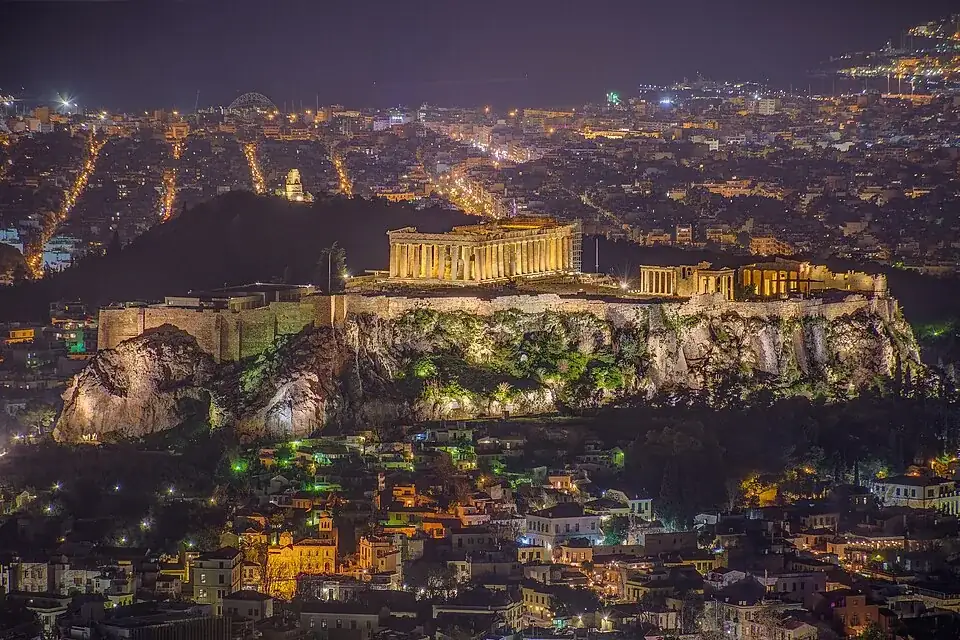
In 447 BCE work began on the Parthenon on the Acropolis; Ictinus and Callicrates designed it, Phidias oversaw the project, the main structure was complete in 438 and decoration continued to 432; the temple also served as the Delian League treasury.
The Parthenon stands on the Acropolis, dedicated to Athena, the city's patron goddess; in the age of Pericles it also served as the treasury of the Delian League. Work began in 447 BCE, the main structure was complete in 438, and decoration continued until 432.
Ictinus and Callicrates designed the building, while Phidias oversaw the project and its sculptural decoration. Doric columns, pediments, frieze and statues turned myth, cult and civic identity into one visual order.
Set back into the finances of the Delian League, the Parthenon was not only a temple: allied tribute flowed into Athens and was converted into a monument on the Acropolis. It became the best-known building of classical Athens and a lasting reference for Western architecture; but that “classical” image also carries the shadow of imperial power.
Sources: event record with 3 claims, 3 sourced; source card src-b3w-greek-polis-02 (Wikipedia lead and article, background only); L2 review, machine extract plus manual comparison.
The Parthenon.Gosspil89, 2018-02-22 · Wikimedia Commons · CC BY-SA 4.0 · CC-BY-SA-4.0 - 11
The Peloponnesian War: cracks in the alliance
Thebes attacked Plataea, an Athenian ally, by night, and Sparta led the Peloponnesian army into Attica. The Peloponnesian War had officially begun. The underlying cause was the growth of the Athenian Empire, which aroused fear in Sparta, Corinth and other states. The war lasted 27 years (431-404 BC), engulfed the entire Greek world, and ended in Athenian defeat.
In 431 BCE Thebes attacked Plataea by night and Sparta invaded Attica; fear of Athens' expanding empire drove Sparta and Corinth into a war that lasted twenty-seven years.
In 431 BCE Thebes attacked Plataea, an Athenian ally, by night, and Sparta led the Peloponnesian army into Attica. The Peloponnesian War had begun.
The event record gives the deeper cause as the growth of the Athenian Empire, which aroused fear in Sparta, Corinth and other states. The war lasted twenty-seven years (431–404 BCE), engulfed the entire Greek world and ended in Athenian defeat. It was not an abstract war of democracy against oligarchy; it was a settling of fears, interests and honour accumulated inside the alliance system.
Athens had its navy, tribute and empire; Sparta had its army and the Peloponnesian League. Each dragged its allies into the field and was constrained by their local interests. The longer the war went on, the less trust remained among the poleis, and the heavier the pressure on citizen soldiers and finances. The buildings and fleet of the Periclean age did not produce a stable Greek order.
Sources: 6 event claims, 6 sourced; source cards src-b3w-greek-polis-03, src-b3w-greek-polis-01 (background only).
SourcesPeloponnesian War — Wikipedia backgroundBattle of Marathon — Wikipedia background
- 12
After Aegospotami: Athens surrenders
After the Battle of Aegospotami, Athens, starved of supplies, surrendered to Sparta. Sparta imposed a pro-Spartan oligarchic government, the 'Thirty Tyrants', tore down the Long Walls connecting Athens to Piraeus, dissolved the Delian League, and reduced the Athenian navy to 12 ships. The Peloponnesian War ended, with Sparta the hegemon of Greece. The war had exhausted the entire Greek world, paving the way for the r…
In 404 BCE Athens surrendered after Aegospotami; Sparta installed the Thirty Tyrants, tore down the Long Walls, dissolved the Delian League and cut the Athenian navy to twelve ships.
In 404 BCE, after the Battle of Aegospotami, Athens ran out of supplies and surrendered to Sparta. Sparta installed a pro-Spartan oligarchy, the Thirty Tyrants, tore down the Long Walls linking Athens to Piraeus, dissolved the Delian League and reduced the Athenian navy to twelve ships.
The Peloponnesian War ended, and Sparta became the hegemon of Greece. But the victor did not restore a balanced world of poleis: Athens' empire was broken, Sparta's hegemony took its place, and the Greek world was exhausted. The event record says this paved the way for the rise of Macedon.
“The limits of democracy” close here. Athenian democracy was not destroyed by a Persian king; it was displaced by an oligarchy after a war among Greek poleis. Nor did citizen politics automatically extend to those outside the citizen body. The story stops at 404 BCE: the poleis were still on the map, but the Athens that had held citizens, fleet, tribute and temple together was no longer the same city.
Sources: 6 event claims, 6 sourced; source cards src-b3w-greek-polis-03, src-b3w-greek-polis-01 (background only).
SourcesPeloponnesian War — Wikipedia backgroundBattle of Marathon — Wikipedia background
Cast
People whose choices move the story. Roles describe this story only.
- SolonAthenian archon · reformer
In 594 BCE cancels debts and debt-slavery, divides citizens by property and creates the Council of Four Hundred and jury courts.
- CleisthenesAthenian statesman · tribal reformer
In 508 BCE redraws tribes and constituencies, laying the foundation of Athenian democracy.
- MiltiadesAthenian general · Marathon
In 490 BCE leads the Athenian and Plataean force and defeats the Persians by double envelopment.
- LeonidasSpartan king · Thermopylae
In 480 BCE holds Thermopylae with about 7,000 allies and dies with 300 Spartans and several hundred allies covering the retreat.
- ThemistoclesAthenian statesman · Salamis
In 480 BCE plans the lure that brings the Persian fleet into the strait of Salamis.
- PausaniasSpartan regent · Plataea
In 479 BCE leads about 40,000 Greeks at Plataea, breaks the Persian army and kills Mardonius.
- PericlesAthenian statesman · Parthenon
In 447 BCE initiates construction of the Parthenon on the Acropolis.
- PhidiasSculptor · Parthenon decoration
Supervises the sculptural decoration of the Parthenon, work continuing to 432 BCE.
- Xerxes IPersian king · Thermopylae and Salamis
In 480 BCE invades Greece with about 300,000 troops and withdraws to Asia after Salamis.
Evidence and limits
Chapter-level sources; key claims checked.
Source count is the number of distinct source records attached to the event nodes shown here. It does not certify the narrative as a whole.