
Guandu: The Handover of Northern Power
StoryFrom receiving Emperor Xian to White Wolf Mountain: how Cao Cao turns the Hebei balance into a monopoly
In 196 CE Cao Cao brought Emperor Xian to Xuchang and placed the court behind his own lines. Three years later Yuan Shao swallowed Gongsun Zan and held the four provinces north of the Yellow River; on paper he was still the stronger man. At Guandu in 200, short of troops and grain, Cao Cao cut the Wuchao supply depot; Yuan's sons then fell to fighting and the north changed hands. This story follows eight event nodes to show how logistics and political standing gradually reversed the balance in the north; read the chapters in chronological order.
The court title and the tuntian grain base give Cao Cao his footing; one raid on Wuchao cuts Yuan Shao's supply, and Yuan's internal strife lets Cao Cao break the northern balance.
Chapter-level sources; key claims checked.
Chapter timeline
Chapters in reading orderAll anchors are approximate region-level placements; they are not precise sites. Chapters without coordinates are listed below by region only.
Chapter contents8 chapters
- Receiving Emperor Xian and moving the capital to Xuchang
- Implementing the tuntian colonies around Xuchang
- Defeating Gongsun Zan and unifying Hebei
- The Battle of Guandu
- Pursuing victory and pacifying Hebei after Guandu
- Yuan Shao's death and the succession struggle
- The capture of Yecheng
- Crushing the Wuhuan at White Wolf Mountain
The story, chapter by chapter
Each chapter opens the underlying event- 01
Receiving Emperor Xian and moving the capital to Xuchang
Cao Cao, acting on Xun Yu's advice, led his army into Luoyang, welcomed Emperor Xian, and moved the capital to Xuchang. Cao Cao appointed himself Grand General (later ceded to Yuan Shao) and was enfeoffed as Marquis of Wuping, controlling the court. 'Using the emperor to command the lords' (Xie tianzi yi ling zhuhou) gave him an absolute political advantage.
Cao Cao gains the court's legitimacy, though he remains weaker than Hebei; the story opens with his political capital.
In 196 CE, acting on Xun Yu's advice, Cao Cao led his army into Luoyang, brought Emperor Xian to Xuchang, and made Xuchang the new capital. The court settled behind Cao Cao's lines, and Cao Cao took nominal control of the central administration.
He first held the title of Grand General, later ceded to Yuan Shao, and was enfeoffed as Marquis of Wuping, while keeping real power over the court. With the emperor as his banner, Cao Cao gained the political initiative: he could issue orders in the court's name and recruit talent under a central institution's label.
In this chapter Cao Cao remains weaker than Yuan Shao in the north; his advantage lies in legitimacy and political resources. In the years that follow, he must turn that title advantage into grain, manpower, and territory.
Sources: 5 event claims, 5 sourced; source cards src-b3w-guandu-01, src-b3w-guandu-03 (background only).
SourcesCao Cao — Wikipedia backgroundEmperor Xian of Han — Wikipedia background
- 02
Implementing the tuntian colonies around Xuchang
Following the advice of Zao Zhi and Han Hao, Cao Cao recruited refugees near Xuchang to implement 'tuntian' (state-managed military-agricultural colonies). The state provided land, oxen, and seeds, and the harvest was split between the state and the settlers. The tuntian system solved Cao Cao's grain supply problem, attracted many refugees, and became the economic foundation of the Cao Wei regime.
Refugees and grain enter the military administration; the logistical base for the Guandu standoff takes shape.
After making Xuchang his capital, Cao Cao followed Zao Zhi and Han Hao's advice and organized tuntian colonies in the surrounding area. The state supplied land, oxen, and seeds to recruited refugees, and the harvest was split between the state and the settlers.
The scheme put displaced people back into farming and gave the army a stable grain supply. Part of the harvest from the colonies went to the military, part remained locally, and land that had been wasted in the wars was cultivated again.
For Cao Cao the colonies were not a one-off fundraising measure but the economic foundation of the later Cao Wei regime. In the Guandu standoff, Cao's army could hold its line for a long time precisely because of this supply system; the chapter lays down the logistical base for the campaigns ahead.
Sources: 5 event claims, 5 sourced; source cards src-b3w-guandu-01, src-b3w-guandu-04 (background only).
SourcesCao Cao — Wikipedia backgroundYuan Shao — Wikipedia background
- 03
Defeating Gongsun Zan and unifying Hebei
After a three-year siege of Yi Fortress (present-day Xiongxian, Hebei), Yuan Shao's forces broke through Gongsun Zan's fortress. Gongsun Zan committed suicide, and his troops were absorbed by Yuan Shao. Yuan Shao now held You, Ji, Qing, and Bing provinces, commanding an army of 100,000, becoming the most powerful warlord in the north.
Yuan Shao ends the civil war in Hebei and becomes Cao Cao's strongest rival to the south.
While Cao Cao built up Xuchang, Yuan Shao in the north ended his long war against Gongsun Zan. After a three-year siege of Yi Fortress (present-day Xiongxian, Hebei), Yuan Shao's forces broke through Gongsun Zan's defenses. Gongsun Zan killed himself, and his troops were absorbed by Yuan Shao.
After the merger, Yuan Shao held the provinces of You, Ji, Qing, and Bing; according to the event record he commanded an army of 100,000 and was the most powerful warlord in the north. His territory and population both exceeded Cao Cao's, and he remained ahead in the balance of strength.
This chapter sets the pre-Guandu pattern: Yuan Shao had no internal enemy left in Hebei and could turn his full force south, while Cao Cao, despite the court's legitimacy, had to face such an opponent with a smaller body. A decisive clash between the two was only a matter of time.
Sources: 5 event claims, 5 sourced; source cards src-b3w-guandu-01, src-b3w-guandu-02 (background only).
SourcesCao Cao — Wikipedia backgroundBattle of Guandu — Wikipedia background
- 04
The Battle of Guandu
Cao Cao and Yuan Shao clashed at Guandu (present-day Zhongmu, Henan) in a decisive battle. Yuan Shao had 100,000 troops and ample provisions; Cao Cao had only 20,000 and was short of supplies. Cao Cao, following the advice of Xun Yu and Guo Jia, held his position and waited. Then Yuan Shao's adviser Xu You defected to Cao Cao and suggested a surprise attack on Yuan Shao's grain depot at Wuchao. Cao Cao personally led…
Wuchao burns and the supply line breaks; the advantage in manpower reverses overnight.
In 200, Cao Cao and Yuan Shao fought their decisive battle at Guandu (present-day Zhongmu, Henan). According to the event record, Yuan Shao had 100,000 troops and ample provisions, while Cao Cao had only 20,000 and was short of supplies. The gap in manpower was clear; on the advice of Xun Yu and Guo Jia, Cao Cao first held his position and waited for the situation to change.
The turning point came from Yuan's own camp. Yuan Shao's adviser Xu You defected to Cao Cao and proposed a raid on the Wuchao grain depot. Cao Cao personally led 5,000 elite cavalry in a night attack and burned Yuan's supplies. With the depot lost, Yuan's army fell into chaos; Cao Cao pressed his attack and, according to the record, destroyed over 70,000 of Yuan's main force. Yuan Shao fled back north across the river with only 800 horsemen.
Guandu was the decisive battle for Cao Cao's unification of the north and a classic case of a smaller force defeating a larger one. The key was not head-on combat but the grain line: with his supplies gone, Yuan's large army disintegrated at once.
Sources: 10 event claims, 10 sourced; source cards src-b3w-guandu-01, src-b3w-guandu-02 (background only).
SourcesCao Cao — Wikipedia backgroundBattle of Guandu — Wikipedia background
- 05
Pursuing victory and pacifying Hebei after Guandu
In 200 AD, Cao Cao defeated the main forces of Yuan Shao at Guandu. By 201, Cao Cao crossed the Yellow River and attacked Cangting (modern Yanggu, Shandong), defeating Yuan Shao's forces again. Yuan Shao retreated to Yecheng and soon fell gravely ill. Cao Cao took control of most of the middle and lower Yellow River region, laying the foundation for unifying northern China.
The front crosses the river; Yuan Shao retreats to Yecheng, and Hebei enters the absorption phase.
After the Guandu defeat, Yuan Shao withdrew north; his main force was damaged but his territory remained. In 201, Cao Cao pursued across the Yellow River, attacked Cangting (present-day Yanggu, Shandong) where Yuan Shao held position, and defeated Yuan's forces again.
Yuan Shao retreated to Yecheng and soon fell gravely ill. Cao Cao took control of most of the middle and lower Yellow River region, pushing the front from south of the Yellow River to its north bank, and laid the groundwork for unifying northern China.
This chapter bridges Guandu and the absorption of Hebei: the battlefield balance had reversed, but the Yuan four provinces were not yet his, and the Yuan following still had substantial room to resist. The initiative now passed to Cao Cao, while the succession problem within the Yuan house would become the breakthrough point.
Sources: 6 event claims, 6 sourced; source cards src-b3w-guandu-01, src-b3w-guandu-02 (background only).
SourcesCao Cao — Wikipedia backgroundBattle of Guandu — Wikipedia background
- 06
Yuan Shao's death and the succession struggle
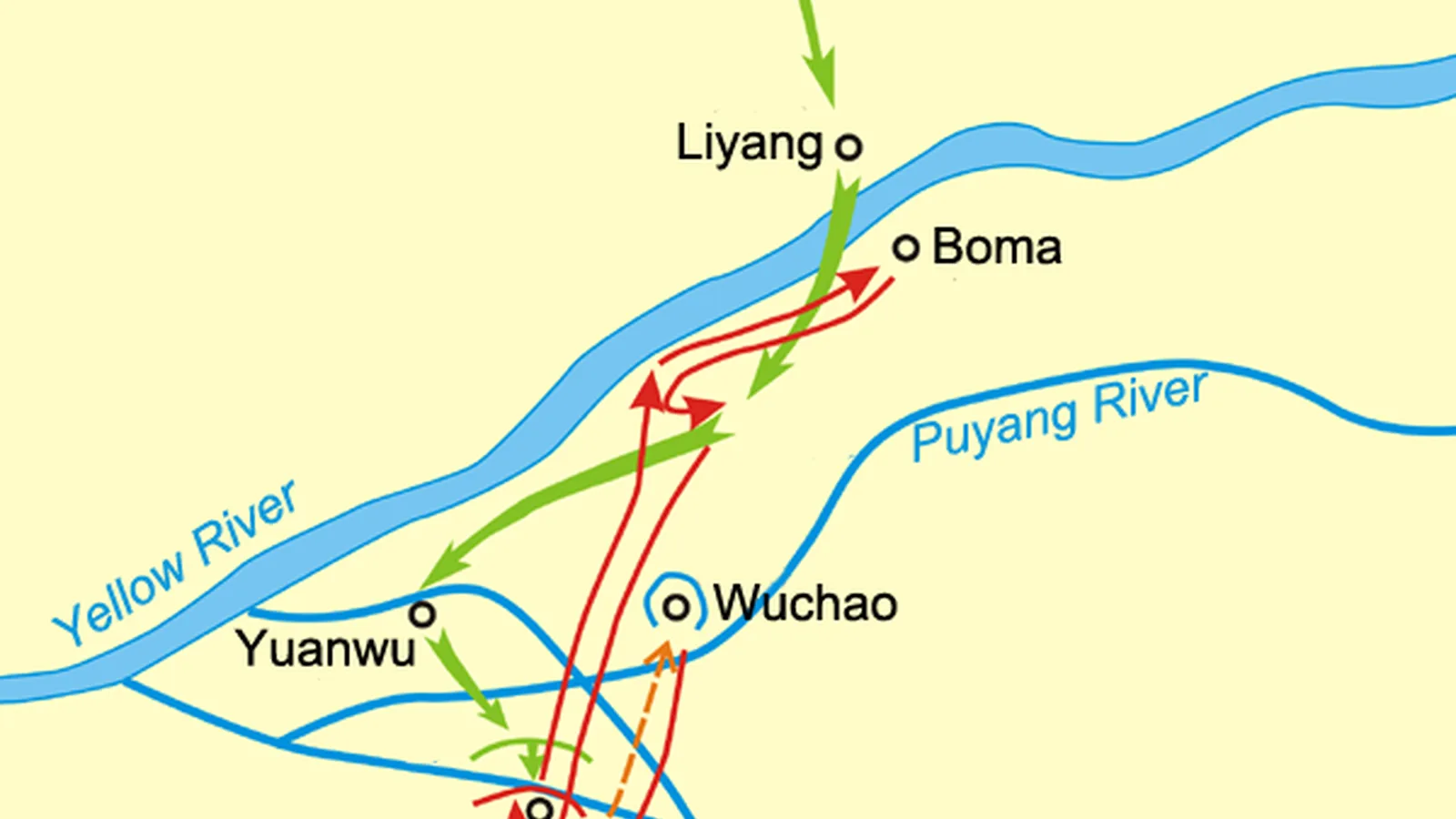
Yuan Shao, the overlord of Jizhou, fell ill and died in May 202 in Yecheng due to his crushing defeat at Guandu. He had favored his youngest son Yuan Shang and named him as heir, but the eldest son Yuan Tan refused to accept. Yuan Tan, allied with Yuan Xi and Gao Gan, opposed Yuan Shang. Yuan Tan stationed his troops at Liyang, and Yuan Shang sent reinforcements. The fraternal strife gave Cao Cao an opportunity.
The succession dispute splits the Yuan bloc, leaving Cao Cao a gap to exploit piece by piece.
In 202, Yuan Shao died at Yecheng. The event record has him falling ill after the Guandu defeat and dying in May of that year. He had favored his youngest son Yuan Shang and named him heir; the eldest son Yuan Tan refused to accept this and, together with Yuan Xi and Gao Gan, opposed Yuan Shang.
Yuan Tan stationed his troops at Liyang, while Yuan Shang sent reinforcements, and the brothers slipped into a civil war over succession. The Hebei bloc split into two lines, and a unified command against the outside no longer existed.
This succession crisis was the opportunity Cao Cao had waited for. The Yuan father and son had built Hebei for years, and an external attack was hard to break quickly; the internal split, however, let Cao Cao defeat them one by one. The campaigns of the following years basically unfolded around this Yuan Tan–Yuan Shang feud.
Sources: 7 event claims, 7 sourced; source cards src-b3w-guandu-01, src-b3w-guandu-02 (background only).
SourcesCao Cao — Wikipedia backgroundBattle of Guandu — Wikipedia background
- 07
The capture of Yecheng
Taking advantage of Yuan Shang's campaign against Yuan Tan, Cao Cao personally led his army to besiege Yecheng (modern Linzhang, Hebei). After months of siege, the city ran out of food. Yuan Shang's relief force was routed, and the city's defender, Shen Pei, was captured and executed. After occupying Yecheng, Cao Cao issued a 'Call for Talent' and implemented the tuntian (military-agricultural colonies) system to res…
Yecheng falls and the Yuan political centre is removed; the Hebei campaign moves into its final stage.
In 204, while Yuan Shang was campaigning against Yuan Tan, Cao Cao personally led his army to besiege Yecheng (present-day Linzhang, Hebei). The siege lasted months until the city ran out of food; Yuan Shang's relief force was routed, and the city's defender Shen Pei was captured and executed.
Yecheng had been the Yuan clan's political centre for years, and its fall removed their roots in Hebei. Cao Cao made Yecheng his new base: on one side he recruited talent, on the other he revived the tuntian system to restore Hebei's economy and production.
This chapter marks the final stage of the Hebei campaign. The Yuan remnant withdrew toward the frontier and the Wuhuan, while Cao Cao extended his control from the Yellow River line into the Hebei heartland. The next problem to solve was the Wuhuan force attached to the Yuan remnant.
Sources: 6 event claims, 6 sourced; source cards src-b3w-guandu-01, src-b3w-guandu-04 (background only).
SourcesCao Cao — Wikipedia backgroundYuan Shao — Wikipedia background
- 08
Crushing the Wuhuan at White Wolf Mountain
Following the advice of his strategist Guo Jia, Cao Cao marched light and fast. He exited through the Lulong Pass (modern Qianxi, Hebei) and met the main Wuhuan cavalry at White Wolf Mountain (modern Kazuo, Liaoning). With Zhang Liao as the vanguard, he launched a sudden attack before the enemy could form up. The Wuhuan leader Tadun was killed, and more than 200,000 Wuhuan surrendered. Yuan Shang and Yuan Xi fled to…
The Wuhuan are broken and the two Yuan remnants are killed; northern unification is complete, and the story turns south.
In 207, following Guo Jia's advice, Cao Cao marched light and fast through the Lulong Pass (present-day Qianxi, Hebei) and met the main Wuhuan cavalry at White Wolf Mountain (present-day Kazuo, Liaoning). With Zhang Liao as vanguard, he attacked before the enemy could form its line.
The Wuhuan leader Tadun was killed, and according to the record over 200,000 Wuhuan surrendered. Yuan Shang and Yuan Xi fled to Liaodong to join Gongsun Kang, who, fearing Cao Cao, sent the two Yuan brothers' heads to Cao Cao.
With this, the Yuan remnant lost its outside support, and all of northern China came under Cao Cao's control. In about seven years after Guandu, the Hebei balance was thoroughly reshaped: Cao Cao, once the weaker party, became the sole hegemon of the north, and his next direction turned south.
Sources: 8 event claims, 8 sourced; source cards src-b3w-guandu-01, src-b3w-guandu-04 (background only).
SourcesCao Cao — Wikipedia backgroundYuan Shao — Wikipedia background
Cast
People whose choices move the story. Roles describe this story only.
- Cao CaoProtagonist · rising from Yan Province
Receives Emperor Xian, establishes colonies, wins at Guandu, then spends years absorbing Hebei.
Open person page ↗ - Yuan ShaoRival · hegemon of Hebei
Holds four provinces with strong forces and grain; after Wuchao falls, his advantage collapses.
Open person page ↗ - Xun YuCao Cao's strategist
With Guo Jia, urges Cao Cao to hold at Guandu and wait for change.
- Xu YouYuan Shao's adviser, later defector
Defects to Cao Cao and proposes the raid on Wuchao.
- Guo JiaCao Cao's strategist
Argues for holding at Guandu; later proposes the light fast march against the Wuhuan.
- Zhang LiaoCao Cao's commander
Leads the vanguard at White Wolf Mountain.
Related stories
Possible relevance from shared year, place, people or category; not causation.
Evidence and limits
Chapter-level sources; key claims checked.
Source count is the number of distinct source records attached to the event nodes shown here. It does not certify the narrative as a whole.