
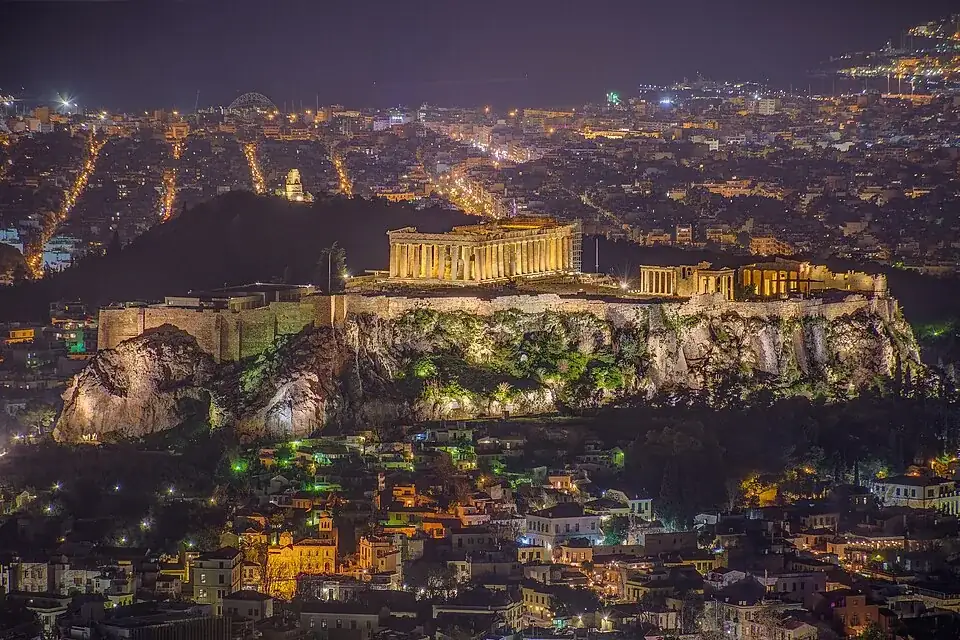
The Parthenon stands on the Athenian Acropolis, is dedicated to the goddess Athena, and also served as the treasury of the Delian League.1 Construction began in 447 BC, the building was substantially complete in 438 BC, and decorative work continued until 432 BC.2 It was designed by Ictinus and Callicrates, with Phidias supervising the overall project and the sculptural decoration.3
Evidence ledger
3 claims3 sourced0 unsourced
Every hard fact in the narrative above is registered here. A claim may also record source-only details that the narrative does not repeat; the related-narrative line points to the corresponding passage, not a guarantee that the source supports every word of the body. A claim without a source stays visibly unsourced.
- Parthenon — WikipediaWikipedia, "Parthenon", lead and "Treasury" section
The Parthenon is a former temple on the Athenian Acropolis, Greece, that was dedicated to the goddess Athena. Like most Greek temples, the Parthenon also served as the city treasury.
Accessed 2026-11-26 · machine excerpt · pending human review
L2: machine-extracted from the Wikipedia lead and Treasury section and compared with the prose; not promoted to L3.
- Parthenon — WikipediaWikipedia, "Parthenon", lead and "Treasury" section
Construction began in 447 BC, the building was substantially complete in 438 BC, and decorative work continued until 432 BC.
Related narrativeConstruction began in 447 BC, the building was substantially complete in 438 BC, and decorative work continued until 432 BC.
- Parthenon — WikipediaWikipedia, "Parthenon", section "Construction", sentences 1–2
Construction started in 447 BC when the Delian League was at the peak of its power. It was completed in 438 BC; work on the artwork and decorations continued until 432 BC.
Accessed 2026-11-26 · machine excerpt · pending human review
L2: machine-extracted from the Wikipedia Construction section and compared with the prose; not promoted to L3.
- Parthenon — WikipediaWikipedia, "Parthenon", section "Construction", sentences 1–2
It was designed by Ictinus and Callicrates, with Phidias supervising the overall project and the sculptural decoration.
Related narrativeIt was designed by Ictinus and Callicrates, with Phidias supervising the overall project and the sculptural decoration.
- Parthenon — WikipediaWikipedia, "Parthenon", section "Construction", sentences 5–6
The Parthenon was built under the general supervision of Phidias, who also had charge of the sculptural decoration. The architects Ictinos and Callicrates began their work in 447, and the building was substantially completed by 432.
Accessed 2026-11-26 · machine excerpt · pending human review
L2: machine-extracted from the Wikipedia Construction section and compared with the prose; not promoted to L3.
- Parthenon — WikipediaWikipedia, "Parthenon", section "Construction", sentences 5–6
Sources and review
Key claims rely on a single source record
Cross-check · 2026-11-20 · UNESCO and the British Museum both support the Parthenon’s fifth-century BCE construction and its 447–432 BCE sculptural work; the body adds no unsupported claim.
- Parthenon — Wikipedia · Wikipedia contributors · Wikipedia lead and full article (accessed 2026-11-26) Original source ↗
L2 claims and source binding
L2 machine extraction plus manual comparison; no L3 two-source human confirmation.
Locations
- Athens· 37.97, 23.73· Approximate
evt-43d72cbb40a64753Source file:
events/evt-43d72cbb40a64753/event.md