
The Franks: from Clovis's baptism to Verdun
Story481–843: how a “barbarian” kingdom became a European framework
In 486 Clovis expelled Syagrius, the last Roman ruler in Gaul, from Soissons and by his death in 511 controlled most of Gaul; in 496 or 508 he was baptised at Reims, becoming one of the first Germanic kings to convert to Catholic Christianity. In 687 Pippin of Herstal defeated the Neustrians at Tertry and power passed from the Merovingian kings to the mayor of the palace; in 768 Pippin died and the kingdom was divided between Charles and Carloman, with Charles taking the whole realm in 771; in 800 Pope Leo III crowned Charlemagne “emperor of the Romans” in Rome; in 843 the Treaty of Verdun divided the empire into middle, eastern and western shares.
Frankish success was not “barbarian force overwhelming civilisation” but the joining of three things: Germanic retinues and kingship, Roman church and local administration, and Christian legitimacy. Clovis's baptism gave the king access to episcopal networks; Pippin II's mayoral politics separated real power from the throne; Charlemagne expanded through conquest and church reform, while Frankish partible inheritance divided the empire among his heirs. Verdun was not a sudden failure but that inheritance logic projected onto an imperial scale.
Chapter-level sources; key claims checked.
Chapter timeline
Chapters in reading orderAll anchors are approximate region-level placements; they are not precise sites. Chapters without coordinates are listed below by region only.
Chapter contents6 chapters
- After Soissons: Clovis takes over the Roman remnant in Gaul
- Baptism at Reims: Clovis places kingship inside the church
- After Tertry: the mayor becomes the real ruler
- Partition and takeover: Charlemagne gets the whole Frankish realm
- Coronation at St. Peter's: the imperial title returns to the West
- Verdun: the empire splits along inheritance lines
The story, chapter by chapter
Each chapter opens the underlying event- 01
After Soissons: Clovis takes over the Roman remnant in Gaul
In 486 Clovis took the Roman province of Belgica Secunda and expelled Syagrius, the last Roman ruler in Gaul, from Soissons. By his death in 511 he had consolidated the Franks and extended his power into the lands of the Alemanni, the Burgundians and the Visigoths, becoming the most powerful ruler in Gaul.
In 486 Clovis took Belgica Secunda and expelled Syagrius from Soissons; by 511 he controlled most of Gaul. Before his baptism he already protected Gallic bishops and church property.
In 486 Clovis took the Roman province of Belgica Secunda and expelled Syagrius, the last Roman ruler in Gaul, from Soissons. By his death in 511 he had consolidated the Franks and extended his power into the lands of the Alemanni, the Burgundians and the Visigoths, becoming the most powerful ruler in Gaul.
This was not a one-sided “barbarian destruction of Rome.” Even before his baptism Clovis recognised the bishops' rights and protected church property; the bishops, in turn, treated him as a king they could work with. After Soissons, Frankish rule rested not on force alone but on continued cooperation with Gallic bishops and Roman local elites.
Sources: 4 event claims, 3 sourced; source cards src-b7-clovis-conversion, src-b7-syagrius-soissons (background only).
- 02
Baptism at Reims: Clovis places kingship inside the church
Remigius, bishop of Reims, baptised Clovis; the traditional date is 496, but the surviving evidence may point to 508. Clovis was one of the first Germanic kings to convert to Catholic Christianity. His conversion was a personal choice, not a collective conversion of the whole kingdom.
Remigius, bishop of Reims, baptised Clovis; the traditional date is 496, but it may be as late as 508. The conversion was a personal choice, not a collective conversion of the kingdom.
Remigius, bishop of Reims, baptised Clovis. The traditional date is 496, but the surviving evidence may point to 508; either way, Clovis was one of the first Germanic kings to convert to Catholic Christianity.
The point is not "the first" but the nature of the conversion: it was Clovis's personal choice, not a collective conversion of the whole kingdom. He had previously been interested in the Arian heresy, but finally accepted Catholic orthodoxy. Later accounts often make the entire army and all his subjects convert with him, turning a personal choice into a state event.
Sources: 4 event claims, 3 sourced; source cards src-b7-clovis-conversion (background only).
SourcesClovis I background
- 03
After Tertry: the mayor becomes the real ruler
In 687 Pippin of Herstal defeated the Neustrians at Tertry and became the sole effective ruler of the Franks. He kept the Merovingian king Theuderic III on the throne and replaced him with three successive Merovingian kings; the throne remained, but real power had passed to the mayor.
In 687 Pippin II defeated the Neustrians at Tertry and became the sole effective ruler; he kept a Merovingian king as figurehead and ruled until 714.
In 687 Pippin of Herstal defeated the Neustrians at Tertry and became the sole effective ruler of the Franks. He did not depose the Merovingian king: Theuderic III remained on the throne, and after his death Pippin replaced him with three successive Merovingian kings. The throne remained, but the army, land and episcopal networks were already in his hands.
The point of mayoral politics was not usurpation but keeping the throne as a usable shell of legitimacy. Pippin II ruled the Franks until his death in 714 and was the first of the great Carolingian mayors of the palace.
Sources: 4 event claims, 3 sourced; source cards src-b7-pippin-tertry-687 (background only).
SourcesPippin II background
- 04
Partition and takeover: Charlemagne gets the whole Frankish realm
In 768 Pippin died and, according to Frankish custom, divided the kingdom between the brothers Charles and Carloman. When Carloman died in 771, Charles disregarded the rights of his heirs and took control of the entire Frankish realm; military campaigning continued for three decades, and the Saxon war only ended in 804.
In 768 Pippin died and the kingdom was divided between Charles and Carloman; in 771 Carloman died and Charles took the whole realm. The Saxon war lasted until 804.
In 768 Pippin died. According to Frankish custom, the kingdom was divided between the brothers Charles and Carloman. The two were almost immediately at odds.
When Carloman died in 771, Charles disregarded the rights of Carloman's heirs and took control of the entire Frankish realm. For the next thirty years, military campaigning was the norm: the Saxon war was the most difficult and long-lasting, and the Saxons only submitted in 804.
Frankish partible inheritance thus showed two faces: it repeatedly produced civil war, and it repeatedly gave the victor a chance to absorb his rival's share. Charlemagne's unity was not an institutional design but the result of a brother's early death, armed takeover and continuous warfare.
Sources: 5 event claims, 3 sourced; source cards src-b7-charlemagne-coronation-800 (background only).
SourcesCharlemagne background
- 05
Coronation at St. Peter's: the imperial title returns to the West
In 799 Pope Leo III was attacked in Rome and fled to Charlemagne for protection. At Christmas in 800 Leo crowned Charlemagne in St. Peter's Basilica and proclaimed him "emperor of the Romans"; this was the first restoration of the imperial title in the West since the Western Roman Empire dissolved, and Byzantium only recognised it in 812.
In 799 Leo III was attacked and fled to Charlemagne; at Christmas in 800 he crowned Charlemagne “emperor of the Romans” in St. Peter's; Byzantium recognised the title in 812.
In 799 Pope Leo III was attacked in Rome and fled to Charlemagne for protection. The negotiations ended with Leo restored to office; Charlemagne then went to Rome.
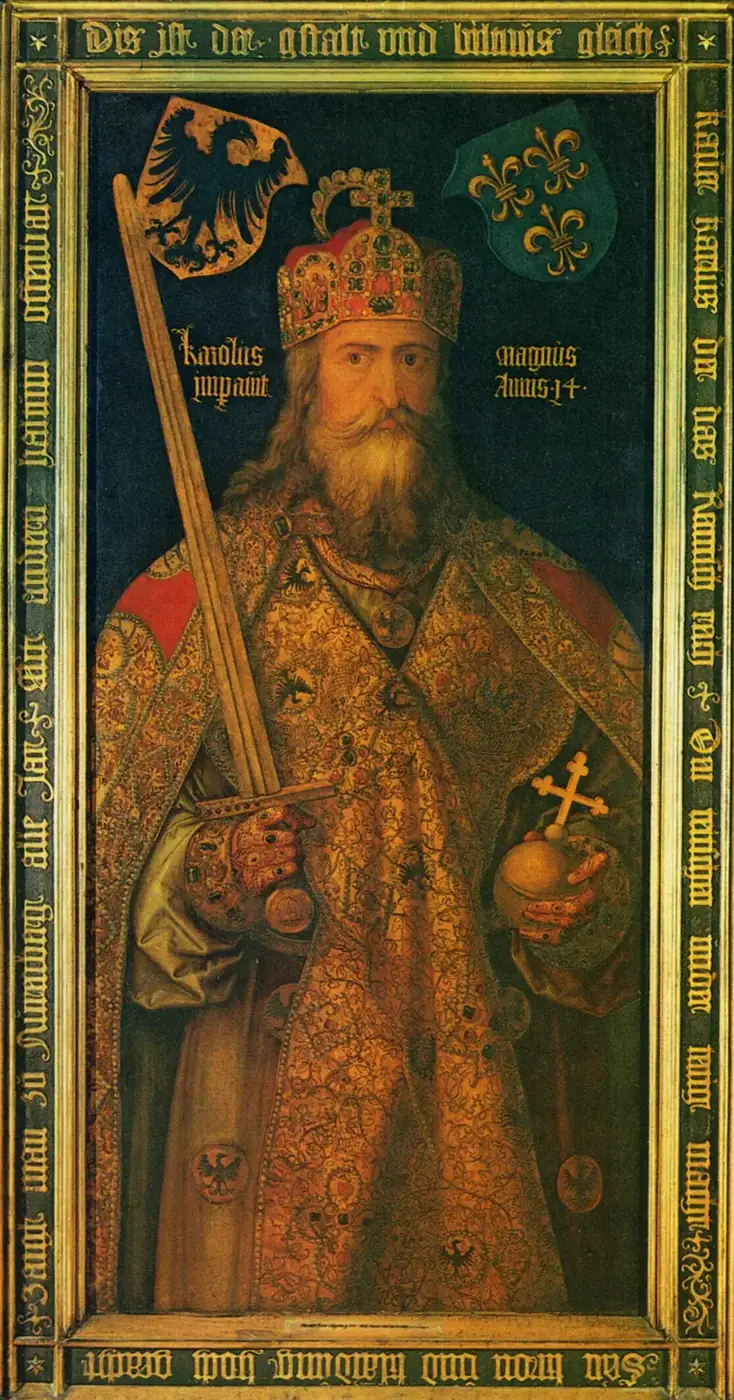
At Christmas in 800, Leo III crowned Charlemagne in St. Peter's Basilica in Rome and proclaimed him "emperor of the Romans." This was the first restoration of the imperial title in the West since the dissolution of the Western Roman Empire. Byzantium only recognised his imperial title in 812.
The coronation was not merely an honour: it let Charlemagne claim the legacy of the Western empire and turned the relationship between pope and emperor into a long negotiation.
Sources: 5 event claims, 4 sourced; source cards src-b7-holy-roman-emperor, src-b7-charlemagne-coronation-800 (background only).
CharlemagneAlbrecht Dürer / Wikimedia Commons · Public domain - 06
Verdun: the empire splits along inheritance lines
In August 843 the three surviving sons of Louis I signed the Treaty of Verdun. Lothar had already been defeated at Fontenoy and driven from Aachen; the treaty divided the empire into middle, eastern and western shares, with Lothar keeping the imperial title and Louis and Charles receiving East and West Francia.
In August 843 the three brothers signed the Treaty of Verdun; Lothar received Middle Francia and kept the imperial title, Louis received East Francia, and Charles received West Francia.
In August 843 the three surviving sons of Louis I signed the Treaty of Verdun. The empire had already been through a civil war: after Louis died, Louis the German and Charles the Bald joined forces against their elder brother Lothar; Lothar was defeated at Fontenoy and driven from Aachen before he agreed to negotiate.
The treaty cut the empire into three: Lothar kept the imperial title and received Middle Francia, a central strip running from Italy to the North Sea; Louis received East Francia, east of the Rhine; Charles received West Francia, the remainder of modern France.
heir title territory Lothar emperor Middle Francia, the central strip from Italy to the North Sea Louis the German king East Francia, east of the Rhine Charles the Bald king West Francia, the remainder of modern France This was not the empire's "sudden failure" but Frankish partible inheritance projected onto an imperial scale: first civil war, then the division of an empire that no one could hold alone.
Sources: 5 event claims, 4 sourced; source cards src-b7-treaty-verdun-843 (background only).
SourcesTreaty of Verdun background
Cast
People whose choices move the story. Roles describe this story only.
- Clovis IFrankish king and convert
Became king of the Franks in 481, expelled Syagrius from Soissons in 486, and was baptised at Reims in 496 or 508.
- Pippin IIMayor of the palace and effective ruler
Defeated the Neustrians at Tertry in 687, kept the Merovingian king as a figurehead, and ruled the Franks until 714.
- CharlemagneKing of the Franks and emperor of the Romans
Became king in 768, took the whole Frankish realm in 771, was crowned in Rome in 800, and died in 814.
- Pippin the ShortCarolingian mayor and king
Took the throne in 751, died in 768, and divided the kingdom between Charles and Carloman.
Evidence and limits
Chapter-level sources; key claims checked.
Source count is the number of distinct source records attached to the event nodes shown here. It does not certify the narrative as a whole.