
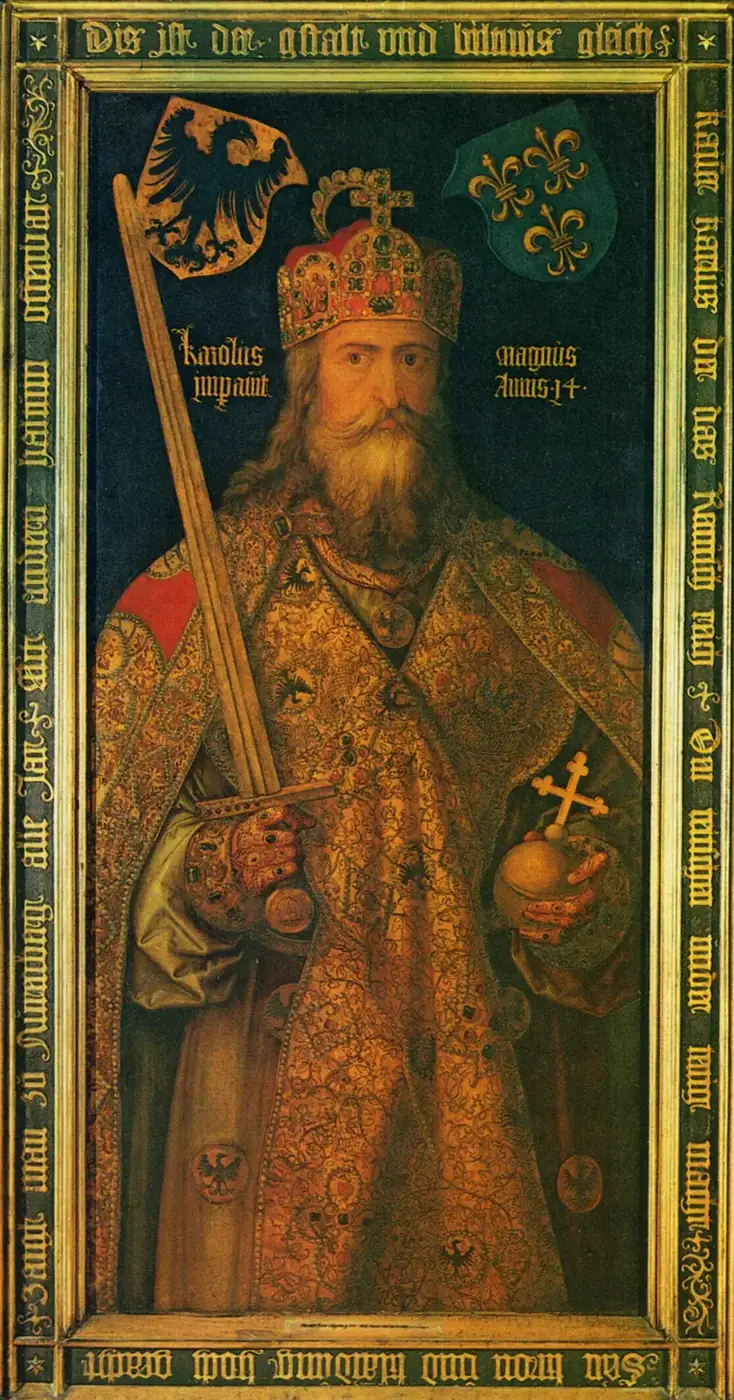
In 799 Pope Leo III was attacked in Rome and fled to Charlemagne for protection.1 The negotiations ended with Leo restored to office; Charlemagne then went to Rome.
At Christmas in 800, Leo III crowned Charlemagne in St. Peter's Basilica in Rome and proclaimed him "emperor of the Romans."2 This was the first restoration of the imperial title in the West since the dissolution of the Western Roman Empire.3 Byzantium only recognised his imperial title in 812.4
The coronation was not merely an honour: it let Charlemagne claim the legacy of the Western empire and turned the relationship between pope and emperor into a long negotiation.5
Evidence ledger
5 claims4 sourced0 unsourced1 author judgment
Every hard fact in the narrative above is registered here. A claim may also record source-only details that the narrative does not repeat; the related-narrative line points to the corresponding passage, not a guarantee that the source supports every word of the body. A claim without a source stays visibly unsourced.
In 799 Pope Leo III was attacked in Rome and fled to Charlemagne for protection.
Related narrativeIn 799 Pope Leo III was attacked in Rome and fled to Charlemagne for protection.
- Holy Roman emperorHistory, Origin of the title: Leo III attacked in 799
In 799 Pope Leo III was physically attacked and fled to the court of Charlemagne, who escorted him back to Rome in 800 and assumed the "formal role" of his protector.
Accessed 2026-11-25 · human read
- Holy Roman emperorHistory, Origin of the title: Leo III attacked in 799
At Christmas in 800, Leo III crowned Charlemagne in St. Peter's Basilica in Rome and proclaimed him "emperor of the Romans".
Related narrativeAt Christmas in 800, Leo III crowned Charlemagne in St. Peter's Basilica in Rome and proclaimed him "emperor of the Romans."
- Holy Roman emperorHistory, Origin of the title: Christmas coronation in St. Peter's
On Christmas Day the pope crowned Charlemagne in St. Peter's Basilica, and those assembled proclaimed him "emperor of the Romans."
Accessed 2026-11-25 · human read
- Holy Roman emperorHistory, Origin of the title: Christmas coronation in St. Peter's
This was the first restoration of the imperial title in the West since the dissolution of the Western Roman Empire.
Related narrativeThis was the first restoration of the imperial title in the West since the dissolution of the Western Roman Empire.
- CharlemagneTop Questions: restoration of the Roman Empire in the West
Charlemagne was crowned "emperor of the Romans" by Pope Leo III in 800 CE, thus restoring the Roman Empire in the West for the first time since its dissolution in the 5th century.
Accessed 2026-11-25 · human read
- CharlemagneTop Questions: restoration of the Roman Empire in the West
Byzantium only recognised his imperial title in 812.
Related narrativeByzantium only recognised his imperial title in 812.
- Holy Roman emperorHistory, Origin of the title: recognition by the Byzantine Empire in 812
On the other hand, he engaged in a long military and diplomatic campaign that in 812 gained his title recognition from the Byzantine Empire.
Accessed 2026-11-25 · human read
- Holy Roman emperorHistory, Origin of the title: recognition by the Byzantine Empire in 812
The coronation was not merely an honour: it let Charlemagne claim the legacy of the Western empire and turned the relationship between pope and emperor into a long negotiation.
Related narrativeThe coronation was not merely an honour: it let Charlemagne claim the legacy of the Western empire and turned the relationship between pope and emperor into a long negotiation.
Editorial judgment, not a historical fact.
Editorial judgment, not a sourced factual claim.
Sources and review
- Holy Roman emperor · Encyclopaedia Britannica (accessed 2026-11-25) Original source ↗
- Charlemagne · Encyclopaedia Britannica (accessed 2026-11-25) Original source ↗
Locations
- Frankish Kingdom· 41.9, 12.45· Approximate
evt-42548dbb9e93f26aSource file:
events/evt-42548dbb9e93f26a/event.md