
Red Cliffs: The Blocker on the Yangtze
StoryAfter Jingzhou falls, Cao Cao moves south; the Sun–Liu alliance halts his momentum by river war and marriage
In 208 Cao Cao campaigned south against Jingzhou; Liu Cong surrendered the province, and after Liu Bei was routed at Changban he withdrew to Xiakou and joined Eastern Wu. The Sun–Liu alliance stopped Cao's forces with a fire attack at Red Cliffs, then sealed the alliance by marriage, contested Jiangling, and took the southern commanderies. After Zhou Yu's early death Cao Cao turned to Guanzhong, while Sun and Liu held the Yangtze line in long stalemate. This story follows seven event nodes to show how river warfare and alliance politics held Cao Cao's unifying momentum to the north bank; read the chapters in chronological order.
After Jingzhou surrenders, Cao Cao presses south; the Sun–Liu alliance holds by river warfare and marriage, and Red Cliffs blocks unification, leaving north and south in stalemate.
Chapter-level sources; key claims checked.
Chapter timeline
Chapters in reading orderAll anchors are approximate region-level placements; they are not precise sites. Chapters without coordinates are listed below by region only.
Chapter contents7 chapters
The story, chapter by chapter
Each chapter opens the underlying event- 01
Cao Cao seizes Jingzhou; Liu Cong surrenders
Cao Cao led a large army south to attack Jingzhou. The governor of Jingzhou, Liu Biao, happened to die of illness, and his son Liu Cong succeeded him. Urged by Kuai Yue and Fu Xun, Liu Cong surrendered all of Jingzhou to Cao Cao. Liu Bei, who had been staying in Jingzhou, retreated from Fancheng but was routed at Changban by Cao Chun's Tiger and Leopard Cavalry; only the arrival of Guan Yu's naval force saved him, al…
Jingzhou falls without a pitched battle; Cao gains ships and a navy, and the southern front shifts at once.
In 208 Cao Cao led a large army south against Jingzhou. The Jingzhou governor Liu Biao happened to die of illness, and his son Liu Cong succeeded him. Urged by Kuai Yue and Fu Xun, Liu Cong surrendered the whole province to Cao Cao.
Liu Bei, who had been lodged in Jingzhou, pulled back from Fancheng but was routed at Changban near Dangyang by Cao Chun's Tiger and Leopard Cavalry. Only the arrival of Guan Yu's naval force saved him, and he fled to Xiakou. Cao Cao then occupied Jiangling, gaining a large fleet and a naval force.
In this chapter Cao Cao takes Jingzhou almost without a pitched battle and gains the means to fight downstream by river. For Sun Quan and Liu Bei the defensive line has been pushed to the Yangtze, and holding back this momentum depends on whether the two can form an alliance.
Sources: 7 event claims, 7 sourced; source cards src-b3w-chibi-01, src-b3w-chibi-02 (background only).
SourcesSun Quan — Wikipedia backgroundCao Cao — Wikipedia background
- 02
The fire attack at Red Cliffs
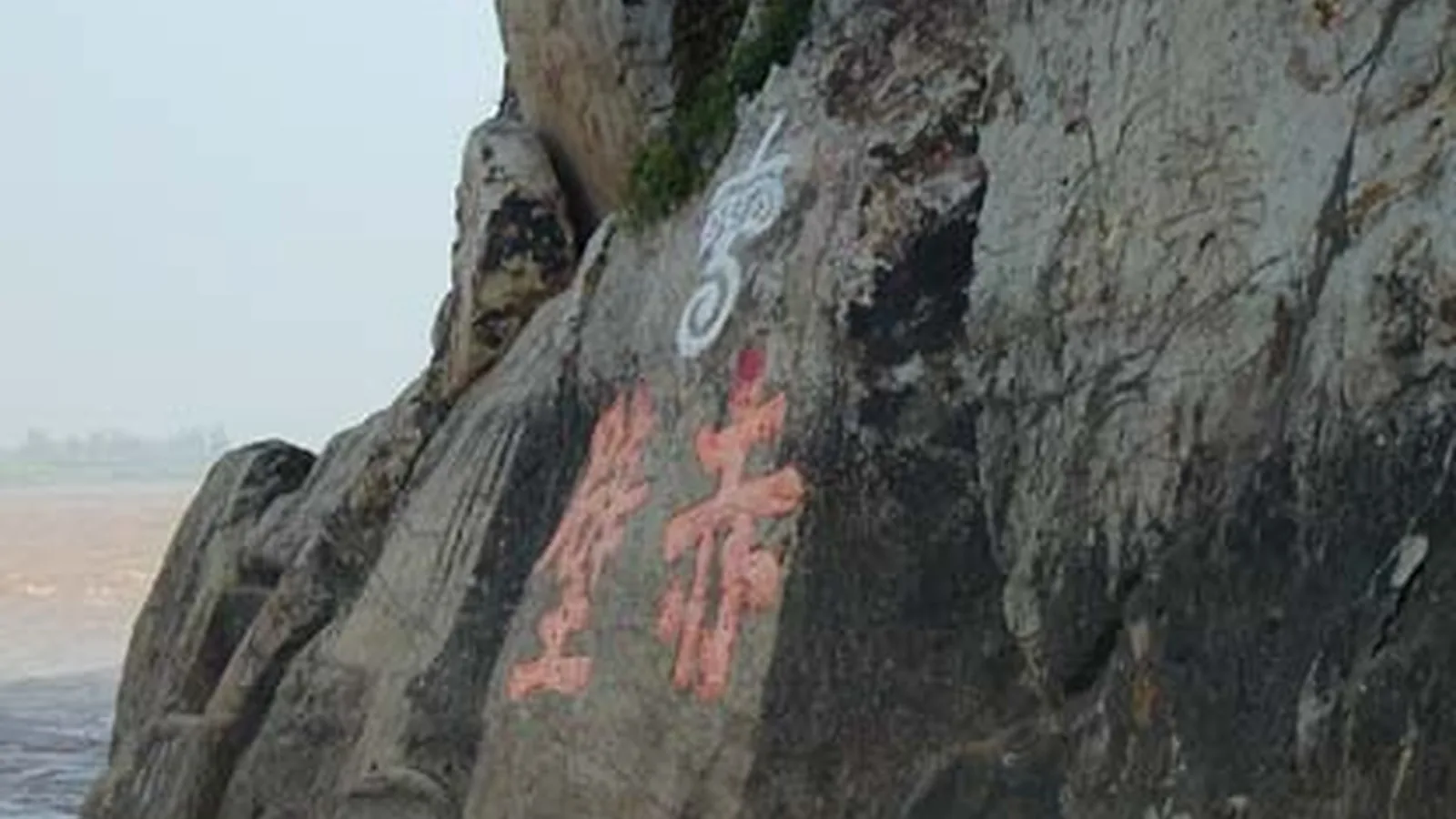
Cao Cao led about 200,000 men downstream along the Yangtze. The Sun–Liu allied force of about 50,000, commanded by Zhou Yu, Cheng Pu, and Zhuge Liang, met them. The two sides fought at Red Cliffs (northwest of modern Chibi, Hubei). Cao's troops, unaccustomed to naval warfare, chained their ships together to reduce rolling. Zhou Yu's subordinate Huang Gai feigned surrender and then, taking advantage of a southeast win…
The fire attack breaks the chained fleet; the plan to unify the south goes bankrupt here.
Cao Cao led about 200,000 men downstream along the Yangtze. The Sun–Liu allied force of about 50,000, commanded by Zhou Yu, Cheng Pu, and Zhuge Liang, met him at Red Cliffs (northwest of present-day Chibi, Hubei). Cao's troops were unaccustomed to naval warfare and chained their ships together to reduce rolling.
Zhou Yu's subordinate Huang Gai feigned surrender and, taking advantage of a southeast wind, steered fire ships laden with kindling and oil into Cao's naval camp. The fire spread, destroying the chained fleet and reaching the shore camps. Cao Cao burned his remaining ships and retreated through Huarong Road; in the mud his losses were more than half his force.
The battle shattered Cao's plan to unify the south. Liu Bei seized the four southern commanderies of Jingzhou, Sun Quan consolidated Jiangdong, and the Three Kingdoms pattern began to take shape. The decisive ground was the river: the northern army's land advantage could not be deployed afloat.
Sources: 11 event claims, 11 sourced; source cards src-b3w-chibi-01, src-b3w-chibi-02 (background only).
SourcesSun Quan — Wikipedia backgroundCao Cao — Wikipedia background
- 03
Sun Quan marries his sister to Liu Bei
After Red Cliffs, to strengthen the Sun–Liu alliance, Sun Quan followed Zhou Yu's advice and gave his younger sister (called Lady Sun in folklore, later Sun Shangxiang) in marriage to Liu Bei. It was a political marriage; Lady Sun was brave and masculine, attended by a hundred maidservants all carrying swords, so much so that Liu Bei was afraid every time he entered her chambers. The marriage temporarily maintained S…
The marriage turns military cooperation into a political arrangement, later planting the Jingzhou dispute.
After Red Cliffs, to strengthen the Sun–Liu alliance, Sun Quan followed Zhou Yu's advice and gave his younger sister Lady Sun in marriage to Liu Bei. It was a political marriage, not a union based on personal inclination between the two sides.
According to the event record, Lady Sun was brave and fond of martial ways; over a hundred maidservants attended her, all carrying swords, so that Liu Bei felt afraid every time he entered her chambers. The marriage kept Sun–Liu cooperation alive for the time being, with the two sides aligned against Cao Cao.
Yet this arrangement, which bound interests to a family tie, was not stable. It steadied the alliance after the war, but it also planted the later dispute over Jingzhou: the alliance was a military necessity, yet it always mixed in calculations of territory and strength.
Sources: 5 event claims, 5 sourced; source cards src-b3w-chibi-02, src-b3w-chibi-01 (background only).
SourcesCao Cao — Wikipedia backgroundSun Quan — Wikipedia background
- 04
Zhou Yu and Cheng Pu contest Jiangling
After the Battle of Red Cliffs, Zhou Yu led tens of thousands of troops to besiege Jiangling (modern Jingzhou, Hubei), defended by Cao Ren. After a year of fierce fighting, Cao Ren broke out and retreated, and Zhou Yu seized Jiangling. Meanwhile, Liu Bei took advantage of the situation to capture the four commanderies of southern Jingzhou (Wuling, Changsha, Guiyang, Lingling), proclaimed himself Governor of Jingzhou,…
The Jiangling siege and the southern four commanderies fix the postwar territory on both sides.
After Red Cliffs, Zhou Yu led tens of thousands of troops to besiege Jiangling (present-day Jingzhou, Hubei), defended by Cao Ren. After a year of fierce fighting, Cao Ren broke out and retreated, and Zhou Yu seized Jiangling.
Meanwhile Liu Bei took the opportunity to move south and recover the four southern commanderies of Jingzhou: Wuling, Changsha, Guiyang, and Lingling. He proclaimed himself Governor of Jingzhou and set his seat at Gong'an. Sun Quan agreed to lend him part of the Nan commandery so that the two could jointly oppose Cao Cao.
This chapter fixes the actual controlled areas after the war: Wu holds the Jiangling line, Liu Bei establishes himself in the southern four commanderies, and the land loan ties the two sides' interests together for the moment. Jingzhou thus becomes the most sensitive border zone within the alliance.
Sources: 6 event claims, 6 sourced; source cards src-b3w-chibi-01, src-b3w-chibi-04 (background only).
SourcesSun Quan — Wikipedia backgroundZhou Yu — Wikipedia background
- 05
Zhou Yu dies at Baqiu
Zhou Yu proposed to Sun Quan a campaign to conquer Yizhou, but on his way back to Jiangling, at Baqiu (modern Yueyang, Hunan), his old battle wounds opened and he died in camp. Zhou Yu was a master of music, magnanimous and lofty. He commanded the Sun–Liu allied forces at Red Cliffs to a great victory over Cao Cao and was a key figure in the founding of Eastern Wu. In his final letter he recommended Lu Su as his succ…
Zhou Yu's early death ends Wu's western expansion; the alliance enters the post-Zhou Yu phase.
Zhou Yu had proposed to Sun Quan a campaign to conquer Yizhou, but on his way back to Jiangling, at Baqiu (present-day Yueyang, Hunan), his old wounds opened and he died in camp, aged thirty-six.
The event record describes him as a master of music and a magnanimous, refined man; at Red Cliffs he commanded the Sun–Liu alliance to a great victory over Cao Cao and was a key figure in the founding of Eastern Wu. In his final letter he recommended Lu Su as his successor. Sun Quan deeply mourned the loss, regarding him as a fallen chief aide.
Zhou Yu's death interrupted Wu's plan to expand west into Yizhou. The alliance then entered the post-Zhou Yu phase, with defence and diplomacy carried on by the Lu Su line; Sun–Liu cooperation and friction both continued to shift within that adjustment.
Sources: 7 event claims, 7 sourced; source cards src-b3w-chibi-01, src-b3w-chibi-04 (background only).
SourcesSun Quan — Wikipedia backgroundZhou Yu — Wikipedia background
- 06
Cao Cao's Call for Talent
At Yecheng, Cao Cao issued the 'Call for Talent,' openly proposing a principle of 'employment based solely on ability.' He declared: 'If we required that only incorruptible men be used, then how could Duke Huan of Qi have become hegemon?' He proclaimed that even men 'with stains on their reputation, laughable conduct, or even lacking benevolence and filial piety but having the skills to govern the state and command a…
The ability-only hiring policy supplies Cao Wei with talent from lower backgrounds.
In 210 Cao Cao issued his Call for Talent at Yecheng, openly proposing the principle of employment based solely on ability. The edict uses Duke Huan of Qi as an example: one cannot rely only on men of flawless conduct. Those with stains on their reputation, laughable conduct, or even lacking benevolence and filial piety, but with the skills to govern and command armies, should still be recommended.
This policy broke the Eastern Han path of selecting officials by moral reputation and the ethical code. Many people of low birth but real ability entered the Cao Wei administration. The hiring standard shifted from family standing and fame to practical competence, supplying Cao Wei with executors at every level.
Alongside the military stalemate, this was Cao Wei's internal adjustment of talent: as its northern controlled area grew, who would govern localities and lead armies became as important as the fighting itself.
Sources: 5 event claims, 5 sourced; source cards src-b3w-chibi-01, src-b3w-chibi-02 (background only).
SourcesSun Quan — Wikipedia backgroundCao Cao — Wikipedia background
- 07
The Battle of Weinan
After his defeat at Red Cliffs, Cao Cao turned west to attack Ma Chao and Han Sui in Guanzhong. Ma Chao allied with Han Sui and ten other warlords from Guanzhong, fielding a total of 100,000 men and holding Tong Pass. Cao Cao employed Jia Xu's stratagem of sowing discord: he wrote a letter to Han Sui, deliberately blotching and altering it, so that Ma Chao suspected Han Sui of colluding with Cao Cao. When the allianc…
Cao Cao pacifies Guanzhong in the west, opening a western front alongside the southern stalemate.
After his defeat at Red Cliffs, Cao Cao turned west to campaign against Ma Chao and Han Sui in Guanzhong. Ma Chao allied with Han Sui and ten other Guanzhong warlords, fielding a total of 100,000 men and holding Tong Pass.
Cao Cao employed Jia Xu's rift stratagem: in a letter to Han Sui he deliberately blotched and altered passages, so that Ma Chao suspected Han Sui of colluding with Cao Cao. When the alliance fell into internal disorder, Cao Cao launched a general attack at Weinan. Ma Chao was badly defeated and fled to Liangzhou; Han Sui was beaten back to Huangzhong, and Guanzhong was pacified by Cao Cao.
While the southern line held in stalemate, Cao Cao removed the Guanzhong warlord threat in the west. With the north and Guanzhong consolidated, his pressure on the south did not disappear; the front merely shifted west for the time being, and the Sun–Liu alliance still faced this long-term opponent.
Sources: 8 event claims, 8 sourced; source cards src-b3w-chibi-02, src-b3w-chibi-01 (background only).
SourcesCao Cao — Wikipedia backgroundSun Quan — Wikipedia background
Cast
People whose choices move the story. Roles describe this story only.
- Sun QuanProtagonist side · lord of Jiangdong
Receives the alliance, seals it by marriage, and holds Jiangdong.
Open person page ↗ - Zhou YuProtagonist side · allied commander
Commands the Red Cliffs fire attack, contests Jiangling, dies at Baqiu.
Open person page ↗ - Liu BeiProtagonist side · lodged in Jingzhou
After the Changban rout joins Wu, then takes the four southern commanderies.
Open person page ↗ - Zhuge LiangProtagonist side · Liu Bei's adviser
Joins the alliance at Red Cliffs and helps sustain Sun–Liu cooperation.
Open person page ↗ - Cao CaoRival · southern expedition commander
Takes Jingzhou, moves downstream, retreats from Red Cliffs, then turns west.
Open person page ↗ - Huang GaiZhou Yu's subordinate
Feigns surrender and drives the fire ships into Cao's naval camp.
- Cheng PuWu general
Shares command on the allied side with Zhou Yu.
- Cao RenCao Cao's defender
Holds Jiangling against Zhou Yu for a year before breaking out.
- Jia XuCao Cao's strategist
Proposes the rift stratagem that sets Ma Chao and Han Sui against each other.
- Ma ChaoGuanzhong warlord
Allies with Han Sui at Tong Pass, flees to Liangzhou after Weinan.
- Han SuiGuanzhong warlord
Alliance member, retreats to Huangzhong.
Related stories
Possible relevance from shared year, place, people or category; not causation.
Evidence and limits
Chapter-level sources; key claims checked.
Source count is the number of distinct source records attached to the event nodes shown here. It does not certify the narrative as a whole.