
Refined at the event level; this event stays on its event page and has no separate curated story page.
The short version
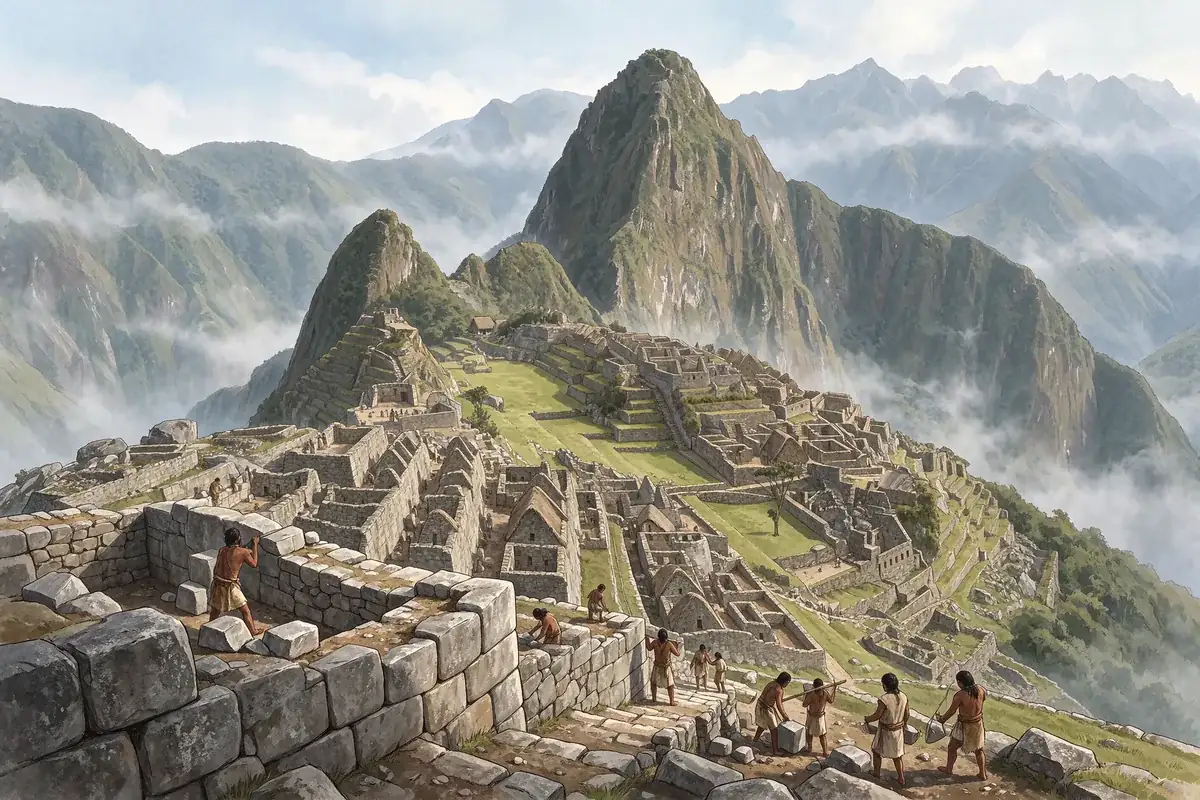
In 1450, on an Andean ridge, masons were fitting enormous blocks of granite together. This is the place later called Machu Picchu. The source does not give the tidy date of legend: it was built between the mid-15th and 16th centuries, and its construction style and other evidence suggest that it was a palace complex of the ruler Pachacuti Inca Yupanqui (reigned c. 1438–71) rather than an ordinary village.
The timeline attaches the event to 1450 to give a readable coordinate, not to say that the work was finished on a particular day in that year. It is closer to the source to read it as a building process that took shape in the mid-15th century and continued into the 16th.
Why it happened
Pachacuti turned the Inca from a local power in Cusco into an Andean empire. An empire had to arrange more than conquest: royal household, ritual, agriculture and roads all had to sit within one order. Machu Picchu sits on a ridge about 2,430 metres above the Urubamba valley. The legacy entry calls it a royal estate; the source calls it a palace complex. The two point in the same direction: it was first of all a place belonging to the ruler, not an ordinary settlement.
Why build a palace so high? The legacy entry gives no single answer. Defence, summer retreat, ritual, royal estate and control of a valley route are all plausible. The source confirms only the period and the palace character; it does not preserve Pachacuti's own reason for the site. That should be left blank.
What happened
The legacy entry describes the engineering in detail: the site divided into farming and urban sectors, roughly two hundred structures dry-laid in finely dressed granite whose joints admit no blade; terraces over layered drainage coping with rain on the steep slope; the Temple of the Sun and the Intihuatana stone used for solstice observation. The source does not itemise those details, so they remain legacy copy.
Even without the numbers, the logic of the site is visible. To build on a steep slope, water and soil must be settled first. Terraces cut the slope into farmable steps, drainage layers carry rain away, and the walls hold without mortar through precise cutting and the weight of the stones. This is not display for its own sake. A ridge offers no flat building site, so every block has to be placed with the land.
What changed
Machu Picchu was later abandoned. The legacy entry says the Spanish never reached it and that the site therefore survived; the source does not explain the abandonment or confirm the Spanish route. What is certain is that it was not covered by a colonial city the way Cusco was, and when it re-entered wider view in the early twentieth century, its walls, terraces and temples were still on the same ridge.
“Well preserved” does not mean “unchanged”. Walls collapse, terraces silt up, vegetation swallows steps. It looks complete today because of later clearing, repair and recording, not because it was never disturbed.
How to read the evidence
This entry carries one source, Britannica's article on Machu Picchu. It directly supports two points: the site was built between the mid-15th and 16th centuries; its construction style and other evidence suggest a palace complex of Pachacuti. The 2,430 metres, the farming and urban sectors, the roughly two hundred structures, the dry joints, the terrace drainage, the Temple of the Sun and the Intihuatana, and the claim that the Spanish never arrived remain legacy copy; the page keeps the “legacy copy · source pending” label.
Read it by separating “who built it and roughly when” from “how refined the engineering was and why it was abandoned”. The first has a source; the second still needs archaeological reports, site surveys and colonial-era documents. A handsome photograph of a ridge should not turn every detail into a verified fact.
Sources behind this read
- Machu Picchu · Encyclopaedia Britannica (accessed 2026-11-21) Original source ↗
Original entry and sentence-level review
In 1450, Machu Picchu sits on a ridge some 2,430 metres above the Urubamba valley and is generally taken to have been a royal estate of Pachacuti.1 Divided into farming and urban sectors, its roughly two hundred structures are dry-laid in finely dressed granite whose joints admit no blade; terraces over layered drainage cope with rain on the steep slope, and the Temple of the Sun and the Intihuatana stone served solstice observation.2 The Spanish never reached it, and so it survived.3
Evidence ledger
3 claims3 sourced0 unsourced
Every hard fact in the narrative above is registered here. A claim may also record source-only details that the narrative does not repeat; the related-narrative line points to the corresponding passage, not a guarantee that the source supports every word of the body. A claim without a source stays visibly unsourced.
In 1450, Machu Picchu sits on a ridge some 2,430 metres above the Urubamba valley and is generally taken to have been a royal estate of Pachacuti.
Related narrativeIn 1450, Machu Picchu sits on a ridge some 2,430 metres above the Urubamba valley and is generally taken to have been a royal estate of Pachacuti.
- Machu Picchu — WikipediaWikipedia, "Machu Picchu", full article, evidence sentence 4
Estimated to be built around 1450, it is believed to have served as an estate for the Inca emperor Pachacuti, though no contemporary written records exist to confirm this.
Accessed 2026-11-26 · machine excerpt · pending human review
L2: machine-extracted from the Wikipedia lead/full article and compared with the prose; not promoted to L3.
- Machu Picchu — WikipediaWikipedia, "Machu Picchu", full article, evidence sentence 4
Divided into farming and urban sectors, its roughly two hundred structures are dry-laid in finely dressed granite whose joints admit no blade; terraces over layered drainage cope with rain on the steep slope, and the Temple of the Sun and the Intihuatana stone served solstice observation.
Related narrativeDivided into farming and urban sectors, its roughly two hundred structures are dry-laid in finely dressed granite whose joints admit no blade; terraces over layered drainage cope with rain on the steep slope, and the Temple of the Sun and the Intihuatana stone served solstice observation.
- Machu Picchu — WikipediaWikipedia, "Machu Picchu", full article, evidence sentence 8
Notable structures include the Temple of the Sun, the Temple of the Three Windows, and the Intihuatana ritual stone.
Accessed 2026-11-26 · machine excerpt · pending human review
L2: machine-extracted from the Wikipedia lead/full article and compared with the prose; not promoted to L3.
- Machu Picchu — WikipediaWikipedia, "Machu Picchu", full article, evidence sentence 8
The Spanish never reached it, and so it survived.
Related narrativeThe Spanish never reached it, and so it survived.
- Machu Picchu — WikipediaWikipedia, "Machu Picchu", full article, evidence sentence 64
Machu Picchu is believed to have been abandoned in the mid-16th century, around the time of the Spanish conquest, likely due to the collapse of Inca rule and disease following European contact.
Accessed 2026-11-26 · machine excerpt · pending human review
L2: machine-extracted from the Wikipedia lead/full article and compared with the prose; not promoted to L3.
- Machu Picchu — WikipediaWikipedia, "Machu Picchu", full article, evidence sentence 64
Sources and review
English translation predates the current source revision; Key claims rely on a single source record
- Machu Picchu — Wikipedia · Wikipedia contributors · Wikipedia lead and full article (accessed 2026-11-26) Original source ↗
- Caral — Wikipedia · Wikipedia contributors · Wikipedia lead and full article (accessed 2026-11-26) Original source ↗
L2 claims and source binding
L2 machine extraction plus manual comparison; no L3 two-source human confirmation.
Locations
- Inca· -13.1631, -72.545· Approximate
evt-f1c982c85b5c1b2aSource file:
events/evt-f1c982c85b5c1b2a/event.md