
Assyria and Neo-Babylon: Empire, Library and Jerusalem
Story885–586 BCE: how an iron-age empire ruled and wrote Jerusalem into memory
In the ninth century BCE Assyria turned from a northern highland state into a war machine across Mesopotamia: in 885 Ashurnasirpal II crushed Aramean revolts; in 880 he moved the capital to Nimrud; in 745 Tiglath-Pileser III built the Neo-Assyrian Empire; in 722 Sargon II founded Dur-Sharrukin; in 655 Ashurbanipal established a great library of clay tablets at Nineveh; in 612 Nineveh fell to a Median-Babylonian coalition. Together these show how empire ruled through armies, deportation, roads and writing — and how its violence was preserved in its own records.
The Assyrian Empire was not a cartoon of innate cruelty. Its scale rested on a professional army, provinces, roads, intelligence and forced deportation; terror propaganda was itself a tool of rule. The library at Nineveh was both a knowledge project and an act of imperial power that gathered texts from across the realm into the capital. After Nineveh fell, Neo-Babylon took over Mesopotamia, but Assyrian administrative and military techniques did not disappear.
Chapter-level sources; key claims checked.
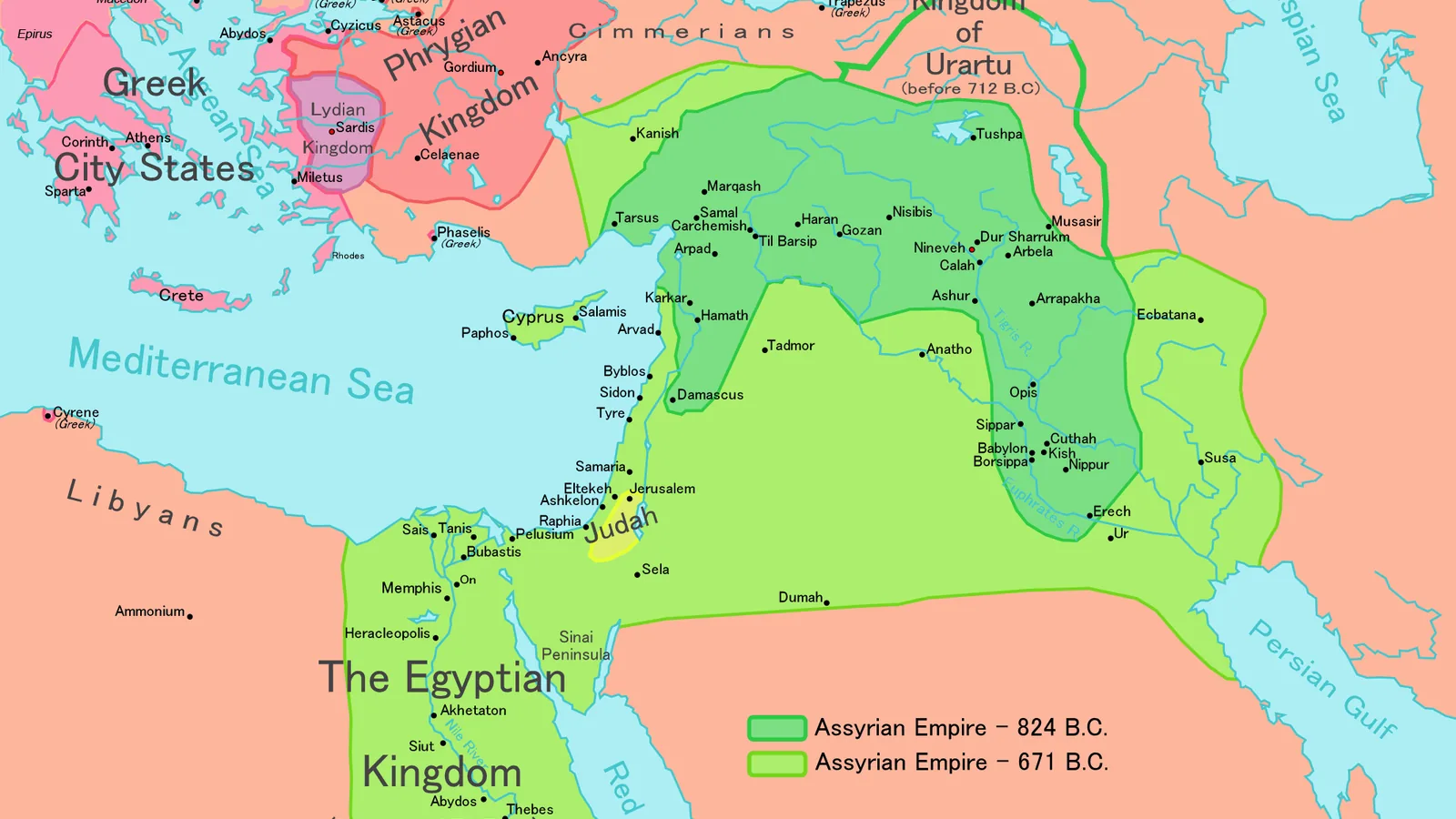
Chapter timeline
Chapters in reading orderAll anchors are approximate region-level placements; they are not precise sites. Chapters without coordinates are listed below by region only.
Chapter contents7 chapters
- Ashurnasirpal II suppresses an Aramean revolt
- Assyria moves capital to Nimrud (Kalhu)
- Tiglath-Pileser III Ascends the Throne, Beginning the Neo-Assyrian Period
- Peak of the Assyrian Empire; Sargon II Builds Dur-Sharrukin
- Ashurbanipal establishes a great library at Nineveh, collecting cuneiform tablets
- The Assyrian Empire completely collapses; Nineveh is besieged by the Medes and Neo-Babylonians
- Babylon captures Jerusalem, ending the Kingdom of Judah
The story, chapter by chapter
Each chapter opens the underlying event- 01
Ashurnasirpal II suppresses an Aramean revolt
Assyrian prince Ashurnasirpal II (later king) was ordered to lead forces in suppressing a revolt by Aramean tribes along the middle Euphrates. He stormed and destroyed the city of Suru, impaled captives on stakes along the river, and burned the leaders alive. This brutal suppression deterred potential opposition, showcasing the terrifying tactics of the Assyrian war machine, and was recorded in palace inscriptions at…
Assyrian prince Ashurnasirpal II (later king) was ordered to lead forces in suppressing a revolt by Aramean tribes along the middle Euphrates. He stormed and destroyed the city of Suru, impaled captives on stakes along the river, and burned the leaders alive.
Assyrian prince Ashurnasirpal II (later king) was ordered to lead forces in suppressing a revolt by Aramean tribes along the middle Euphrates. He stormed and destroyed the city of Suru, impaled captives on stakes along the river, and burned the leaders alive. This brutal suppression deterred potential opposition, showcasing the terrifying tactics of the Assyrian war machine, and was recorded in palace inscriptions at Nimrud.
Ashurnasirpal II’s suppression of revolt wrote terror into official inscriptions: flaying, amputation, piles of bodies. The descriptions are propagandistic and exaggerated, but they show fear used as a repeatable technique of rule.
Sources: 5 event claims, 5 sourced; source cards src-b3w-assyria-nineveh-04, src-b3w-assyria-nineveh-07 (background only).
SourcesNimrud — Wikipedia backgroundNeo-Assyrian Empire — Wikipedia background
- 02
Assyria moves capital to Nimrud (Kalhu)
Assyrian king Ashurnasirpal II decided to move the capital from the ancient city of Ashur to Nimrud (ancient Kalhu, present-day Nimrud, Iraq). He mobilized tens of thousands of captives and laborers and spent 15 years building the magnificent Northwest Palace, whose walls were decorated with alabaster reliefs depicting war, hunting, and court life. The new capital marked a northward shift of Assyria's political cente…
Assyrian king Ashurnasirpal II decided to move the capital from the ancient city of Ashur to Nimrud (ancient Kalhu, present-day Nimrud, Iraq).
Assyrian king Ashurnasirpal II decided to move the capital from the ancient city of Ashur to Nimrud (ancient Kalhu, present-day Nimrud, Iraq). He mobilized tens of thousands of captives and laborers and spent 15 years building the magnificent Northwest Palace, whose walls were decorated with alabaster reliefs depicting war, hunting, and court life. The new capital marked a northward shift of Assyria's political center, facilitating control over northern mountains and trade routes.
Moving the capital to Nimrud was not just a change of palace but the gathering of court, army, priests and tribute on a new stage. A capital is where an empire makes its resources visible.
Sources: 5 event claims, 5 sourced; source cards src-b3w-assyria-nineveh-01, src-b3w-assyria-nineveh-06 (background only).
SourcesNineveh — Wikipedia backgroundLibrary of Ashurbanipal — Wikipedia background
- 03
Tiglath-Pileser III Ascends the Throne, Beginning the Neo-Assyrian Period
Tiglath-Pileser III overthrew Ashur-nirari V and ascended the throne. During his reign, he carried out comprehensive reforms of the empire's internal administration, military, and governance, establishing a provincial system and a professional army, ushering the Assyrian Empire into its peak period and beginning the glorious era of the Neo-Assyrian Empire.
Tiglath-Pileser III overthrew Ashur-nirari V and ascended the throne.
Tiglath-Pileser III overthrew Ashur-nirari V and ascended the throne. During his reign, he carried out comprehensive reforms of the empire's internal administration, military, and governance, establishing a provincial system and a professional army, ushering the Assyrian Empire into its peak period and beginning the glorious era of the Neo-Assyrian Empire.
Tiglath-Pileser III replaced temporary levies with a standing professional army and turned client states into provinces. Institutions mattered more than a single victory: they allowed the empire to campaign year after year.
Sources: 4 event claims, 4 sourced; source cards src-b3w-assyria-nineveh-02, src-b3w-assyria-nineveh-07 (background only).
SourcesTiglath-Pileser III — Wikipedia backgroundNeo-Assyrian Empire — Wikipedia background
- 04
Peak of the Assyrian Empire; Sargon II Builds Dur-Sharrukin
Assyrian king Sargon II built a new capital, Dur-Sharrukin ('Fortress of Sargon'), near Nineveh. The city walls were 24 meters high, and the palace was adorned with large lamassu (human-headed winged bull statues), showcasing Assyria's prosperity and military might.
Assyrian king Sargon II built a new capital, Dur-Sharrukin ('Fortress of Sargon'), near Nineveh.
Assyrian king Sargon II built a new capital, Dur-Sharrukin ('Fortress of Sargon'), near Nineveh. The city walls were 24 meters high, and the palace was adorned with large lamassu (human-headed winged bull statues), showcasing Assyria's prosperity and military might.
Sargon II founded Dur-Sharrukin and moved large conquered populations into the new capital. Forced deportation addressed rebellion, labour and loyalty at once and was standard Assyrian practice.
Sources: 4 event claims, 4 sourced; source cards src-b3w-assyria-nineveh-07, src-b3w-assyria-nineveh-03 (background only).
SourcesNeo-Assyrian Empire — Wikipedia backgroundSargon II — Wikipedia background
- 05
Ashurbanipal establishes a great library at Nineveh, collecting cuneiform tablets
Ashurbanipal sent scholars to Babylonia to copy ancient texts, collecting tens of thousands of clay tablets containing epics, science, and religion, preserving much of Mesopotamian knowledge for posterity.
Ashurbanipal sent scholars to Babylonia to copy ancient texts, collecting tens of thousands of clay tablets containing epics, science, and religion, preserving much of Mesopotamian knowledge for posterity.
Ashurbanipal sent scholars to Babylonia to copy ancient texts, collecting tens of thousands of clay tablets containing epics, science, and religion, preserving much of Mesopotamian knowledge for posterity.
Ashurbanipal’s library collected divination, medicine, literature and administrative texts. It preserved the Epic of Gilgamesh and made “collecting the world’s knowledge” a display of imperial power.
Sources: 5 event claims, 4 sourced; source cards src-b3w-assyria-nineveh-06, src-b3w-assyria-nineveh-07 (background only).
SourcesLibrary of Ashurbanipal — Wikipedia backgroundNeo-Assyrian Empire — Wikipedia background
- 06
The Assyrian Empire completely collapses; Nineveh is besieged by the Medes and Neo-Babylonians
In 612 BCE the Median king Cyaxares and the Babylonian king Nabopolassar jointly besieged Nineveh, the Assyrian capital. The last Assyrian king, Sin-shar-ishkun, held out behind its massive walls while the allies combined siege engines with the diversion of river water. After some three months the flood breached part of the defences and the allies stormed the city; Sin-shar-ishkun perished in its fall, reportedly bur…
In 612 BCE the Median king Cyaxares and the Babylonian king Nabopolassar jointly besieged Nineveh, the Assyrian capital.
In 612 BCE the Median king Cyaxares and the Babylonian king Nabopolassar jointly besieged Nineveh, the Assyrian capital. The last Assyrian king, Sin-shar-ishkun, held out behind its massive walls while the allies combined siege engines with the diversion of river water. After some three months the flood breached part of the defences and the allies stormed the city; Sin-shar-ishkun perished in its fall, reportedly burning himself in his palace. The Assyrian empire, dominant in western Asia for three centuries, was destroyed and its lands partitioned between Babylonia and Media.
The fall of Nineveh was not the result of one battle but of an empire torn open by several rivals at once. Once the capital fell, provinces, army and tribute networks broke quickly.
Sources: 6 event claims, 6 sourced; source cards src-b3w-assyria-nineveh-07, src-b3w-assyria-nineveh-01 (background only).
SourcesNeo-Assyrian Empire — Wikipedia backgroundNineveh — Wikipedia background
- 07
Babylon captures Jerusalem, ending the Kingdom of Judah
Nebuchadnezzar II breached the walls of Jerusalem, and the Kingdom of Judah fell. Zedekiah tried to flee but was captured near Jericho; before his eyes his sons were killed, after which his own eyes were gouged out, and he was bound in bronze chains and taken to Babylon. The Babylonians completely destroyed Jerusalem and the First Temple, deporting most of the inhabitants—the 'Babylonian Captivity'.
Nebuchadnezzar II breached the walls of Jerusalem, and the Kingdom of Judah fell.
Nebuchadnezzar II breached the walls of Jerusalem, and the Kingdom of Judah fell. Zedekiah tried to flee but was captured near Jericho; before his eyes his sons were killed, after which his own eyes were gouged out, and he was bound in bronze chains and taken to Babylon. The Babylonians completely destroyed Jerusalem and the First Temple, deporting most of the inhabitants—the 'Babylonian Captivity'.
Neo-Babylon captured Jerusalem and applied Assyrian-style imperial methods to Judah. The Temple was destroyed and elites deported, yet the disaster left a textual tradition that turned catastrophe into a test of faith.
Sources: 5 event claims, 5 sourced; source cards src-b3w-assyria-nineveh-02, src-b3w-assyria-nineveh-01 (background only).
SourcesTiglath-Pileser III — Wikipedia backgroundNineveh — Wikipedia background
Cast
People whose choices move the story. Roles describe this story only.
- Ashurnasirpal IIAssyrian king and builder of Nimrud
Known for large campaigns, forced deportation and the palace at Nimrud; his inscriptions are central evidence for Assyrian terror propaganda.
- Tiglath-Pileser IIIReformer of the Neo-Assyrian Empire
Built the professional army and provincial system that turned Assyria from a regional power into a transregional empire.
- AshurbanipalLast strong Assyrian king and library builder
Collected a vast collection of clay tablets at Nineveh, preserving much Mesopotamian literature.
Evidence and limits
Chapter-level sources; key claims checked.
Source count is the number of distinct source records attached to the event nodes shown here. It does not certify the narrative as a whole.