
Refined at the event level; this event stays on its event page and has no separate curated story page.
The short version
In 1405 a Ming fleet sailed out of Chinese waters for the first time. The legacy entry gives July 11 as the departure date, Nanjing as the port, more than 200 ships, and a flagship 44 zhang long — about 148 metres. The source gives a smaller set: 62 ships, 27,800 men, a departure in 1405 and a return in 1407. Put the two sets side by side before combining them into one “exact” ledger.
Why it happened
Zhu Di had taken the throne from his nephew in 1402. By 1405 Nanjing was politically settled, but the legitimacy problem had not gone away. The legacy entry lists three motives: display Ming power, build tributary relations and search for the missing Jianwen Emperor. That framework is common and plausible, but the attached source does not preserve a sentence explaining why the fleet sailed. It can be a guide to the background; it cannot be presented as the emperor's own decree.
What can be confirmed is the action: during the Yongle reign the Ming state sent a fleet carrying soldiers, craftsmen and goods into the South China Sea and the Indian Ocean. This was not a private smuggling run or a simple trading voyage. It was state-organised, and its scale was meant to be remembered in every port it reached.
What happened
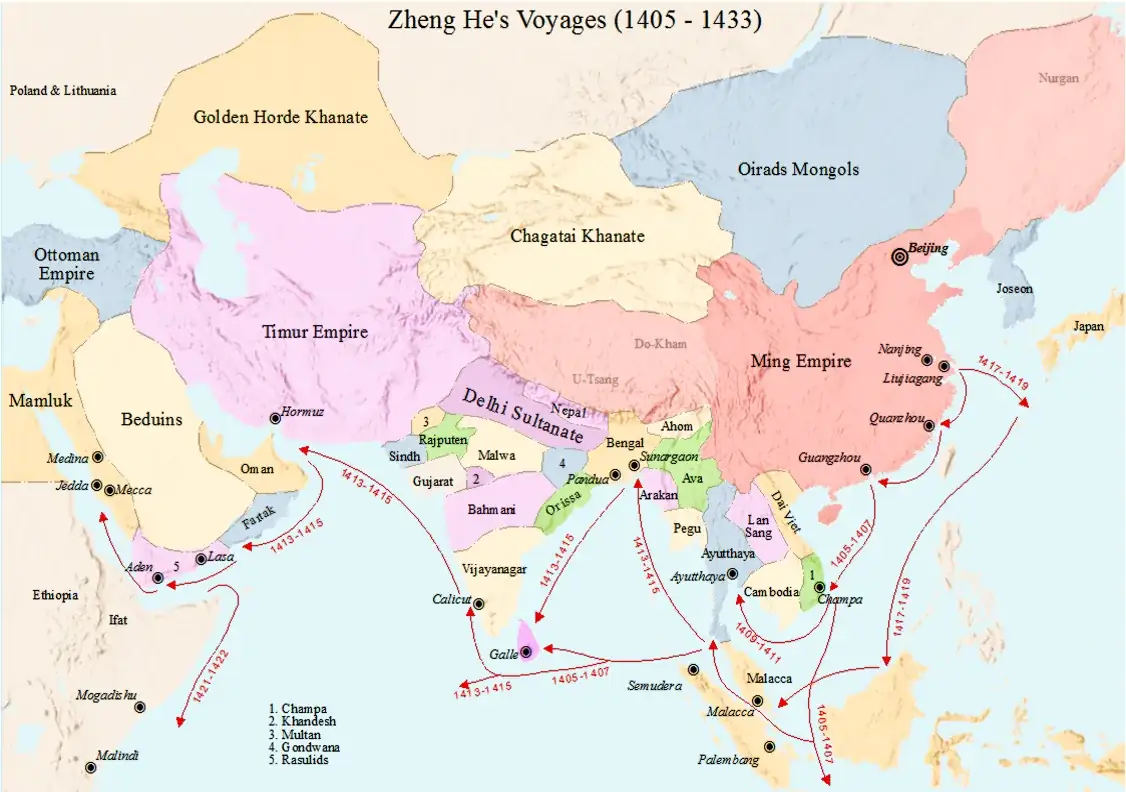
The source is specific: Zheng He first set sail in 1405 commanding 62 ships and 27,800 men. The fleet visited Champa in southern Vietnam, Siam, Malacca, Java, and then crossed the Indian Ocean to Calicut on the Malabar Coast and Ceylon. Zheng He returned to China in 1407.
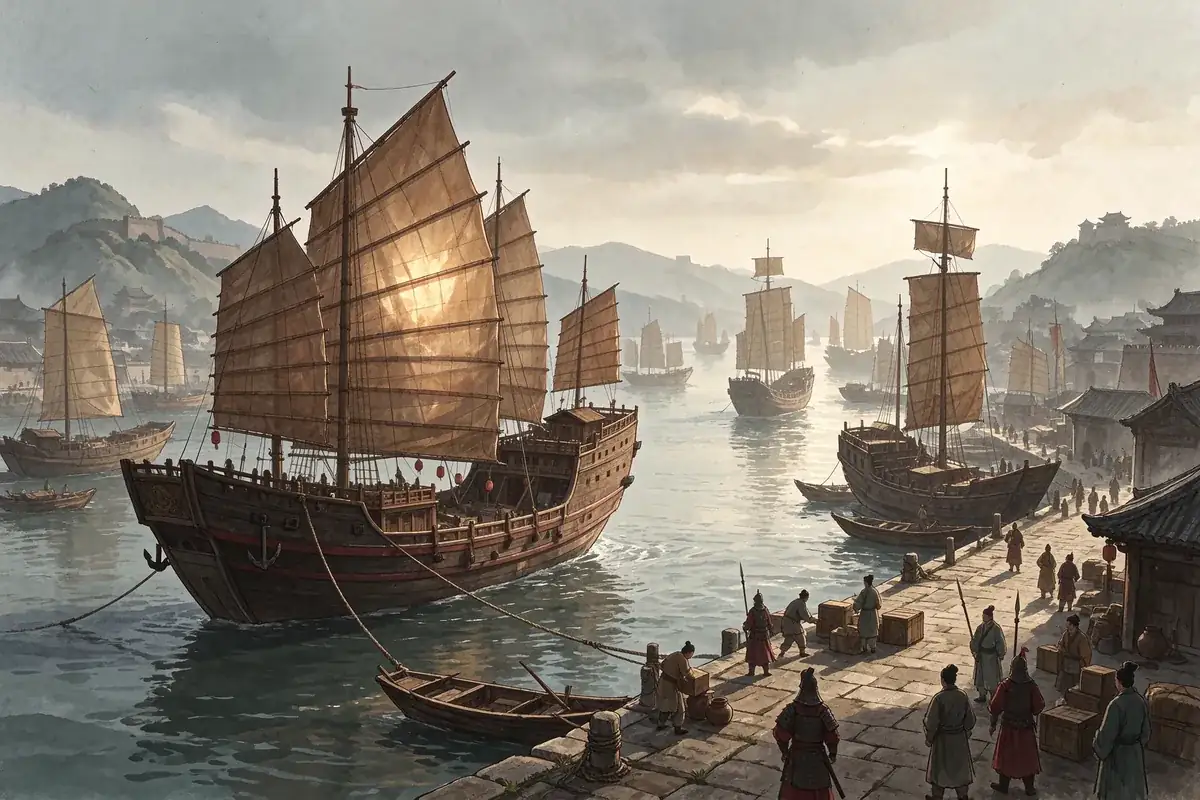
The legacy version is larger: more than 200 ships of various sizes, 27,800 soldiers and craftsmen, and a largest treasure ship 44 zhang long, about 148 metres, described as the biggest wooden sailing ship in the world at the time. This is not a case of deciding quickly who is right. The 62 may be the core ocean-going squadron; the 200-plus may include escorts, supply vessels and coastal craft. The 44-zhang figure comes from the legacy compilation, is often quoted and often questioned, and the attached source does not support it. What can be confirmed is a very large, highly organised fleet; what cannot be confirmed is the length of every ship.
What changed
The source covers only the first voyage: Zheng He returned to China in 1407. The legacy entry places it in a longer sequence of seven voyages, with six still to come. That long sequence is a later narrative frame; the attached source does not unfold each voyage. What the first voyage produced was not a new territory but a repeatable route, a set of port relationships and a diplomatic routine. The fleet could move through Champa, Malacca, Java and Calicut because the Ming state understood the monsoon, the supply chain and the port network. That explains why a voyage could work better than any argument about the size of the flagship.
The legacy entry also lists the search for Jianwen as one motive. It connects to the previous event: Jianwen disappeared in 1402, and the Yongle Emperor wanted an answer. But turning a state-scale maritime expedition into a manhunt is not well supported. It can be one political motive; it cannot be the only purpose.
How to read the evidence
This entry carries one source, Britannica's “Zheng He”. It directly supports the first sailing in 1405, 62 ships, 27,800 men, the visits to Champa, Siam, Malacca, Java, Calicut and Ceylon, and the return in 1407. The July 11 date, the Nanjing departure, the 200-plus ships, the 44-zhang flagship and the search for Jianwen remain legacy copy pending further research; the page keeps the “legacy copy · source pending” label.
Read the numbers by asking what each one counts: ships, men and ship length may come from different accounting systems. Do not treat the larger number as automatically the truer one, and do not pour the whole story of seven voyages into the evidence for the first.
Sources behind this read
- Zheng He · Encyclopaedia Britannica (accessed 2026-11-21) Original source ↗
Original entry and sentence-level review
In June 1405 (the third year of the Yongle reign), the Yongle Emperor ordered Zheng He and Wang Jinghong to sail to the Western Ocean.1 According to the Ming History, the fleet carried 27,800 soldiers and sailors and included 62 large ships, each "44 zhang long and 18 zhang wide."2 It left from Liujiahe in Suzhou, sailed out through the Wuhumen passage in Fujian, reached Champa first, then visited the various states and ports, including Calicut and Ceylon. It returned in September 1407, accompanied by envoys from several states.3
The Ming History gives two motives side by side: the court suspected the Jianwen Emperor had fled overseas and wanted to trace him, and it also wanted to display its power abroad and demonstrate China's wealth.4 Britannica likewise records 62 ships and 27,800 men.6 The significance of the voyage is not the "discovery" of a new route but the conversion of an existing monsoon trade network into an operation organised, supplied and repeated by the state.5
Evidence ledger
6 claims5 sourced0 unsourced1 author judgment
Every hard fact in the narrative above is registered here. A claim may also record source-only details that the narrative does not repeat; the related-narrative line points to the corresponding passage, not a guarantee that the source supports every word of the body. A claim without a source stays visibly unsourced.
In June 1405 (the third year of the Yongle reign), the Yongle Emperor ordered Zheng He and Wang Jinghong to sail to the Western Ocean.
Related narrativeIn June 1405 (the third year of the Yongle reign), the Yongle Emperor ordered Zheng He and Wang Jinghong to sail to the Western Ocean.
- Ming History, juan 304: Biography of Zheng He《明史》卷三百四·郑和传,永乐三年六月条
永乐三年六月,命和及其侪王景弘等通使西洋。
Accessed 2026-11-25 · human read
The source gives only the month, not the day; the text therefore does not assert 11 July.
- Ming History, juan 304: Biography of Zheng He《明史》卷三百四·郑和传,永乐三年六月条
According to the Ming History, the fleet carried 27,800 soldiers and sailors and included 62 large ships, each "44 zhang long and 18 zhang wide."
Related narrativeAccording to the Ming History, the fleet carried 27,800 soldiers and sailors and included 62 large ships, each "44 zhang long and 18 zhang wide."
- Ming History, juan 304: Biography of Zheng He《明史》卷三百四·郑和传,永乐三年六月条
将士卒二万七千八百余人,多赍金币。造大舶,修四十四丈、广十八丈者六十二。
Accessed 2026-11-25 · human read
"62" refers to the large ships, not the total number of vessels; the source does not say "more than 200 ships."
- Ming History, juan 304: Biography of Zheng He《明史》卷三百四·郑和传,永乐三年六月条
It left from Liujiahe in Suzhou, sailed out through the Wuhumen passage in Fujian, reached Champa first, then visited the various states and ports, including Calicut and Ceylon. It returned in September 1407, accompanied by envoys from several states.
Related narrativeIt left from Liujiahe in Suzhou, sailed out through the Wuhumen passage in Fujian, reached Champa first, then visited the various states and ports, including Calicut and Ceylon. It returned in September 1407, accompanied by envoys from several states.
- Ming History, juan 304: Biography of Zheng He《明史》卷三百四·郑和传,永乐三年六月至五年九月条
自苏州刘家河泛海至福建,复自福建五虎门扬帆,首达占城,以次遍历诸番国……五年九月,和等还,诸国使者随和朝见。
Accessed 2026-11-25 · human read
Calicut and Ceylon are drawn from the list of destinations in the same biography; the quoted sentence summarises them as "the various states."
- Ming History, juan 304: Biography of Zheng He《明史》卷三百四·郑和传,永乐三年六月至五年九月条
The Ming History gives two motives side by side: the court suspected the Jianwen Emperor had fled overseas and wanted to trace him, and it also wanted to display its power abroad and demonstrate China's wealth.
Related narrativeThe Ming History gives two motives side by side: the court suspected the Jianwen Emperor had fled overseas and wanted to trace him, and it also wanted to display its power abroad and demonstrate China's wealth.
- Ming History, juan 304: Biography of Zheng He《明史》卷三百四·郑和传,传首
成祖疑惠帝亡海外,欲踪迹之,且欲耀兵异域,示中国富强。
Accessed 2026-11-25 · human read
The two motives are kept side by side; the search for Jianwen is not presented as the sole cause.
- Ming History, juan 304: Biography of Zheng He《明史》卷三百四·郑和传,传首
The significance of the voyage is not the "discovery" of a new route but the conversion of an existing monsoon trade network into an operation organised, supplied and repeated by the state.
Related narrativeThe significance of the voyage is not the "discovery" of a new route but the conversion of an existing monsoon trade network into an operation organised, supplied and repeated by the state.
Editorial judgment, not a historical fact.
Author's judgment, not a quotation from the source.
Britannica likewise records 62 ships and 27,800 men.
Related narrativeBritannica likewise records 62 ships and 27,800 men.
- Zheng HeSection: Naval expeditions, paragraph 1
He first set sail in 1405, commanding 62 ships and 27,800 men.
Accessed 2026-11-25 · human read
A second independent source is used to cross-check the ship and personnel figures, not to replace the Ming History.
- Zheng HeSection: Naval expeditions, paragraph 1
Sources and review
- Ming History, juan 304: Biography of Zheng He · 张廷玉等 · 国学大师(《明史》全文检索) · 清乾隆武英殿本《明史》 (accessed 2026-11-25) Original source ↗
- Zheng He · Encyclopaedia Britannica (accessed 2026-11-21) Original source ↗
Locations
- South China Sea· 3, 103· Approximate
evt-f84e79be07dbdf6dSource file:
events/evt-f84e79be07dbdf6d/event.md